The package comes back on the day it was promised. The model runs. Every member passes. The drawings are tidy, the calculation sheet is legible, and the person who did the work clearly knew what they were doing.
And your engineer still spends four days fixing it.
This is the version of outsourcing that nobody warns you about, because it doesn't look like failure. There is no obvious incompetence to point at. There is just a package that was built on a slightly different set of assumptions than the ones in your office, and now somebody has to reconcile the two — usually the most expensive person on your team, usually the week the drawings were due.
We sit on the production side of this arrangement. We prepare structural analysis, design and documentation for firms in other countries, and their licensed engineers review and seal it. So we've watched a fair number of these engagements start well, and we've watched some of them go sideways in the first month. The pattern is consistent enough to be worth writing down.
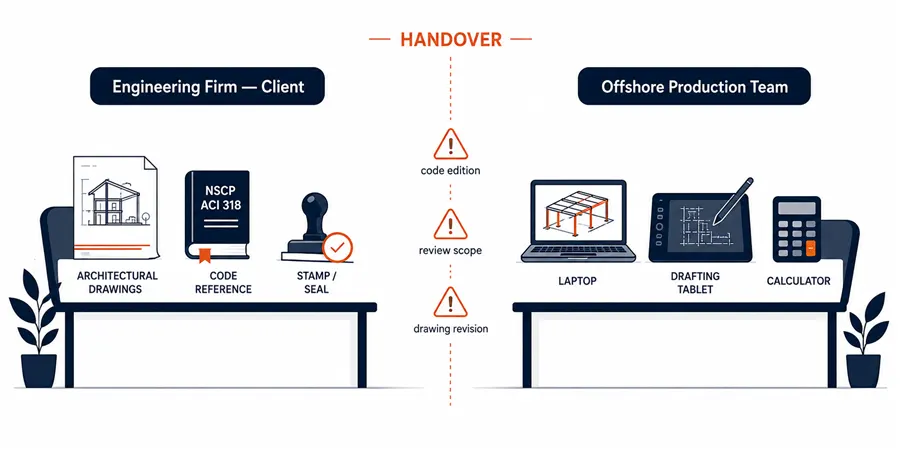
Almost none of it is about engineering ability. It's about handover.
Small technical firms don't have a smooth pipeline. They have a lumpy one. Three tenders land in the same fortnight, then six quiet weeks, then a developer wakes up and wants the whole podium re-run.
A full-time hire is a flat line drawn across that. You're paying the same salary in the quiet weeks as in the brutal ones, and if the brutal weeks are only a third of the year, the maths never quite closes. So the work goes out — to a freelancer found on a platform, to a friend-of-a-friend's office overseas, to whoever answered the email.
That decision is usually sound. What follows it usually isn't, because the brief that goes out with the work is written in about eleven minutes by someone who is already behind.
The most common first brief we receive is a set of architectural PDFs, a sentence naming a code, and a deadline. No edition year. No soil data. No statement of who is checking the output. That brief is not enough information to quote from honestly, let alone design from — and the firms that send it are not careless firms. They're busy ones.
"Design to ASCE 7" is not a design criterion. It's a family of documents that disagree with each other.
ASCE 7-22 revised the basic wind speed maps, with most of the change concentrated in hurricane-prone regions, and added an entire new chapter on tornado loads — Chapter 32 — which requires Risk Category III and IV structures inside the mapped tornado-prone region to be designed for the greater of tornado or wind demands. That standard is referenced by the 2024 IBC. If your jurisdiction is still on an earlier IBC cycle referencing ASCE 7-16, and the offshore team designs to 7-22 because it's newer and therefore assumed better, you now have a package that doesn't match the code your plan reviewer is holding.
The same trap exists everywhere. AS/NZS 1170.2:2021 superseded the 2011 edition and its amendments, and it didn't just adjust numbers — it redrew wind regions. Central Australia moved into a new Region A0. Tasmania became Region A4. Region B split into B1 and B2. A climate change multiplier came in. There are dozens of substantive changes in that revision, and a site classified under the 2011 map can land in a different region under the 2021 one.
So when a package is prepared to the wrong edition, the failure isn't a rounding error. It's a different wind region, a different load, and a redesign.
Name the standard, the edition year, and any state, provincial or municipal amendment that applies. "AS/NZS 1170.2:2021, Region B2" or "ASCE 7-16 per the locally adopted IBC cycle, Risk Category II" removes the entire failure mode. If the offshore team doesn't ask you for this before quoting, that tells you something about how they intend to work.
Need structural capacity this month, not next quarter? Aedo works as a production team for engineering and construction firms — analysis, design development, CAD documentation and structural BOM/BOQ, to the standard your jurisdiction specifies.
Every firm we work with has a licensed engineer who reviews and seals. That part is never in dispute. What gets fuzzy is everything upstream of the seal.
There is a real difference between "check that this is right" and "check that this matches what we would have done." The first is a technical review. The second is a house-style review, and it takes about three times as long, because it isn't looking for errors — it's looking for divergence.
When that expectation isn't stated, the reviewing engineer opens a technically correct package, finds that the shear wall was placed where the analysis wanted it rather than where the office always puts it, and treats that as a defect. It isn't a defect. It's an unbriefed preference. But it burns the same hours.
Write down three things before the first package: who reviews, what they're reviewing against, and how many review cycles are inside the fee. That last one matters more than people expect — an engagement with unlimited revisions built into a fixed price is either mispriced or about to become adversarial.
"Review" means different things to different people. To one engineer it means confirming the design is safe and compliant. To another it means confirming it looks like their own work. Both are legitimate. Only one of them can be inside a fixed fee, and you have to say which one you're buying.
This one is quiet, and it's expensive, and it's the reason we don't let takeoff sit in a separate silo from documentation.
Here's the mechanism. Drawings go to Rev C. A column drops from 500 square to 450 in one grid line. The BOQ was extracted at Rev B, because that's when the quantity surveyor had a free afternoon. Nobody re-extracts, because the change looks small and everyone remembers it. The tender goes out with a concrete volume that doesn't match the drawing set it was priced from.
Nothing catches this. Not a structural check — the design is fine. Not a drawing review — the drawings are current. The two documents are individually correct and jointly wrong, and the discrepancy surfaces on site, when a subcontractor prices a variation.
The discipline that prevents it is unglamorous: quantities are re-derived from the issued revision, every issue, and the reconciliation is recorded. When a BOM or BOQ leaves our office it carries the drawing revision it was taken off, on the face of the document. It's a small thing. It has saved a lot of arguments.
"Are your drawings and your quantities produced by the same team from the same revision, and does the BOQ state which revision it was extracted from?" If the answer involves two separate vendors who don't talk to each other, you have just found where your variations are going to come from.
This is exactly the gap Aedo's structural BOM/BOQ closes. Every quantity we issue is re-derived from the drawing revision it left with, on the face of the document — not extracted once and forgotten. If your current outsourcing arrangement can't say that, it's worth a second look.
Firms underestimate how much of their drawing output is convention rather than engineering. Layer naming. Title block fields and who fills them. Which details come from the standard library and which get drawn fresh. Whether bar schedules go on the sheet or in a separate table. Whether sections are cut looking north or looking at the grid.
None of that is in the code. All of it is in your reviewer's head, and none of it travelled with the brief.
So the first package comes back drafted to somebody else's convention, and it reads as sloppy even though every line is deliberate. The reviewer's confidence drops on the first sheet, and once confidence drops, everything after that gets read as a mistake.
The fix costs one email: send a completed drawing set from a project you were happy with, plus your CAD template. A competent offshore team will match it on the second package and hold the match after that. If they can't match a template you handed them, you've learned something cheaply.
Time zones get blamed for a lot of outsourcing problems they don't actually cause. Asynchronous work is fine. What isn't fine is verbal feedback that never becomes a written record.
A call is comfortable. You talk through eleven changes in twenty minutes and everyone hangs up feeling aligned. Then nine of the eleven get made, one gets half-made because the phrasing was ambiguous, and one gets forgotten entirely. Nobody can prove what was agreed, so the argument becomes about memory rather than about the drawing.
Marked-up PDFs solve this completely. The comment is attached to the location it refers to, it survives the week, and it can be closed out item by item. Use the call for the things calls are good at — judgment, priorities, why a decision was made — and put every actionable change in writing on the drawing itself.
We have been on the wrong end of this. Early on we took a scope change over a call, made the change we understood, and delivered a package the client didn't recognise. We were confident we'd heard it correctly. We probably had. It didn't matter — there was nothing to point at. We now ask for changes in writing even when it feels like bureaucracy, and we'd rather look pedantic on day one than argue about it on day thirty.
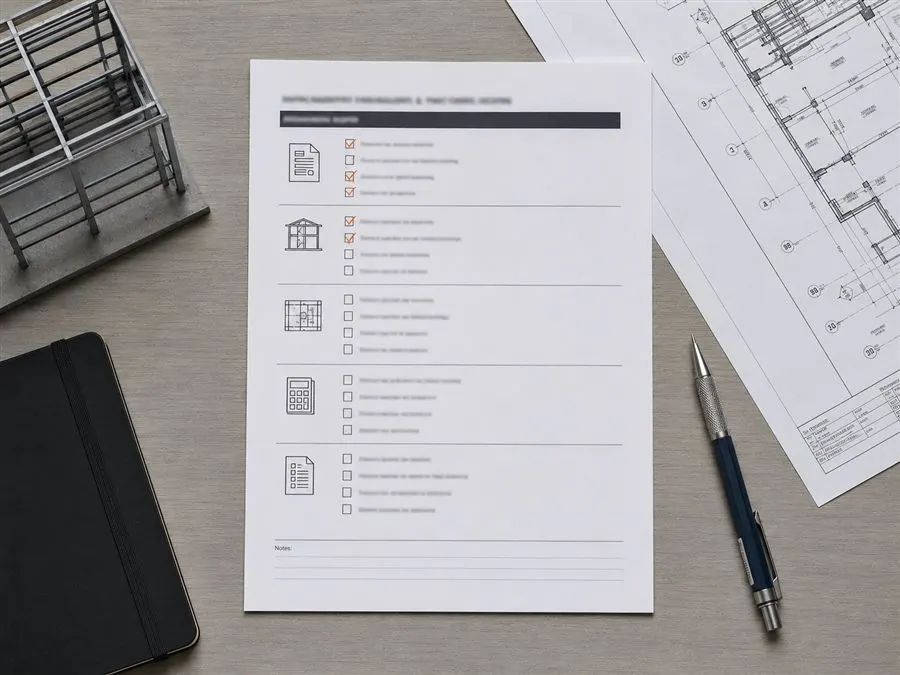
Everything above collapses into a handful of questions answered before work starts. This is roughly what we ask for, and you should expect any serious partner to ask for something similar:
| What we need | Why it decides something |
|---|---|
| Architectural set, current revision, with the revision number | Everything downstream references it — and it establishes the baseline for the first variation |
| Design standard with edition year and local amendments | Different editions give different loads on the same building (see Failure 1) |
| Geotechnical report, or the assumed bearing capacity in writing | Foundations are either designed or guessed; there is no third option |
| Risk / importance category and occupancy | Drives importance factors and, under ASCE 7-22, whether tornado provisions apply at all |
| Deliverable list and native file formats | "Drawings" can mean PDF, DWG, or a model you expect to keep working in |
| Your CAD or drafting standard, plus one sample set you were happy with | Removes the convention mismatch before it costs a review cycle |
| Who reviews, against what, and how many cycles are in the fee | The single biggest driver of whether the relationship stays friendly |
| Whether structural BOM/BOQ is in scope | Decides whether quantities are reconciled against the drawings or bolted on later |
Eight lines. Fifteen minutes to fill in. It is genuinely the difference between an engagement that works and one that quietly costs you more than the hire you were avoiding.
Have your answers to those eight lines? Send them straight to Aedo Engineering and we'll reply with a fixed quote and the applicable design standard — no retainer, no obligation.
We would rather say this plainly than have you find out on a live job.
Outsourcing does not fix an unclear design intent. If the architectural scheme is still moving, sending it offshore just means the churn happens at a distance, with a lag, and with a variation attached to each lap. Settle the scheme first.
It does not remove review time. It moves the work, not the responsibility. Whoever seals the drawings has to read them properly, and that engineer's hours are a real cost that belongs in your fee calculation from day one. Any comparison of hourly rates that ignores review time is a comparison you'll regret.
It does not replace local knowledge. A jurisdiction with an unusual plan-review culture, a specific local amendment, or an inspector with known preferences needs someone local who has been through it. We can design to the standard. We can't tell you what the reviewer in your county is going to ask for in the third week.
And it doesn't survive a bad first brief. Which is the whole point of this article.
Judge an offshore partner on the questions they ask before quoting, not on the rate they quote. A team that asks for the edition year, the bearing capacity, the review chain and your drafting standard is a team that has been burned by all four and has built process around them. A team that quotes immediately is pricing a guess.
Don't begin with a retainer. Don't begin with the biggest job in the office, either — the instinct to "make it worth the setup effort" is exactly backwards.
Begin with one small, complete, real package. A single-storey steel frame. One foundation package. An existing-structure check. Something with a genuine deliverable at the end, small enough that a bad outcome costs a week rather than a project.
That one package tells you almost everything: whether they handled the code edition without being reminded, whether the drawings look like yours, whether the quantities tie to the revision, whether the questions they asked mid-way were good questions, and whether the reply came when they said it would.
If the answers are yes, the second package is easy and the third one barely needs supervision. If they're no, you've spent a week finding out instead of a quarter.
Aedo Engineering works as an offshore production team for structural engineering firms, design-build contractors, fabricators and developers — the work your pipeline needs this month, without a permanent hire against a lumpy workload.
Your firm keeps the client relationship and the local professional sign-off. We provide the production capacity behind it.
Structural analysis is a solved problem. Competent engineers in a dozen countries will get the same member sizes for the same building under the same code. That has not been the differentiator for a long time.
What separates an outsourcing arrangement that works from one that quietly bleeds hours is whether the assumptions made it across the gap — the edition, the review chain, the revision, the conventions, the written record. Get those on paper before the first package and most of this article never happens to you.
Working out whether offshore support fits your firm? Send us a sample scope and we'll tell you honestly whether it's a fit.
A locally licensed engineer in the project's jurisdiction, where sealing is required. Offshore production support prepares the analysis, design development and documentation for that engineer's review and approval — it does not replace them. The reviewing engineer carries professional responsibility for what they seal, which is precisely why their review has to be budgeted as real engineering time rather than treated as a signature at the end.
An assumption that was never written down. In most engagements the analysis is competent and the arithmetic is right, but the code edition, the review responsibility, the office drafting standard, or the drawing revision the quantities were taken off was assumed instead of stated. Handover gaps cause far more rework than engineering error does.
Architectural drawings at the current revision, the design standard with its edition year and any local amendments, the geotechnical report or an assumed bearing capacity in writing, the deliverable list with file formats, your CAD or drafting standard, and the name of whoever is reviewing on your side. A partner who quotes confidently without asking for the edition year and the review chain is quoting a guess.
It's more elastic, which isn't the same thing. Comparing hourly rates ignores two real costs: review time on your side, and the ramp-up on the first couple of packages while conventions get matched. What outsourcing genuinely changes is that capacity tracks the pipeline instead of sitting as a fixed salary through a quiet quarter. For a firm with lumpy workload that's usually the decisive argument — but it's an argument about elasticity, not about rate.
Send one small, complete, real package — not a hypothetical exercise, and not the largest job in the office. A single-storey frame or one foundation package will surface everything that matters: code handling, drafting standards, revision discipline, the quality of the questions they ask mid-way, and whether the reply arrives when they said it would. A bad fit then costs one package instead of a quarter.
We support a defined set of international standards — IBC / ASCE 7 / ACI 318 / AISC 360 in the United States, NCC with AS/NZS 1170 / AS 3600 / AS 4100 in Australia, NBC with CSA A23.3 / CSA S16 in Canada (jurisdiction-dependent), NZS 1170 / NZS 3101 / NZS 3404 in New Zealand, the Eurocodes, and IBC-based or jurisdiction-specific requirements in parts of the Middle East. The exact code, edition and local amendments are agreed during scoping, before any work starts. Full detail is on the offshore engineering support page.
When we publish a new structural breakdown, code analysis, or piece on engineering practice, we'll send it directly to you.
No spam. One email per insight. Unsubscribe anytime.