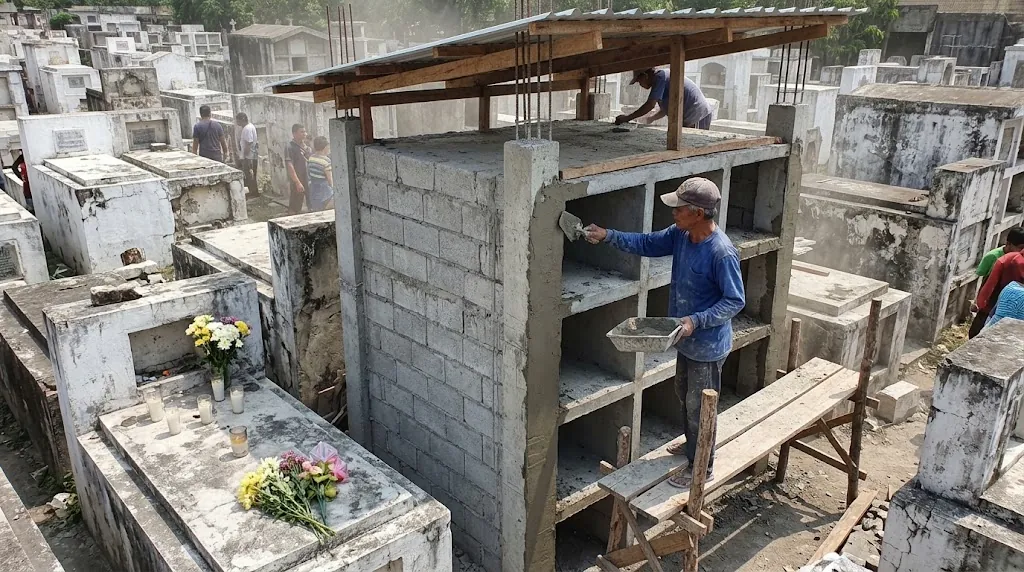
Hollow-block niches: common practice the IRR rules out. Illustrative photo.
Walk through almost any town cemetery in the Philippines and count how many family tombs and apartment-type niches were laid up in hollow blocks, plastered and painted. Most of them, in our experience. The cemetery guidelines in the 2004 Revised IRR of the National Building Code (PD 1096) say they should not be: vaults for above-ground tombs and mausoleums shall be of solid reinforced concrete, multi-level niches shall be solid reinforced concrete at least 150 mm thick, and concrete hollow blocks "shall not be allowed" for either.
That one rule changes the formwork, the cement count and the price of everything that follows, so the calculator below is built around it. It sizes a single tomb, a stack of niches, or a roofed family mausoleum in reinforced concrete and prices it with the figures in our own 2026 price guides. Families tend to decide this at Undas, standing in front of the old tomb with everyone present. The building happens in the months after, and the rules are the same in March as they are on the first of November.
Pick the type, the number of niches across and how many levels high, and the finish. You get the concrete, cement, sand, gravel, rebar, formwork and hollow-block quantities, a planning cost range and a sketch that redraws from your inputs. Every price is editable.
The niche grid, the base slab and, for the roofed types, the columns and roof, at the sizes you entered. The numbered tags match the key below.
A sketch for planning only: not to scale and not for construction. Bar sizes and spacing, footing depth, the connection of the block to the base and the roof framing are per structural design. The front of each niche is shown open: it is closed with a sealed slab after interment, which this tool does not price.
The National Building Code doesn't use the word nitso, but its fee schedule sorts these structures the way families talk about them. Section 8.p of the schedule of fees in the 2004 Revised IRR has separate lines for tombs, charged per square metre of covered ground area; semi-enclosed mausoleums, "whether canopied or not", per square metre of built-up area; totally enclosed mausoleums per square metre of floor area; and columbaria. Section 701 puts tombs, mausoleums and niches in Group J, Division J-3, with courts, stages and record vaults.
The fees themselves are small. The schedule we read charges ₱5.00 per square metre for tombs and semi-enclosed mausoleums and ₱12.00 for totally enclosed ones, so the building fee on a 14 m² open mausoleum comes to ₱70. (The printed schedule repeats the enclosed-mausoleum line a second time at ₱5.00, which looks like a typesetting error.) Your LGU may charge a different schedule or add its own fees; the money is rarely what holds a family up. The drawings and the cemetery's rules are.
The cemetery. Whoever runs the cemetery decides what may stand on a lot, how high it goes and often who may build it. We could not find a Negros Oriental city or town ordinance on cemetery structures online, so here is a nearby one we could read. Bacolod City Ordinance No. 907 of 2019, which covers only the city-owned cemeteries, lets a family build a "floating niche" at its own expense, but the niche becomes city property after five years, when exhumation is mandatory, and the ordinance says plainly that no vertical improvement is allowed. A family that builds a two-level tomb there without asking has built something the rules forbid. In a private memorial park, the park's own rules sit in the lot purchase contract, on top of the IRR guidelines. Read whichever applies to you before you pay for a design.
The Office of the Building Official. Section 301.2.b of the IRR lists tombs, mausoleums and niches among the accessory permits issued by the Building Official. The cemetery guidelines go further: before construction starts on any mausoleum, canopy over a tomb, or multi-level niches, a building permit shall be secured from the OBO. That means signed and sealed plans. Those guidelines cover structures within cemeteries and memorial parks, and the IRR defines a cemetery as public or private land used for burial, so the town cemetery is covered as much as the private park. Our ancillary and accessory permits guide explains the two kinds of accessory permit. The same guidelines also set a placement rule that catches families with lots against the cemetery wall: tombs and mausoleums may be built right up to the wall only where the cemetery is enclosed by a solid reinforced concrete wall at least 2.00 m high. Otherwise a 5.00 m clearance is kept between the perimeter fence and the nearest plot.
The health office. PD 856, the Code on Sanitation, sets the burial rules. Section 91 requires graves to be at least 1.5 m deep and "filled well and firmly". The PD 1096 IRR guidelines repeat the 1.50 m for ground interment and allow 1.00 m from the base of a concrete vault to ground level, depending on the depth of the water table. The 1996 DOH implementing rules for the chapter add that no remains shall be buried where the water table is less than 2 m below natural ground. The 2010 revision of the DOH rules (read in a secondary copy) says no remains shall be buried without a burial permit from the city or municipality where the burial takes place. If the old tomb has to be opened to rebuild, Section 92 lets disinterment be permitted after three years for non-dangerous communicable diseases and five years for dangerous ones, with shorter periods only with the regional director's approval, and the remains go into a durable, sealed container.
Can we bury Lola on our own land? It comes up often in the provinces. PD 856 Section 90 makes burial anywhere other than a legally authorized place unlawful, keeps a burial ground at least 25 m from any dwelling (and bars building a house within that distance), and keeps it at least 50 m from either side of a river or from any water supply source.
The 1996 DOH rules call a family burial ground a "private burying ground or place of enshrinement" and ask for a city or municipal council resolution, a certification from the planning office on the site, a certification from the city or municipal engineer that the structures follow the National Building Code, and a site of at least 1.2 hectares including a 50 m buffer zone. Burial is limited to 10 niches in no more than 30 m² at the centre of the site, later burials go on top of existing niches up to 4 niches or 3.0 m, whichever is lower, and every niche must be enclosed in concrete or other impervious material, strictly watertight, with the floor sloped to the centre and a 5 cm weep hole resting on the ground on the side opposite the opening.
DOH revised the Chapter XXI rules in Administrative Order No. 2010-0033. The copy of that order we read, a secondary reproduction on a law-library site, does not repeat these private-ground clauses and repeals only rules that are inconsistent with it, so we can't tell you for certain which version your health office applies. Ask the city or municipal health office before anyone digs.
Concrete, not blocks, for anything that holds a body. The IRR guidelines are specific: vaults for above-ground tombs and mausoleums in solid reinforced concrete, multi-level niches in solid reinforced concrete of at least 150 mm, and no hollow blocks, ceramics, adobe or similar unit masonry in either. Multi-level niches may abut the cemetery wall only if that wall is also solid reinforced concrete. The engineering reason is the same as the legal one. A niche is a small sealed box that has to stay watertight for years while it carries the boxes stacked on it, and a plastered block wall with mortar joints is a poor way to make a sealed box. The calculator prices the concrete version only. Where you see hollow blocks in it, they are for a curb or low wall around the lot. (The one place the guidelines let blocks in is a columbarium for ashes, whose vertical divisions may be 100 mm hollow blocks under a non-porous mortar coat.)
Cover matters more on a tomb than on a house. A tomb is outdoors, wet half the year, and many are within sight of the sea. NSCP 2015 Table 420.6.1.3.1 gives the minimum cover: 75 mm for concrete poured straight onto the soil and buried in it for good, which is the base slab; 40 mm for 16 mm bars and smaller exposed to weather; 50 mm for 20 mm bars and up. In a 150 mm niche wall with 40 mm on each face there are 70 mm left for steel, which is why thin niche walls usually carry a single layer of bars near the middle. The design decides that, not the mason. The rust-stained cracks you see along the edges of old tombs are mostly bars that were laid against the formwork with no cover at all.
The ground under a cemetery is not undisturbed ground. It has been dug and backfilled for decades, and the next family will dig a 1.5 m grave a metre from your base, possibly right after the rainy season. We treat the base of a niche block as one slab under the whole block rather than a strip under each wall, set it below the soil a neighbouring grave will disturb, and keep the block's weight spread. A roofed mausoleum is light for its size, so wind can pull harder on its footings than people expect; a small footing under a big roof can come close to lifting at one edge. Small structures get small attention. That is how they end up leaning.
Roof: slab or sheet. A concrete roof slab is heavier, needs edge beams and a waterproofing layer, and lasts if the slab is sloped to drain. A metal roof on light steel framing is cheaper and lighter on the base, but it needs proper tie-down for typhoon wind and steel that is protected from rust if the cemetery is near the coast. Our roofing cost guide covers the sheet, framing, flashing and tie-down lines the calculator uses. For an apartment block with no roof, the top slab is the roof: give it a fall and a waterproof coat, because a ponding top slab is where most niche leaks start.
Not every tomb needs rebuilding, and a family should not be talked into it. What the cracks look like tells you most of what you need to know, and the same triage we use on house walls works here. Our wall crack repair guide has the methods and prices.
| What you see | What it usually means | What to do |
|---|---|---|
| Fine cracks in the plaster, no pattern, nothing moving | Shrinkage of the plaster or paint | Open up, fill and repaint. The crack guide prices this at ₱150 to ₱300 per metre. |
| Cracks along the lines between niches or where a block wall meets a concrete post | Two materials moving differently, common in mixed block and concrete tombs | Re-plaster over mesh if it stays still (₱250 to ₱500 per metre in the guide); watch it through one rainy season |
| Rust stains, bulging or a corner that has broken off showing bars | Bars with too little cover are corroding and pushing the concrete off | Break out, treat or replace the steel and rebuild the cover. Priced after someone has looked at it. |
| The whole tomb leans or one side has dropped | The ground under it moved, often after a grave was dug beside it | Patching won't hold. Plan a rebuild on a proper base. |
| Water stains or smell around the front seal | A leaking seal or top slab | Reseal and waterproof the top. Don't wait for the next Undas. |
One request we always turn down: adding another level on top of an old hollow-block tomb. The old walls and base were never designed for the weight, and a new niche level in blocks is the very thing the IRR guidelines rule out. If the family needs more niches, build a new reinforced concrete block on its own base, beside the old one or in its place after the remains have been transferred under PD 856 Section 92.
Take the default: two niches across, three levels high, 0.80 by 0.70 by 2.40 m clear inside each niche, 150 mm walls and slabs, no roof, plaster and paint. The block comes out 2.05 m wide, 2.70 m high and 2.55 m deep. It takes about 8.1 m³ of concrete including the base, about 77 bags of cement, 4.3 m³ of sand, 8.5 m³ of gravel, about 770 kg of bars and some 59 m² of formwork. With the default prices that is about ₱135,000 to ₱209,000 for materials, labour and the plaster-and-paint finish. A single tomb for one casket on its own base comes to about ₱43,000 to ₱68,000. Put the same six niches under a metal roof on four columns over a 4.0 by 3.5 m area and it rises to about ₱183,000 to ₱284,000.
Where the defaults come from: cement at ₱240 to ₱300 a bag from our cement price guide; washed sand and ¾" gravel at ₱1,100 to ₱1,500 per m³ from our sand and gravel price guide; bars at ₱37 to ₱47 per kg from our rebar price guide; 95 kg of bars per m³, the midpoint of the band in our bill of materials guide; 4" blocks at ₱13 to ₱24 from our CHB price guide; labour at 30 to 45 percent of cost from our labour rates guide. The finish rates add up the lines in our tile and painting guide and the 20 mm plaster rate in our plastering guide: plaster and exterior paint ₱455 to ₱760 per m², porcelain tile on plaster ₱1,260 to ₱2,170, granite on plaster ₱2,915 to ₱5,750 with the guide's 30 percent extra on setting labour for stone. The metal roof adds 0.5 mm rib-type sheet, light steel framing, flashing and installation from the roofing guide, ₱1,500 to ₱2,340 per m² of sloped roof at a 20 degree pitch.
Negros Oriental prices can sit at or below those national bands. The materials schedule for our Manjuyod court job, revised 4 September 2026, carries ₱200 a bag for Type 1P cement, ₱850 per m³ for washed sand, ₱850 per m³ for gravel and ₱395 for a 6 m length of 16 mm bar (about ₱42 per kg). Prices move, so get your own quote and type it into the calculator. The tool will be closer to your job than any national figure.
Three things push the price up that a calculator can't see: a cemetery where trucks can't reach the lot, so every bag and every bucket of concrete is carried by hand; a lot that needs an old tomb broken out first; and a family that wants the job done in the weeks before 1 November, when every mason in town already has work.
Where AEDO fits in. Inside Negros Oriental the AEDO team designs and builds family tombs, niche blocks and mausoleums in reinforced concrete, from the permit drawings to the last coat of paint; see design-build and our pages for Dumaguete, Bais and Tanjay. Anywhere else in the Philippines we prepare the structural design for the permit (the 3-working-day structural design is ₱7,500 up to 150 sqm) and check a local contractor's quantities and quote against it. A Single Milestone Check from ₱7,500 per visit covers a site check at the base or before the pour. We don't deal with cemetery offices or health permits on a family's behalf, and nothing on this page replaces the rules your cemetery gives you.
Building code: Implementing Rules and Regulations of PD 1096, 2004 Revised IRR (2005 official edition as printed): Section 301.2.b (accessory permits), Section 701 Group J-3, the guidelines on buildings and other accessory structures within cemeteries and memorial parks (location, protective enclosures, interments, burials and entombments, items 1 to 3), and the schedule of fees item 8.p. Sanitation: PD 856 Sections 90, 91 and 92; DOH Implementing Rules of Chapter XXI, 30 September 1996, Section 2 (definition 26), Sections 3.5 and 4.3; DOH Administrative Order No. 2010-0033 (read for whether it repeats them). Local example: Bacolod City Ordinance No. 907, 26 June 2019. Structure: NSCP 2015 Volume I, Table 420.6.1.3.1 (page 4-136), read in AEDO's copy. Prices: AEDO's 2026 price guides as linked above, and AEDO's Manjuyod job materials schedule, 2 September 2026. AEDO assumptions with no source, edit them: niche clear size 0.80 x 0.70 x 2.40 m; base slab 250 mm thick projecting 300 mm; 250 mm columns; 100 mm floor slab; 125 mm roof slab with 200 x 300 mm edge beams; one 1.0 x 2.1 m door; applying the 30 to 45 percent labour share to concrete work only; the 5 percent waste figure borrowed from blocks to concrete. What we could not confirm: any Negros Oriental LGU cemetery ordinance; whether DOH AO 2010-0033 keeps or replaces the 1996 private burial ground clauses; whether your LGU still uses the 2004 fee schedule.
How much does it cost to build a nitso in the Philippines?
With the default prices from our 2026 price guides, the calculator puts a single above-ground reinforced concrete tomb at about 43,000 to 68,000 pesos and a block of six apartment-type niches, two across and three high with plaster and paint, at about 135,000 to 209,000 pesos. Both cover materials, labour and finish only; transport, permits, cemetery fees and the contractor's overhead and profit are extra.
Can a nitso or mausoleum be built with hollow blocks?
Not under the cemetery guidelines in the 2004 Revised IRR of the National Building Code. They require vaults for above-ground tombs and mausoleums to be solid reinforced concrete, and multi-level niches to be solid reinforced concrete at least 150 mm thick, and they say concrete hollow blocks and other unit masonry shall not be allowed for either.
Do I need a building permit for a mausoleum or apartment niches?
Yes. The same IRR guidelines say a building permit shall be secured from the Office of the Building Official before construction starts on any mausoleum, canopy over a tomb, or multi-level niches, and Section 301 lists tombs, mausoleums and niches among the accessory permits. The cemetery administration's own rules and the lot contract apply on top of that.
Can we bury a family member on our own land?
Only in a legally authorized place. PD 856 Section 90 makes burial elsewhere unlawful and keeps burial grounds 25 metres from any dwelling and 50 metres from a river or water source. The 1996 DOH rules for a private family burial ground also ask for a council resolution and a site of at least 1.2 hectares including a 50-metre buffer. Ask the city or municipal health office which rules it applies now.
Does AEDO build tombs and mausoleums?
In Negros Oriental, yes: AEDO designs and builds family tombs, niche blocks and mausoleums in reinforced concrete. Elsewhere in the Philippines AEDO prepares the structural design for the permit and checks a contractor's quantities and quote, and the family hires a local builder.
Documents read for this article on 28 October 2026. External links open in a new tab. Where we could read only part of a document, or only a secondary copy, the entry says so.
We found no Philippine standard for the inside size of a burial niche. This article is general information for planning, not a structural design or legal advice.
Tell us the cemetery, the lot, how many niches and levels, and any rules the cemetery gave you. The AEDO team will check the size, the structure and the quantities before you commit to a builder.