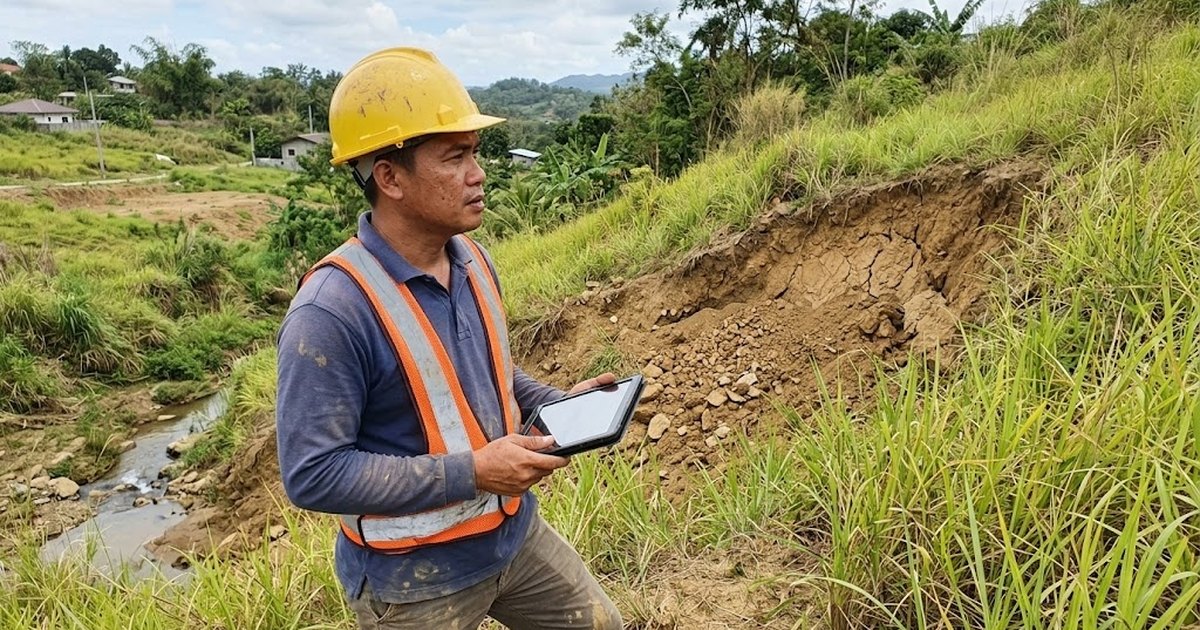
Check slope, flooding and fault hazards before you buy or build on a lot. Illustrative photo.
Short answer: four government tools will tell you most of what is wrong with a lot, they are all free, none of them needs an account, and together they take about fifteen minutes. Almost nobody runs them before paying a deposit — which is why so many Philippine houses end up with a foundation budget that doubles after the land is already bought.
Screen the lot for free first. Only spend on a soil boring test once the free screening says the lot is worth designing for. Doing it the other way round means paying ₱50,000–₱80,000 to investigate a site you were never going to build on — or worse, discovering the problem after the deed of sale is signed, when your negotiating position is gone.
These are the official sources. Between them they cover earthquake, volcanic, hydrometeorological and geological hazards, and they are drawn from the same agency data your engineer would cite.
Pin a location and it generates an initial multi-hazard assessment report — seismic, volcanic and hydrometeorological — using official data from PHIVOLCS, PAGASA, MGB, DOH, DepEd and DPWH. No registration. Start here.
hazardhunter.georisk.gov.phMeasures the shortest distance from your site to the nearest active fault. PHIVOLCS has taken it down while it addresses system security concerns and directs users to HazardHunterPH in the meantime — so use HazardHunterPH for the fault distance too, and check this page for its return.
phivolcs.dost.gov.ph — FaultFinder statusRain-induced landslide and flood susceptibility, mapped at municipal and barangay level. The MGB regional office will also issue a geohazard assessment for a specific site on request — several LGUs now ask for one before a permit.
mgb.gov.phThe planning office holds the zoning classification and the Comprehensive Land Use Plan. This decides what you are allowed to build at all, and many LGUs have written fault, flood and slope restrictions into their own ordinance.
See our setbacks guide →This is the most commonly misquoted rule in Philippine land buying, so it is worth being exact about it.
HLURB Board Resolution No. R-515-92, adopted 17 August 1992, amended the rules implementing PD 957 to require a five-metre easement on both sides of the Marikina Valley Fault Trace and such other fault traces as may be identified by PHIVOLCS, with no development allowed inside it. That resolution binds subdivision and condominium projects registered under PD 957 — which is a large share of the land sold to Filipino homebuyers, but not all of it.
For an individual private lot bought outside a PD 957 project, the same five metres either side of the trace is a PHIVOLCS recommendation rather than a nationwide statute. Many local government units have since written it into their own zoning ordinances, which makes it binding where you are even though it is not binding everywhere. Check the ordinance, not the internet.
Shaking can be designed for. Surface rupture cannot. When a fault moves, the ground on either side of the trace displaces relative to itself, and no ordinary footing, slab or frame can bridge that. Every other seismic hazard is an engineering problem with a price attached; being on the trace itself is the one that has no design solution at any budget. Treat the trace and its immediate buffer as land you do not build on, regardless of which rule technically applies to your title.
Enter what the free government tools told you. This returns a go, caution or walk-away verdict, the rule that applies to each flag, and the band of extra cost the hazards are likely to add before the house itself is priced. Legal limits are cited; cost bands are AEDO practice.
A hazard rating on its own means nothing to a budget. What matters is which part of the house it forces you to change.
| Flag | What it forces | Where the money goes |
|---|---|---|
| On or beside the fault trace | Do not build. Relocate the footprint or the purchase. | No design solution at any price |
| Liquefaction susceptible | Soil boring, then a deeper or piled foundation; possible ground improvement | Foundation and investigation |
| High flood susceptibility | Finished floor raised above the flood depth, plus freeboard; flood loads designed for | Earthworks, fill, foundation, slab |
| Moderate to high landslide | Slope stability study; retaining structures; drainage discipline | Retaining walls and site drainage |
| Inside the Water Code easement | The strip is unbuildable. Re-plan the footprint. | Lost buildable area |
| Storm surge advisory area | Elevation, wave and debris loads, corrosion-resistant detailing | Structure and finishes |
Two of those — flooding and liquefaction — are the ones that most often turn a cheap lot into an expensive house. A lot priced ₱400,000 below the neighbouring one is not a bargain if the ground under it forces ₱600,000 of foundation and fill. That arithmetic is the whole reason to screen before you commit. Our soil boring test cost guide covers the investigation step, site development costs covers the earthworks, and foundation types covers what you end up choosing between.
Three habits separate a useful screening from a false sense of safety.
And one habit that matters more than all three: run the checks before the deposit, not after. Every remedy on this page is cheaper when you still have the option of not buying.
The three, twenty and forty metre easement widths are quoted from Article 51 of PD 1067, the Water Code of the Philippines, which subjects the banks of rivers and streams and the shores of seas and lakes to an easement of public use within those zones and forbids building structures of any kind inside them. The five-metre fault easement is HLURB Board Resolution No. R-515-92 of 17 August 1992, amending the implementing rules of PD 957, and it binds subdivision and condominium projects; outside those it is a PHIVOLCS recommendation unless a local ordinance adopts it. HazardHunterPH is a GeoRisk Philippines application led by DOST-PHIVOLCS and draws on PHIVOLCS, PAGASA, MGB, DOH, DepEd and DPWH data. Soil boring prices of ₱25,000–₱35,000 per 10 m borehole and ₱50,000–₱80,000 for a two-hole residential investigation are the published Metro Manila figures used throughout this site. Everything in the scorecard's cost bands is AEDO practice, labelled as such, not code.
How do I check if a lot is on a fault line in the Philippines?
Use HazardHunterPH at hazardhunter.georisk.gov.ph. Pin the location and it generates a site-specific report covering seismic, volcanic and hydrometeorological hazards, including distance to the nearest active fault, and it needs no account. PHIVOLCS FaultFinder used to be the dedicated tool for fault distance, but PHIVOLCS has taken it offline while it addresses system security concerns and now points users to HazardHunterPH instead. Treat any mapped trace as indicative rather than surveyed, because the published line has a real width of uncertainty on the ground, and a lot that plots close to a trace deserves a site inspection before any money changes hands.
Is the five-metre fault easement a law for private houses?
It binds subdivision and condominium projects directly. HLURB Board Resolution R-515-92, adopted on 17 August 1992, amended the rules implementing Presidential Decree 957 to require a five-metre easement on both sides of the Marikina Valley Fault Trace and other fault traces identified by PHIVOLCS, with no development allowed inside it. For an individual private lot outside a PD 957 project the five metres either side of the trace is a PHIVOLCS recommendation rather than a nationwide statute, though many local government units have adopted it in their own zoning ordinances, which makes it enforceable locally. The engineering position is the same either way, because no ordinary building can accommodate ground that tears apart along the trace.
Can you build on a flood-prone lot in the Philippines?
Usually yes, but the flood depth has to be designed for rather than hoped away. A lot rated moderately or highly susceptible to flooding needs a finished floor level set above the known flood depth with freeboard on top, and the structure below that level designed for the water loads the National Structural Code sets out in its flood loads section. The cost is real and it is mostly earthworks and foundation work, so it belongs in the price you negotiate for the lot, not in a surprise variation later.
What does the Water Code easement stop me from building?
Article 51 of Presidential Decree 1067, the Water Code, places the banks of rivers and streams and the shores of seas and lakes under an easement of public use along a zone of three metres in urban areas, twenty metres in agricultural areas and forty metres in forest areas. Inside that zone no one may build structures of any kind. The strip is measured from the bank, it is not part of your buildable area even when your title covers it, and a lot whose depth is largely inside the easement can end up with almost no usable footprint.
Does a hazard report replace a soil test?
No. A hazard report is a screening tool built from regional mapping, and it tells you which risks are plausible at that location. A soil boring test measures what is actually beneath the specific footprint and is what a foundation design is based on. Published Metro Manila pricing runs roughly twenty-five to thirty-five thousand pesos per borehole for a typical ten-metre hole excluding mobilisation, and a two-hole residential investigation usually totals fifty to eighty thousand pesos. Screen first for free, then spend on boring once the lot is worth designing for.
What should I ask the seller before paying a deposit?
Ask for the title and the approved subdivision or relocation plan so the boundaries can be plotted, the zoning classification from the local planning office, and whether the lot has an existing right of way on paper rather than by tolerance. Then run the free hazard checks yourself rather than relying on the seller's answer. A deposit paid before the zoning classification and the hazard ratings are known is the single most common way a buyer ends up owning land they cannot build the house they wanted on.
Every statute, code and official tool used or referred to in this guide, linked to its primary source. Links open in a new tab.
Soil boring prices and the hazard cost bands in the scorecard are AEDO's own practice figures for Philippine residential work in 2026, not code or agency figures.
A screening report, the lot plan and an hour of an engineer's time is the cheapest stage of this project. It is also the only stage where walking away is still free.