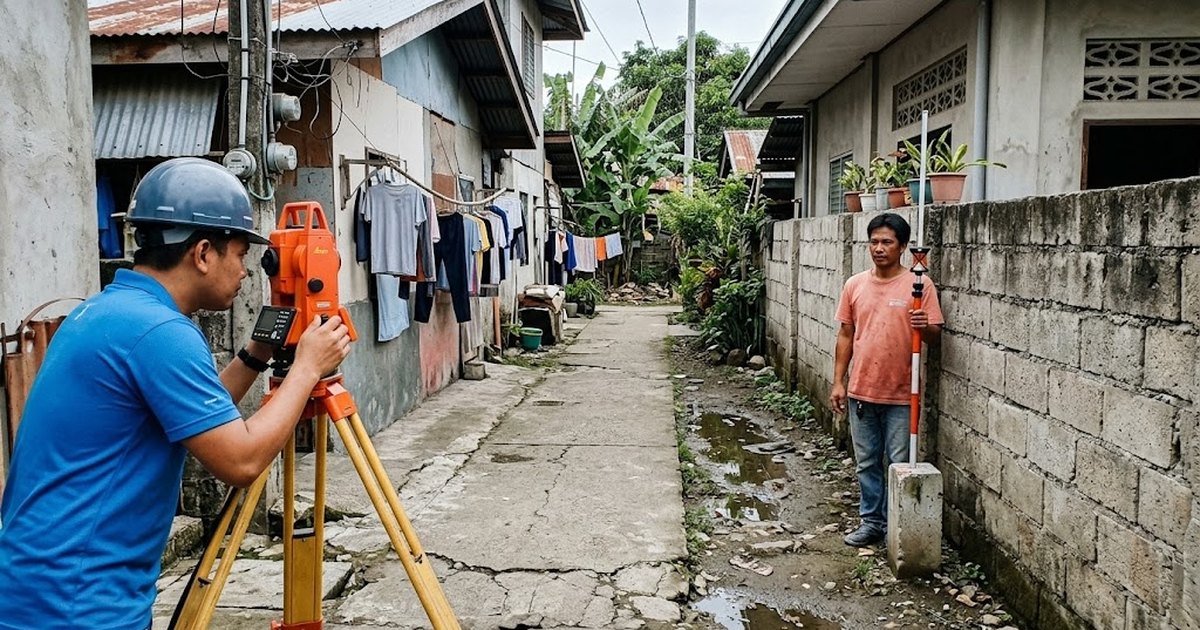
A relocation survey settles where the boundary and the right of way really are. Illustrative photo.
Short answer: four short articles of the Civil Code settle almost every Philippine boundary argument — 649 for access, 670 for windows, 674 for roof water and 684 for excavation. They are old, they are specific, and they are routinely broken by houses that sailed through a building permit. Knowing them before you design is cheaper than learning them from a neighbour.
A permit checks your plans against the National Building Code and the zoning ordinance. These easements sit in the Civil Code, and they are enforced by your neighbour in a civil action, not by the building official. A house can hold a valid permit, a certificate of occupancy, and still have a window that has to be closed up. The two systems do not talk to each other.
"The owner, or any person who by virtue of a real right may cultivate or use any immovable, which is surrounded by other immovables pertaining to other persons and without adequate outlet to a public highway, is entitled to demand a right of way through the neighboring estates, after payment of the proper indemnity."
The same article ends with the sentence that defeats most claims: "This easement is not compulsory if the isolation of the immovable is due to the proprietor's own acts." Subdivide your own land badly and landlock a piece of it, and you cannot then demand a way out through someone else.
So there are four conditions to satisfy, not one:
Article 650 then decides where it goes, and the order matters: the easement is established at the point least prejudicial to the servient estate, and only insofar as consistent with that rule, where the distance to the highway is shortest. Least prejudice outranks shortest route. People argue this the wrong way round constantly.
Article 651 sets the width as "that which is sufficient for the needs of the dominant estate," and says it may be changed from time to time. There is no fixed metre figure in the Code for an ordinary right of way — the width follows the actual need.
Article 652: where a piece of land acquired by sale, exchange or partition is surrounded by other estates of the vendor, exchanger or co-owner, that person is obliged to grant a right of way without indemnity. If you bought a back lot from someone who kept the land between you and the road, this is the article to read before negotiating a price for access. In a simple donation the rule reverses and the donor is indemnified by the donee.
"No windows, apertures, balconies, or other similar projections which afford a direct view upon or towards an adjoining land or tenement can be made, without leaving a distance of two meters between the wall in which they are made and such contiguous property. Neither can side or oblique views upon or towards such conterminous property be had, unless there be a distance of sixty centimeters. The nonobservance of these distances does not give rise to prescription."
Article 671 tells you how to measure. For a direct view, from the outer line of the wall where the openings do not project, and from the outer line of the projection where they do — so a balcony is measured from the balcony edge, not the wall behind it. For an oblique view, from the dividing line between the two properties.
Two details that catch people out. First, that closing sentence: non-observance does not give rise to prescription. A window built 800 mm from the line does not become lawful by standing there for twenty years. Second, Article 669 provides the fallback — where the Article 670 distances are not observed, the owner of a wall which is not a party wall may still make openings to admit light, at the height of the ceiling joints or immediately under the ceiling, thirty centimetres square, with an iron grating embedded in the wall and a wire screen. That is the legal high-level vent, and it is the design answer for a tight urban lot.
And Article 673 adds the reverse case: where a right to direct views has been acquired by title, the owner of the servient estate cannot build closer than three metres, and any stipulation permitting distances less than Article 670 prescribes is void.
Check a design, or an existing house, against the Civil Code distances — and, if the lot is landlocked, test whether a compulsory right of way is available and what the indemnity is likely to be measured on. Every limit here is quoted from the Code; land values are yours to supply.
"The owner of a building shall be obliged to construct its roof or covering in such manner that the rain water shall fall on his own land or on a street or public place, and not on the land of his neighbor... Even if it should fall on his own land, the owner shall be obliged to collect the water in such a way as not to cause damage to the adjacent land or tenement."
Two duties, and the second is the one that gets ignored. Bringing the eave back inside the boundary is not compliance on its own — the water then has to be collected so it does not damage the neighbour anyway. A downpipe discharging at ground level a metre from the line satisfies the first sentence and breaches the second.
The mirror image is Article 637: lower estates are obliged to receive the waters which naturally, and without the intervention of man, descend from the higher estates, along with the stones or earth they carry. The owner of the lower estate cannot build works that impede this, and the owner of the higher estate cannot make works that increase the burden. Natural flow, both parties must live with. Anything you channel, concentrate or redirect is no longer natural, and it becomes yours to answer for.
"No proprietor shall make such excavations upon his land as to deprive any adjacent land or building of sufficient lateral or subjacent support."
One sentence, and it is the article behind most collapsed boundary walls in Philippine urban work. It is an absolute duty and it does not depend on whether the excavation was otherwise permitted. Practically: if the neighbour is digging below your footing level, record the condition of your structure before it goes deeper and raise it in writing early. The dispute that follows will be about whether the damage predated the work, and the only thing that answers that is a dated record.
Article 682 adds the general nuisance easement — every building and piece of land is subject to the easement prohibiting the proprietor from committing nuisance through noise, jarring, offensive odour, smoke, heat, dust, water, glare and other causes. It is the catch-all for construction impacts that do not fit the specific articles.
If a river, creek, sea or lake touches your lot, one more line applies and it is not in the Civil Code. Article 51 of PD 1067, the Water Code, subjects the banks of rivers and streams and the shores of seas and lakes to an easement of public use within a zone of three metres in urban areas, twenty metres in agricultural areas and forty metres in forest areas, and forbids building structures of any kind inside it. That strip is not yours to build on even when the title covers it. We cover how it interacts with the other constraints in the lot hazard checks guide, and the zoning and National Building Code setbacks in the setback requirements guide.
Every article quoted on this page is reproduced from the Civil Code of the Philippines, Republic Act 386: Art. 637 natural drainage, Art. 649 the right of way and its indemnity, Art. 650 least prejudice and shortest distance, Art. 651 width, Art. 652 the free right of way after a sale, exchange or partition, Art. 657 the 75 m animal path, 37.5 m animal trail and 10 m compulsory easement, Art. 669 the 0.30 m square grated light opening, Art. 670 the 2.00 m and 0.60 m view distances and the rule against prescription, Art. 671 how to measure them, Art. 673 the 3.00 m distance where a right to direct views exists, Art. 674 roof drainage, Art. 682 nuisance and Art. 684 lateral and subjacent support. The 3, 20 and 40 metre waterway easements are Art. 51 of PD 1067. The indemnity arithmetic in the checker is arithmetic, not valuation. None of this page is legal advice.
What are the requirements for a right of way in the Philippines?
Article 649 of the Civil Code entitles the owner of an immovable surrounded by other immovables and without adequate outlet to a public highway to demand a right of way through the neighbouring estates, after payment of the proper indemnity, and it adds that the easement is not compulsory if the isolation is due to the proprietor's own acts. Article 650 then requires that the easement be established at the point least prejudicial to the servient estate and, insofar as consistent with that rule, where the distance to the public highway is shortest. Read together those give four conditions: the estate is surrounded, there is no adequate outlet, the isolation is not self-inflicted, and indemnity is paid. Least prejudice governs the location, and it outranks the shortest route.
Do I have to pay for a right of way?
Usually yes. Article 649 sets the indemnity by the kind of passage. Where the easement is continuous for all the needs of the dominant estate and establishes a permanent passage, the indemnity is the value of the land occupied plus the amount of damage caused to the servient estate. Where the passage is only what is necessary for cultivation and gathering crops, without a permanent way, the indemnity is the damage caused by the encumbrance. There is one important exception. Under Article 652, where a piece of land acquired by sale, exchange or partition is surrounded by other estates of the vendor, exchanger or co-owner, that person is obliged to grant a right of way without indemnity.
How wide can a right of way be?
Article 651 sets the width of the easement as that which is sufficient for the needs of the dominant estate, and says it may accordingly be changed from time to time. There is no fixed metre figure in the Civil Code for an ordinary right of way. The width follows the actual need, which for a residential lot generally means vehicular access, and it can be revisited if the need genuinely changes. The only numbers the Code does fix are for livestock passages in Article 657, where an animal path may not exceed seventy-five metres and an animal trail thirty-seven metres and fifty centimetres, and a compulsory easement established under that section is limited to ten metres.
How far must a window be from the boundary in the Philippines?
Article 670 says no windows, apertures, balconies or other similar projections affording a direct view upon or towards an adjoining land may be made without leaving a distance of two metres between the wall in which they are made and the contiguous property. For side or oblique views the distance is sixty centimetres. Article 671 explains how to measure: for direct views from the outer line of the wall when the openings do not project, from the outer line of the projection when they do, and for oblique views from the dividing line between the two properties. Article 670 also states that non-observance of these distances does not give rise to prescription, so a window built too close does not become lawful by standing there for years.
Can my neighbour's roof drain rainwater onto my land?
No. Article 674 obliges the owner of a building to construct its roof or covering in such manner that the rain water falls on his own land or on a street or public place, and not on the land of his neighbour, even where the adjacent land belongs to two or more persons one of whom owns the roof. The duty does not stop there. Even where the water does fall on his own land, the owner is obliged to collect it in such a way as not to cause damage to the adjacent land. That second sentence is the one most often overlooked, and it is why a gutter discharging at the boundary is not a fix.
My neighbour is excavating right at the boundary. Can I stop it?
Article 684 states that no proprietor shall make such excavations upon his land as to deprive any adjacent land or building of sufficient lateral or subjacent support. It is a short article and an absolute duty, and it does not depend on whether the excavation is otherwise permitted. In practice the remedy starts with evidence: photograph and if possible survey the condition of your structure before the excavation goes deeper, because the argument that follows will be about whether the damage predated the work. Raise it in writing early. A deep excavation beside an existing footing is one of the few neighbour disputes where waiting turns a design problem into a collapse.
Every statute, code and official tool used or referred to in this guide, linked to its primary source. Links open in a new tab.
The indemnity figures in the checker are arithmetic on the values you enter, not a valuation. Nothing on the page is legal advice.
Window positions, eave overhangs, drainage discharge and excavation sequencing are drawing-board decisions. On site they become somebody else's lawsuit.