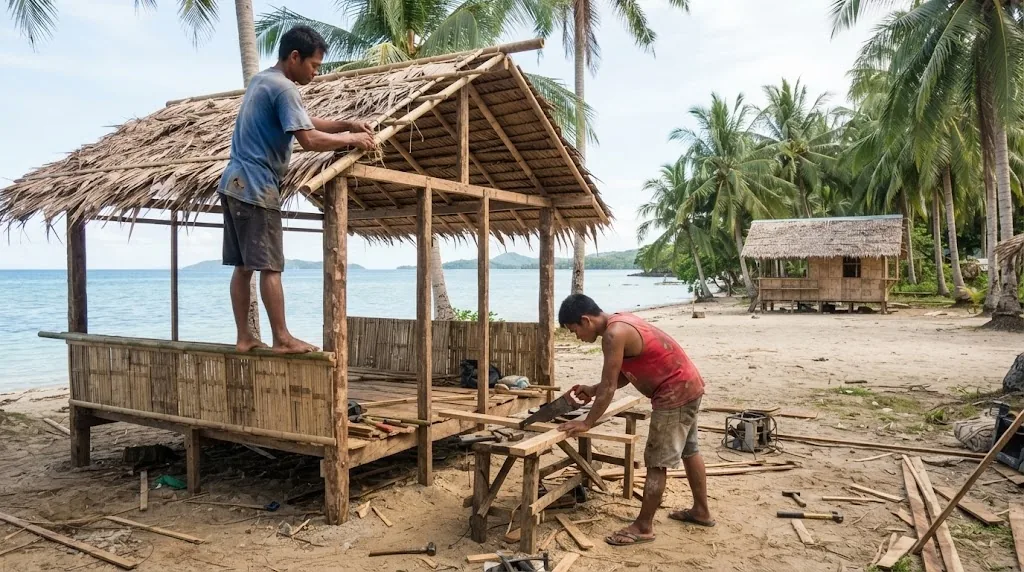
Native cottages are cheap per sqm, but check the lot's shoreline easement before the first post goes in. Illustrative photo.
Short answer: a native bamboo-and-nipa cottage runs roughly ₱6,000–₱12,000 per sqm, a hybrid unit with concrete posts under a native or engineered-nipa roof runs ₱12,000–₱20,000 per sqm, and a full concrete cottage with CHB walls and a GI or tile roof runs ₱18,000–₱28,000 per sqm, all AEDO market estimates. The material choice is only half the budget question. The other half is compliance most owners skip until it stops a build: how far back from the water you're legally allowed to build, and whether the structure needs Department of Tourism accreditation before you can legally rent it out.
If you own beachfront or near-shore land in Negros Oriental, Siquijor, or anywhere along the Dumaguete coastline and you're pricing a cottage, cabana, or a handful of rental units, this guide walks the cost by material tier, the shoreline easement that determines where you're even allowed to build, and what DOT accreditation and the building permit actually require for a commercial tourism structure versus a private residential hut.
Enter the floor area per cottage, how many units, and a construction tier. Each row is a line item (rate × area × units) and the total is the exact sum of the rows shown. Add your own nightly rate and occupancy to see a simple payback.
A cottage or cabana is a simpler structure than a fully enclosed house: fewer walls, often no glazed windows, and usually one open-plan room instead of partitioned rooms with full interior finishing. That's why even the full-concrete tier here prices below AEDO's standard house construction cost per sqm — you're paying for a roof, posts or walls, a floor, and basic electrical, not a complete enclosed envelope.
The tier is mostly a choice between upfront cost and lifespan. Native materials are cheap and give the authentic look guests expect from a beach cottage, but bamboo posts in ground contact and nipa or cogon roofing typically need replacement or heavy repair every 3–7 years depending on treatment and exposure to salt air, AEDO market estimate. A hybrid unit — concrete or CHB posts and footing carrying a native or synthetic-nipa roof — pushes the maintenance cycle out considerably while keeping the native look. Full concrete costs the most per sqm but needs the least recurring maintenance, which matters if the cottage is a rental asset you want generating income, not downtime for repairs.
A lot of the people pricing a beach cottage in the Philippines aren't here. They're Filipinos working in New Zealand, Australia, the Middle East or the US with family land by the sea, or couples planning a small rental resort to retire into. The cost per sqm doesn't change because you're overseas. What changes is the risk: you can't drop by the site, so money goes out on progress you can't see, and the setback and permit problems covered below get found late, when fixing them costs the most.
The way to handle it is to lock everything that can be decided on paper before a contractor mobilizes, then check the build against those papers from a distance. Here's how that works with AEDO:
Foreign nationals generally can't own Philippine land except by inheritance. A lease is the usual route: under PD 471, a lease of private land to a foreigner can run up to 25 years, renewable for another 25 by mutual agreement. A former natural-born Filipino has separate rights to buy land within area limits. Settle which of these you're relying on with a lawyer before the foundation goes in. Our guide to building as a foreigner in the Philippines walks through each path.
Article 51 of Presidential Decree 1067, the Water Code of the Philippines, subjects the shores of the sea to a public easement "within a zone of three (3) meters in urban areas, twenty (20) meters in agricultural areas and forty (40) meters in forest areas," measured along the shore, and states plainly that no one may build structures of any kind inside that zone. Twenty meters is the figure most people repeat, but it's the agricultural-land figure, not a flat national rule. Whether your specific lot counts as urban, agricultural or forest is set by its classification in the municipal/city zoning ordinance and DENR land classification, not by how developed the area looks. A lot inside a declared urban or poblacion zone can be 3 meters; the same beachfront a few barangays over, still classified agricultural, is 20 meters.
Before you site a cottage, get the classification confirmed in writing from your municipal or city planning/zoning office and, if there's any doubt, DENR-CENRO. Don't rely on a neighbor's fence line or an existing structure next door as your reference — plenty of coastal builds predate enforcement or were never checked.
There's a second, separate issue that catches owners off guard: the easement above assumes your land is privately titled up to the shoreline. If any part of the planned structure sits seaward of the shoreline — on the beach or tidal flat itself, which is public foreshore land — private title doesn't apply there at all, and construction requires its own DENR Foreshore Lease Agreement (FLA) before anything goes up. DENR has publicly reminded Siquijor coastal resort operators of exactly this, and has stated that building while an FLA application is still pending remains illegal regardless of how far along the application is.
A structure inside the easement or on unleased foreshore land that hasn't been flagged yet isn't grandfathered in — it's unpermitted, and it can be ordered removed, or block your ability to get DOT accreditation or a mortgage/title transfer later. If you're buying or inheriting land with an existing cottage close to the water, get the setback checked before you spend anything on a rebuild or expansion in the same footprint.
A cottage you plan to rent out, or that's part of a resort you operate, is a commercial or tourism occupancy under the National Building Code (Presidential Decree 1096) — even if it's a single small nipa hut. That changes what the permit route requires compared to a private family hut you're not renting out:
Native materials themselves aren't a problem — bamboo, nipa and similar are recognized construction materials under the National Building Code's Implementing Rules and Regulations, which set fire-resistance and occupancy limits for light native-material structures. What still needs to happen is an engineer or architect signing and sealing simple plans (foundation, floor plan, wind bracing for posts and roof), because the building official is approving the design and site siting, not just approving that bamboo is an allowed material. Budget for that professional fee alongside construction.
If the cottage, cabana or small cluster of units is a paid accommodation, it falls under the Department of Tourism's definition of an accommodation establishment — the same category as resorts, tourist inns, pension houses, apartelles and bed-and-breakfasts. Under Republic Act 9593 (the Tourism Act) these are classified as primary tourism enterprises, and DOT accreditation for that category is mandatory, not a nice-to-have.
DOT's current framework is the Updated Progressive Accreditation System (UPAS) under DOT Memorandum Circular No. 2023-0003, which replaced the older Certificate of Registration process with a three-tier scheme — Basic, Regular and Premium — and ties accreditation to documented compliance with facility, safety and environmental standards, plus a valid Mayor's/Business Permit and SEC or DTI registration, renewed annually with a current business permit. Where a one- or two-unit cottage rental lands in that tier system, and the exact facility checklist for your scale, is specific enough that we're not going to guess at it here — confirm directly with the DOT Region VII (Central Visayas) office covering Negros Oriental and Siquijor before you finalize the fit-out, since some accreditation requirements (fire exits, signage, minimum room count for certain categories) can affect the floor plan.
Sequence that avoids wasted spend. Confirm the easement classification and, if relevant, the foreshore lease status first — it determines where the cottage can even sit. Get the locational clearance and building permit for commercial/tourism occupancy next. Build. Then apply for DOT accreditation once the facility exists and meets the checklist for your chosen tier. Owners who build first and check compliance after are the ones who end up relocating or losing a cottage already built.
How much does it cost to build a nipa hut or beach cottage in the Philippines?
It depends almost entirely on the material tier. A native cottage built in bamboo, nipa and cogon typically runs about ₱6,000–₱12,000 per sqm, AEDO market estimate. A hybrid unit with concrete posts and footing but a native or engineered-nipa roof runs about ₱12,000–₱20,000 per sqm. A full concrete cottage with CHB walls, a poured slab and a GI or tile roof runs about ₱18,000–₱28,000 per sqm, still cheaper per sqm than a fully enclosed house because a cottage has far less wall, window and interior finish work. A 20-sqm native cottage lands around ₱120,000–₱240,000; the same footprint in full concrete is closer to ₱360,000–₱560,000.
How far from the beach can I legally build?
Under Article 51 of the Water Code of the Philippines (Presidential Decree 1067), the shores of the sea are subject to a public easement of three meters in urban areas, twenty meters in agricultural areas, and forty meters in forest areas, measured from the shoreline, and no structure of any kind may be built inside that zone. Which distance applies depends on how your specific lot is classified in the LGU zoning ordinance and land classification records, not on how the area looks or is commonly used, so confirm the classification with your municipal/city planning office or DENR-CENRO before you site the cottage. This easement is separate from foreshore land itself: if any part of the structure sits on public foreshore land (seaward of the shoreline, below the mean high water mark), that requires its own DENR Foreshore Lease Agreement, and construction before that lease is approved is illegal regardless of how far along the application is.
Do I need DOT accreditation to rent out a beach cottage?
If you are operating it as a paid accommodation, an accommodation establishment (resort, tourist inn, pension house, apartelle, B&B and similar) is classified by the Department of Tourism as a primary tourism enterprise, and DOT accreditation for that category is mandatory, not optional, under its Updated Progressive Accreditation System (a three-tier Basic, Regular and Premium scheme set out in DOT Memorandum Circular No. 2023-0003). It replaced the older Certificate of Registration and requires a valid Mayor's/Business Permit, SEC or DTI registration, and documented compliance with facility, safety and environmental standards, renewed with a valid business permit each year. Exact facility thresholds and which tier a one- or two-unit cottage rental falls under are specific to your setup, so confirm directly with the DOT regional office serving Negros Oriental/Siquijor before you price the fit-out.
Is a resort cottage permit different from a residential house permit?
Yes. A cottage you rent out or that is part of a resort operation is a commercial or tourism occupancy under the National Building Code (PD 1096), not residential, even if it looks like a small hut. That changes the permit route: it needs a locational clearance confirming the LGU zoning allows commercial/tourism use on that lot, a Fire Safety Evaluation Clearance from the Bureau of Fire Protection under the Fire Code (RA 9514), and, because most coastal and foreshore areas are declared environmentally critical areas, it may also need an Environmental Compliance Certificate or Certificate of Non-Coverage from DENR-EMB before the building permit is released. A single family nipa hut you are not renting out is generally processed as residential, but check with your municipal engineer's office, because classification is set locally.
Can bamboo and nipa construction pass a building permit?
Yes, native materials are recognized construction materials under the National Building Code and its Implementing Rules and Regulations, which classify light native-material structures and set the fire-resistance and occupancy limits that apply to them. In practice, a resort cottage in bamboo and nipa still needs an engineer or architect to sign and seal simple plans (foundation, floor plan, and how the roof and posts are braced against wind), because the building official is approving the design, not just the material. Budget for that professional fee alongside the construction cost.
Can I build a beach cottage in the Philippines while living abroad?
Yes, if everything that can be decided on paper is settled before a contractor starts: confirm the lot's shoreline easement and zoning, get a complete signed and sealed design and permit set, then have the build checked against those plans with regular photo progress reports before each payment. AEDO can build directly in Negros Oriental; elsewhere it provides the design and remote oversight of a contractor you hire locally. If you are not a Filipino citizen, you generally cannot own the land except by inheritance, and a lease of private land to a foreigner under PD 471 runs up to 25 years, renewable for another 25 by mutual agreement.
Legal and regulatory references used in this article. External links open in a new tab.
Per-sqm cost figures for native, hybrid and full-concrete cottage construction are AEDO market estimates based on current Negros Oriental / Siquijor market pricing, not a published third-party price list — informal online quotes for native-material builds vary widely by supplier and season, so treat these as planning ranges. Full-concrete tier estimates are cross-checked for consistency against AEDO's own house construction cost per sqm guide (₱20,000–₱26,000/sqm economy finish for a fully enclosed house), adjusted down for a cottage's simpler open-plan envelope. Building permit and fire clearance requirements summarized from PD 1096 (National Building Code) and RA 9514 (Fire Code) as generally applied to commercial/tourism occupancies; confirm current local requirements with your municipal engineer's office and BFP station, since implementation details vary by LGU.
Get the siting, permit route and structural design right before you spend on materials — not after the easement or DOT accreditation flags a problem.