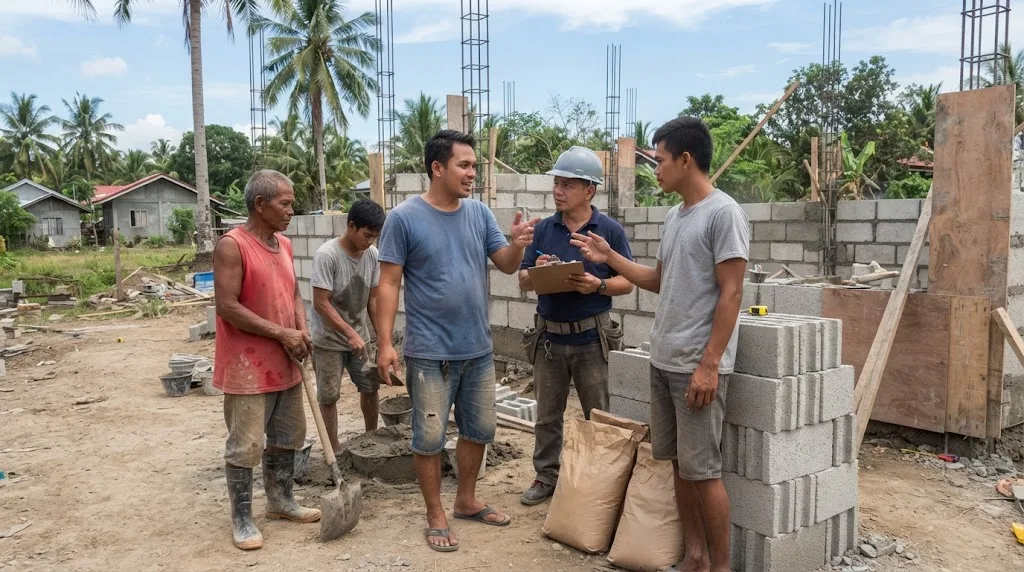
The owner bought the blocks, the foreman quoted the labor. Whoever counts the blocks every morning is running the job. Illustrative photo.
Short answer: with pakyaw you pay a foreman a lump sum for the labor and you buy every bag of cement yourself. With a licensed contractor you sign one contract and he supplies the materials, the labor and the supervision, and carries most of the risk that comes with them. Pakyaw is usually cheaper on paper, but by less than people expect once you count the costs a contractor normally absorbs. On AEDO 2026 planning ranges, a 100 sqm standard-finish bungalow comes to about ₱2.85M–₱4.01M through a contractor and about ₱2.58M–₱3.43M on pakyaw. That pakyaw figure already includes the extra waste, the site costs, the supervising engineer you have to hire anyway and your own time at two days a week. The difference, roughly ₱0.27M–₱0.58M, is what you're paid for doing the contractor's job. Whichever way you pay for labor, the building permit, the sealed plans and the licensed engineer supervising the work don't change.
The calculator runs that comparison with your own numbers. After it: what each arrangement really is, the trouble with owner-supplied materials, who pays when a worker gets hurt or a wall cracks, what the law says about licences, and when pakyaw is the right call.
All figures are AEDO 2026 planning ranges, not quotations. Contractor prices use the finish bands in our house construction cost guide; the materials share, waste baseline, site costs, contingencies and durations are AEDO planning assumptions. The engineer oversight line starts at AEDO's published monthly oversight rate.
Pakyaw is a way of pricing labor: a fixed amount for a finished piece of work instead of a daily wage. On small jobs it's per unit, so much per square metre of CHB wall or per cubic metre of concrete. On a house it's often the whole structure or the whole house for one lump sum, split into payments as the work goes up. The foreman takes the lump sum and pays his own masons, carpenters and helpers. Our 2026 labor rates guide lists the unit rates: CHB laying ₱200–400 per sqm, plastering ₱90–300 per sqm per side, concrete ₱1,500–2,500 per cubic metre.
On a house, pakyaw nearly always means labor only. You buy the cement, steel, blocks, lumber, roofing and fixtures, and you arrange the deliveries. In Civil Code terms it's a contract for a piece of work: Article 1713 says the contractor "may either employ only his labor or skill, or also furnish the material." Pakyaw is the first kind. A general contractor is the second.
| Pakyaw (labor only) | Licensed general contractor | |
|---|---|---|
| What you pay for | Labor, as a lump sum to a foreman | The finished work: materials, labor, equipment, supervision |
| Who buys materials | You | The contractor, marked up inside his price |
| Contracts you manage | Several: the crew, every supplier, a separate engineer | One |
| Who schedules deliveries | You | The contractor |
| Crew idle because materials are late | Your problem, and under Art. 1721 possibly your bill | His problem |
| Site engineer | You hire one (IRR §308 needs one anyway) | Usually on his staff |
| Licence you can check | Usually none | PCAB licence under RA 4566 |
| Who absorbs price rises | You, on every delivery | Him, on a lump-sum price (Art. 1724), unless a plan change and its price are agreed in writing |
| Typical saving | About 10–14% in favour of pakyaw on our default case, if the waste and the owner's time stay under control | |
If your real question is which contract type to sign with a contractor (lump sum, cost-plus or labor-only), our contract types guide covers that. This article is about the step before: whether to have a contractor at all.
"Contractor or individual workers?" sounds like two options. In the Philippines it's three, and the legal position is different for each.
There's a fourth that people drift into without meaning to: a contractor's price for "labor and supervision" while you still buy materials. That's pakyaw with a licensed party on the labor side, and it's a reasonable middle ground if you want to buy materials and still have someone accountable for the crew.
Yes, and plenty of Filipino houses are built that way. The law allows it (Art. 1713), and contractors will price labor-only or labor-and-supervision work if you ask. The question is whether you can run what you're taking on. Owner supply tends to go wrong in the same five places.
There's a legal side too. When materials fail, the Civil Code looks at who furnished them:
None of this means don't do it. It means buy to a BOQ, have someone who reads drawings check deliveries against the specs, and keep receipts. That someone is usually your supervising engineer, which is one more reason the calculator counts one.
This is the question owners don't ask until it happens, and it's where pakyaw and a contractor differ most.
How far RA 11058 and DOLE's construction safety rules reach a single family house built by a small crew is less clear than the text makes it sound. Section 2 applies the Act to all establishments, projects, sites and other places where work is undertaken in all branches of economic activity, except the public sector. But the Act leaves it to the Secretary of Labor to set requirements by number of employees, nature of operations and hazard, and it has a separate section (§30) on core standards for micro and small enterprises. DOLE D.O. 13 s.1998, the construction safety guideline, covers operations in the construction industry "based on the classification code of the PCAB", and while some of its duties are written for general constructors (safety personnel under Section 7), others are not: Section 5 requires a Construction Safety and Health Program on "every construction project", and Section 6 puts PPE on "every employer". We haven't found a DOLE issuance that says plainly how these apply to a private owner building one house with a pakyaw crew, so we won't claim one. Two duties still make sense on any house: D.O. 13 §6.2 requires safety harnesses and life lines for workers on unguarded surfaces 6 metres or more above ground, which is roof work on a typical two-storey house; and §8.1 puts a certified first-aider on sites of up to 50 workers, as a duty of the "construction project owner or his duly authorized representative." Those are the 1998 figures; later OSH rules under RA 11058 may be stricter, so treat them as the minimum.
The practical answer is simpler than the legal one. A pakyaw foreman rarely has insurance, a payroll or assets. When a mason falls off the scaffold, the family comes to the house owner, and the owner pays the hospital because it's the right thing to do and because the safety law names the project owner too. A licensed contractor with a real payroll and a safety program puts a party with something to lose between you and that risk. Our CSHP guide covers what a proper safety program contains.
A crack in a beam, a leaking slab, a wall out of plumb. On either route the Civil Code gives the owner remedies against whoever did the work:
These rights are the same on paper for a pakyaw foreman and a licensed contractor. What differs is whether there's anyone to collect from. A judgment against a foreman who has moved on to another province is worth very little. A contractor has a licence to lose: RA 4566 lists willful departure from plans and specifications, and abandoning a project without just excuse, among the grounds for disciplinary action against the licence (Section 28). That's leverage an owner on pakyaw doesn't have.
Pakyaw and direct hire work, and we see it done well. A basic-finish bungalow in Bais City, built by a local crew the owner hired directly, came in at about ₱19,000 per sqm in direct cost. The scope was trimmed to fit: no exterior painting, and ceilings only over the living area and master bedroom. It worked with a trimmed scope on a simple bungalow. That's the pattern.
People searching this topic run into "labor-only contracting is illegal" and worry that pakyaw is. It's worth being precise, because the Labor Code and the DOLE order were written for businesses, not households.
DOLE D.O. 174 s.2017 implements Articles 106 to 109. Its Section 2 says it applies "to all parties in an arrangement where employer-employee relationship exists." DOLE's Department Circular No. 01 s.2017 (June 2017) then clarified that contracting and subcontracting in the construction industry under the licensing coverage of PCAB is governed instead by D.O. 19 s.1993, D.O. 13 s.1998 and the 2011 DOLE-DPWH-DILG-DTI-PCAB joint administrative order. So D.O. 174 isn't the rulebook for licensed construction work, and neither issuance speaks directly to a homeowner hiring a pakyaw crew. Don't read that silence as either a ban or a pass. What's clearly on your side of the line is the wage exposure in Articles 106, 107 and 109 and Civil Code Art. 1729: if the foreman doesn't pay his crew, they can come to you. Pay against measured, finished work, and get the crew's acknowledgment when the foreman pays them.
RA 4566, the Contractors' License Law, defines a contractor very broadly (Section 9(b)): any person who undertakes to "construct, alter, repair, add to... any building," whether "himself or by or through others," or any part of it. Nothing in that definition turns on who buys the materials.
Read together, a house built under a pakyaw contract with an unlicensed foreman sits uncomfortably against the law's text, while a house built by administration, with the owner hiring and directing daily workers, isn't "by contract" in the same way. The law has no tidy "owner-builder" category, and we haven't found an LGU or PCAB rule that spells out how small house crews are treated. How strictly your Building Official looks at this varies. What is clear: a PCAB licence is something you can check, and a licensed contractor has something to lose. The contractor selection guide covers how to verify one.
Choosing pakyaw doesn't make the house a smaller legal thing. Under the 2004 Revised IRR of PD 1096:
The duty to engage that professional sits with the owner on either route. On a contractor job the role is often filled by the designer doing inspections or an engineer the contractor already has on site, so owners rarely pay for it separately; confirm in writing who signs the §308 logbook. On pakyaw nobody on the crew side can sign it, so you hire one. That's why the calculator adds a separate engineer cost only on the pakyaw side. Our building permit guide covers the full sequence, and stages of house construction shows where the critical inspections fall.
| Pakyaw usually works | Pakyaw usually doesn't |
|---|---|
| Small repairs and finishing: tiling, painting, a fence, a CR re-do, a ceiling | A two-storey reinforced-concrete house without a licensed engineer checking the steel before every pour |
| The owner, or someone trusted, is on site most days | The owner works abroad or in another city and manages by text |
| A foreman you've worked with before, with houses you can visit | A crew found last week through a cousin |
| Scope is fixed on sealed drawings with a BOQ | "Bahala na, we'll decide as we go" |
| Materials can be stored locked and dry on site | An open lot with no bodega and no watchman |
| Bungalow, simple roof, good ground | Suspended slabs, long spans, retaining walls, poor soil, anything structural without an engineer |
The line we draw as engineers is about structure, not money. Tiles laid badly get redone. A column with the wrong bars inside it stays that way. If the job has a suspended slab, the saving from pakyaw is never worth skipping an engineer at the rebar inspection before the pour, and the calculator won't let you leave one out. For two-storey work specifically, our bungalow vs two-storey cost guide shows where the structural money goes.
Reading the calculator's default case. A 100 sqm standard-finish bungalow, the owner on site two days a week, a ₱5,000/sqm pakyaw labor quote, 10% waste expected, a contractor at 15% markup. Contractor route: ₱2,700,000–3,800,000 contract price, plus a 5% owner's variation allowance and a few days of your time, ₱2,854,009–₱4,009,009. Pakyaw route: materials ₱1,526,087–2,147,826, labor ₱500,000, extra waste and site costs ₱152,609–214,783, 10% contingency, a supervising engineer over about 6.6 months at ₱15,000–30,000 a month, and ₱86,176 of your time, ₱2,581,908–₱3,433,379. Pakyaw saves ₱272,102–₱575,631, about 10–14%.
What moves it. Put your days on site at zero and waste at 20% and the saving drops to about ₱176,000–396,000. Choose two storeys and the job runs longer, so the engineer and your time cost more. What the calculator can't price is the one bad pour or the one accident, and those are exactly the risks that sit with you on pakyaw.
Most of the pakyaw disputes that reach us come from the same missing pieces. None of them cost much.
If the numbers say you'd rather hand the whole thing over, check the contractor's quote with our quote checker before you sign, and compare it with the cost bands in our house construction cost guide. Once works start, the progress billing checker keeps payments in line with what's built.
Where AEDO fits. Nationwide, AEDO prepares the complete design package (architectural, structural, electrical and plumbing) with a BOQ your foreman or contractor can price, and provides remote construction oversight of the crew or contractor you hire locally, from ₱7,500 per milestone visit or ₱15,000 a month. In Negros Oriental, AEDO also designs and builds under one contract, which is the contractor route in this article.
Legal points are from the Civil Code (Articles 1711, 1713, 1715, 1718 to 1724, 1727 to 1729), the Labor Code (Articles 106 to 109), RA 4566 (Sections 9, 13, 28 and 35, the last as amended by RA 11711), RA 11058 (Sections 2, 21, 28 and 30), DOLE D.O. 13 s.1998 (Sections 4 to 8), D.O. 174 s.2017 (Section 2), DOLE Department Circular No. 01 s.2017, and the 2004 Revised IRR of PD 1096 (Sections 301, 302.3, 304.5 and 308). Contractor finish bands are from AEDO's house construction cost guide; pakyaw unit rates and the fully loaded vs bare labor gap from AEDO's labor rates guide; the 55–70% materials share from AEDO's contract types guide; the oversight rate is AEDO's published price. The two-storey premium of about 15% is from AEDO's bungalow vs two-storey guide. The 15% default contractor markup, 65% materials share, 5% baseline waste, 5% site costs, 5% and 10% contingencies, the pakyaw labor defaults, the ₱30,000 upper oversight figure, durations and the owner-time assumptions are AEDO 2026 planning estimates.
What is pakyaw in Philippine construction?
Pakyaw is a lump-sum price for labor. Instead of paying workers by the day, you agree a fixed amount with a foreman for a piece of work, per square metre of wall, per cubic metre of concrete, or for the whole house, and the foreman pays his own crew. On a house, pakyaw almost always means labor only: the owner buys and delivers the materials. In Civil Code terms it is a contract for a piece of work in which the contractor puts in only his labor or skill (Article 1713).
Is pakyaw cheaper than hiring a contractor?
Usually yes on paper, by less than people expect. On AEDO 2026 planning ranges, a 100 sqm standard-finish bungalow comes to about ₱2.85M to ₱4.01M through a licensed contractor and about ₱2.58M to ₱3.43M on pakyaw, once you add the extra material waste, the site costs a contractor normally carries, the supervising engineer you have to hire anyway, a bigger contingency and your own time at two days a week. That is a saving of roughly ₱0.27M to ₱0.58M, about 10 to 14 percent. It is payment for doing the contractor's job and carrying his risk, and it shrinks fast when waste runs high or nobody from your side is on site.
Can I build a house with owner-supplied materials?
Yes. The Civil Code allows a contractor to put in only his labor while the owner furnishes the material, and many contractors will price a labor-only or labor-and-supervision contract. What you take on is the whole procurement job: buying to a bill of quantities, scheduling deliveries so the crew never waits, checking that what arrived matches the specification, storing it securely and absorbing over-orders, breakage and theft. You also take on the quality risk of the materials. Under Article 1723 a contractor answers for a collapse caused by inferior materials furnished by him, so a crew that only installed your materials has an argument that bad materials are your problem.
Who is liable if a pakyaw worker gets injured on my house?
On paper, mostly the foreman: under Article 1728 of the Civil Code the contractor is liable for the claims of the laborers he employs and of third persons for death or physical injuries during the construction. But the owner is not outside it. RA 11058 Section 21 makes the project owner jointly and solidarily liable with the employer and contractors for compliance with the occupational safety and health law, and if you hire workers by the day and direct them yourself, you are their employer. In practice a pakyaw foreman rarely has insurance or assets, so the injured worker's family comes to the house owner. A licensed contractor with its own payroll and safety program puts a real party between you and that risk.
Do I still need an engineer and a building permit if I use pakyaw?
Yes. The way you pay for labor does not change the permit. The Revised IRR of PD 1096 requires a building permit for new construction, with plans signed and sealed by the licensed professionals for each discipline, and Section 308 requires the owner to engage a licensed architect or civil engineer for full-time inspection and supervision of the work, with a site logbook submitted at completion. Only minor works on the Section 301.3 list, such as like-for-like repairs that do not touch structure, are exempt. The permit terms also say that when construction is undertaken by contract, the work shall be done by a licensed contractor under RA 4566.
Laws, implementing rules and references read for this article. External links open in a new tab.
This article is general information for owners choosing how to build, not legal advice; whether a particular arrangement is lawful or who is liable in a particular accident depends on facts an article can't know. We found no DOLE issuance, PCAB rule or IRR provision that says directly how pakyaw crews on a single private house are treated under D.O. 13, D.O. 174 or RA 4566, so none is claimed. The Bais City benchmark is a completed-project figure from AEDO's own records. All cost figures are AEDO 2026 planning ranges, not quotations or market surveys.
Get the plans, the BOQ and a licensed engineer lined up first. Then either route has something solid to price against and someone qualified checking the steel.