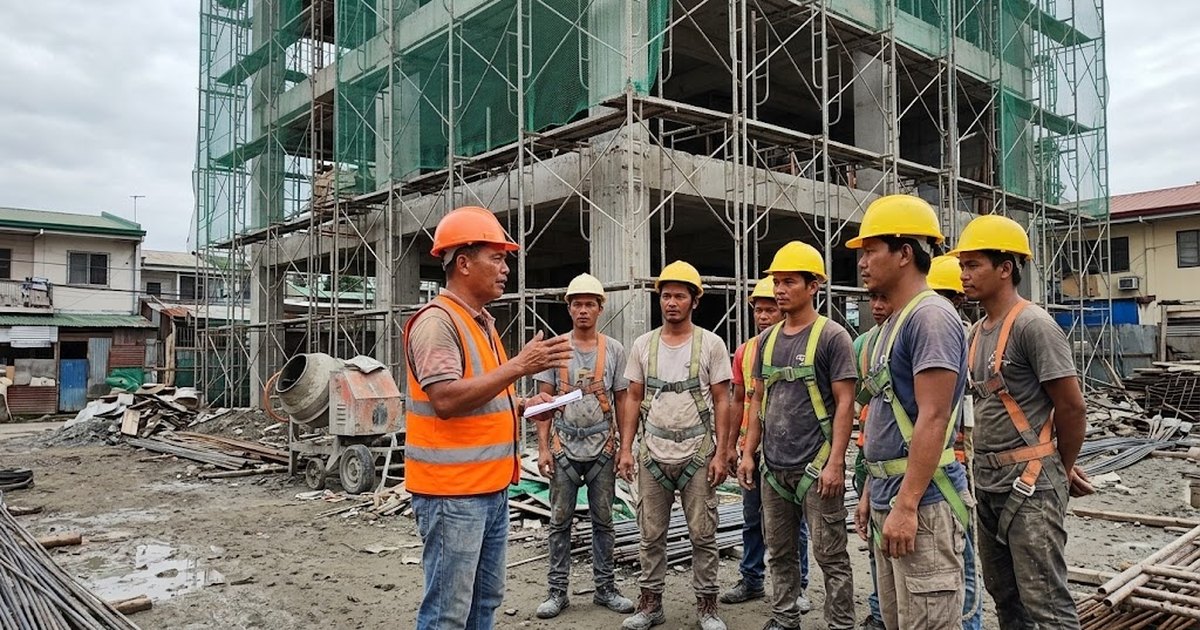
A written safety program and daily briefings are part of the permit, not paperwork after the fact. Illustrative photo.
Short answer: no construction project in the Philippines can legally start work without a Construction Safety and Health Program (CSHP) in place. This is a requirement of Republic Act No. 11058 and its implementing rules, DOLE Department Order No. 198, Series of 2018 — the CSHP has to be prepared and signed by the project's construction manager, staffed with a Safety Officer at a tier that scales with your headcount and risk classification, and it feeds directly into whether your building and occupancy permits hold up under a DOLE compliance visit. Skip it, and DOLE has the legal authority to stop your site and fine it up to ₱100,000 per day.
Most owners find out about this requirement the hard way — a DOLE labor inspector shows up mid-construction, or a permit reviewer asks for a document nobody budgeted for. It's worth knowing before you break ground, not after.
If you searched for "electrician's safety seminar" or "OSH awareness training" and landed here — that seminar requirement is real (RA 11058 bars deploying anyone on a construction site without an OSH safety and health awareness seminar), but it's a worker-level requirement, not something an owner or developer manages directly. The document that actually sits on an owner's desk is the CSHP covered in this article — the program your contractor's safety officer has to have approved before crews mobilize.
Enter your project's peak workforce and a few basics. This tells you whether a CSHP applies (it always does) and gives the commonly cited minimum Safety Officer tier for a high-risk activity at that headcount — confirm the exact tier and count with DOLE or a safety practitioner before finalizing your staffing plan.
Used only to size the illustrative safety-budget line — DOLE's SO-tier trigger is workforce size, not project cost.
DOLE Department Order No. 13, Series of 1998 — the construction-industry-specific OSH guidelines that DOLE's general IRR incorporates by reference — sets out what the program has to state. It isn't a generic safety pledge; it's a working document with teeth:
The project or construction manager has to execute and verify the CSHP, then submit it to DOLE's Bureau of Working Conditions for approval, disapproval, or a required modification before it takes effect. And this isn't a document you write once and shelve — D.O. 13-98 requires that the cost of implementing the program be carried as its own line item, quantified in the project's tender documents and construction contract, not absorbed silently into general conditions.
Construction is classified as a high-risk activity under DOLE's OSH rules, which on its own pushes the required Safety Officer level above the entry tier even for a small crew. The tier system itself — Safety Officer 1 through 4 — is defined by training hours and OSH experience, roughly:
| Tier | Training basis |
|---|---|
| SO1 | 8-hour OSH orientation course plus a 2-hour trainer's course |
| SO2 | 40-hour OSH training course applicable to the industry |
| SO3 | The 40-hour course, plus 48 hours of advanced/specialized OSH training, plus at least 2 years of OSH experience |
| SO4 | Higher advanced-training and experience threshold, generally reserved for large or high-hazard operations |
Where a construction project sits within that scale is set by a DOLE table cross-referencing worker headcount against risk classification. AEDO could not retrieve DOLE's complete official table for every bracket directly from primary text for this article. What's consistently cited by safety-training providers and practitioner commentary: a high-risk site with roughly 1 to 9 workers needs a minimum of SO2, and one with roughly 10 to 50 workers needs a minimum of SO3. Treat these two numbers as the commonly cited figures, not a verbatim IRR quote — if your headcount sits near either boundary, confirm the exact bracket and any additional committee requirements with DOLE's regional office or your safety officer before you lock in staffing, because getting the tier wrong is exactly the kind of gap a labor inspection catches.
One thing that is not the trigger, based on everything read for this article: project cost and building height don't appear to set the Safety Officer tier directly — headcount and risk classification do. A tall, low-crew project and a short, high-crew project can land on different tiers even at similar contract values, which is a common point of confusion.
DOLE issued Department Order No. 252, Series of 2025 (effective May 16, 2025), a Revised IRR of RA 11058 that supersedes D.O. 198-18. Based on published law-firm summaries, the update broadens coverage and adds provisions on psychosocial hazards, climate-related risk, and worker protection against retaliation for hazard reporting — it does not appear, from what AEDO could verify, to change the construction-industry CSHP content requirements or the Safety Officer tier mechanics described above, which trace to D.O. 13-98. If your project falls under D.O. 252-25's broadened scope in some other respect, confirm directly with DOLE.
Two more numbers worth knowing before you budget for compliance. D.O. 13-98 requires a 40-hour basic construction safety and health training course for safety personnel, plus a minimum of 16 hours per year of continuing training for every full-time safety officer. And no worker — not just electricians — can be deployed on a construction site without first completing an OSH safety and health awareness seminar, whether through DOLE itself, an accredited safety organization, or a recognized training institution. On top of that, the Construction Safety and Health Committee has its own required makeup: the project manager sits as chair, the safety officer(s) as members, at least one representative per subcontractor, and a minimum of three worker representatives.
RA 11058 gives the DOLE Secretary explicit authority, under Section 22, to order a stoppage of work or suspension of operations where noncompliance creates grave and imminent danger to worker safety and health. Separately, Section 28 sets an administrative fine of up to ₱100,000 per day for a willful failure to comply with OSH standards or a compliance order — a fine that keeps accruing daily until the violation is fixed, not a one-time penalty. A missing or unapproved CSHP is one of the most visible gaps for a labor inspector to find, precisely because it's a single document that's supposed to already exist before the first worker sets foot on site.
AEDO's role in this. In Negros Oriental, where AEDO designs and builds directly, the CSHP and Safety Officer requirement is handled as part of AEDO's own project management — it's not a separate line item you have to chase down. Outside Negros Oriental, AEDO does not deploy safety personnel or self-perform construction; it prepares the complete design package and provides remote construction oversight of the contractor the client hires locally, and confirming that contractor actually has an approved CSHP and correctly tiered Safety Officer in place is part of what that oversight checks — AEDO does not train workers or issue safety certifications.
Does every construction project in the Philippines need a CSHP?
Yes. RA 11058 and its IRR (DOLE D.O. 198-18) require a Construction Safety and Health Program on every construction project before work starts, regardless of size — what changes with project size is the required Safety Officer tier and committee structure, not whether a program is needed at all.
Who signs or prepares the CSHP?
The project manager or construction manager executes and verifies the CSHP under DOLE Department Order No. 13-98, and it is submitted to DOLE's Bureau of Working Conditions for approval, disapproval, or required modification. The safety officer administers it on-site day to day, but the accountable signatory is the project's construction manager.
What Safety Officer level does a construction project need?
Construction is classified as a high-risk activity under DOLE rules, which by itself pushes the minimum required tier above the entry level even on small sites. Commonly cited guidance puts a 1-9 worker high-risk site at Safety Officer 2 (SO2) minimum and a 10-50 worker high-risk site at Safety Officer 3 (SO3) minimum, but AEDO could not verify the complete worker-count table for every tier and bracket directly from DOLE's primary text, so treat the exact cutoff for your headcount as a hold point to confirm with DOLE or a safety practitioner before you finalize staffing.
What happens if a site has no CSHP?
RA 11058 lets the DOLE Secretary order a stoppage of work when noncompliance creates grave and imminent danger to worker safety, and Section 28 allows an administrative fine of up to 100,000 pesos per day for a willful violation of OSH standards, continuing until the violation is corrected. A missing CSHP is exactly the kind of gap DOLE inspectors flag on a compliance visit.
Does AEDO provide the Safety Officer and CSHP for a project?
In Negros Oriental, where AEDO designs and builds directly, the CSHP and Safety Officer requirement is coordinated as part of AEDO's own project management. Outside Negros Oriental, AEDO does not deploy safety personnel or self-perform construction — it provides the design package and remote oversight of the contractor the client hires locally, and confirming that contractor has a compliant CSHP and correctly tiered Safety Officer in place is one of the things that oversight checks.
Primary and near-primary sources read directly for this article.
Where a specific number could not be confirmed against DOLE's own primary text, this article says so explicitly rather than presenting a secondary-source figure as settled law.
Not a generic checklist — a review of your specific headcount, site, and permit timeline.