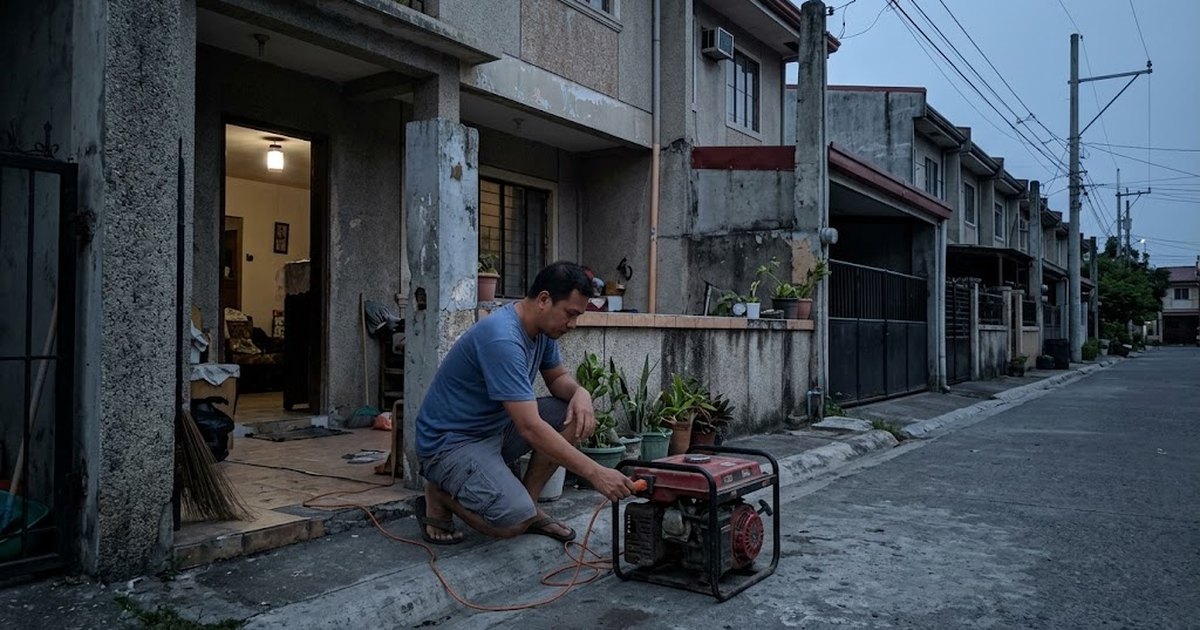
Size the generator from the appliances you actually need to run, including their starting surge. Illustrative photo.
Short answer: add up the running watts of everything you actually want to run at the same time during a brownout, add the single biggest starting surge among your motor-driven appliances — not all of them — then add a safety margin. That number, not "buy the biggest one you can afford," is what should decide the generator you buy. Most households either buy too small a unit that trips every time the aircon kicks on, or spend twice what they needed to because a shop quoted them for every appliance's startup watts added together.
This matters more in a lot of Philippine households than a one-time inconvenience calculation — Negros Oriental, the rest of Visayas and much of Mindanao see brownouts often enough that a generator stops being a typhoon-season purchase and becomes a standing household decision. The calculator below does the actual arithmetic against your own appliance list, in watts and kVA, so you're sizing against your house instead of a shop's rule of thumb.
Check what you'd run during a brownout and set the sizes that apply. This adds your running watts, finds the single largest starting surge, and applies a safety margin — the same logic a generator supplier should be using, done transparently against your own list.
Every appliance has a running-watts number: the steady draw once it's already operating. Anything with a compressor or motor — a refrigerator, a freezer, a window or split-type aircon, a water pump, a washing machine — also has a starting-watts number, sometimes called surge or inrush current, which is the brief spike it draws for a second or two while the motor spins up from a dead stop. A rice cooker, an incandescent bulb, or a phone charger has essentially no surge, because there's no motor to start; a compressor kicking on can briefly pull several times its running wattage.
This is exactly what the calculator above computes, so you can check it by hand against your own list:
| Step | What it is |
|---|---|
| 1. Total running watts | Sum the steady running watts of every appliance you'll actually run at the same time. |
| 2. Add the single largest surge | Find the one motor-driven appliance with the highest starting watts, and add just its surge — not every motor's surge. |
| 3. Apply a safety margin | Multiply the total by roughly 1.20-1.25 so the generator isn't running flat-out at its rated maximum continuously, which shortens engine life and leaves no room for a slightly higher-than-expected draw. |
| 4. Convert to kVA if needed | Generators are often rated in kVA rather than watts. A common approximation is watts ÷ 0.8 (a typical power factor) = kVA — useful for comparing against a supplier's kVA-rated spec sheet. |
The starting-current mechanism behind step 2 is well documented in generator-manufacturer engineering literature: a motor's inrush current on startup is a multiple of its running current, driven by the physics of an electric motor accelerating from a standstill, and the exact multiple depends on the specific motor and how the generator's alternator and voltage regulator respond to the load (see Kohler Power Systems in Sources). Consumer-facing appliance charts commonly simplify this to a rule of thumb of roughly 2 to 3 times running watts for typical household motors like refrigerator and pump compressors, which is the range this calculator uses — your appliance's actual nameplate or spec sheet is the exact figure if you have it.
Once you have a computed watt figure, it maps roughly onto one of four common size classes sold in the Philippine market. These price bands are AEDO's own observation of current supplier listings, not a government price schedule — treat them as a planning range, not a quote.
| Size class | Typically covers | Rough price band (2026) |
|---|---|---|
| Small inverter ~800W-2,000W | Fridge, lights, fans, phone/laptop charging, a router — no aircon or pump | ₱15,000-₱30,000 |
| Mid-size ~2,000W-5,000W | The above plus one small aircon or a water pump, run one at a time | ₱30,000-₱70,000 |
| Large portable/standby ~5,000W-10,000W | Most of a household running together — fridge, one or two aircon units, pump, washing machine | ₱70,000-₱150,000 |
| Whole-house standby with ATS 10,000W+ | The full house, automatically, including simultaneous aircon units and heavier loads | ₱150,000+ installed |
An inverter generator produces cleaner power (lower total harmonic distortion) that's safer for routers, laptops, LED drivers and inverter-type aircon units. A conventional open-frame generator is usually cheaper per watt but noisier and less forgiving of sensitive electronics. If your household runs much of that kind of load — most do now — size toward an inverter unit even if it costs somewhat more per watt than an open-frame model of the same rating.
A generator that can't be hooked up safely is worse than no generator. The single most dangerous mistake is plugging a portable unit directly into a wall outlet or wiring it straight into the panel without a transfer switch — this can send power backward through the meter and onto the utility grid, a hazard known as backfeeding. A lineworker restoring power on what they believe is a de-energized line can be seriously injured or killed by a backfed generator they have no way of seeing from the street. OSHA's own generator safety guidance treats this, together with carbon monoxide exposure from running a generator indoors or too close to windows and doors, as the two most serious hazards of portable generator use (see Sources).
A licensed electrician installing a proper transfer switch or interlock device — which physically prevents the generator and the grid from ever being connected at the same time — is a small cost against that risk. This is a wiring and panel job for a licensed electrician, not a DIY project, regardless of how simple the generator's own instructions make it look.
Where AEDO fits in. AEDO doesn't sell or install generators. Where this comes up in our own scope is the electrical side of a house design or renovation — sizing the panel, wiring and transfer-switch provision so a generator (yours, bought wherever you like) can actually be added later without re-doing the electrical work. That's part of the complete electrical design AEDO prepares nationwide as design services; in Negros Oriental, AEDO also builds the electrical work directly.
What size generator do I need for a small house with just a fridge and lights?
A refrigerator plus basic lights, fans, a TV and a router typically adds up to a peak load, including the fridge's starting surge, a little over 1,000 watts — a small 1,500-2,000W inverter generator usually covers that with margin. Run the calculator above with your own appliances for a number specific to your house; fridge running watts alone vary roughly 150W-400W by model and age.
Do I add up the starting watts of every appliance, or just one?
Just the single largest one, in almost every realistic case. Motors briefly surge on startup, but that surge lasts a second or two and it's extremely unlikely two motors start at the exact same instant. Size for total running watts plus the one biggest surge, plus a margin — adding every appliance's starting watts together is the most common way people oversize (and overpay for) a home generator.
Inverter generator or conventional open-frame generator — which is better for brownouts?
Inverter units produce cleaner, more stable power that's safer for routers, laptops and inverter-type aircon. Conventional open-frame units are usually cheaper per watt and fine for simpler loads like lighting, a pump or a rice cooker, but noisier and less forgiving of sensitive electronics. Most households now have enough electronics worth protecting that sizing toward an inverter unit is worth the difference.
Can I plug a portable generator directly into my house wiring?
No — never connect a generator to your home's wiring without a properly installed transfer switch or interlock device, wired by a licensed electrician. Doing so can backfeed electricity onto the grid, seriously injuring or killing a lineworker restoring power, on top of the risk to your own generator and wiring. This is documented in OSHA's own generator safety guidance.
How much does a home backup generator cost in the Philippines?
Rough 2026 market bands: small 800W-2,000W inverter units run roughly ₱15,000-₱30,000; mid-size 2,000W-5,000W units roughly ₱30,000-₱70,000; larger 5,000W-10,000W units roughly ₱70,000-₱150,000; whole-house units above 10,000W with an automatic transfer switch commonly exceed ₱150,000 installed. These are AEDO's own market observations, not a government price schedule, and actual prices vary by brand, fuel type and installation complexity.
References used for the figures and safety guidance in this article. Links open in a new tab.
Appliance running/starting watt ranges (refrigerator, freezer, aircon per HP, pump per HP, washing machine, rice cooker, baseline loads) and the PHP price bands by generator size class are AEDO's own compiled estimates from generator-manufacturer sizing guides and current supplier listings, not figures from a single verifiable government or manufacturer table — check your own appliance's nameplate wattage for an exact figure where it matters.
Whether it's a new house or a panel upgrade, AEDO can size the electrical design so adding a transfer switch and generator later is straightforward, not a rewire.