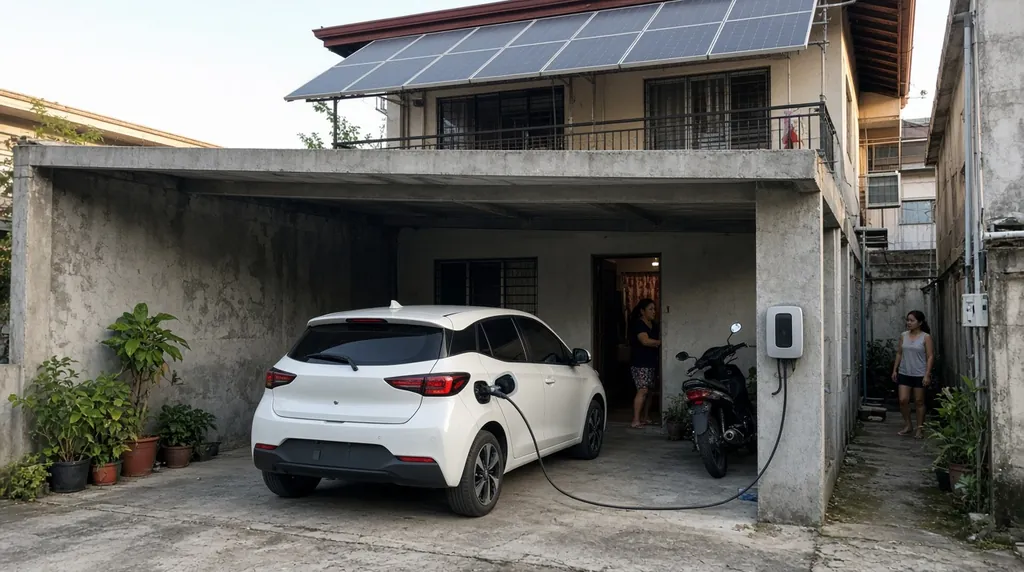
The panels above the carport only charge the car directly while the sun is up. Plug in after dinner and the power comes from somewhere else. Illustrative photo.
Short answer: an EV adds a predictable number of kWh a month, and the panel count follows from when you charge. Take a car using 0.15 kWh per km (a starting value; use your own vehicle's figure) driven 40 km a day: that's 180 kWh a month. Charged in the daytime, it needs about 1.5 kWp of extra panels, rounded up to four 450 W panels (1.8 kWp), at our planning yield of 4.0 kWh per kWp per day. Charged at night, the panels can't feed it directly. You either buy from the grid at your full rate, store daytime solar in a battery and lose about 15% on the way through, or export more by day and take net-metering credits, which pay only the generation charge, so you need roughly 1.5 times the panels for the same night charge. On running cost, the default car is about ₱221 per 100 km on grid power against about ₱887 for a 10 km/L gasoline car at the DOE's NCR common price for RON 91 in the week of 22 to 28 September 2026.
The calculator below works it out for a car, an e-motorcycle or an e-trike, checks whether your existing solar has spare output, draws the added panels on a roof plane, and flags when the charger may be too much for your main breaker. After it: why fuel prices pushed this question up, how much electricity an EV really uses, why day and night charging give different answers, what the charger draws, and what to check before you buy panels or a wall box.
Your vehicle, your daily km and when you charge give the kWh the vehicle adds each month, the extra solar that covers it, the panel count and roof area, and the monthly cost of fuel vs grid vs solar. Every rate is editable. The vehicle presets fill in starting values only; replace them with your own vehicle's figures.
One roof plane, eave at the bottom. Existing panels in blue, the panels added for the vehicle in orange, laid portrait in rows. The numbered tags match the key below.
Planning sketch only, not for construction. NTS. Module gaps, rails, attachment points and edge setbacks are not set by this calculator: they come from the racking datasheet and the wind-uplift design for your roof, so they're marked "per design". Existing panels are drawn at the panel size entered, which may differ from yours.
On 24 March 2026 the President signed Executive Order No. 110, declaring "a state of national energy emergency" because of the Middle East conflict and its danger to the country's energy supply (Section 1). It stays in force for one year unless extended or lifted (Section 12). Among the long-term demand-side strategies it calls for is "accelerating the transition to renewable energy through the use of electric vehicles in mass transport" (Section 4(e)), and it directs the DTI to "promote the adoption and use of electric vehicles, renewable energy, and other energy-efficient solutions in the transportation, logistics, and manufacturing sectors" (Section 6(c)). Neither line is aimed at private household cars, but both point the same way. On 1 April 2026 the DOE used the same emergency to order utilities and co-ops to process net-metering applications within a non-extendible 10 working days, for systems up to 100 kW. Our net-metering guide covers that in detail.
Pump prices are the other half. In the DOE's NCR price monitor for the week of 22 to 28 September 2026, the common price was ₱88.70 per liter for RON 91 and ₱103.30 for diesel. On 29 September prices dropped by ₱0.24 for gasoline and ₱7.57 for diesel, according to Top Gear Philippines' weekly fuel update, which also notes that since the start of September gasoline had risen by over ₱15 per liter and diesel by over ₱18. So for the week of 29 September to 5 October, diesel is several pesos below the monitored figure and gasoline about the same. Those are Metro Manila figures, and prices move every Tuesday. Provincial prices differ, so type your own pump price into the calculator. If you're weighing an EV, an e-motorcycle or an e-trike because of fuel, the next question is where its electricity comes from.
Everything in this article hangs on one number: kWh per km. It differs a lot between a car, an e-motorcycle and an e-trike, and between models of the same type, so we don't publish a table of "typical" values. The calculator's presets (0.15 for a car, 0.04 for an e-motorcycle, 0.08 for an e-trike) are placeholders to get you started, not measurements. Get your own figure one of three ways:
Then the monthly energy is simple: kWh per km × km per day × 30. At the defaults that's 0.15 × 40 × 30 = 180 kWh a month, or 6 kWh a day. For comparison, the default house in our net-metering guide uses 339 kWh a month, so this car alone adds over half of that household's use. An e-motorcycle at the 0.04 placeholder and the same 40 km a day adds 48 kWh a month, which one 450 W panel covers at our planning yield (0.45 × 4.0 × 30 = 54 kWh).
A kWh of solar is worth the most when it's used the moment it's produced. That's the same rule our net-metering guide explains for the whole house, and an EV makes it sharper because the car is often parked at work in the daytime and plugged in at home at night.
| Where the charge comes from | Solar you need for each kWh the car takes | Why |
|---|---|---|
| Daytime, panels straight to the car | 1 kWh | The panel output goes to the charger before it reaches the meter. Every kWh saves your full rate. |
| Night, from a home battery charged by the panels | about 1.18 kWh (1 ÷ 0.85) | NREL's initial measurements on its lithium-ion behind-the-meter test systems showed round-trip efficiency "near 85%"; your battery's datasheet may differ. Plus the battery itself, which isn't in our cost range. |
| Night, from the grid, offset by net-metering credits | about 1.52 kWh at the defaults (₱14.7424 ÷ ₱9.7032) | Exported kWh are credited at the utility's generation charge, "the DU's blended generation cost, excluding other generation adjustments" in the DOE's primer, while the night kWh you import cost your full rate. |
| Night, straight from the grid | 0 kWh (no added panels) | You pay your full rate for every kWh. The cheapest to set up, the most expensive to run. |
Run the calculator's default car through each option and the extra solar comes out at 1.50 kWp for daytime charging, 1.76 kWp from a battery and 2.28 kWp offset with net-metering credits, against 0 kWp and about ₱2,654 a month on straight grid power. If your car is home in the daytime even two or three days a week, shifting those charges to midday is the cheapest "upgrade" there is.
Brownouts. A plain grid-tie system doesn't help during one. The ERC's net-metering interconnection standards say that "in the event there is no power from the DU, the RE facility should automatically disconnect," so the inverter shuts down and the charger with it. Charging through a brownout takes a hybrid system with a battery that can safely island, and a car can empty a home battery quickly. Our hybrid vs grid-tie vs off-grid guide sizes that battery from the loads you want to keep running; most households keep it for the fridge, lights and fans, not the car.
Sellers sometimes describe home chargers as "Level 1" and "Level 2". Look for the kW and the amps on the datasheet instead. Two real examples, picked only because their makers publish clear ratings; they are European-market products, we don't sell or recommend either brand, and a charger bought here should suit Philippine outlets and be rated for your supply:
| Type | Datasheet rating | Current at 230 V | Hours to put 6 kWh in the car |
|---|---|---|---|
| Portable cable on a wall socket (Mode 2, control box in the cable) | 2.3 kW maximum, 10 A, 230 V (Brennenstuhl portable EV charger, product page) | 2,300 ÷ 230 = 10 A | 6 ÷ 2.3 = about 2.6 h |
| Wall box (Mode 3, IEC 61851-1) | 7.4 kW, 32 A single-phase, 230 V (Wallbox Pulsar Plus datasheet) | 7,400 ÷ 230 = about 32 A | 6 ÷ 7.4 = about 0.8 h |
Hours are energy into the charger; the car itself may limit the rate. For a 40 km day, the slow portable charger is already enough. A wall box mainly buys speed.
The solar mismatch. A 7.4 kW wall box draws far more than a small home array can produce at any moment; the four panels (1.8 kWp) added for the default car deliver at most about 1.8 kW, and less on a hot or hazy day. The calculator balances energy over a month, but while the wall box runs flat out, whatever the panels can't supply that minute comes from the grid at your full rate. Two fixes: turn the charging current down to roughly what the panels make (the Pulsar Plus datasheet lists a configurable current "from 6 A to rated current" and says it is compatible with "solar charging"), or use a slower charger for longer. Even the 2.3 kW portable cable outruns those 1.8 kWp of panels, so the default case also leans on the grid around the edges of the day.
Your service. A charger runs at full current for hours. Our electrical service sizing guide turns the load into amps through the power factor (kW ÷ 0.85 for ordinary household load) and takes continuous loads at 125% when it sizes a breaker. The calculator does the same: what's already running, at its power factor, plus the charger, then × 1.25, against your main breaker. A 7.4 kW wall box alone is about 32 A, or about 40 A at 125%. Add 4.8 kW of aircon and other load running at the same time (about 24.6 A at 0.85) and it's about 57 A, or about 71 A at 125%: more than a 60 A main. If the check fails, or you didn't enter your breaker, read our EV charger installation guide: it covers the dedicated circuit, the protection, and when the service entrance or the utility's drop has to be upgraded.
Protection and permits. The wall box datasheet lists 6 mA DC leakage protection and refers the installation's protection to the maker's installation guide; the protective devices upstream are part of the electrical design. That design follows the Philippine Electrical Code and is done by a Professional Electrical Engineer (PEE). Under RA 7920, Section 31(a), a PEE's field of practice includes "the sole authority to seal electrical plans". At AEDO, the electrical plans are prepared with the PEE on our team, who signs and seals them.
With the calculator's defaults (a car at 0.15 kWh per km, 40 km a day, compared with a 10 km/L gasoline car):
| Option | Working | Per month (1,200 km) | Per 100 km |
|---|---|---|---|
| Gasoline car | 1,200 km ÷ 10 km/L × ₱88.70 | ₱10,644 | ₱887 |
| EV on grid power | 180 kWh × ₱14.7424 | ₱2,654 | ₱221 |
| EV on daytime solar | No kWh bought; panels paid up front | ₱0 running | ₱0 running |
| Extra panels for daytime charging | 4 × 450 W = 1.8 kWp × ₱50–70 per W | ₱90,000–₱126,000 once, which pays back against grid charging in about 2.8–4.0 years | |
Three caveats. The pump price is Metro Manila's common price for one week and changes weekly. The 10 km/L and 0.15 kWh/km are placeholders, and the gap between fuel and electricity depends entirely on them, so type your own. And the payback compares solar with charging from the grid, not with buying fuel: the switch from fuel to electricity saves money on its own, before a single panel goes up. The panel cost range is our payback guide's market range for a grid-tie system without a battery. Batteries, roof repairs and a service upgrade are extra and are quoted after a survey.
Maybe, if you're exporting a lot now. On a net-metered bill the exported kWh is printed every month. That's solar your house doesn't use at the moment it's produced, and a car charging at the same hours would use it at your full rate instead of earning only the generation-charge credit. Type it into the calculator: daytime charging uses it first, and you'll see the credit you give up counted as a cost.
Two cautions. Exports happen when the sun is strong and the house is quiet, usually late morning to early afternoon; if the car isn't home then, that spare solar doesn't help it. And if you add panels to a net-metered system, tell the utility first. The amended Net-Metering Agreement form, quoted in our net-metering guide, says any modification goes through "the same process as that of a new customer, including the execution of a new Net-Metering Agreement", and adding panels or a battery counts. The net-metering limit is 100 kW per account. A charger by itself is a load, not a generator, so it isn't a net-metering modification, but it is a change to your service that the utility may need to know about if the service has to be upgraded.
The default car's four panels at 2.1 × 1.05 m take about 8.8 m² of roof for the modules alone. Our rooftop mounting guide uses roughly 5.5–6.5 m² of array area per kWp for current crystalline modules, which gives 9.9–11.7 m² for 1.8 kWp. Edge setbacks and attachment spacing come from the wind-uplift design, not from a rule of thumb, which is why the drawing marks them "per design". Before adding panels, have the roof checked for the extra dead load and uplift; the mounting guide shows the NSCP Section 207D check.
If the house roof is already full or faces the wrong way, a carport roof can carry panels too, directly over the car. That turns the carport into a small structure designed for panel weight and typhoon uplift, not a light shade. Our carport cost guide covers the steel frame and roofing; ask for it to be designed for the panels from the start rather than adding them later.
Charging a delivery van, a company car or a few e-trikes at a shop or warehouse is a different case: those vehicles can often charge in the daytime, which is when a business already uses most of its solar. Our commercial solar guide covers that daytime-load match and what changes above the 100 kW net-metering limit.
What AEDO does. AEDO supplies and installs rooftop solar in Negros Oriental only, the same rule as our construction work, and quotes after a bill review and site survey; there's no price list. Anywhere else in the Philippines we don't install. We size the extra solar against your vehicle and your bills, check the roof structure for the added panel load and wind uplift, have your electrical service capacity reviewed for the charger, and review an installer's quote before you sign. Electrical plans are signed and sealed by the Professional Electrical Engineer on our team, as RA 7920 requires.
Pump prices: the DOE Oil Industry Management Bureau's NCR price monitor for the week of 22–28 September 2026 (RON 91 common ₱88.70, diesel ₱103.30), and the 29 September rollback from Top Gear Philippines' weekly fuel price update. Charger ratings: the Brennenstuhl portable charger page (2.3 kW, 10 A, 230 V) and the Wallbox Pulsar Plus datasheet (7.4 kW, 32 A, 230 V; configurable 6 A to rated current). Battery round-trip efficiency, 85%: NREL. Export credit at the generation charge: the DOE net-metering primer. Grid rate ₱14.7424/kWh: Meralco's September 2026 advisory, as in our payback guide. Export credit ₱9.7032/kWh: our net-metering guide's estimate. Yield 4.0 kWh/kWp/day, 450 W panels and ₱50–70 per watt: our payback guide. Panel size 2.1 × 1.05 m: our Dumaguete installation guide's default. 5.5–6.5 m² per kWp: our rooftop mounting guide. Power factor 0.85 and 125% for continuous loads: our electrical service sizing guide. The vehicle presets (0.15, 0.04 and 0.08 kWh/km), the 10 km/L fuel economy and the 40 km a day are starting values we chose, not sourced figures: replace them.
How many solar panels do I need to charge an electric car at home in the Philippines?
Work it out from the energy, not the car. Multiply the car's energy use per km by the km you drive each day and by 30 to get kWh per month, then divide by the solar yield per kWp per month. With the calculator's starting values, 0.15 kWh per km and 40 km a day, the car needs 180 kWh a month. At AEDO's planning yield of 4.0 kWh per kWp per day, daytime charging needs about 1.5 kWp of extra panels, rounded up to four 450 W panels (1.8 kWp). Replace the 0.15 with your own vehicle's figure, because it is a starting value, not a spec.
Can I charge my EV with solar at night?
Not directly. Panels produce nothing at night, so a night charge comes from the grid, from a home battery charged by the panels during the day, or from the grid offset by net-metering credits. A battery loses energy going in and out; an NREL field test measured round-trip efficiency near 85 percent, so you need about 18 percent more solar than the car uses. Net metering credits exported solar at the utility's generation charge, which is lower than your full rate, so offsetting night charging that way takes more panels than daytime charging: about 1.52 times as many kWh at the calculator's default rates.
How much does it cost to charge an EV compared with gasoline in the Philippines?
With the calculator's defaults, a car using 0.15 kWh per km costs about 221 pesos per 100 km charged from the grid at Meralco's September 2026 residential rate of 14.7424 pesos per kWh. A gasoline car doing 10 km per liter costs about 887 pesos per 100 km at the DOE's NCR common price for RON 91 of 88.70 pesos per liter for the week of September 22 to 28, 2026. Daytime solar charging has no per-km running cost, but the panels cost money up front. The km per liter, the kWh per km and the pump price in your town are your own numbers, so type them in.
What charger do I need for solar EV charging at home?
Either works for solar. A portable Mode 2 charger on a wall socket is rated around 2.3 kW at 230 V and 10 A in one manufacturer's published specifications, and a single-phase wall box around 7.4 kW at 230 V and 32 A on another's. A small array cannot cover a 7.4 kW draw on its own, so the grid supplies the difference unless the charger's current is turned down; the wall box datasheet lists a configurable current from 6 A and compatibility with solar charging. The circuit, protection and any service upgrade are designed by a Professional Electrical Engineer.
Do I need to tell my utility if I add panels for my EV?
Yes, if your system is net-metered. The amended Net-Metering Agreement form says any modification to the renewable energy facility goes through the same process as a new customer, including a new Net-Metering Agreement; adding panels or a battery is a modification. The ERC rules cap net metering at 100 kW per account. An EV charger alone is a new load, not a generator, but it can still push your service past what the main breaker and the utility's service drop were sized for, so have that checked.
Will my solar keep charging the car during a brownout?
Not with a plain grid-tie system. The ERC net-metering interconnection standards require a grid-connected system to disconnect automatically when there is no power from the utility, so the panels stop feeding the house and the charger. To charge during a brownout you need a hybrid system with a battery that can island safely, and even then a car can drain a home battery fast, so most households save the battery for lights, the fridge and fans.
Issuances, price monitors, datasheets and studies read for this article in late September and early October 2026. External links open in a new tab.
We did not find a manufacturer spec sheet for the vehicle presets, so the kWh per km, the km per liter and the km per day are starting values, not sourced figures. The pump prices are Metro Manila's and change weekly. Some fuel-price aggregator pages showed far lower "today" prices in early October 2026 (gasoline in the ₱60s); those figures did not match the DOE's own monitor, so we used the DOE figures. We did not read the Philippine Electrical Code's EV charging provisions, so none is cited by number. This article is general information, not an electrical design for your house.
Send us your bills, the vehicle, the charger you're considering and a photo of your panel board. A licensed engineer will tell you how much solar the vehicle really needs and what your roof and service need checked.