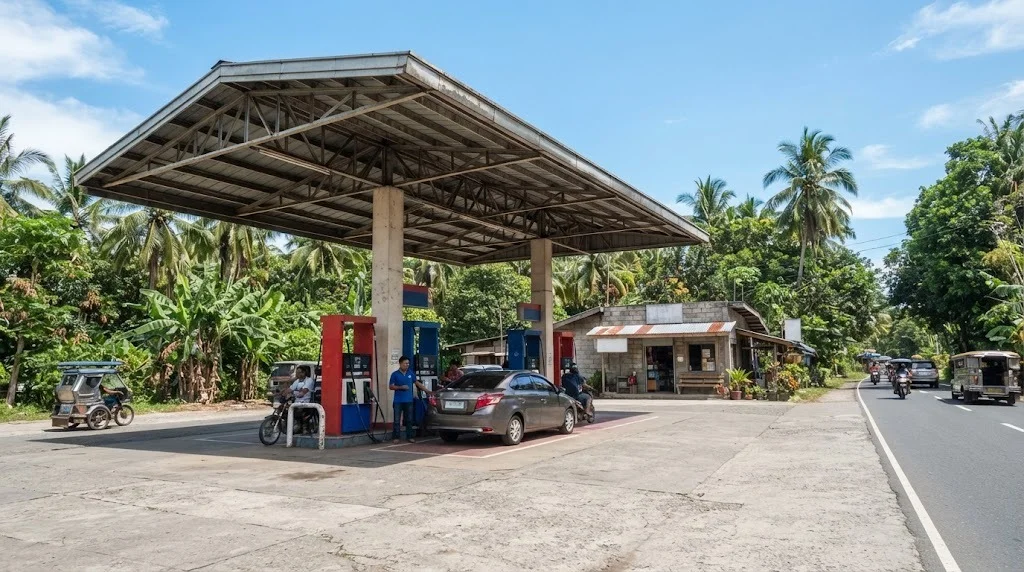
The canopy looks like the simplest part of a fuel station. Structurally, it is usually the part most likely to fail in a typhoon. Illustrative photo.
Short answer: a gas station is not one construction cost, it is at least four — the canopy and dispenser islands, the underground storage tanks and piping, the pump equipment itself, and (often) a convenience store. Get those four scoped separately before comparing any single number a contractor quotes you. Two permitting tracks run in parallel with the build: the Department of Energy's Certificate of Compliance process under Republic Act No. 8479, and the Fire Safety Inspection process under RA 9514's Revised Fire Code. Structurally, the part most people underestimate is the canopy — a large, mostly open roof surface that wind wants to lift off, not push down, and that has to be engineered for that case specifically.
Every published "gas station construction cost" figure you'll find online is really quoting one of four very different line items, usually without saying which one. A realistic budget separates them:
A quote that bundles all four into one "per sqm" rate is usually hiding which of them it actually covers.
Sizes a budget range by pump island and tank count, and separately flags whether your canopy's structural design covers the wind uplift case. Every figure is an AEDO practice band for early budgeting — it is not a quotation and not a substitute for a sealed structural design.
The retail fuel business in the Philippines has been deregulated since 1998, which surprises people who assume it works like a regulated utility. Republic Act No. 8479, the Downstream Oil Industry Deregulation Act, opened the retail side to free entry — but "deregulated" does not mean "unmonitored." Section 5 of RA 8479 requires anyone engaging in a downstream oil industry activity, including retailing, to give the Department of Energy prior notice for monitoring purposes, and Section 10 has the DOE actively encouraging private-sector entry into gasoline station retailing while keeping oversight of the sector.
The DOE's Oil Industry Management Bureau implements that oversight in practice through Department Circular No. DC2017-11-0011, the Revised Rules and Regulations Governing the Business of Retailing Liquid Fuels. It sets up the Certificate of Compliance (COC) framework that a new outlet has to go through before commercial operation — the specific document list and technical criteria are the DOE's own checklist, and are worth pulling directly from the DOE Oil Industry Management Bureau or your DOE regional office rather than a secondhand summary, since the requirements are periodically amended.
The COC process runs alongside, not instead of, three other tracks: the local government's building permit and business permit, RA 9514's Fire Safety Inspection Certificate, and — where the project triggers it — DENR's Environmental Compliance Certificate process. None of the four substitutes for another.
Get the current COC checklist from the source, not a summary. DOE circulars on retail liquid fuels have been updated more than once since 2017. Before finalizing your site layout or tank specification, confirm the current document list and technical requirements with the DOE's Oil Industry Management Bureau or your DOE regional field office — a checklist copied from a blog (including this one) can be out of date by the time you file.
The 2019 Revised Implementing Rules and Regulations of RA 9514 treats fuel dispensing as a hazardous-materials matter, not a generic building-fire matter. Two things are worth being precise about, because this is exactly the kind of code detail that gets fabricated online:
What a fire-safe fuel station design has to address, regardless of the exact figures your Fire Marshal applies: adequate separation between dispensers and any ignition source or occupied structure, spill containment at the dispenser islands, portable fire extinguishers rated for Class B (flammable liquid) fires at the pump area, and — depending on scale — a fixed suppression or foam system for larger installations. These get finalized with your Fire Safety Engineer or Practitioner as part of the Fire Safety Evaluation Clearance, which has to be in hand before the Fire Safety Inspection Certificate can be issued.
A house or warehouse roof is heavy, enclosed, and has walls helping to hold it down. A fuel station canopy is the opposite on every count: it's a large, thin, mostly flat surface, open on all four sides, carried on a handful of slender columns with nothing else attached to help resist load. Wind moving across and under that surface doesn't just push sideways — it creates a net upward suction force, especially at the edges and corners, that a canopy built only to carry its own dead weight was never designed to resist.
National Structural Code of the Philippines 2015, Volume I (Section 207) sets out how wind loads on structures, including open roof structures like canopies, are determined — basic wind speed by location, exposure category, and the pressure coefficients that apply to the specific roof geometry. NSCP is a printed ASEP standard with no official public URL, so no specific table or figure number from it is quoted here without AEDO having the printed text in front of us for that exact canopy geometry; what matters for a buyer or developer to understand is that this analysis has to be done for the actual site and actual canopy shape, not assumed from a fabricator's standard catalog drawing built for a different wind zone.
The practical failure mode: a canopy erected from a steel supplier's stock design, with anchor bolts and base plates sized for the roof's own weight, holds up fine in ordinary weather and then lifts, racks, or fails outright in a strong typhoon — the load case it was never actually checked against. The fix is not more steel everywhere; it's a wind uplift check specific to that canopy's height, span, and site exposure, translated into the right anchor bolt size, embedment, and base connection detail.
An underground storage tank foundation has to solve a problem most building foundations never face: buoyancy. An empty or partially empty tank in wet or high-groundwater soil can float or shift upward if it isn't held down — the opposite failure mode from a normal foundation, which mostly worries about settling. A properly designed installation accounts for:
None of this is visible once the concrete is poured and the pavement goes back down — which is exactly why it matters that it's engineered up front, and exactly why an existing station's tank pad condition is one of the harder things to assess without excavation or ground-penetrating methods.
Presidential Decree No. 1586 established the Philippine Environmental Impact Statement System: projects the President has declared environmentally critical, or that fall within a declared environmentally critical area, must secure an Environmental Compliance Certificate (ECC) from DENR before proceeding; projects outside those categories are treated as non-critical and are not required to file a full environmental impact statement. Whether a specific fuel station triggers the ECC requirement depends on its location, scale, and DENR-EMB's project screening — this is not a blanket "every gas station needs an ECC" rule, and it is not a blanket exemption either. Screen it with DENR-EMB (or the DOE checklist, which references the applicable environmental clearance) before assuming either way.
DOE's Certificate of Compliance, the local government's building/business permits, RA 9514's Fire Safety Inspection Certificate, and DENR's environmental clearance (where triggered) run on different agencies, different document lists, and different timelines. Sequencing them — knowing which one has to close before the next can even be filed — is most of what makes a fuel station's permitting timeline longer than a comparable commercial building's.
Who can seal the structural design. Under the Civil Engineering Law (RA 544), the practice of civil engineering covers consultation, design, and engineering supervision of structures — a fuel station canopy's structural design and its wind-uplift analysis fall within that scope and must be signed and sealed by a PRC-licensed civil engineer, not supplied as an unsealed fabricator drawing.
How AEDO can help. For a new station: structural design of the canopy and dispenser islands (with a site-specific NSCP 2015 wind uplift check, not a catalog span table) and a permit-ready set coordinated with your DOE, Fire Code, and local government submissions. For a station you're considering buying or leasing: a third-party structural assessment of the canopy, visible foundation and tank-pad condition, and dispenser islands before you commit — the same kind of assessment AEDO performs on industrial tanks and silos, scoped for a fuel retail site. AEDO's PRC-licensed engineers can perform design and assessment work anywhere in the Philippines; AEDO builds directly only in Negros Oriental, and provides remote design and oversight of a local contractor elsewhere.
How much does it cost to build a gas station in the Philippines?
There is no single per-sqm rate that means much here, because a fuel station is really four separate cost items: the canopy and dispenser islands, the underground storage tanks and piping, the pump equipment itself, and a convenience store or service bay if included. As an AEDO practice band for budgeting only, a basic 2 to 4 island station with a modest canopy, two double-wall underground tanks, and no convenience store typically lands in the tens of millions of pesos before land, DOE/Fire Code permitting, and pump equipment supply are added. A station with a branded convenience store and more islands costs meaningfully more. Get a scope-specific estimate rather than relying on a flat per-sqm figure.
What permits does a new gas station need from DOE?
Under Republic Act No. 8479 (Downstream Oil Industry Deregulation Act of 1998), the retail liquid fuels business is deregulated but still monitored by the Department of Energy — Section 5 requires anyone engaging in a downstream oil activity to give prior notice to the DOE. The DOE's Oil Industry Management Bureau implements this through Department Circular No. DC2017-11-0011, which sets the rules for retail liquid fuels outlets and the Certificate of Compliance (COC) process a station goes through before commercial operation. This sits alongside, not instead of, the Fire Safety Inspection Certificate under RA 9514, the local government's building and business permits, and DENR's environmental requirements where they apply.
Does RA 9514 (Fire Code) require specific separation distances for fuel dispensers?
RA 9514's 2019 Revised IRR does regulate automotive service stations and fuel dispensing under its Flammable and Combustible Liquids provisions (Section 10.3.7.5), and it defines both the "Automotive Service Station" and "Dispensing Device" as specific terms in its Rule 3 definitions. What it does not give in any form we can verify and quote here is a single universal separation-distance figure in meters between a dispenser, a tank, and a property line — that figure depends on tank capacity, product class, and the specific provision your local Fire Marshal applies during plan evaluation. Confirm the exact clearance for your layout with the Bureau of Fire Protection office that will evaluate your Fire Safety Evaluation Clearance, before your civil layout is finalized.
Why is wind uplift the critical design case for a fuel station canopy?
A fuel station canopy is a large, mostly flat roof surface carried on a handful of slender columns, open on all sides — structurally the opposite of a building, which has walls to help resist wind. Wind moving under and over that surface creates a net upward (uplift) force rather than the downward gravity load a column and footing are naturally good at resisting. NSCP 2015, Volume I (Section 207) covers wind loads on structures including open, canopy-type roofs, and a canopy designed only for its own dead weight without a proper site-specific wind uplift check is a common cause of canopy failure in a typhoon. The anchor bolts, column-to-footing connection, and purlin-to-rafter connections all have to be sized for that uplift case specifically, not just for gravity.
Can AEDO assess an existing gas station before I buy or lease it?
Yes. A structural assessment of an existing station — canopy condition and anchorage, foundation and tank-pad condition where visible, dispenser island condition, and whether the canopy appears to have been built to an engineered wind design at all — is a design and engineering service, so AEDO's PRC-licensed engineers can carry it out anywhere in the Philippines, not only in Negros Oriental. If the assessment turns up retrofit or repair work, AEDO builds directly only in Negros Oriental; elsewhere AEDO provides the remediation design and remote engineering oversight of a contractor you engage locally.
Every code section and legal reference cited above, checked against the primary source before publishing. Cost figures are AEDO's own practice-based estimates, not from any published rate schedule.
Tell us the number of islands, tanks, and whether you're building new or evaluating an existing station — you'll get a real scope, not a guess.