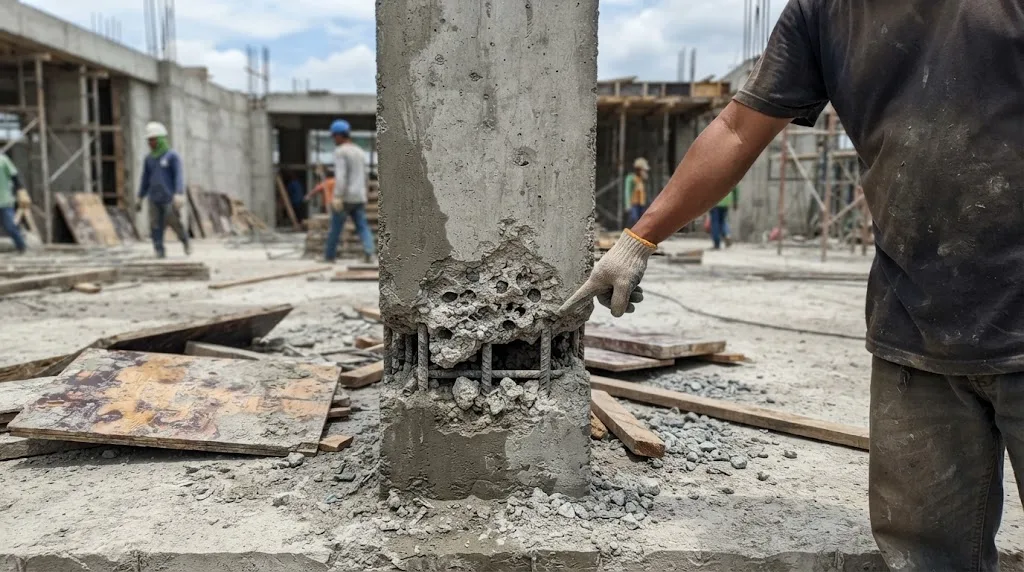
The bottom of a column is where honeycomb shows up most, and where it matters most: paste leaks out of the form joint at the base and the ties are closest together there. Illustrative photo.
Short answer: honeycomb is concrete where the cement paste never filled the gaps between the gravel, and whether it matters depends on how deep it goes and where it is. A shallow patch that stops short of the steel, in the middle of a wall or beam, is a cosmetic repair the contractor fixes at his own cost. A void that reaches or passes the bars, sounds hollow when you tap it, or sits at the top or bottom of a column next to the beam, slab or footing is a structural question: that end zone is where NSCP 2015 bunches the column's ties, because it's where a column can yield in a strong earthquake. Take the case in the photo, a void about 20 by 15 cm at a column base with a bar showing: the checker below puts it in the engineer-assessment band, with an AEDO planning range of ₱10,000 to ₱79,000 for the assessment, the repair and a possible core test. What it should never get is a coat of plaster.
Below the checker: what causes honeycomb, the three depths and why they're treated differently, which locations are structural, how to assess and repair it properly, what the NSCP actually says (it covers prevention, not repair), how to stop it on the next pour, and who pays.
Describe the worst patch: which element, where on it, how deep, how big, and whether steel is showing. You get a severity band, the action we'd recommend, and an AEDO 2026 planning range for the assessment and repair. The bands are AEDO site practice, not an NSCP classification (the code doesn't have one). A licensed engineer's inspection overrides anything this tool says.
Concrete is gravel held together by a paste of cement, water and sand. When it's placed and vibrated properly, the paste flows into every gap between the stones, around every bar and into every corner of the form. Honeycomb is what you get where it didn't: the stones are there, but the spaces between them are empty. When the forms come off you see bare gravel, sometimes with holes you can put a finger into, and sometimes a bar with nothing around it.
It isn't the same as the small round bubbles you see on most formed surfaces (bugholes), which are trapped air against the form face and are usually a finishing issue. And it isn't a crack. Honeycomb is missing material: less concrete where the designer counted on it, and less cover over the steel.
Almost always the same handful of things, and usually more than one at once:
We found no honeycomb classification in the parts of Sections 426 and 427 of NSCP 2015 we read (pages 4-178 to 4-189). On site, most engineers sort it by depth, because depth decides what's been lost. This is the practice we use, not a code table:
| Class (AEDO practice) | What you see | What's been lost | Usual repair |
|---|---|---|---|
| Surface | Exposed gravel, shallower than the cover. No steel visible. Sounds solid when tapped around it. | Appearance, and some of the cover | Chip loose stones, patch with repair mortar. Contractor's cost. |
| To the bars | Steel visible in the void. Cover gone over that area. | The cover protecting the steel from rust; some bond around the bar | Structural patch: chip back, clean bar, fill with non-shrink or polymer mortar. Supervisor signs off. |
| Behind the bars / hollow | Void continues past the bars into the core, or the area sounds hollow over a wide patch, or you can see through. | Part of the load-carrying section and the bond of the bars | In a column, beam or slab, or wherever it sounds hollow or goes through: engineer assessment first, then repair by written method (form-and-pour, grout, or strengthening; sometimes break out and recast). In a wall or footing, a small patch behind the bars can be a structural patch that the supervising engineer inspects chipped back and signs off; a large one goes to the engineer. |
The cover you're comparing against comes from NSCP 2015 Table 420.6.1.3.1: 40 mm to the ties on columns and beams not exposed to weather, 20 mm on indoor slabs and walls, 40 or 50 mm on formed concrete exposed to weather or ground (by bar size), and 75 mm where concrete is cast against soil. Our pre-pour rebar checklist has the full table. A void deeper than that number has reached the steel.
Where the void is matters as much as how deep. Four places we treat as structural every time:
Surface honeycomb in the middle of a wall or on the side face of a beam mid-span, with no steel showing, is normally not structural. It still gets patched, because it's a defect and because it will let water in.
What you're trying to find out is how far the void goes and whether the rest of the pour is sound. In the order we do it:
If the engineer still has doubt about whether the element is safe to keep, NSCP Section 427 is the formal route: a strength evaluation by analysis where the effect is understood (427.2.2), using measured dimensions, bar locations and core strengths (427.3.1), or by load test where it isn't, or where the members can't practically be measured (427.2.3). That's rare on houses, but it's what "the engineer will assess it" means when it's serious. Our structural assessment report guide shows what a written report covers.
The methods below are standard repair practice, described in guides such as ACI 546R-14, Guide to Concrete Repair (concrete removal and surface preparation, repair materials, concrete replacement, and structural repair of columns and beams are among its chapters and sections). We describe them; the repair material's data sheet and your engineer set the details.
| Method | When it's used | How it's done |
|---|---|---|
| Patch with repair mortar | Surface honeycomb; small voids to the bars | Chip back to sound concrete, avoid feathered thin edges, clean the bar, prepare the surface as the product says (some want a bonding agent, some a saturated surface-dry substrate), then trowel a non-shrink or polymer-modified repair mortar in layers no thicker than the data sheet allows. Cure. |
| Form and pour (or grout) | Deep voids behind the bars; large areas | Chip back (in a loaded column or beam, only after the engineer has said whether shoring is needed), clean, prepare. Fix a tight form over the opening with a raised pouring pocket, and fill with flowable non-shrink grout or repair micro-concrete so it fills upward without trapping air. Remove the pocket after it hardens. Cure. |
| Epoxy injection | Cracks, not honeycomb | Injects resin into a crack to rebond it. ACI 546R-14 treats crack repair separately from replacing missing concrete. An open, gravelly void has nothing to inject into; it has to be removed and replaced. |
| Strengthening or recasting | Voids through the section, or at column ends, where the engineer's check says the element is short | Only to a design: jacketing, added steel, or breaking out and recasting the element with temporary support. Not a crew decision. |
Things that aren't repairs: plastering over it; smearing ordinary wet sand-cement mortar into the face of a deep void (it slumps, shrinks and doesn't fill the back; a stiff dry-pack mortar rammed in thin layers is a different thing, and is used where the engineer's method allows it); filling it the same afternoon before anyone has checked how deep it goes; and breaking deep into a loaded column with a heavy breaker, or cutting ties to get at the void. Whatever the method, the supervising engineer should see the chipped-back void before it's filled. Once it's filled, the depth can't be checked without breaking it again.
We read Section 426 (construction documents and inspection) and Section 427 (strength evaluation of existing structures) of NSCP 2015 for this article. There's no honeycomb definition, no severity classes and no repair procedure. What the code does is require the conditions that prevent honeycomb, and require inspection while it happens:
For the repair itself, specifications usually point to American Concrete Institute documents. ACI 301-10 (Specifications for Structural Concrete) has a section on repair of surface defects (5.3.7); the current edition is ACI 301-20, so check which one your specifications cite. ACI 546R-14 is the repair guide. They apply to your job only if your specifications call them up; ACI 546R-14 is a guide, not a contract document. NSCP 2015 is the edition we checked; if your plans cite a newer one, it governs.
In the Philippines, the "general building code" that 426.13 defers to is PD 1096 and its 2004 Revised IRR. Section 308 puts the duty on the owner: the owner to whom the building permit was issued must engage a duly licensed architect or civil engineer "to undertake the full time inspection and supervision of the construction work" (308.1), and a logbook is kept at the site recording the actual progress of construction, tests conducted, weather conditions and other pertinent data (308.4). On completion, that professional submits the logbook, signed and sealed, to the Building Official (308.5). Section 304.5 makes the daily logbook a condition of the permit.
For honeycomb, that means three entries: the pour (element, date, who was there, vibrator used), the defect found when the forms came off (location, depth, photos), and the repair (method, material, who checked it before it was covered). If your supervisor works for the contractor, those entries tend to get thin. Section 304.5(a) cites Civil Code Article 1723: a supervising engineer or architect is solidarily liable with the contractor if the building collapses from defective construction. That's a good reason for a real supervisor to insist on seeing the chipped void. Building from abroad? Our guide to building while abroad covers what a relative on site can and can't check.
Honeycomb is cheaper to prevent than to repair, and most of the prevention happens the day before the pour:
Honeycomb is a workmanship defect, and the Civil Code puts it on the contractor.
In practice: write down the defect with photos, send the contractor a dated written demand for repair to a stated method, hold the progress payment for that element until it's fixed and signed off, and keep your supervisor's logbook entry. Our guides to substandard materials and defects after turnover go further into the claim.
What AEDO does. A licensed AEDO civil engineer can look at honeycomb photos remotely and tell you which class it's in, or come to site: our published structural assessment is ₱5,000 flat for the site visit and a written report within 5 business days; testing is quoted separately, and the testing bands exclude access equipment and out-of-town mobilisation (structural assessment), and a Single Milestone Check starts at ₱7,500 per visit if you'd rather have the next pour watched (project oversight). Photo review nationwide; site assessments in Negros Oriental, Cebu, Luzon and NCR; we build only in Negros Oriental. If a core test or a designed repair is needed, we'll say so in the report and explain why.
Code text was read from the NSCP 2015 Volume I scan: Sections 426.5.2, 426.6.2, 426.11.1, 426.13 and 427.2 to 427.3 (pages 4-178 to 4-189), with Table 420.6.1.3.1 and Sections 418.6.4.1, 418.7.5.1 and 418.8.3.1 as used in our deep-checked rebar inspection guide. Civil Code Articles 1715, 1716, 1719 and 1723 were read from the text of RA 386; we found no amendment to them. Supervision and the logbook are from Sections 304.5 and 308 of the 2004 Revised IRR of PD 1096. The severity classes, checker bands and peso ranges are AEDO practice and planning figures, not code.
Is honeycombing in my new columns a problem?
It depends on how deep it goes and where it is. Shallow honeycomb that stops short of the steel, away from the column ends, is usually a patch job. Honeycomb that reaches or goes behind the bars, sounds hollow when tapped, or sits at the top or bottom of a column next to the beam, slab or footing is a structural question for an engineer, because those end zones are where NSCP 2015 puts the column's closest ties and where a column can yield in a strong earthquake. Exposed bars also mean the concrete cover is gone, and the steel will rust if it isn't repaired properly.
How do you fix honeycomb in concrete after removing the forms?
Tap the area and mark everything that sounds hollow. Chip out all the loose and weak concrete back to sound, hard concrete, and if the bars are exposed, chip far enough behind them that the repair material can wrap them. If that means going behind the bars of a column or beam already carrying a slab, roof or storey, stop at the loose stones and call the engineer first: it may need temporary shoring and a light chipping hammer, with no ties cut or bent. Clean the steel of loose rust, prepare the surface the way the repair product's data sheet says (a bonding agent, or a saturated surface-dry substrate), then fill with a non-shrink or polymer-modified repair mortar in layers, or form up and pour a flowable repair concrete or grout for deep voids. Cure it and have the supervising engineer check it before it is plastered. Deep honeycomb in a column or beam end should be repaired to an engineer's written method, not the crew's.
Can the contractor just plaster over honeycomb?
No. Plaster over honeycomb hides a void and a thin or missing cover to the steel; it doesn't fill them. The void stays weak, water gets to the bars, and the rust eventually cracks the plaster off. Once it's plastered, nobody can see how deep it went. Under Civil Code Article 1719, a defect that was hidden and that you couldn't be expected to recognize survives your acceptance of the work, but it's far easier to have it repaired properly when the forms come off.
Does the NSCP say how to repair honeycomb?
No. We found no honeycomb classification or repair method in the parts of Sections 426 and 427 of NSCP 2015 we read (pages 4-178 to 4-189). What it does require is prevention: Section 426.5.2.1(j) says concrete shall be consolidated by suitable means during placement and worked around reinforcement and embedments and into the corners of forms, and Section 426.11.1.2(c) says formwork shall be sufficiently tight to inhibit leakage of paste or mortar. If there is doubt that part of a structure meets the code and it is to stay in service, Section 427.2.1 requires a strength evaluation as required by the licensed design professional or building official. Repair methods come from guides such as ACI 546R-14 and the project specifications.
Who pays to repair honeycomb?
Normally the contractor. Civil Code Article 1715 requires the contractor to execute the work with the qualities agreed upon and without defects that destroy or lessen its value or fitness. If it isn't, the owner may require the contractor to remove the defect or execute another work, and if the contractor fails or refuses, the owner may have it done at the contractor's cost. Put the demand in writing, with photos, and have the supervising engineer record it in the site logbook.
Is a rebound hammer enough to check honeycombed concrete?
No. A rebound hammer reads the surface hardness at one spot, and ASTM C805 itself says rebound numbers can't be used to accept or reject concrete. It can help show whether the rest of a pour is uniform. Tapping with a hammer finds hollow areas, chipping shows how deep the void goes, and if the engineer needs the actual strength of the concrete, cores are drilled and tested. Our core testing guide explains the NSCP acceptance rule for cores.
Codes, laws and guides read for this article. External links open in a new tab.
We couldn't read the full text of ACI 546R-14 or ACI 301-10 (both are sold by ACI), so we describe what they cover from their published contents pages and don't quote them. The depth classes (surface, to the bars, behind the bars) and the checker's scoring are common site practice and AEDO's own, not a code classification. Repair clearances, layer thicknesses and curing come from the repair product's data sheet and your engineer. This article is general information, not a repair design for your building.
Send us photos with a tape in the frame and the structural sheet for that element. A licensed civil engineer will tell you what class it is and what the repair should be before anyone plasters over it.