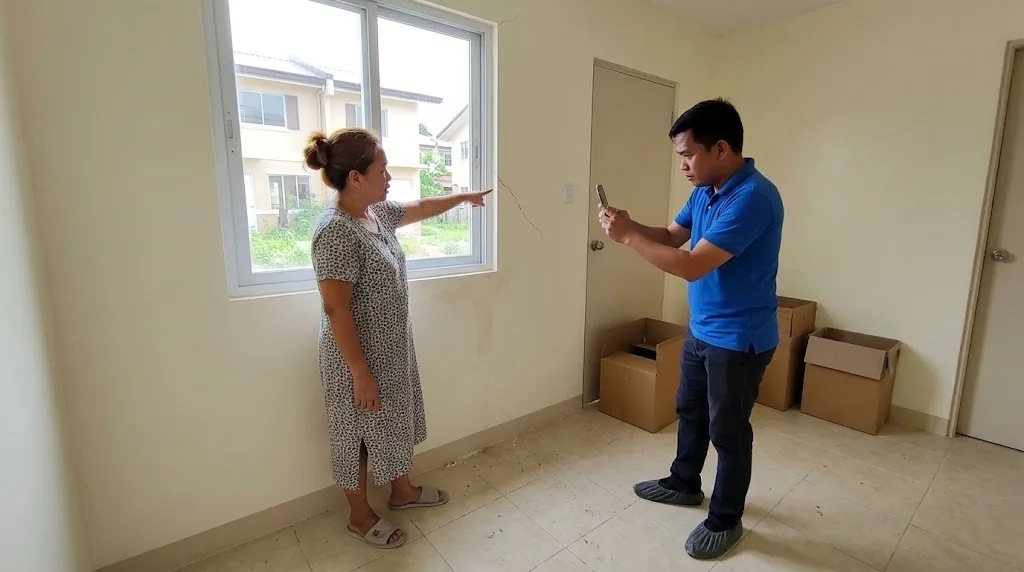
Photograph and date every defect you find after turnover, and send the contractor a written note. Illustrative photo.
🏗️
AEDO Engineering
AEDO Construction OPC, PRC-licensed civil engineers. Articles 1716, 1719 and 1723 are quoted directly from the Civil Code of the Philippines.
Short answer: accepting the finished work does not waive every defect. Civil Code Article 1719 says acceptance relieves the contractor unless the defect was hidden — something an ordinary inspection wouldn't have caught — or you expressly reserved your rights when you signed off. And Article 1716 voids any waiver entirely if the contractor acted fraudulently, such as deliberately concealing a defect they knew about.
What that means in practice: a crack you walked past during the final walkthrough and said nothing about is a hard claim to make later. A waterproofing failure that only showed up as a leak eight months after turnover is a different story.
Free Claimability Checker · By AEDO Construction
Is This Defect Still Claimable?
Answer based on what actually happened at turnover, not what you wish had been documented. The checker applies Civil Code Articles 1716, 1719 and 1723.
What this is and is not. A read of your situation against the Civil Code, not legal advice.
Whether a specific defect counts as "hidden" can turn on facts — how visible it was, what an ordinary inspection
would show — that only your actual documentation can settle.
Want an engineer's read before you send a demand letter? Send photos, the turnover paperwork,
and when the defect appeared.
Get the defect reviewed →
What Acceptance Actually Waives
Article 1719: "Acceptance of the work by the employer relieves the contractor of liability for any defect in the work, unless: (1) the defect is hidden and the employer is not, by his special knowledge, expected to recognize the same; or (2) the employer expressly reserves his rights against the contractor by reason of the defect." Article 1716 adds that any agreement waiving or limiting the contractor's liability is void outright if the contractor acted fraudulently.
Figure: Waived, Claimable, or the 15-Year RuleThe 15-year rule runs on its own track.
A structural collapse from bad materials or construction stays claimable for 15 years, waiver or no waiver.
The 15-Year Rule Is Not a General Defects Warranty
Article 1723 is often mistaken for a blanket 15-year warranty on the whole house. It isn't. It applies specifically if the building collapses within 15 years of completion because of a defect in the plans, the ground, the construction, or the materials used — and it holds regardless of whether you accepted the work. A leaking roof, a hairline plaster crack, or a sticking door is a general defects matter under Articles 1715 and 1719, decided on the hidden-defect and reservation rules above, not the 15-year rule.
Watch the Prescription Clock Too
Separate from what's waived is how long you have to sue. Article 1144 gives 10 years from when the cause of action accrued to bring an action on a written contract — the usual basis for a defects claim outside the 15-year structural rule. A written extrajudicial demand or an acknowledgment from the contractor interrupts that period under Article 1155; silence does not.
Where These Figures Come From
Articles 1716, 1719, 1723, 1144 and 1155 are quoted from the Civil Code of the Philippines (Republic Act No. 386), read directly from the primary text.
Frequently Asked Questions
Can I still claim if I signed a turnover or acceptance certificate?
Sometimes. Civil Code Article 1719 says acceptance relieves the contractor of liability for defects, but not if the defect was hidden and you weren't in a position to recognize it by your own special knowledge, and not if you expressly reserved your rights when you signed. Signing "received in good order" without listing a defect you didn't yet know about does not waive it.
What counts as a hidden defect versus a waived one?
A hidden (latent) defect is one an ordinary inspection at turnover would not have revealed — bad waterproofing under tiles, undersized wiring behind a finished wall, a foundation issue that only shows up after settling. A visible crack or an unfinished paint job you walked past during the walkthrough and didn't flag is generally treated as accepted.
Is there a deadline to file a claim for a construction defect?
For an ordinary breach-of-contract claim on a written construction contract, Article 1144 gives you 10 years from when the cause of action accrued to file in court. That is separate from Article 1723's 15-year rule, which applies specifically to structural collapse caused by defective plans, ground conditions, construction or materials.
Does the 15-year rule cover leaks and cosmetic cracks?
No. Article 1723 is about liability if the building collapses within 15 years of completion due to defects in the plans, the ground, the construction, or the materials used. A leaking roof or a hairline cosmetic crack is a general defects issue under Articles 1715 and 1719, not the 15-year structural rule.
What if the contractor said the turnover was "as-is"?
An "as-is" clause can function as a broad waiver, but Article 1716 makes any waiver void if the contractor acted fraudulently — for example, deliberately concealing a defect they knew about. A vague "as-is" line at turnover does not automatically defeat a hidden-defect claim.
Sources
Statutes used in this guide, read directly from the primary text. Links open in a new tab.
Republic Act No. 386, Civil Code of the Philippines, Lawphil. Article 1716, voiding a fraudulent waiver; Article 1719, acceptance and its hidden-defect/reservation exceptions; Article 1723, the 15-year structural liability rule; Articles 1144 and 1155, the 10-year prescriptive period for a written-contract action and what interrupts it.
Whether a specific defect is "hidden" for Article 1719 purposes depends on the facts of the inspection at turnover; this guide gives the general rule, not a ruling on your specific case.
Get a Post-Turnover Defect Independently Assessed
An engineer's read of the defect, when it likely arose, and where it stands under the Civil Code.
Defect classified: cosmetic, functional, or structural
Assessment of whether it was reasonably discoverable at turnover
Documentation prepared for a demand letter if warranted
Available nationwide; site attendance in Negros Oriental, Cebu, Luzon and NCR