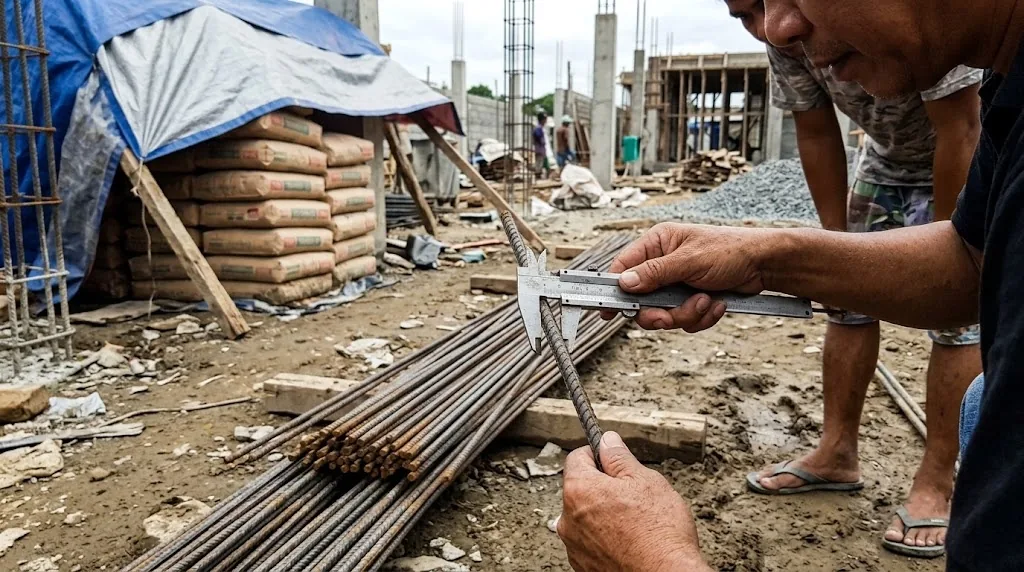
A caliper check on delivered rebar takes a minute and settles a size dispute before anything is poured. Illustrative photo.
🏗️
AEDO Engineering
AEDO Construction OPC, PRC-licensed civil engineers. Articles 1715, 1716 and 1723 are quoted directly from the Civil Code of the Philippines.
Short answer: you can require the contractor to remove the substandard material and redo the work at their own cost — Civil Code Article 1715 gives you that right regardless of what stage the project is at. Signing off on the work, or paying a billing that covered it, does not automatically forgive a material swap you were never told about. If the contractor acted deliberately, Article 1716 voids any waiver outright.
What changes is how hard it is to prove and how expensive it is to fix. A 10mm rebar delivered instead of the 12mm on your plans is easy to catch before it's poured. The same swap discovered a year after the slab is finished needs a different kind of evidence — and possibly destructive testing.
Free Severity Checker · By AEDO Construction
How Strong Is Your Claim?
Answer based on what you can actually show, not what you're confident happened. The checker applies Civil Code Articles 1715, 1716, 1719 and 1723.
What this is and is not. A read of your situation against the Civil Code, not legal advice on
your specific case. Whether a specific swap is "material" enough to matter can turn on facts a checker can't see.
Not sure what was actually delivered? Send the plans, the delivery paperwork and photos, and
we'll tell you what an independent verification can still confirm.
Get the materials reviewed →
What Article 1715 Actually Gives You
The contractor must execute the work "in such a manner that it has the qualities agreed upon and has no defects which destroy or lessen its value or fitness for its ordinary or stipulated use." If it doesn't, you may require the contractor to remove the defect or execute another work. If they fail or refuse, you may have it removed or redone at the contractor's cost.
That right doesn't depend on whether the swap was an honest mistake or deliberate. It only depends on whether the delivered material actually falls short of what was specified.
Figure: Does Acceptance Erase the Claim?Acceptance is not a blank release.
A hidden substitution, or a fraudulent one, survives your sign-off.
If It's Already Covered Up
Photos beat memory. Delivery photos, packaging, invoices and any text exchange naming the brand or size are your strongest evidence once the material is out of sight.
Destructive testing is still an option. A concrete core sample, a cut into a wall, or exposing a section of rebar can confirm what's actually there — at a cost, and usually only worth it for structural elements or a large claim.
Structural elements carry the 15-year rule. If the material is in a column, beam, slab or footing, Article 1723 makes the contractor liable for damages if the building later collapses within 15 years because of inferior materials they furnished — separate from, and on top of, your Article 1715 remedy now.
Beyond a Civil Claim: The PCAB Route
If your contractor holds a PCAB license, a substitution isn't only a matter between the two of you. Section 28 of RA 4566 (the Contractors' License Law) lists willful material and substantial departure from or disregard of plans and specifications, and any willful or fraudulent act causing injury or damage, as grounds to suspend or revoke a contractor's license. Section 29 lets any person file a verified written complaint with the Board — you don't need to already be in litigation to do this.
Where These Figures Come From
Articles 1715, 1716, 1719 and 1723 are quoted from the Civil Code of the Philippines (Republic Act No. 386), read directly from the primary text. Sections 28 and 29 are quoted from RA 4566, the Contractors' License Law.
Frequently Asked Questions
Can I make my contractor redo work done with the wrong materials?
Yes. Civil Code Article 1715 says the contractor must execute the work with the qualities agreed upon and no defects that lessen its value or fitness. If it isn't, you may require the contractor to remove the defect or redo the work, and if they refuse, you may have it removed or redone at their cost.
What if I already accepted and paid for the work?
Acceptance generally relieves the contractor of liability under Article 1719, but not if the defect was hidden and you couldn't reasonably have known about it, and not if you expressly reserved your rights. A material swap you were never told about is exactly the kind of thing acceptance is not supposed to erase — and Article 1716 makes any waiver void outright if the contractor acted fraudulently.
Is swapping materials without telling the owner illegal, or just a contract issue?
It's primarily a civil matter under Articles 1715 and 1716. But if your contractor is PCAB-licensed, a willful, material departure from the plans and specifications is also a ground for suspending or revoking their license under Section 28 of RA 4566, and Section 29 lets any person file a verified written complaint with the Board.
The substandard material is already inside a wall or under a slab. Is it too late?
Not necessarily, but it gets harder and more expensive to prove and to fix. Photos from before it was covered are the strongest evidence; without them you may need destructive testing — a concrete core sample or opening up a section of wall — to confirm what was actually used.
Does this affect the 15-year structural liability rule?
Yes, if the substandard material is in a structural element. Article 1723 makes the contractor liable if a building collapses within 15 years of completion due to defects in construction or the use of inferior-quality materials they furnished — and that liability doesn't depend on whether you accepted the work.
Sources
Statutes used in this guide, read directly from the primary text. Links open in a new tab.
Republic Act No. 386, Civil Code of the Philippines, Lawphil. Article 1715, the contractor's duty to deliver work of the agreed quality and the owner's remedy for defects; Article 1716, voiding a waiver obtained through fraud; Article 1719, acceptance and its hidden-defect exception; Article 1723, the 15-year structural liability rule.
Republic Act No. 4566, the Contractors' License Law, Supreme Court E-Library. Section 28, grounds for suspension or revocation of a contractor's license; Section 29, filing a verified written complaint with the Board.
Where a specific material standard (rebar grade, cement type, block class) is in question, verify it against the PNS/ASTM standard for that product rather than relying on this guide's general legal framework alone.
Get the Materials Independently Verified
An engineer's read of what was delivered against your plans and specifications.
Delivery paperwork and photos checked against the BOQ/plans
Guidance on destructive testing if the material is already covered
Documentation prepared for a PCAB complaint if needed
Available nationwide; site attendance in Negros Oriental, Cebu, Luzon and NCR