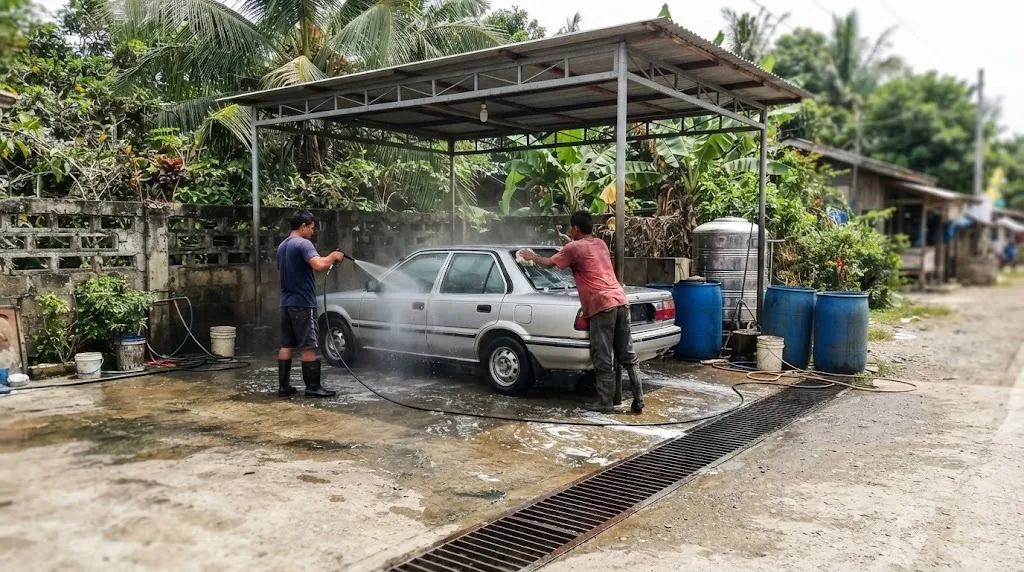
Everything that matters in a car wash happens at floor level: the slope, the trench drain, and where the water goes after it. Illustrative photo.
Short answer: a three-bay hand-wash car wash with a steel canopy, a small office and waiting room, trench drains, a silt and oil interceptor and a modest recycling tank lands around ₱1.6M to ₱2.7M in building works on AEDO's 2026 planning rates. Land and washing equipment are on top of that. The part most owners budget last is the part the government checks first: wash water that leaves your lot is wastewater under the Clean Water Act (RA 9275), it needs a DENR discharge permit, and car washing has its own list of regulated parameters in DAO 2016-08, oil and grease and suspended solids among them.
The calculator turns your bay count and daily car count into a site footprint, a daily water figure, what recycling saves, an interceptor size and a cost band. Then the sections below explain each line.
Water use per car is from the US EPA WaterSense at Work guide. Bay sizes, throughput, interceptor and tank volumes, and every peso figure are AEDO planning estimates, not code values.
No Philippine code tells you how big a wash bay has to be, so anyone quoting you "the standard car wash bay" is quoting habit. What does exist is the car slot in the 2004 Revised IRR of PD 1096, Rule VII Sec. 707(4): an average car parking slot is computed at 2.50 × 5.00 m for perpendicular or diagonal parking. That is a parking dimension, not a wash dimension, and it is too tight to wash in. A washer needs to walk around the car with a wand and a bucket, open the doors to vacuum, and keep overspray off the next bay.
AEDO plans a hand-wash bay at about 4.5 × 8.0 m, which gives roughly 1.3 m of working room either side of an ordinary sedan, and about 5.0 × 10.0 m for an in-bay automatic so the gantry has travel. Those are our planning figures. If you're buying an automatic, the supplier's installation drawing overrides them.
The bays are only part of the lot. Cars queue before the wash and get dried and vacuumed after it, so the layout needs stacking space on both sides. We allow two car slots per bay at the IRR's 2.50 × 5.00 m, plus about 35% for the driveway, turning and apron. A three-bay hand wash ends up needing roughly 250 m² of paved area before you add an office, which surprises most people who pictured three bays and nothing else.
The wash slab does two jobs: carry the cars, and deliver every litre of dirty water to one place. The second job is the one that fails. A flat slab puddles, the washer sprays the puddle around, and the silt ends up in the neighbour's canal.
A car wash canopy is a wide, light roof on a few columns, open on every side. Wind gets under it. That makes uplift, not weight, the design case, and it's the same problem our gas station guide walks through for fuel canopies. The loads come from NSCP 2015 Section 207; our wind load guide shows how the wind zone and exposure change them. The practical consequences are anchor bolts sized for tension, footings heavy enough to hold the canopy down, and roof sheeting fastened for uplift at the edges and corners, where the pressures peak.
Two layout points specific to car washes: leave enough clear height for vans and SUVs with roof racks (AEDO usually plans 3.0 to 3.5 m clear for a hand wash; an automatic gantry sets its own figure), and keep columns out of the washer's walking path around the car. A column in the wrong place gets hit by a reversing car every month.
The most useful per-car numbers we found are from the US EPA's WaterSense at Work guide, Section 5.4 Vehicle Washes (November 2023), which summarises industry field studies:
| Wash type (EPA) | Fresh water per vehicle |
|---|---|
| Self-service, hand-held wand | about 57 L on average |
| In-bay automatic, average (2018 study) | about 170 L |
| In-bay automatic, no reclaim | as much as 280 L |
| In-bay automatic, with reclaim | as little as 72 L |
| Conveyor (tunnel), average fresh water (2018 study) | about 114 L, with reclaimed water on top |
Those are American washes, so read them as a starting point. A Philippine hand wash with a pressure washer behaves most like EPA's hand-held wand category, and your own meter will tell you the real figure within a week of opening.
Recycling is where owners either save a lot or waste money on a filter nobody maintains. EPA's guidance is specific: at a minimum a reclaim system should separate grit, oil and grease, which is enough to reuse water for the underbody and rocker-panel wash; anything used for wax or the final rinse needs reverse osmosis. EPA also notes that reclaim is often not feasible for self-service stalls, because customers dump debris and oil that foul the filters. The economics favour high-volume automatic bays. On a small hand-wash site, get the interceptor right first and treat recycling as the upgrade.
On supply: a car wash drawing its own groundwater is not "domestic use". The Water Code (PD 1067) lets a landowner use groundwater for domestic purposes without a permit (Art. 6), but otherwise no person may appropriate water without a water right evidenced by a water permit (Art. 13). If you plan a well, budget for the permit as well as the drilling. Our deep well guide covers the well itself.
Car wash water carries sand and road grit, oil and fuel residue from underbodies, and soap. Each needs handling in a different place. The grit settles in a silt pit. The oil floats, so a multi-chamber oil and grease separator slows the water down, holds the oil back behind baffles and lets cleaner water out from below. The soap, measured as surfactants, is the one a simple interceptor doesn't remove well, which is one reason to use biodegradable detergents and not overdose them.
We looked for a Philippine primary-source sizing rule for car wash interceptors and did not find one we could read and cite. So the calculator sizes the silt pit and separator together as about one hour of peak-hour flow, with a 1.5 m³ minimum, and it says clearly that this is an AEDO planning estimate. The real sizing belongs in the engineer's report for your discharge permit, which has to state your treatment process and estimated efficiency anyway. The interceptor only works if someone empties it: plan a manhole you can reach, a skimming routine for the oil, and a licensed hauler for the sludge.
Staff and customer toilets go to a septic tank sized under the National Plumbing Code, never into the wash-water interceptor. Mixing them breaks both. See our septic tank sizing guide. DAO 2016-08 adds that domestic sewage of all establishments is monitored for the same parameters as the sewerage sector (PSIC 37000), so it isn't invisible to DENR either.
The legal chain is short and worth knowing before you pour any concrete:
Which limits apply? The Philippine Statistics Authority classifies car washing and auto-detailing services as PSIC subclass 45204, under class 4520 (maintenance and repair of motor vehicles). DAO 2016-08 Table 8 lists the significant effluent parameters for PSIC 452 and 454 as: color, pH, total suspended solids, ammonia, nitrate, nickel, cadmium, mercury, lead, oil and grease, benzo(a)pyrene and surfactants. The limits themselves are in Table 9 and depend on the class of the water body you discharge to:
| DAO 2016-08 Table 9 (maximum) | Class A | Class B | Class C | Class SC |
|---|---|---|---|---|
| Oil and grease, mg/L | 5 | 5 | 5 | 10 |
| Total suspended solids, mg/L | 70 | 85 | 100 | 100 |
| Surfactants (MBAS), mg/L | 2 | 3 | 15 | 15 |
| Color, TCU | 100 | 100 | 150 | 150 |
| pH (range) | 6.0–9.0 | 6.0–9.0 | 6.0–9.5 | 6.0–9.0 |
| Lead, mg/L | 0.02 | 0.02 | 0.1 | 0.1 |
Class AA and Class SA waters carry "NDA", no discharge allowed. DAO 2021-19 later updated six parameters (ammonia, boron, copper, fecal coliform, phosphate and sulfate); ammonia is on the car wash list, so use the 2021 figure for it, which our STP guide covers. Oil and grease, suspended solids, surfactants, color, pH and lead were not touched by the 2021 order.
Notice how tight 5 mg/L of oil and grease is. That is why the separator, the skimming routine and the choice of degreaser matter more than the brand of pressure washer.
AEDO's role on a car wash. Nationwide, AEDO designs the site: bay layout and stacking, the slab falls and trench drains, the canopy for your wind zone, the water supply, and the drainage path through the interceptor, drawn so the building permit set and the discharge permit's engineer's report describe the same system. Outside Negros Oriental we can also provide remote oversight of the contractor you hire locally. In Negros Oriental, AEDO designs and builds it.
The discharge permit runs alongside the usual small-business sequence. The order varies by LGU, so treat this as the list, not the schedule:
Keep the two budgets apart. They are priced differently and bought from different people.
| Building works (AEDO 2026 planning rates) | Rate |
|---|---|
| Wash bay slab with falls and trench drains | ₱2,800–₱4,200 per m² of bay |
| Queue, drying and driveway paving | ₱1,600–₱2,200 per m² |
| Steel canopy over the bays, wind-designed | ₱3,000–₱5,500 per m² of roof |
| Office, waiting room and CR | ₱20,000–₱35,000 per m² |
| Silt pit, oil separator and recycle tank (reinforced concrete) | ₱30,000–₱45,000 per m³ of chamber |
| Water tank, pump and supply piping | ₱80,000–₱180,000 lump sum |
| Outfall line and sampling pit | ₱25,000–₱60,000 lump sum |
| Contingency | 10% |
The paving rate sits a little above the reinforced 150 mm band in our driveway guide, to allow for commercial traffic. The canopy rate sits between a light residential carport (our carport guide quotes ₱1,400–₱2,200 per m² of roof) and a fuel station canopy, because a car wash canopy is higher, wider and more exposed than a house carport. The office rate is the same mid-range commercial fit-out band our laundry shop guide uses.
Equipment is everything you could unbolt and take with you: pressure washers, foam cannons or foam generators, vacuums, air compressors, an automatic gantry if you go that way, and the recycling filter unit. We don't publish peso ranges for it, because the spread between brands and between new and second-hand is wider than any band would be honest about. Get three quotes and enter the total in the calculator. On a hand-wash site the building usually dominates; on an automatic site the gantry alone can outweigh the building.
Discharge permit rules are quoted from RA 9275 Sections 14, 27 and 28 and DAO 2005-10 Rules 14.1, 14.3, 14.4, 14.5 and 14.9. The car wash PSIC code is from the PSA's PSIC listing; its effluent parameters and the Table 9 limits are read from the signed DAO 2016-08, and the scope of DAO 2021-19 from that order's text. Per-car water use and the reclaim guidance are from EPA WaterSense at Work Section 5.4 (2023). The car slot size is from the 2004 Revised IRR of PD 1096, Sec. 707(4); vehicle floor loads from NSCP 2015 §205.3.3; the water permit rule from PD 1067 Articles 6 and 13. Bay dimensions, slab falls, canopy clearances, throughput, interceptor and tank sizing and all peso rates are AEDO planning estimates.
How much does it cost to build a car wash in the Philippines?
On AEDO's 2026 planning rates, a three-bay hand-wash car wash with a steel canopy, a 20 sqm office and waiting room, trench drains, a silt and oil interceptor and a small recycling tank comes to roughly ₱1.6M to ₱2.7M in building works. That excludes the land, the washing equipment (pressure washers, foam units, vacuums, any automatic gantry or recycling filter unit) and permit fees. The building side scales mostly with the number of bays and whether you roof them. The equipment side scales with how automated you go, and it should be priced from supplier quotes, not from a per-sqm rate.
How big should a car wash bay be?
No Philippine code sets a car wash bay size, so this is layout practice, not a rule. AEDO plans a hand-wash bay at about 4.5 by 8.0 metres, which leaves roughly 1.3 metres of working room on each side of an ordinary car, and about 5.0 by 10.0 metres for an in-bay automatic so the gantry can travel. Queue and drying spaces are laid out at the 2.50 by 5.00 metre car slot that the National Building Code IRR uses for perpendicular parking.
Does a car wash need a DENR discharge permit?
If wash water leaves your lot, yes. Section 14 of the Clean Water Act (RA 9275) requires a discharge permit, and Rule 14.1 of its implementing rules (DAO 2005-10) says any person that discharges wastewater into Philippine waters and/or land shall secure a wastewater discharge permit from the EMB Regional Office. The application needs an engineer's report prepared by a registered chemical or sanitary engineer or pollution control officer. The permit is valid for up to five years and is renewable. Discharging without one is a prohibited act under Section 27, with fines of ₱10,000 to ₱200,000 for every day of violation under Section 28.
What effluent limits apply to car wash wastewater?
Car washing is PSIC subclass 45204, which sits under PSIC 452. DAO 2016-08 Table 8 lists the significant parameters for that group as color, pH, total suspended solids, ammonia, nitrate, nickel, cadmium, mercury, lead, oil and grease, benzo(a)pyrene and surfactants. The limits depend on the class of the receiving water body. For a Class C water body, Table 9 sets oil and grease at 5 mg/L, total suspended solids at 100 mg/L, surfactants (MBAS) at 15 mg/L, color at 150 TCU and pH at 6.0 to 9.5. Class AA and SA waters allow no discharge at all. DAO 2021-19 later updated six parameters including ammonia, but not oil and grease, suspended solids, pH or surfactants.
How much water does a car wash use, and is recycling worth it?
The best published per-car figures are American, from the US EPA's WaterSense at Work guide: about 57 litres per vehicle on average for hand-held wand washing, about 170 litres for an in-bay automatic, and up to 280 litres for an in-bay automatic with no reclaim, which a reclaim system can cut to as little as 72 litres. The same guide says a reclaim system should at minimum separate grit, oil and grease. Recycling pays best on high-volume automatic bays. On a small hand-wash bay the bigger win is usually a proper silt and oil interceptor, which you need for the discharge permit anyway.
Statutes, DENR orders, agency classifications and technical guidance read for this article. External links open in a new tab.
Bay dimensions, slab falls, canopy clearances, throughput per bay, interceptor and tank volumes and all peso rates are AEDO's own planning estimates, not code values. The DAO 2005-10 permit fees are the 2005 schedule and may since have been revised; confirm with your EMB Regional Office. We found no Philippine primary source for car wash interceptor sizing that we could read and cite, so none is claimed.
Get the bays, the drainage and the interceptor designed together, before the permit offices ask about them.