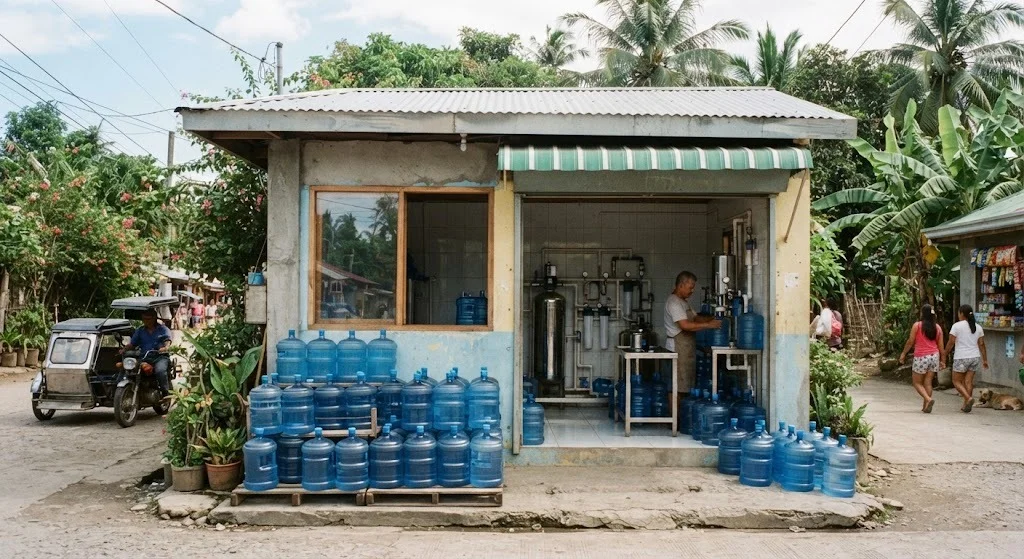
A refilling station needs three separate zones working together — filtration, filling, and storage — not just floor space. Illustrative photo.
Short answer: the fit-out construction for a water refilling station — the structure, filtration/RO equipment room, bottle-washing and filling area, storage, drainage and the electrical load for pumps and UV sterilizers — typically runs ₱28,000-₱65,000 per sqm in 2026, depending mainly on how many treatment lines you run and how automated the filling process is. That's the construction cost only; the RO/filtration machinery itself, storage tanks, and any delivery vehicles are equipment and business costs quoted separately. A small single-line starter station around 20 sqm commonly lands near ₱560,000-₱760,000 in fit-out cost; a 45 sqm full-service setup with multiple lines can run ₱2.16M-₱2.93M.
Most water refilling station guides online talk about the business side — franchise fees, RO machine brands, profit margins — and almost nothing about what the physical structure itself actually needs to cost and comply with. That gap matters, because a water refilling station is one of the few small businesses where the local health office, not just the building official, decides whether you're allowed to open. This guide covers both: the construction number, and the sanitary permit requirements that construction has to be built around from day one.
Enter your planned floor area and pick a capacity tier. This gives a construction/fit-out cost range broken into the major components — it excludes the RO/filtration machinery, storage tanks, delivery vehicles, and business registration fees.
At 15-60 sqm, a water refilling station looks like it should cost about the same as any small commercial space of that size — but it doesn't, because three separate zones have to coexist inside a small footprint and none of them can compromise on the others. The filtration/RO room needs its own plumbing rough-in, backflow prevention, and a floor drain that can handle a tank overflow without flooding the rest of the space. The bottle-washing and filling area needs stainless or tiled washable surfaces, its own floor drain sloped correctly, and enough electrical capacity for pumps, a UV sterilizer, and often an ozone generator running at the same time. Clean-container storage needs to stay dry and out of direct sun. Cram all three into a space sized like a sari-sari store and one of them loses — usually drainage, which is exactly the corner an inspector will flag first.
These per-sqm rates sit above AEDO's published sari-sari/small-retail range (₱16,000-₱38,000/sqm in our sari-sari store cost guide) because a refilling station carries plumbing, drainage, and dedicated electrical load a generic retail shell doesn't need — closer in character to the wet-area-heavy end of AEDO's commercial kitchen fit-out guide, capped below its top end since a refilling station doesn't need cooking-line ventilation or grease trapping.
Water refilling stations in the Philippines are regulated primarily under the DOH Supplemental Implementing Rules and Regulations of Chapter II ("Water Supply") of the Code on Sanitation of the Philippines (Presidential Decree No. 856), issued June 25, 1999. Your City or Municipal Health Office is the one that actually issues the Sanitary Permit, after inspecting the station against this regulation — the headline requirements are:
| Requirement | What the rule says |
|---|---|
| Distance from pollution sources | The station must be located at least 25 meters from direct sources of pollution (Sec. 4.2.1(b)) |
| Water quality testing | Bacteriological testing at least monthly; physical and chemical testing at least every six months; biological testing at least once a year (Sec. 8.1.1) |
| Operator certification | At least one plant operator must complete a 40-hour basic certification course covering water treatment, sanitary chemistry, and public health engineering; other staff need a shorter water-sanitation orientation before their health certificate is issued (Sec. 9.5.1) |
| Tank cleaning | Storage tanks cleaned and sanitized at least once a month; containers sanitized with an approved chlorine solution (Sec. 4.4.2, 4.4.4) |
| Container holding time & conditions | Refilled containers awaiting delivery held no more than 24 hours, at controlled cool-room temperature, off the floor on a raised platform (Sec. 4.4.4) |
These are the requirements as written in the primary regulation — but sanitary permitting in the Philippines is administered locally, and your City or Municipal Health Office may add site-specific conditions or documentation on top of this baseline. Confirm the current checklist with them directly before you finalize your layout, not after.
Designing the space first, buying the RO equipment second. Backflow prevention, floor drain placement, and electrical circuit sizing all depend on the specific RO/filtration equipment's plumbing connections and motor loads — locking the layout before the equipment spec is chosen is one of the most common reasons a station fails its first Sanitary Permit inspection and needs rework.
The Sanitary Permit is separate from — and typically a prerequisite alongside — the general business registration sequence every small business in the Philippines goes through:
The sequence above reflects the typical logic most Philippine LGUs follow, but the exact order and document checklist for the Sanitary Permit and Mayor's Permit differ from city to city and municipality to municipality. Confirm the current requirements and sequence with your own City or Municipal Health Office and Business Permits and Licensing Office before you file — don't assume this article's order matches your LGU's process exactly.
AEDO's role outside Negros Oriental. Nationwide, AEDO designs a water refilling station — structural, electrical, drainage and layout, sized to your specific RO equipment — and provides remote oversight of a contractor the client hires locally. In Negros Oriental, AEDO designs and builds it directly.
How much does it cost to build a water refilling station in the Philippines?
Fit-out construction (structure, filtration room, bottle-washing and filling area, storage, and electrical) for a water refilling station typically runs ₱28,000-₱38,000 per sqm for a starter single-RO-line setup, ₱38,000-₱50,000 per sqm for a standard tier with UV/ozone treatment and semi-automatic filling, and ₱48,000-₱65,000 per sqm for a full-service tier with multiple lines and automated filling. This excludes the RO/filtration machinery, tanks, and delivery vehicles, which are equipment and business costs quoted separately from the structure itself. A basic 20 sqm starter station commonly lands around ₱560,000-₱760,000 in fit-out cost; a 45 sqm full-service station can run ₱2.16M-₱2.93M.
What sanitary permit requirements apply to a water refilling station in the Philippines?
Water refilling stations are regulated under the DOH's Supplemental Implementing Rules and Regulations of Chapter II (Water Supply) of the Code on Sanitation of the Philippines (PD 856), issued June 25, 1999. Key requirements include locating the station at least 25 meters from direct sources of pollution, monthly bacteriological testing and testing every six months for physical and chemical parameters, at least one certified operator who has completed a DOH-recognized 40-hour water refilling station course, monthly cleaning and sanitizing of storage tanks, and refilled containers held no longer than 24 hours at controlled temperature before delivery. Your City or Municipal Health Office issues the actual Sanitary Permit after inspecting against these requirements — confirm the current local checklist with them before applying, since some LGUs add their own local requirements.
Do I still need a business permit and DTI registration for a water refilling station?
Yes, both are separate from the Sanitary Permit and the building permit. DTI business name registration (under Act No. 3883, the Business Name Law) is required if you operate under a name other than your own legal name, and a barangay clearance plus a Mayor's/Business Permit from your LGU is required to operate. Most LGUs require the Sanitary Permit to be secured before or alongside the Mayor's Permit application, but the exact sequence and document checklist vary by city or municipality, so confirm the order with your local Business Permits and Licensing Office.
How big does a water refilling station need to be?
There's no single fixed minimum floor area set by national regulation, but a functional layout needs separate zones for the filtration/RO equipment, the bottle washing and filling area, and clean-container storage, plus clearance for a delivery vehicle to load and unload. In practice, a single-line starter setup fits in as little as 15-18 sqm, while a station running multiple RO lines with automated filling and a dedicated delivery bay typically needs 40-60 sqm or more.
Does AEDO build water refilling stations outside Negros Oriental?
AEDO designs and builds water refilling stations directly in Negros Oriental. Outside that province, AEDO provides the structural, electrical, and layout design package and remote oversight of a contractor the client hires locally, rather than self-performing the construction.
Statutes, official regulations and AEDO's own published cost guides referred to in this article. External links open in a new tab.
Sanitary Permit checklists and their exact sequence relative to the business/mayor's permit vary by LGU — confirm current requirements with your City or Municipal Health Office and Business Permits and Licensing Office before filing.
Get a layout and structural/electrical design sized to your actual RO equipment, with the drainage and sanitary provisions your Health Office inspection will check.