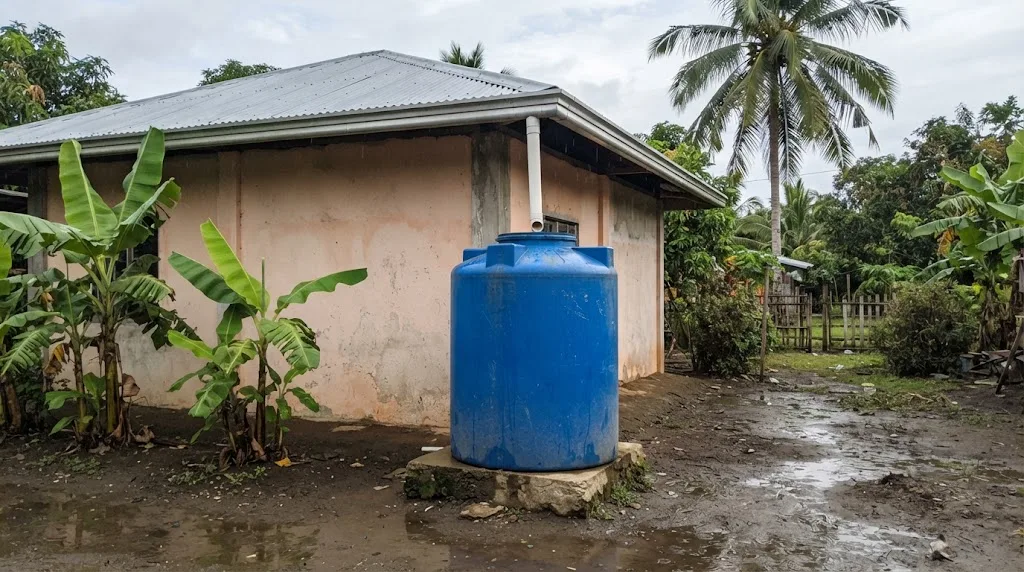
The roof does the collecting. The gutter, the first-flush diverter and the tank decide how much of it you actually keep. Illustrative photo.
Short answer: your roof catches far more rain in a year than most households use. The problem is timing. In Dumaguete, PAGASA's normals put April at 49.1 mm of rain against 158.6 mm in October, so a tank that looks huge in the rainy months can run dry in the months you'd lean on it most. Size the tank for the dry months, and keep the water for flushing, laundry, cleaning and plants unless you treat and test it.
The calculator below runs a month-by-month water balance for your roof, your daily use and your tank, then prices the gutters, first-flush diverter, tank and fittings.
The basic arithmetic is simple. One millimeter of rain falling on one square meter of roof is one liter of water. Multiply your roof area by the rainfall in millimeters and you have the liters that land on it.
You won't keep all of it. The Texas Water Development Board's Texas Manual on Rainwater Harvesting, one of the most widely used design references, lists where it goes: the first flush you divert on purpose, evaporation, splash-out and overshoot from gutters in hard rain, and leaks. It says most installers assume a collection efficiency of 75 to 90 percent. The calculator lets you pick within that band and defaults to 80%. Overflow once the tank is full is a separate loss, and the calculator's water balance counts it on its own.
Two details trip people up:
PAGASA publishes climatological normals for its synoptic stations. The nearest one to most of Negros Oriental is Dumaguete City. These are the 1991-2020 monthly rainfall normals the calculator uses by default:
| Month | Rain (mm) | Rainy days | Month | Rain (mm) | Rainy days |
|---|---|---|---|---|---|
| Jan | 96.7 | 11 | Jul | 146.0 | 14 |
| Feb | 73.7 | 8 | Aug | 104.6 | 11 |
| Mar | 68.2 | 7 | Sep | 116.8 | 12 |
| Apr | 49.1 | 5 | Oct | 158.6 | 13 |
| May | 84.5 | 8 | Nov | 146.4 | 11 |
| Jun | 144.0 | 12 | Dec | 134.0 | 12 |
Annual total 1,322.6 mm over 124 rainy days (PAGASA counts a rainy day as at least 1 mm in the 24 hours from 8 AM). Normals are 30-year averages, not a forecast. A dry year can bring much less, and rain in the hills of Valencia or the uplands above Bais can differ from what falls at the Dumaguete station. If you have a better local figure, type your own annual rainfall into the calculator; it keeps Dumaguete's monthly pattern and scales it, so treat that result as indicative.
The gutter is the part homeowners underbuy. A gutter that's too small, sagging, or clogged with leaves overshoots in heavy downpours, and the TWDB manual lists gutter overshoot among the main losses. Gutters also need a slight fall toward the downspout so water doesn't sit and breed mosquitoes. If your roof already leaks at the eaves or the gutter joints, fix that first; our roof leak repair guide covers the usual culprits.
A leaf screen at the gutter or downspout stops the big debris. The first-flush diverter handles the fine stuff. The TWDB manual describes the simplest version: a PVC standpipe that fills with the first water of each rain, backs up, and lets the rest flow on to the tank. It has to be drained after each rain, usually through a small valve or drip hole at the bottom, or it stops doing its job.
How much to divert? The manual gives a rule of thumb of at least 10 gallons per 1,000 square feet of roof, and mentions recommendations of 1 to 2 gallons per 100 square feet. In metric, that's roughly 0.41 to 0.81 liters per square meter, so about 33 to 65 liters for an 80 sqm roof. Trees over the roof, long dry spells and dusty roads push you toward the higher end.
Whatever the material, the TWDB manual's basics apply: the tank must be opaque to stop algae and covered with screened vents to keep mosquitoes out. If the water is meant for drinking, the manual adds that the tank must be accessible for cleaning and must never have held toxic materials, and being able to get in and clean it is worth having on any tank. Keep it close to where the water is used and, if you can, out of direct sun. An overflow pipe should discharge well away from your footings, not onto the soil right beside the house.
Runs a month-by-month water balance: rain on your roof fills the tank, your daily use empties it, anything over capacity overflows. Default rainfall is PAGASA's Dumaguete normal. It's a planning check, not a design.
Take a bungalow with 80 sqm of guttered roof, Dumaguete rainfall, 80% efficiency, and a household that wants 150 liters a day from the tank for flushing, laundry and plants. These are the calculator's default inputs, so you can check every number:
Now the uncomfortable part. Run the same house with only half the normal rain (type 661.3 mm into the calculator) and even the 10,000 liter tank covers just 77.3% of the year. A rainwater tank is a strong second source, not a guarantee. That's why most systems we'd recommend keep a water district connection or a well as the backup. If you're weighing a well, our deep well cost guide covers drilling and the NWRB rules.
| Above-ground poly tank | Underground RC or ferrocement cistern | |
|---|---|---|
| Cost per liter | ₱6-10 (AEDO market estimate, 2026) | ₱15-25 including excavation (AEDO market estimate, 2026) |
| Space | Uses yard space; 5,000 L and up gets tall and wide | Under a driveway, garden or carport |
| Getting water out | Tap at the base for the garden; a pump or a raised base for toilets | Always needs a pump |
| Inspection | Easy: you can see leaks and the outside | Needs a manhole; cracks are hidden |
| Engineering | A level, firm base that carries the full weight (1,000 L of water is about 1 tonne) | Walls, slab and cover designed for soil and water pressure, plus any vehicle load on top |
For most houses, a poly tank wins on cost and simplicity. Buy one sold as opaque. The TWDB manual also notes that standard polypropylene tanks must be installed above ground; burying one needs a specially reinforced tank. Underground concrete makes sense when you need a lot of storage on a small lot. The manual warns that concrete tanks can crack and leak, especially underground in clay soil. It calls a structural engineer highly recommended for a poured-in-place concrete cistern and encourages one for ferrocement tanks too.
Raising a tank so it gravity-feeds your toilets means a tank stand, and a full tank is heavy. A 5,000 liter tank holds about 5 tonnes of water. Our elevated water tank tower guide covers what that stand needs. If you'd rather keep the tank on the ground and pump, see water pressure pumps for houses.
Rainwater is excellent for toilet flushing, laundry, washing floors and cars, and watering plants. Those uses don't need drinking-quality water, and they're a big share of what a household runs through.
Drinking is different. A roof collects dust, leaves, pollen, and bird and rodent droppings. The first-flush diverter and screens reduce that but don't make the water safe. The TWDB manual says potable systems need treatment beyond the leaf screen and roof washer, generally filtration and disinfection in series; its common setup is a 5-micron sediment cartridge, a 3-micron activated carbon cartridge, then ultraviolet light, with cartridges replaced regularly so they don't grow bacteria themselves.
In the Philippines, drinking water quality is measured against the Philippine National Standards for Drinking Water of 2017 (DOH Administrative Order No. 2017-0010). If treated rainwater is going to a drinking tap, have it tested against that standard, and test again periodically.
One more rule if the house also has a water district line: never connect the rainwater piping directly to the potable supply. The TWDB manual says a house that tops up its rainwater system from a public supply needs a backflow prevention device so tank water can't be drawn back into the utility's pipes, and the Portland, Oregon code it cites also requires an air gap. In practice, if you top the tank up from the water district line, keep an air gap: the fill pipe should end above the tank's overflow level, never below the water. That last detail is standard plumbing practice, not a figure from the manual. Tying the tank into the house pipes falls under the plumbing code; see our National Plumbing Code guide for when a master plumber's permit applies.
Rainwater and dengue. An open drum under the downspout is a mosquito nursery. Every opening in the system, the tank inlet, vents, the overflow outlet and the first-flush drain, should be screened or sealed, and gutters should drain completely between rains. If you can see wrigglers in stored water, the system isn't sealed.
Republic Act No. 6716, approved on March 17, 1989, is titled "An Act Providing for the Construction of Water Wells, Rainwater Collectors, Development of Springs and Rehabilitation of Existing Water Wells in All Barangays in the Philippines". What it does:
So RA 6716 doesn't require you to put a tank on your house, and it isn't a subsidy you can apply for as a household. Where it matters to a homeowner is at barangay level: if your barangay has, or wants, a communal rain collector, the Act is the legal basis for who builds it and who maintains it.
Article 6 of the Water Code (PD 1067) lists "rain water falling on such lands" among the waters on private land that belong to the State. The same Article says the landowner "may use the same for domestic purposes without securing a permit, provided that such use shall be registered, when required by the Council." The Council can still regulate that use when water is being wasted or in an emergency. Article 7 adds that anyone who collects water in cisterns, tanks or pools has exclusive control over that water. For a household collecting its own roof water for its own use, that means no water permit.
The Philippine Green Building Code (June 2015, a referral code of PD 1096) does make rainwater harvesting mandatory. Section 11.2.1 says rainwater from roofs and hardscape "must be collected and reused for non-potable purposes", sets the minimum storage tank in cubic meters as the building footprint area divided by 75, limits use to non-potable purposes such as toilet flushing, irrigation and cooling towers, and allows no exceptions.
But Section 8.1 and Table 1 limit the whole Code to new construction or alteration of specific building types above a minimum total gross floor area: residential condominiums of 20,000 sqm, malls of 15,000 sqm, and hotels or resorts, schools, hospitals, offices and mixed-occupancy buildings of 10,000 sqm. A house isn't covered. For comparison only, the formula would give an 80 sqm footprint a 1.07 cubic meter (about 1,067 liter) tank, which is small next to what the water balance above says a household actually needs to ride through April.
Check locally as well. Cities and municipalities can pass their own green building or water ordinances, and those can reach smaller buildings than the national Code does. The zoning or building official's office will know.
When to bring in an engineer. A 1,000 liter tank at the downspout is a weekend job. Bring in an engineer when the tank is going on a raised stand or a roof deck, when you're building an underground cistern, when the tank ties into the house plumbing or a pump, or when the water is meant for drinking. Those are the setups where weight, wall pressure, cross-connection or water quality can go wrong. Our water tank and cistern sizing calculator is the companion tool for sizing storage from household demand.
How big should my rainwater tank be?
Size it for your driest month, not your yearly total. Every 1 mm of rain on 1 square meter of roof is 1 liter of water before losses. An 80 sqm roof in Dumaguete, using PAGASA's 1,322.6 mm annual normal and 80% collection efficiency, catches about 84,646 liters a year, but only about 3,142 liters in April, the driest month. At 150 liters a day, our month-by-month calculator shows a 5,000 liter tank covers 98.2% of the year's use and runs short in April, while a 10,000 liter tank covers all of it. With the 5,000 liter tank, the most that roof can supply every month is about 133 liters a day.
Can we drink harvested rainwater?
Not straight from the tank. Roofs collect dust, leaves and bird and animal droppings, and a first-flush diverter and leaf screen only reduce that. The Texas Water Development Board's rainwater manual says potable systems need treatment beyond the leaf screen and roof washer, usually filtration and disinfection in series. In the Philippines, drinking water is judged against the Philippine National Standards for Drinking Water of 2017 (DOH Administrative Order No. 2017-0010), so have treated rainwater tested before the family drinks it. For most houses, the sensible use is non-potable: toilet flushing, laundry, cleaning and the garden.
Does the law require a rainwater harvesting system for a house?
Not at the national level. RA 6716 (1989) directs the DPWH to build water wells, rainwater collectors and spring developments in barangays, maintained by a Barangay Waterworks and Sanitation Association; it puts no duty on private homeowners. The Philippine Green Building Code does require rainwater harvesting, with a minimum tank of the building footprint area divided by 75 in cubic meters, but only for the building types and sizes in its Table 1, such as condominiums of at least 20,000 sqm and offices, hotels, schools and hospitals of at least 10,000 sqm. A single house is not on that list. Under Article 6 of the Water Code, rain falling on private land belongs to the State, but the landowner may use it for domestic purposes without a permit, provided the use is registered when the Council requires it. Check your city or municipality too, since a local ordinance can add its own rules.
How much does a rainwater harvesting system cost in the Philippines?
For an 80 sqm roof with 20 meters of gutter and a 5,000 liter above-ground poly tank, our calculator gives about ₱49,500 to ₱94,000: gutters and downspouts ₱9,000 to ₱18,000, first-flush diverter and leaf screen ₱2,500 to ₱6,000, the tank ₱30,000 to ₱50,000, and the base, overflow, screens and fittings ₱8,000 to ₱20,000. With a 10,000 liter tank the range is ₱79,500 to ₱144,000. A pump, an underground cistern or filters and UV for drinking use add to that. All of these rates are AEDO market estimates for 2026, so get local quotes before committing.
Should I use a poly tank or an underground concrete cistern?
For most houses, an above-ground poly tank is cheaper, faster to install and easy to inspect. Pick one made of opaque plastic, since the Texas rainwater manual notes tanks must be opaque to stop algae, and keep it covered with screened vents against mosquitoes. An underground reinforced concrete or ferrocement cistern makes sense when you need a large volume on a tight lot, but it costs more per liter because of excavation, it always needs a pump, and its walls and slab should be designed by an engineer. Concrete tanks can crack and leak, especially underground in clay soil.
Primary legal texts and official data first, then the design reference and AEDO's own guides. External links open in a new tab.
AEDO market estimates, 2026, not figures from a published price list: gutter and downspouts ₱450-900/m installed; first-flush diverter and leaf screen ₱2,500-6,000; above-ground poly tank ₱6-10 per liter; underground RC or ferrocement cistern ₱15-25 per liter including excavation; tank base, overflow, screens and fittings ₱8,000-20,000; small pressure pump and controls ₱10,000-20,000; cartridge filters and UV unit ₱15,000-35,000. They move with supplier, brand, site access and soil, so treat the calculator output as a planning range and get local quotes.
A licensed engineer sizes the tank against your roof and your real daily use, designs the stand or cistern for the weight it carries, and keeps the rainwater piping safely separate from your drinking supply.