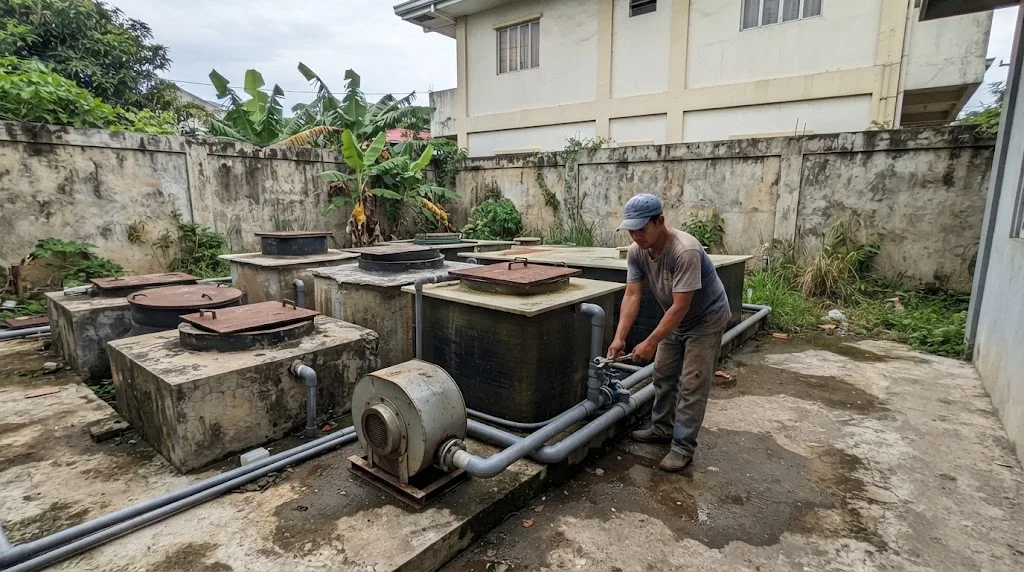
A building-scale STP is a small process plant with tanks, blowers, pumps and a monitoring obligation — not a bigger septic tank. Illustrative photo.
Short answer: a septic tank disposes of sewage into the ground on your own lot. A sewage treatment plant treats it to a standard and discharges it — to a creek, river, sea or sewer — and the moment you do that, you are a point source under the Philippine Clean Water Act (RA 9275). That means a permit to discharge under Section 14, effluent that meets the DENR General Effluent Standards, quarterly monitoring, and fines under Section 28 of ₱10,000 to ₱200,000 for every day of violation. Most developers discover this after the building is designed, when there is no space left for the plant.
This guide covers the two questions that actually decide your budget: do you need an STP at all, and how big is it. The calculator below turns your building's water demand into a design flow, tank volumes, a footprint and a cost band you can put in a feasibility study.
Enter what the building is and how many people or units it serves. You get an average and peak design flow, indicative tank volumes, a footprint allowance and a capital cost band — a feasibility number, not a permit-ready design.
A septic tank is a disposal device: solids settle, liquid seeps out through an absorption field into the soil, and nothing is discharged to a water body. It is sized under the National Plumbing Code, Appendix B — Table B-2 by bedroom count or drainage fixture units, Table B-4 by the soil's leaching capacity — which our septic tank sizing guide walks through.
A sewage treatment plant is a treatment device: it produces an effluent that goes somewhere. The moment that effluent leaves your property to a creek, canal, sea or public sewer, three things attach to your project at once:
There is also a connection obligation most people miss. RA 9275 Section 8 directs water agencies in Metro Manila and highly urbanized cities to connect the existing sewage lines of subdivisions, condominiums, commercial centers, hotels, hospitals, market places, public buildings and industrial complexes — including households — to an available sewerage system; in non-urbanized areas, septage or combined sewerage-septage systems apply instead. Where a public sewer exists, the question is usually not "septic or STP" but "what pre-treatment does the utility require before I connect".
An STP is sized from flow, and flow is sized from water demand. The chain is short and worth understanding before anyone quotes you a plant:
The two mistakes we see repeatedly are sizing the plant on the peak (an oversized plant that never reaches a stable biological load, and costs more to run than to build) and sizing it on the average with no equalization tank (a plant that is hydraulically overwhelmed twice a day and fails its own effluent standard). Both are avoidable at the feasibility stage, which is why the calculator above shows them separately.
An STP needs a footprint, a truck route for desludging, a power supply for blowers and pumps, an odour buffer from occupied areas and access for a sampling point. Retrofitting it into a basement after the structural design is frozen is the single most expensive way to build one — the tanks become deeper, the excavation needs shoring, and the sampling point ends up somewhere the EMB inspector cannot reach. Fix the footprint at schematic design.
The governing instrument is DENR Administrative Order No. 2016-08, the Water Quality Guidelines and General Effluent Standards of 2016. Its Tables 9 and 10 carry the numeric limits, by parameter and by the classification of the receiving water body.
On 20 June 2021 the DENR issued DAO 2021-19, Updated Water Quality Guidelines (WQG) and General Effluent Standards (GES) for Selected Parameters, issued under Sections 19(e) and 19(f) of RA 9275, which require the guidelines and standards to be reviewed every five years. It updates six parameters only: ammonia as NH3-N, boron, copper, fecal coliform, phosphate as phosphorus, and sulfate. Those updated effluent limits are:
| Parameter (GES) | Class A | Class B / SB | Class C / SC | Class D / SD | Class AA / SA |
|---|---|---|---|---|---|
| Ammonia as NH3-N, mg/L | 2 | 3 | 4 | 9 | No discharge allowed |
| Boron, mg/L | 4 | 4 | 4 (SC 25) | 12 (SD 100) | No discharge allowed |
| Total copper, mg/L | 1 | 1 | 1 | 2 | No discharge allowed |
| Fecal coliform, MPN/100 mL | 100 | 200 | 400 | 800 | No discharge allowed |
| Phosphate as phosphorus, mg/L | 1 | 1.5 (SB 2) | 4 | 10 | No discharge allowed |
| Sulfate, mg/L | 500 | 500 | 550 | 1,000 | No discharge allowed |
Source: DENR DAO 2021-19, Tables 1 to 6. Marine classes SA to SD are shown where their value differs from the freshwater class beside it. Sulfate has no recommended value for SA to SD due to natural occurrence in marine and brackish waters.
You will see it written online that the 2021 Order cut the BOD limit. It didn't — BOD is not among its six updated parameters. What it changed for BOD is narrower and stricter: the General Effluent Standard for strong wastewater applies only once the establishment proves its influent data fall within the values in Table 10 of DAO 2016-08 over the last twelve months, with laboratory results from a DENR-recognized environmental laboratory submitted to the EMB Central Office — and only for effluent discharged to Class C, D, SC or SD water bodies. If your consultant is designing to a relaxed "strong wastewater" BOD number without that evidence on file, the relaxation is not yours to use.
What this article does not quote: the numeric BOD, COD, TSS, oil-and-grease, pH and temperature limits in DAO 2016-08 Tables 9 and 10. AEDO could not retrieve a primary copy of that Order while writing this guide, and our standing rule is not to publish a code figure we have not read at source. Get those values from the Order itself or from your EMB regional office — and treat any blog (including this one) quoting them second-hand with suspicion.
Almost every building-scale plant in the Philippines, whatever the vendor calls it, is a variation on the same sequence. Understanding it is how you read a quotation:
There is no published Philippine cost index for building-scale STPs the way there is for concrete or steel, so the bands in the calculator are AEDO's own 2026 planning estimates from packaged-plant and cast-in-place civil-works pricing, expressed per cubic metre per day of rated capacity. They fall as capacity rises, because the fixed cost of blowers, controls and the civil shell spreads across more flow.
The items that turn a "supplied and installed" quotation into a real project cost are almost always the same ones:
AEDO's role on an STP project. Nationwide, AEDO does the feasibility sizing, the civil and structural design of the tanks and enclosure, the coordination between the sanitary, electrical and structural scopes, and the permitting path — then reviews vendor proposals against the flow and effluent standard the project actually has to meet, so you are comparing like with like. In Negros Oriental, AEDO builds the civil works directly.
RA 9275 Sections 8, 14, 19 and 28 are quoted from the statute text. DAO 2021-19's six updated parameters, the strong-wastewater BOD condition and the SEQP modification requirements are quoted from the Order signed 20 June 2021, read in full for this article. DAO 2016-08 is identified as the governing WQG/GES instrument and its Tables 9 and 10 as the location of the full numeric standards — those numbers are deliberately not reproduced here, because a primary copy could not be retrieved. Septic tank sizing references the National Plumbing Code Appendix B. Water demand defaults, return and peaking factors, tank retention times, footprint allowances and all cost bands are AEDO's own planning estimates, not code or published market figures.
Does my building need a sewage treatment plant or is a septic tank enough?
It depends on where the wastewater ends up, not on the building's size alone. A septic tank plus absorption field, sized under the National Plumbing Code Appendix B, handles on-site disposal into the ground. Once treated wastewater is discharged to a water body or to a sewer that leads to one, it becomes a point-source discharge under RA 9275, which means it has to meet the DENR effluent standards and needs a permit to discharge under Section 14. Section 8 also requires establishments in Metro Manila and highly urbanized cities to connect to an available sewerage system, with septage or combined sewerage-septage systems applying in non-urbanized areas. The practical answer for most projects comes from the LGU and the EMB regional office.
How is an STP's design flow calculated?
From the building's water demand. A commonly used planning assumption is that 80 to 90 percent of supplied water returns as wastewater, giving an average daily flow in cubic metres per day. A peaking factor is then applied because a hotel, mall or school does not generate that flow evenly across 24 hours. Average daily flow sizes the plant's rated capacity; peak flow sizes the equalization tank, pumps and hydraulics.
What effluent standards does a Philippine STP have to meet?
The General Effluent Standards in DENR DAO 2016-08, with the applicable column set by the classification of the water body you discharge to. DAO 2021-19, signed 20 June 2021, updated six parameters. For a Class C water body those updated limits are 4 mg/L ammonia, 4 mg/L boron, 1 mg/L total copper, 400 MPN/100 mL fecal coliform, 4 mg/L phosphate and 550 mg/L sulfate. Class AA and SA carry a No Discharge Allowed entry for those parameters.
Did DAO 2021-19 lower the BOD limit for sewage treatment plants?
No. BOD is not one of its six updated parameters. What it added is a condition on the strong-wastewater BOD standard: it applies only once the establishment shows influent data within the values in Table 10 of DAO 2016-08 over the last twelve months, with results from a DENR-recognized laboratory submitted to the EMB Central Office, and only for discharge to Class C, D, SC or SD water bodies.
What are the penalties for discharging untreated sewage?
Under RA 9275 Section 28, not less than ₱10,000 and not more than ₱200,000 for every day of violation; gross violations carry ₱500,000 to ₱3,000,000 per day and imprisonment of six to ten years. The fines run per day, which is why a plant failing its monitoring is an operating problem rather than a one-off penalty.
Statutes, DENR issuances and AEDO's own reference articles used in this guide.
Water demand defaults, the 80–90% return factor, peaking factors, retention times, footprint allowances and all peso figures are AEDO's own planning estimates for feasibility use, not code values or published market rates. Confirm the receiving water body's classification, the ECC/CNC determination and pollution control officer requirements with your EMB regional office before design.
Get the flow, the footprint and the permitting path settled while the architecture can still absorb them.