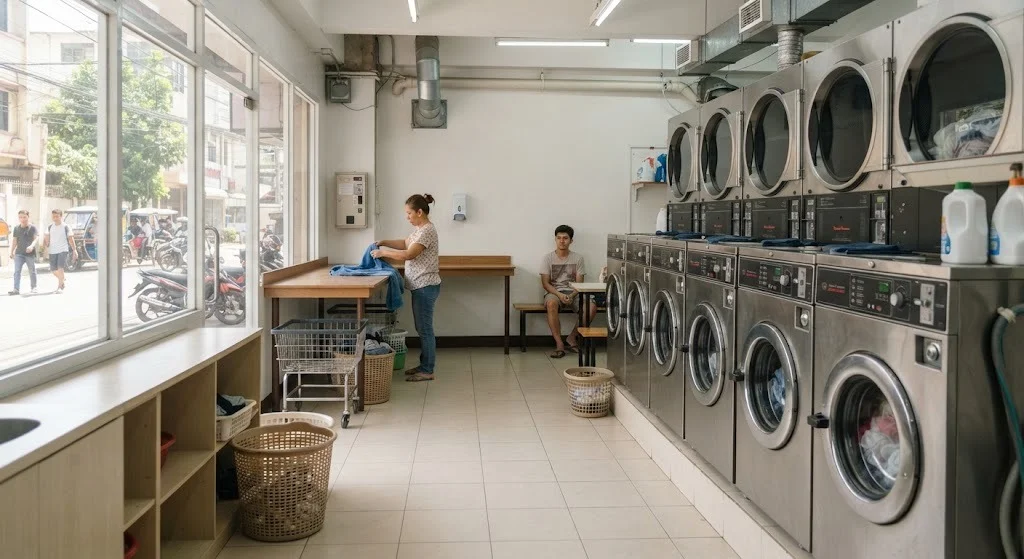
A bank of commercial washers and dryers needs power, water, drainage and floor capacity an ordinary retail unit was never built for. Illustrative photo.
Short answer: a laundry shop or laundromat uses the same published 2026 commercial fit-out bands as any other small commercial space — roughly ₱10,000-₱20,000/sqm basic, ₱20,000-₱35,000 mid-range, ₱35,000-₱45,000+ high-end — but lands 20-30% above that base band because of four building-services loads an ordinary retail shop never carries: a 3-phase electrical service sized for a bank of motors and heating elements, a water supply and drainage system sized for several machines discharging at once, dedicated dryer exhaust venting, and a floor checked for concentrated machine loads rather than just foot traffic. None of those four are cosmetic, and none of them are optional once you're past two or three machines.
Most people costing out a laundromat start from a per-machine sticker price and a rough per-sqm fit-out rate, then get surprised when the electrician quotes a 3-phase service upgrade or the plumber says the existing drain can't take eight machines running at once. This guide walks through why those loads exist, what drives them, and gives you a working number before you sign a lease.
Enter your machine count and floor area. This gives a fit-out cost range plus a first-pass electrical, water and drainage load — a planning number for budgeting and sizing conversations, not a permit-ready design.
The base bands above are the same published 2026 office/commercial fit-out figures AEDO uses across its cost guides, because no market source has published a laundromat-specific rate for the Philippines. What pushes a laundromat above that base isn't the wall finishes or ceiling — it's four systems layered on top that a retail shop selling clothes or snacks never needs at all.
| By finish level | ₱ per sqm |
|---|---|
| Basic / bare shell | 10,000–20,000 |
| Mid-range | 20,000–35,000 |
| High-end / branded | 35,000–45,000+ |
AEDO's own estimate for the laundromat machinery uplift is 20 to 30 percent on top of the base band, to cover the 3-phase service and panel, heavier water and drain rough-in, dedicated dryer venting, and a floor-loading check. That uplift is AEDO's engineering judgement for the added M&E scope, not a cited market figure, and it should be checked against an actual electrical and plumbing take-off once the machine count and layout are fixed.
A single domestic-style washer runs fine on a single-phase outlet. A bank of commercial washers and electric dryers doesn't, because the combined motor and heating load — several kilowatts per machine once you add the water heater or heating element — pushes the total connected load past what a typical single-phase retail service is built to carry. The correct way to size the service is the same kVA-and-demand-factor method AEDO uses in its electrical service sizing guide: total the connected load in kW, convert to kVA against the equipment's power factor, apply a demand factor, then divide by the supply voltage (using √3 for a three-phase system) to get the service current a main breaker and transformer must carry. Standard ampere ratings and transformer sizes then round that current up to the next manufactured size.
The exact per-machine kilowatt figure has to come from your machine's own nameplate or spec sheet — it varies by brand, capacity and whether the dryer heats electrically or by LPG gas with only an electric blower motor. What doesn't vary is the method: this is Philippine Electrical Code sizing practice, applied by a registered electrical practitioner under RA 7920, the same as it would be for any other commercial load.
This is the part most first-time laundromat owners get wrong: they think of "the pipe size" as one number, when the National Plumbing Code sizes both supply and drainage by fixture unit, precisely to handle several fixtures running at once. Under NPC Table 6-5, a laundry tub/clotheswasher carries a Water Supply Fixture Unit (WSFU) value of 2; under NPC Table 7-1 (§705), the same fixture carries a Drainage Fixture Unit (DFU) value of 2, with a minimum trap size of 38-51mm. Add those up for every machine and you get a fixture-unit total — see our national plumbing code guide for how WSFU converts to a demand flow, and our drain pipe sizing guide for how DFU converts to a branch and building drain size under NPC Table 7-5 (§706).
The reason this matters for a laundromat specifically is scale: a home washer's 2 WSFU / 2 DFU sits on a branch designed for a handful of fixtures total. A bank of 8-10 commercial machines can hit 16-20 fixture units on water supply alone, with several machines filling or draining at the same moment during peak hours — exactly the "simultaneous use" case the fixture-unit method exists to handle, just read much higher up the demand curve than a house ever needs to. That branch, main and building drain sizing is your RLMP's calculation to run against the actual fixture-unit total, not something to scale up from a residential rule of thumb.
A commercial kitchen needs a grease trap ahead of the sewer connection; a laundromat's equivalent concern is lint and fine sediment from wash water reaching the drainage line or septic system. Whether your LGU requires a lint trap or interceptor ahead of the building drain is a local sanitary-permit question to confirm with your city or municipal engineer's office before filing — this guide doesn't cite a specific national requirement for it because none of the sources checked for this article specify one.
Every dryer — electric or gas-heated — needs its own vented duct run to the exterior, sized and routed per the manufacturer's installation manual, to clear the moist, lint-laden exhaust air the drying cycle produces. In a multi-dryer bank, that means either several independent short duct runs to the outside wall or a properly engineered consolidated exhaust system; running dryer exhaust into a shared duct without engineering it for the combined airflow is a recognized way to get lint buildup, restricted airflow and a fire-risk condition, which is why manufacturers specify it and it's routinely checked at commercial buildout. There's no single Philippine statute cited here for duct sizing specifically — this is manufacturer specification and fire-safety practice, and your mechanical designer should size it against your actual dryer models rather than a generic rule.
A loaded commercial washer or dryer sits on a small footprint of feet or a base frame, concentrating its full weight — plus the dynamic load of a spinning drum — onto a few points on the slab rather than spreading it evenly. NSCP 2015 (National Structural Code of the Philippines, Volume 1, 7th Edition), Chapter 2, Section 205, Table 205-1 already recognizes this distinction: its "Manufacturing" occupancy rows carry a code-specified concentrated load (9.0 kN light / 13.4 kN heavy) in addition to the uniform load (6.0 kPa / 12.0 kPa), precisely because equipment loads a floor at discrete points, not evenly — the same principle AEDO's warehouse racking floor load guide applies to pallet racking. A laundromat isn't a manufacturing occupancy, but a row of heavy-duty machines on a suspended slab, a mezzanine, or an upper floor of a mixed-use building should be checked against a concentrated load at the machine's actual footprint, not just against a general commercial uniform load — this is a structural design check, not a finishing-schedule line item, and it matters most when the shop isn't sitting on slab-on-grade.
AEDO's role, single shop or franchise rollout. Nationwide, AEDO designs the structural, electrical and plumbing scope for a laundry shop — sized to your actual machine count and layout — and coordinates MEPFS design once for a multi-unit or franchise rollout so every branch doesn't repeat the same engineering from scratch. In Negros Oriental, AEDO designs and builds it directly.
A laundromat's permitting follows the same layered sequence as any small commercial fit-out — the specifics of fees and required attachments vary by LGU, so this is the general order to expect rather than a fixed checklist:
Fit-out cost bands are the same published 2026 commercial fit-out figures AEDO cites across its cost guides, used here as a floor for a laundromat. The 20-30% machinery uplift is AEDO's own estimate, not a cited market figure. The 3-phase electrical sizing method follows Philippine Electrical Code practice under RA 7920; WSFU/DFU figures are NPC Tables 6-5 and 7-1 (§705); branch/drain sizing references NPC Table 7-5 (§706); floor concentrated-load figures are NSCP 2015 Table 205-1. Dryer exhaust venting and lint-trap requirements are manufacturer specification and local sanitary-permit practice, not a cited national statute.
How much does it cost to build a laundry shop or laundromat in the Philippines?
Using the same published 2026 commercial fit-out bands AEDO cites for offices and kitchens (roughly ₱10,000-₱20,000/sqm basic, ₱20,000-₱35,000 mid-range, ₱35,000-₱45,000+ high-end), a laundromat lands 20-30% above the base band because of the heavier electrical, water and drainage scope a bank of commercial washers and dryers needs. A 40-60 sqm shop with 6-10 machines commonly ends up in the ₱1M-₱2.5M range once the 3-phase service, plumbing rough-in and floor check are priced in, before the machines themselves.
Does a laundromat need a 3-phase electrical service?
Most commercial washer and electric-dryer models are built for 3-phase supply once you have more than a few units, because the combined motor and heating load pulls more current than a typical single-phase retail service can carry. The exact service size is a kVA and demand-factor calculation done against your actual machine nameplates, following Philippine Electrical Code sizing practice under RA 7920 — not a fixed number that applies to every shop.
Why does a laundromat need special plumbing design, not just a bigger pipe?
The National Plumbing Code sizes both water supply and drainage by fixture unit, not by pipe diameter alone, precisely to handle multiple fixtures running at once. A laundry tub/clotheswasher is rated at 2 Water Supply Fixture Units and 2 Drainage Fixture Units per NPC Tables 6-5 and 7-1 respectively — a bank of 8 machines can run simultaneous cycles that a small residential branch was never sized for, so the branch, main and building drain need to be sized against the total fixture-unit count, not scaled up by guesswork.
Does the floor need special design for a bank of laundry machines?
It should be checked, yes. NSCP 2015 Table 205-1 already treats floors carrying machinery differently from floors carrying people or general storage — its Manufacturing rows carry a code-specified concentrated (point) load in addition to the uniform load, precisely because equipment loads a floor at discrete legs or feet, not evenly. A row of heavy-duty washers and dryers on a suspended slab or an upper floor should be checked against a concentrated load the same way a warehouse floor is checked for pallet racking, not just against a general storage uniform load.
Does AEDO build laundromats outside Negros Oriental?
AEDO designs and builds laundry shops directly in Negros Oriental. Outside that province, AEDO provides the structural, electrical and plumbing design package — including multi-unit or franchise roll-out coordination — with remote oversight of a contractor the client hires locally.
Codes, statutes, published guides and AEDO's own cost/reference articles used in this article. External links open in a new tab.
Fit-out cost bands are the published 2026 commercial fit-out figures AEDO cites across its cost guides, used here as a floor for a laundromat; the machinery uplift percentage is AEDO's own estimate, not a cited market figure. Dryer exhaust venting and lint-trap/interceptor requirements are manufacturer specification and local sanitary-permit practice — no specific national statute is cited for either because none was found to verify one. Confirm LGU-specific fees and requirements with your city or municipal engineer's office before filing.
Get the structural, electrical and plumbing scope sized to your actual machine count before you sign a lease or order equipment.