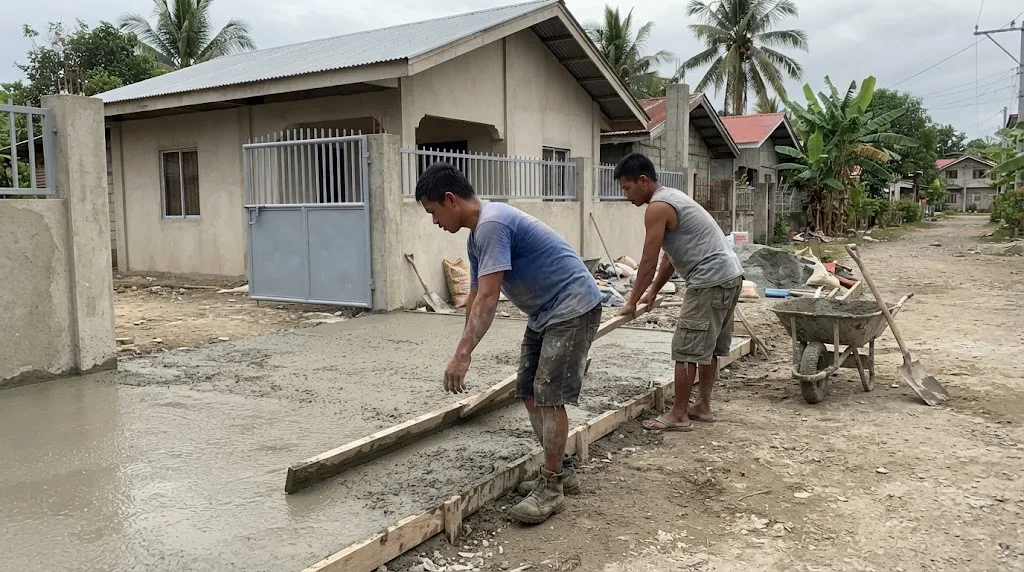
Screeding the pour level against the side forms. Thickness, the gravel bed and the joints you cut later decide how long it lasts. Illustrative photo.
Short answer: a reinforced 150 mm driveway on a gravel bed comes to roughly ₱1,522 to ₱2,106 per sqm in our calculator for a 30 sqm job, and a plain 100 mm garden path about ₱870 to ₱1,308 per sqm. Breaking out an old slab first, or asking for a stamped finish, adds a lot to that.
But the price per sqm matters less than you'd think. A cracked driveway usually isn't a cement problem. More often it cracked because the base was soft, the joints were missing or too far apart, or nobody kept the slab wet for the first week. Those three things cost very little to do right. This guide goes through each one, then the calculator prices your driveway line by line and tells you where the joints go.
There's no Philippine code table that sets the thickness of a private driveway. The National Building Code's driveway rules deal with where a driveway crosses the public sidewalk and how steep the ramp can be, which our driveway ramp slope guide covers. The slab itself is an engineering choice. This is what AEDO specifies as practice:
| Use | Slab (AEDO practice) | Gravel bed | Reinforcement |
|---|---|---|---|
| Garden path, walkway, side passage | 75 to 100 mm | 100 mm | Usually plain |
| Driveway for ordinary cars | 100 mm | 100 mm | 10 mm bars at 300 mm each way |
| SUVs, pickups, garage slab | 150 mm | 100 to 150 mm | 10 mm bars at 300 mm each way |
| Delivery trucks, water tanker, small commercial | Designed, often 200 mm+ | 150 mm+ | Designed |
Why 50 mm makes such a difference: a slab resists bending with its section modulus, and that grows with the square of the thickness. Going from 100 mm to 150 mm multiplies it by (150 ÷ 100)², which is 2.25 times, for only 50% more concrete. That's the cheapest insurance in the whole job. For scale, DPWH Department Order No. 40, Series of 2014 sets a minimum of 280 mm for concrete pavement on arterial and secondary national roads, and DPWH's reinforced pavement pay items under Item 311 (Department Order No. 11, Series of 2025) start at 0.15 m. A home driveway is a much lighter job, but once trucks use it regularly it needs a real pavement design, not a rule of thumb.
A slab on grade is only as good as what's under it. NRMCA's CIP 4, Cracking Concrete Surfaces, puts it plainly: remove all topsoil and soft spots, and compact the soil or granular fill under the slab by rolling, vibrating or tamping. It also lists improper subgrade preparation among the main reasons concrete surfaces crack.
On a typical Negros Oriental lot, that means scraping off the topsoil and any organic fill, compacting the ground, then placing 100 to 150 mm of base course gravel (G1) and compacting it in layers with a plate compactor. Our site development cost guide explains why fill tipped in one lift and simply levelled looks fine on pour day and dishes a year later. If your lot was recently filled, get the fill compacted properly before anyone forms the driveway.
This is where a lot of owners get sold something they don't need, or skip something they do. The honest answer from NRMCA's CIP 4: wire mesh and reinforcement in slabs cannot prevent cracking. What they do, placed at the right level, is keep the cracks that do form tight, so the slab stays in one piece and water and dirt don't get in. CIP 4 asks for at least 50 mm of concrete cover over the steel so rust doesn't spall the surface.
Rebar prices in the calculator come from our steel rebar price guide: about ₱45 to ₱47 per kg for 10 mm bars.
Concrete shrinks as it dries. A 10 m slab with no joints will crack somewhere, usually diagonally and usually right where it looks worst. A joint is a planned weak line, cut or tooled into the surface, so the crack forms in a straight line inside the groove. NRMCA's CIP 6, Joints in Concrete Slabs on Grade, gives the rules most contractors should follow:
For comparison, DPWH Department Order No. 40, Series of 2014 puts contraction joints at every 4.5 m on national road concrete pavement, which lines up with the 4.5 m upper limit above. The calculator below works out the joint count for your slab using the tighter end of the CIP 6 range, 24 times the thickness.
CIP 4 says the slab, and so the subgrade under it, should be sloped for proper drainage. Flat driveways hold puddles, and water that stands against the house wall or runs into the garage becomes a damp problem later. As AEDO practice, we give driveways and paths a fall of about 1 to 2% away from the house, which is 10 to 20 mm for every metre, toward a canal, a grated drain or the lawn. Where the driveway meets the street, the sidewalk crossing and ramp rules in our driveway ramp slope guide apply, and the ramp is not allowed to intrude into the public sidewalk.
Concrete doesn't dry hard; it hardens through a reaction with water. Let the surface dry out in the first days and the top layer stays weak and dusty, and early shrinkage cracks open. NRMCA's CIP 11, Curing In-Place Concrete, says curing should continue as required by the specification or for at least 3 to 7 days, and that concrete in a dry environment can lose as much as 50% of its potential strength compared with moist-cured concrete. CIP 4 asks for at least 3 days of keeping it moist.
On a residential driveway that means one of these, starting as soon as the surface can take it without marking:
As AEDO practice, we keep cars off a normal-mix driveway for at least 7 days. How early a slab can take traffic really depends on the mix, and DPWH's Item 311 reinforced pavement pay items even come in separate 14-day, 7-day and 3-day versions. Our concrete mix ratio guide covers Class A (1:2:4), which the calculator prices and which we use for reinforced driveways, and the leaner Class B that the guide lists for slabs on grade and pathways.
Pouring a new topping over a cracked, sunken old driveway almost always fails, because the new layer cracks along the old cracks within months. If the old slab has settled, it has to come out. That cost is mostly weight: the calculator takes reinforced concrete at about 2.4 tonnes per cubic metre, the figure used in our demolition cost guide, then prices a manual crew and truck trips using that guide's figures. A 100 mm slab is about 0.24 tonnes per sqm, so 30 sqm is over 7 tonnes of debris for a 6-wheeler to haul away.
Enter the size and the build-up. Each row is a separate line item, the total is the exact sum of the rows, and the joint layout follows NRMCA CIP 6. It's a planning range, not a quote.
These all come straight from the calculator above. Small jobs cost more per sqm than the table suggests, because a crew's minimum day and the delivery charge don't shrink with the area. The site-mixed rows cover materials and pour-and-finish labour; if the crew also mixes by hand or rents a mixer, add that.
| Job (from the calculator) | Total | Per sqm |
|---|---|---|
| 10 m x 1 m garden path, 100 mm plain, 100 mm gravel, site-mixed | ₱8,701 - ₱13,080 | ₱870 - ₱1,308 |
| 10 m x 3 m car driveway, 100 mm, bars at 300 mm, 100 mm gravel, site-mixed | ₱34,016 - ₱48,851 | ₱1,134 - ₱1,628 |
| 10 m x 3 m driveway, 150 mm, bars at 300 mm, 100 mm gravel, ready-mix | ₱45,674 - ₱63,179 | ₱1,522 - ₱2,106 |
| Same 150 mm driveway with a stamped finish | ₱62,174 - ₱95,579 | ₱2,072 - ₱3,186 |
| Same 150 mm driveway, breaking out 30 sqm of old 100 mm concrete first | ₱57,515 - ₱82,217 | ₱1,917 - ₱2,741 |
Worked example (from the calculator): a 10 m by 3 m driveway, 150 mm thick, on 100 mm of gravel, with 10 mm bars at 300 mm each way, ready-mix and a broom finish comes to ₱45,674 to ₱63,179. That's 4.73 m³ of concrete at ₱21,263-22,680, concrete labour at ₱6,750-11,250, forms, joints and curing at ₱2,400-4,500, the gravel bed at ₱3,915-6,210, about 136 kg of bars at ₱7,194-8,009, and overhead and profit at ₱4,152-10,530. The joint layout is two transverse joints, giving three panels about 3.33 m long, cut at least 38 mm deep. If an old 100 mm slab has to come out first, add about 7.2 tonnes of break-out at ₱10,764-15,865, which brings the total to ₱57,515 to ₱82,217.
Our site development cost guide uses a broader planning band of ₱1,100 to ₱1,900 per sqm for a reinforced driveway on a base, which overlaps these figures; the 150 mm ready-mix version runs a little above its top end. Land levelling, a drainage canal, a gate and any retaining wall are not included here.
When to call an engineer first. If the driveway sits on recently filled ground, runs down a steep slope, will carry trucks or a water tanker, or passes over a septic tank or a buried pipe, have it checked before the forms go up. Those are the cases where a standard 100 or 150 mm slab isn't enough and the fix is in the base or the design, not the concrete.
How much does a concrete driveway cost per sqm in the Philippines?
In our calculator, a 10 m by 3 m driveway (30 sqm) at 150 mm thick, on 100 mm of gravel, with 10 mm bars at 300 mm each way, ready-mix concrete and a broom finish comes to ₱45,674 to ₱63,179, or about ₱1,522 to ₱2,106 per sqm. A plain 100 mm pathway on gravel using site-mixed concrete works out to about ₱870 to ₱1,308 per sqm. Concrete, aggregate, rebar and labour rates come from AEDO's published 2026 price guides; the forms-and-curing allowance, bar tying labour and contractor overhead and profit are AEDO market estimates.
How thick should a concrete driveway be?
As AEDO practice, 100 mm is enough for a footpath and for ordinary cars on a well-compacted gravel bed, and 150 mm is the better choice for SUVs, pickups, a garage slab, or anywhere a delivery truck may turn in. Going from 100 mm to 150 mm gives the slab 2.25 times the bending capacity, because a slab's section modulus grows with the square of its thickness. Regular truck traffic needs a proper pavement design; for comparison, DPWH Department Order No. 40, Series of 2014 sets a minimum of 280 mm for concrete pavement on arterial and secondary national roads.
How far apart should control joints be in a concrete driveway?
NRMCA's CIP 6, Joints in Concrete Slabs on Grade, says the maximum joint spacing should be 24 to 36 times the slab thickness, with a recommended limit of 4.5 m (15 feet), and panels should be square or nearly so, no longer than 1.5 times their width. For a 100 mm slab that is 2.4 m to 3.6 m, and for a 150 mm slab 3.6 m to 4.5 m. The joint groove should be at least one quarter of the slab thickness deep, and not less than 25 mm.
Does a concrete driveway need wire mesh or rebar?
Reinforcement does not stop a driveway from cracking. NRMCA's CIP 4 says wire mesh and reinforcement in slabs cannot prevent cracking, but placed at the proper location they can reduce crack width, with at least 50 mm of concrete cover. CIP 6 adds that mesh should be cut or discontinued across contraction joints. Joints, a compacted base and proper curing control cracking; the bars or mesh keep the cracks that still form tight. AEDO usually specifies a bar mat for driveways that carry cars and leaves short garden paths plain.
How much does it cost to break out an old concrete driveway?
In our calculator, breaking out 30 sqm of old 100 mm concrete is about 7.2 tonnes of debris and two 6-wheeler trips, which comes to ₱10,764 to ₱15,865 before contractor overhead and profit. That uses the manual demolition productivity, crew cost and ₱3,000 per truck trip default from AEDO's demolition cost guide. A thicker old slab, tight access or a long haul to the dump site pushes it up.
How long should a new concrete driveway be cured before I drive on it?
NRMCA's CIP 11 says curing should continue as required by the specification, or for at least 3 to 7 days, by keeping the surface wet or covered, or with a curing compound. As AEDO practice, keep cars off a normal-mix driveway for at least 7 days and heavier vehicles off longer. How soon a slab can take traffic depends on the mix; DPWH's own pay items for reinforced concrete pavement even come in separate 14-day, 7-day and 3-day versions.
Philippine government issuances first, then industry practice sheets, then AEDO's own price guides. External links open in a new tab.
The forms, joints and curing allowance (₱80-150/sqm), bar cutting and tying labour (₱8-12/kg), stamped finish add-on (₱500-900/sqm) and contractor overhead and profit (10-20%) are AEDO market estimates, not figures from a published price list. The slab thickness table, the 1-2% drainage fall and the 7-day keep-off period are AEDO practice, not code requirements. Prices move with haul distance, site access and your supplier, so treat the calculator output as a planning range.
A licensed engineer looks at the ground, the levels and what will drive on it, then gives you the slab thickness, base, joint layout and drainage fall, with a priced bill of quantities.