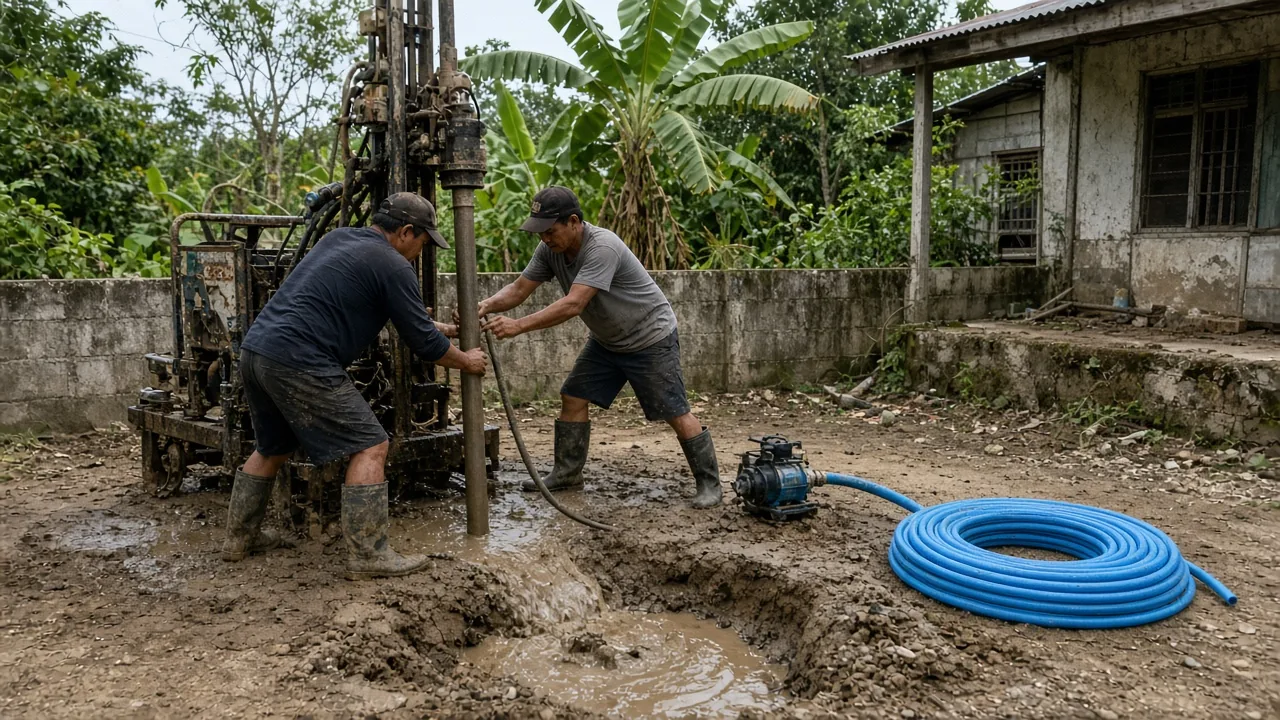
Drilling depth depends on where water is actually found, which is why the final cost moves with the ground. Illustrative photo.
Short answer: a full household deep well system, drilling, casing, submersible pump, elevated tank and tower, plumbing and wiring, commonly lands in the low-to-mid six figures in pesos for a typical Negros Oriental lot, and the single biggest swing factor is depth, which nobody can quote accurately without either drilling a test hole or asking a driller who has already worked near your barangay. Most rural and semi-rural lots in the province have no municipal water line reaching them, so a well isn't optional, it's the water supply.
There's a second thing almost no one budgets for: the Water Code of the Philippines requires groundwater appropriation to go through the National Water Resources Board (NWRB), and while a single household's own well is usually exempt from needing a full water permit, it still has requirements you should know before the rig shows up. We cover that, plus real cost drivers, pump sizing and tank sizing, below.
The stain-on-the-map answer is: depth and geology. Two lots a few hundred meters apart in the same barangay can need very different well depths depending on where the sand or gravel layer sits and whether the shallow water is reliable or seasonal. Drilling contractors price per site rather than off a fixed national rate, which is why you'll see wildly different numbers quoted online. A real example we found: a driller on Siargao Island quoted ₱1,500 per foot (about ₱4,900 per meter) plus a ₱15,000 mobilization fee, reflecting the added cost of moving a rig to an island. That is not a mainland Negros Oriental number, it's one real data point showing how much site access alone moves the price.
Because of all this, treat any drilling cost you see online, including the ranges in the calculator below, as a planning number, not a quote. The only way to get a firm number is a driller who knows your specific barangay, or a test bore.
Enter your household size, how many fixtures typically run at once, your storage preference, and your best estimate of well depth. Each cost row is a straight quantity × rate, and the total is the exact sum of the rows shown.
A household deep well system is really five separate purchases bundled into one project. Understanding each one helps you sanity-check a contractor's quote instead of just comparing bottom-line totals.
Under the Water Code of the Philippines (Presidential Decree No. 1067), all water, surface or underground, belongs to the State, and appropriating it generally requires a water permit from the National Water Resources Board (Article 13). That sounds like it applies to every backyard well, but Article 6 of PD 1067 carves out a specific exemption: a landowner may use groundwater found on their own land for domestic purposes without securing a permit at all, subject only to registration when the Council requires it — no flow-rate condition is written into that Article. NWRB practice, per legal commentary (Respicio & Co.), treats this domestic exemption as covering use up to 5 liters per second; that specific 5 lps figure isn't stated in the Water Code text itself, but a typical household pump draws a small fraction of it anyway, so most homeowners drilling one well for one house fall inside the exemption either way.
Exempt from a permit is not the same as exempt from every requirement. Two things still apply to a household well:
The permit requirement gets real, not theoretical, the moment your well stops being purely single-household: supplying a second household, a small business, an irrigation setup, or drawing at or above NWRB's practical 5 lps domestic-use threshold all push you into needing a full NWRB water permit before drilling, which is a longer process with its own technical requirements on well location, depth and spacing that NWRB has authority to approve or deny.
Practical takeaway. If you're drilling one well for your own single-family home, budget a small registration step with NWRB, not a full permit process, and make sure whoever you hire is an NWRB-registered driller so the paperwork holds up later. If two neighbors want to split the cost of one well, or you're supplying a small sari-sari store or rental units off the same source, check with NWRB before drilling, because that likely needs the full permit.
Tank size and pump size answer two different questions. The tank answers "how much water do we have in reserve if the pump or the power goes out for a while." The pump answers "how fast can we refill that reserve, and can it keep up when two fixtures run at once." Sizing one without the other is how homes end up with a big tank that takes all day to refill, or a strong pump feeding a tank too small to smooth out a power outage.
For tank size, the WHO's water-quantity research treats about 100 liters per person per day as the level associated with low health risk in a house with multiple taps, against 50 liters per person per day as a more basic, still health-adequate level. We looked for a Philippine-specific per-capita figure in the DOH's implementing rules for the Code on Sanitation's water supply chapter and didn't find one stated there, so the WHO figures are the calculator's sourced basis; if your household already knows its actual consumption from a water bill history, use that instead.
For pump sizing, Grundfos's own guidance on domestic groundwater pumps puts it plainly: the pump has to be sized on the flow the household actually needs at the same time, not just averaged over a day, because two bathrooms, a washing machine and a hose running together demand more flow than a single kitchen tap. Franklin Electric's published FPS Series V residential line shows the same flow class sold across a spread of horsepower ratings, because deeper wells need more horsepower to deliver the same flow against more head. That's why the calculator above asks for depth, not just people and fixtures.
| Household scale | Rough daily demand (100 L/person) | Typical reserve tank | Starting pump size |
|---|---|---|---|
| Small household, 3-4 people | 300-400 L | 500-1,000 L | 1/2-3/4 HP for wells under ~60m |
| Average household, 5-6 people | 500-600 L | 1,000-1,500 L | 3/4-1 HP for wells under ~60m |
| Larger household, multi-generation, 7-10 people | 700-1,000 L | 1,500-3,000 L | 1-1.5 HP, more for deeper wells |
Table figures are AEDO planning ranges built on the WHO 100 L/person/day basis and Franklin Electric's published flow/HP classes, not a fixed rule — always confirm final pump selection against your well's measured total dynamic head.
How deep does a deep well need to be in the Philippines?
There's no single number. It depends on where the water-bearing sand or gravel layer sits under your specific lot, which can be 15 meters away from a neighbor's well with a completely different depth. A shallow dug well (poso) might hit usable water at 6-15 meters in some barangays; a mechanically drilled deep well or borehole commonly runs 30-100+ meters where the shallow aquifer is unreliable, seasonal, or contaminated by a septic tank nearby. The only way to know your lot's number is a test bore or a conversation with a licensed well driller who has worked nearby.
How much does it cost to drill a deep well or borehole in the Philippines?
Drilling contractors price per site, not off a published national rate card, because cost swings with depth, soil versus rock, casing diameter and material, and how far the rig has to travel. As an AEDO market estimate for typical soil-to-soft-rock conditions on the mainland, budget roughly ₱1,200-₱2,500 per meter for drilling plus ₱280-₱550 per meter for casing, plus a mobilization fee for the rig, commonly ₱8,000-₱15,000. A real quote we found for island logistics (Siargao) was ₱1,500 per foot (about ₱4,900 per meter) plus a ₱15,000 mobilization fee, which shows how much site access alone can move the number. Treat any of these as a planning range until a local driller quotes your actual lot.
Do I need an NWRB permit to drill a well on my own property?
Usually not a full water permit, but you're not automatically off the hook either. Under the Water Code of the Philippines (PD 1067), all water belongs to the State and its appropriation generally needs a permit from the National Water Resources Board (Article 13). Article 6 of the same Code carves out a specific exemption, though: a landowner can use groundwater on their own land for domestic purposes without a permit at all, subject only to registration when NWRB requires it, with no flow-rate condition written into that Article. NWRB practice, per legal commentary, treats this domestic exemption as covering use up to about 5 liters per second, and a typical household well draws nowhere near that anyway, so most homeowners fall under it either way. What the exemption does not remove is registration: NWRB requires the well to be registered, with the driller, depth, casing and pump details on file, and the well should be drilled by an NWRB-registered well driller. If the well will supply more than one household, a business, or irrigation, or if it exceeds that practical 5 lps threshold, a full water permit is required before drilling.
What size submersible pump do I need for a household well?
A submersible pump is sized on two numbers together: the flow rate you need and the total dynamic head the pump has to push against, which is the well depth to the pumping water level plus friction in the rising main plus the height and pressure needed at the tank. Manufacturer data (Franklin Electric's residential FPS Series V line) shows the same flow class, for example 10 GPM, sold across several horsepower ratings from 1/2 HP up to several HP, because the horsepower needed for a given flow rises with depth. As a rough starting point, many single-household wells under about 40-60 meters run on a 1/2-1 HP pump; deeper wells or homes wanting several fixtures running at once often need 1.5-2 HP. Confirm the final selection with your pump supplier or driller using your well's actual depth and pumping water level, not flow rate alone.
How big should my overhead or elevated water tank be?
Size it off your household's daily demand times the number of days of reserve you want, then round up to a tank size actually sold locally. The World Health Organization's water-quantity research (Howard and Bartram) treats 50 liters per person per day as the intermediate service level adequate for health, and about 100 liters per person per day as the optimal level associated with low health risk when a house has multiple taps. A household of 5 at 100 liters per person per day needs about 500 liters a day; a single day of reserve at that rate needs a 500-liter tank, while a 2-3 day reserve, common where power or the pump is less reliable, needs 1,000-1,500 liters. We couldn't find a specific per-capita liters-per-day figure in the Code on Sanitation of the Philippines' DOH implementing rules for water supply, so the WHO figures are the most defensible sourced basis for this kind of planning.
What's the difference between a shallow well (poso) and a deep well or borehole?
A shallow or dug well taps the water table close to the surface, often by hand-digging or a simple bored hole a few meters deep, and it's more exposed to dry-season drops and to contamination from a nearby septic tank or livestock area. A deep well or borehole is mechanically drilled, cased, and screened into a deeper, usually more reliable and better-protected aquifer layer. It costs more to put in but is generally the safer, steadier source for a permanent household supply, which is why most rural Philippine homes moving off a shallow well or a water-delivery truck go straight to a drilled deep well.
Legal, technical and health references used in this article. External links open in a new tab.
Drilling ₱/meter, casing ₱/meter, mobilization fee, submersible pump price by horsepower tier, tank ₱/liter, tower/stand cost and plumbing/electrical allowance in the calculator are AEDO market estimates, not figures from a published price list. They vary by supplier, region and site access — get a local quote before committing.
Get the well, pump, tank and plumbing sized as part of your site development plan, not bolted on after the house is done.