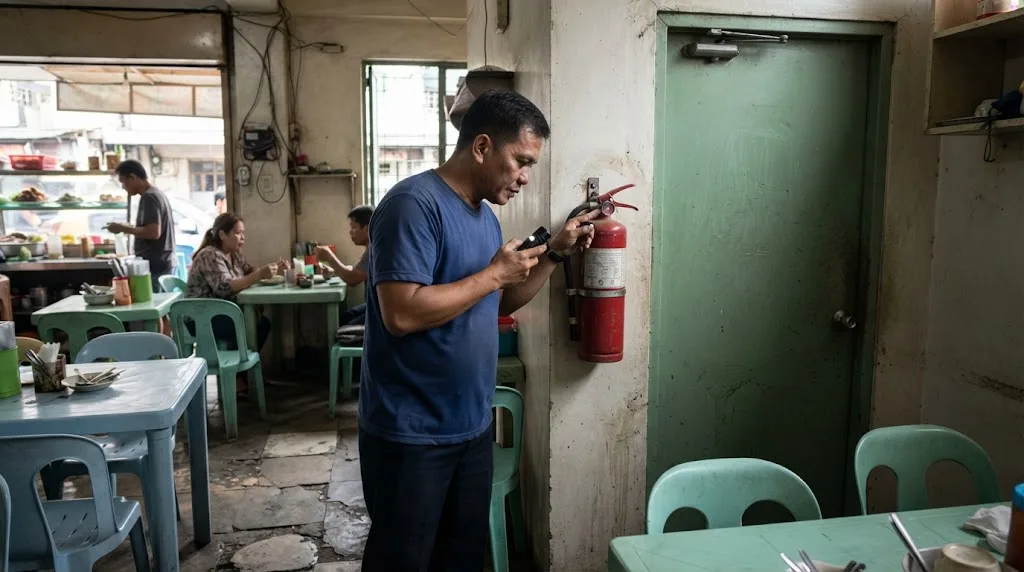
The extinguisher tag and the exit door next to it are two of the first things an inspector looks at. Both are cheap to get right. Illustrative photo.
Short answer: the fire code violations that keep coming up in BFP inspections of small businesses are simple ones. A padlocked or blocked back exit. An extinguisher that's empty, expired or missing. No lit EXIT sign, and in many occupancies no battery emergency light. Extension cords feeding half the counter. An LPG tank sitting right next to the stove. No evacuation plan on the wall. Every one of them traces to a specific line in RA 9514 or its 2019 Revised IRR, and most cost a few thousand pesos to fix. Failing costs more: the IRR's fine schedule puts most of these at ₱37,500 to ₱50,000, capped at ₱50,000 in total, and the end of the road is a closure order and a revoked business permit. For a 120 sqm single-floor eatery with five of the usual gaps (one extinguisher short, no exit signs, octopus wiring, LPG beside the stove, no evacuation plan), our checker puts the corrections at roughly ₱21,600 to ₱65,000 in AEDO 2026 planning figures, plus ₱6,000 to ₱12,000 for battery emergency lights that a small eatery isn't expressly required to have but should.
You aren't fined on the first visit. The IRR gives you a Notice to Comply and a deadline first, so an inspection you're not ready for isn't the end of the world. But the deadlines for the worst items are 24 hours, not two weeks. Run the checker, then read the sections for whatever it flags.
Tick what's already in place. The checker lists the gaps an inspector would likely cite, with the 2019 Revised IRR clause, the correction period and the fine range for each. Correction costs are AEDO 2026 planning ranges, not quotations. The Fire Marshal's own inspection is what counts.
We couldn't find a published BFP ranking of violations, so we won't pretend this list is ranked. These are the items commonly cited against restaurants, shops, clinics, boarding houses and small warehouses, and the reason is simple: they're the things that go wrong in a space after the permit is out. The building gets used, stock piles up, someone plugs in one more fan.
Each one sits on a specific line in the law. The table gives you the line, how long the IRR gives you to fix it after a Notice to Comply (Section 13.0.0.6), and the fine range in the Rule 12 schedule (Section 12.0.0.4 B).
| Violation | Where it's written | Time to correct | Fine range |
|---|---|---|---|
| Exit blocked by stock, tables or boxes | RA 9514 §8(a); RIRR Rule 10 Ch. 2 Div. 2 D | Immediately or 24 hours | ₱37,500–50,000 (item 5.a) |
| Exit padlocked while people are inside | RA 9514 §8(f); RIRR §10.2.5.3 C.1 and H | Immediately or 24 hours | ₱37,500–50,000 (item 5.f) |
| Extinguishers missing, empty or expired | RIRR §10.2.6.9 B and E.2 | 15 days | ₱37,500–50,000 (item 4.a) |
| No lit EXIT signs, or no emergency lights where the occupancy division requires them | RA 9514 §7(d)(11); RIRR §§10.2.5.11, 10.2.5.12 | 15 days | ₱37,500–50,000 (item 4.k) |
| Octopus wiring, jumpers, overloaded circuits | RA 9514 §8(m); RIRR §10.2.7.1 B | Immediately or 24 hours | ₱37,500–50,000 (item 5.m) |
| Unsafe LPG storage or use | RIRR §10.3.7.8; §10.2.7.1 A | Immediately or 24 hours | ₱2,843.20 per litre, max ₱50,000 (item 1.d) |
| No fire alarm where the occupancy needs one | RA 9514 §7(d)(2); occupancy divisions of RIRR Rule 10 | 15 days | ₱37,500–50,000 (item 4.b) |
| No posted evacuation (fire exit) plan | RA 9514 §7(d)(7); RIRR §10.2.5.13 | 15 days | ₱37,500–50,000 (item 4.g) |
| No fire safety program or drills | RIRR Rule 10 Ch. 2 Div. 2 J.1; §10.2.21 | 15 days | No separate line; the schedule's catch-all for similar violations applies |
| Storage in or under the stairs | RA 9514 §8(a); RIRR §10.2.5.4 F.2 | Immediately or 24 hours | ₱37,500–50,000 (item 5.a) |
| Exit door swings the wrong way where it must swing out | RIRR §10.2.5.3 B | Set in the notice, up to 15 days | ₱37,500–50,000 (item 7, inadequate means of egress) |
| Renovated without an FSEC | RIRR Rule 9 Div. 1 C; §9.0.2.2 | Set in the notice | ₱37,500–50,000 (item 8.c) |
| Required signs missing (e.g. FIRE EXIT KEEP DOOR CLOSED, NOT AN EXIT, the occupant-capacity sign in a restaurant of 50 or more) | RIRR §§10.2.5.3 C.3, 10.2.5.12 A.2, 10.2.8.1 E | Set in the notice | ₱12,500–27,500 (item 6) |
Two things in that table surprise most owners. First, the 24-hour items are the cheap ones: clearing a doorway, taking a padlock off, unplugging an extension cord. The IRR treats them as immediate because they're the ones that kill people. Second, the fines don't stack forever. Section 13.0.0.2 A.3 caps the total for several violations at ₱50,000, which is also the ceiling in RA 9514 Section 11. The money isn't really the risk. The closure order is.
This is the one inspectors care about most, and the one owners argue with most ("we lock the back door because of theft"). The rule is flat. RA 9514 Section 8 lists as prohibited acts obstructing exit ways, including aisles, any part of stairways, hallways and corridors leading to an exit (item a), and locking fire exits while people are inside the building (item f). The IRR repeats it in its general requirements: every exit shall provide free and unobstructed egress from all parts of the building at all times, and no lock that would prevent escape from the inside may be installed (Rule 10, Chapter 2, Division 2, item D).
Section 10.2.5.3 C adds that an exit door opens from the inside without a key, tool or special knowledge, with a knob, handle or panic bar obvious even in darkness; paragraph H bans padlocks, hasps, bars and chains on doors that need panic hardware.
For a shop worried about theft: lock from the outside when you close, and use hardware that opens from the inside with one push or turn. And watch the slow creep: the case of drinks by the back door, spare chairs in the corridor, the mop bucket at the stair. Once cited, you get immediately or 24 hours (Section 13.0.0.6 A.1 and A.5).
If the exit itself is the problem (too narrow, too far, only one where you need two), that's a design issue, not housekeeping. Our fire exit and egress guide covers widths, travel distances and how many exits the code wants.
Section 10.2.6.9 of the IRR is the whole rulebook. The parts that get businesses cited:
How many? Paragraph A says the City or Municipal Fire Marshal designates the type and number, so their count is final. For planning, Table 7 in paragraph G gives the Class A spacing:
| Hazard (RIRR §10.2.6.9 C) | Typical spaces named in the IRR | Minimum rating | Max. walk to an extinguisher | Max. floor area per unit |
|---|---|---|---|---|
| Low | Offices, classrooms, assembly halls, hotel guest rooms | 2-A | 15 m | 200 sqm |
| Moderate | Dining areas, mercantile shops and their storage, light manufacturing, parking garages, warehouses of Class I or II commodities | 3-A | 12 m | 100 sqm |
| High | Woodworking, vehicle repair, cooking areas, painting and flammable liquid handling | 4-A | 10 m | 75 sqm |
Two 2-A units hung side by side can stand in for one 3-A or 4-A (Table 7 note). Class B hazards have their own Table 8 (10-B per 100 sqm and 10 m for moderate). Where there's energized equipment, the unit must be listed for Class C (paragraph G.2.d). So a 120 sqm eatery plans on at least two units by floor area, and since the IRR classes cooking areas as high hazard, one of them belongs within easy reach of the stove.
One more thing worth knowing: under the Anti-Red Tape law as amended by RA 11032 (the new Section 12(f) it inserted), BFP officials and employees may not sell, offer to sell or recommend specific brands of extinguishers or other fire safety equipment to an applicant. If someone at inspection pushes a particular supplier, that's the law they're breaking. Buy DTI-marked units from whoever you like.
RA 9514 Section 7(d)(11) requires properly marked and lighted exits with emergency lights to illuminate exit ways during a power failure. The IRR spells it out in two sections.
Exit marking, Section 10.2.5.12. Exits carry a readily visible sign, and the way to an exit is marked wherever the exit isn't immediately visible (A.1), with an EXIT arrow where the direction isn't obvious (A.4). Nothing may block or compete with it (A.3). Signs are lit by a reliable source, the same one as the emergency lighting where that's required (B.1). The word EXIT is at least 150 mm tall with 19 mm strokes (C). A door that looks like an exit but isn't gets a NOT AN EXIT sign (A.2).
Emergency lighting, Section 10.2.5.11 C. It comes on automatically when normal lighting fails, including a tripped breaker (C.5), and holds for at least 1.5 hours (C.2), on proper storage batteries, not dry cells (C.4). The exit path floor is lit to at least 10.7 lux (A.3).
Who needs them? Section 10.2.5.11 C.3 says emergency lighting is provided as specified in each occupancy division. Places of assembly, storage buildings, and Class A and B stores (Section 10.2.15.2 I.2) need it outright. An office, clinic or salon needs it only if the building is two or more storeys above the exit level, or 50 or more people are on a floor above or below it (Section 10.2.16.2 H.2). Small Class C stores and small lodging houses aren't named. Every store still needs exit illumination and signs (I.1), and a windowless shop in a brownout is exactly the case the rule is for, so we'd fit battery units anyway.
EXIT signs are a similar story for small boarding houses: Section 10.2.14.5, for lodging and rooming houses of 15 persons or less, has no exit-sign clause, while hotels, dormitories and apartments do (Sections 10.2.14.3 and 10.2.14.4). The checker shows them as recommended there, not as a violation.
Switch off the lighting breaker. Every EXIT sign should stay lit and every emergency light should come on by itself. Leave it off for 90 minutes once before inspection day. Units that die in 20 minutes have tired batteries, which is the usual failure, and they're cheaper to replace now than to explain later.
Extension cords daisy-chained behind the counter, a triple adapter feeding the chiller, the rice cooker and the phone chargers, a "jumper" bypassing a breaker that kept tripping. RA 9514 Section 8(m) makes it a prohibited act to use jumpers, tamper with wiring, or overload the electrical system beyond its designed capacity. The IRR puts it in the immediately or 24 hours group (Section 13.0.0.6 A.11), and all wiring must follow the latest Philippine Electrical Code (Section 10.2.7.1 B).
The fix isn't a better extension cord. It's more outlets on proper circuits, installed by a licensed electrician, and sometimes a bigger service. A breaker that trips every afternoon is telling you the circuit is loaded past its design, and the jumper that "fixed" it just removed the only thing protecting the wire. DOLE also requires an annual electrical inspection of establishments, which our electrical safety inspection guide covers, and a clean electrical report helps on inspection day.
For restaurants this is the one that decides whether the inspector relaxes or starts writing. Gas equipment and piping follow NFPA 54 or NFPA 58 (Section 10.2.7.1 A), and Section 10.3.7.8 adopts both for LPG and adds its own rules. For a building LPG system (paragraph C), pipes may not obstruct entry or exit (C.2) or run near heat (C.4), piping inside commercial units needs gas leak sensors tied to an automatic shut-off (C.5, C.6), and LPG piping is barred from enclosed staircases and protected exit corridors (C.11).
What the IRR text doesn't give is a stove-to-cylinder distance for a small kitchen on one or two 11 kg tanks. That comes through NFPA 58 by reference and your Fire Marshal's reading of it, so we won't quote a number. The direction is clear enough: cylinder away from the burners, ideally outside the kitchen wall in a ventilated enclosure, proper regulator, sound hose, and no spares in the dining area or under a stair. Failing to observe precautions for flammable gases is a 24-hour item (Section 13.0.0.6 A.12.c), and the fine is computed per litre: ₱2,843.20 per litre or less, up to ₱50,000 (Section 12.0.0.4 B.1.d).
Kitchens with a hood and exhaust duct have one more rule. Section 10.2.7.1 C requires cooking equipment to be protected by an automatic kitchen hood fire suppression system under NFPA 96 and NFPA 17A. It exempts restaurants under 50 occupants using outdoor, portable or food-warming-only equipment, and restaurants using small cooking appliances with no hood or exhaust duct. If you have a hood and duct over real cooking, plan on suppression. Our commercial kitchen fit-out guide covers the rest of the kitchen.
The general rule is broad: fire alarm systems shall be provided in every building of such size, arrangement or occupancy to give adequate warning (Rule 10, Chapter 2, Division 2, item G). The occupancy divisions make it specific.
| Your business, as the IRR classes it | Alarm requirement | Clause |
|---|---|---|
| Restaurant with 50 or more occupants (assembly) | Fire alarm with manual initiation; automatic detection above 300 occupants | §10.2.8.8 D.1 |
| Restaurant under 50 occupants, or shop (mercantile), Class A or B | Automatic fire alarm system | §10.2.15.3 C |
| Mercantile Class C: 278 sqm or less, street floor only | No alarm clause in Division 15; the general rule and your Fire Marshal still apply | §10.2.15.1 A; Div. 2 G |
| Office, clinic, salon (business) | Fire alarm system; manual initiation allowed; at minimum a manual system | §10.2.16.3 D.1, D.2, D.4 |
| Boarding house, 15 persons or less (lodging or rooming house) | Manual fire alarm system, plus a single-station smoke or heat detector in each sleeping room | §10.2.14.5 C |
| Warehouse, ordinary or low hazard, 2,000 sqm or less | Manual fire alarm system; above that, automatic detection and alarm | §10.2.18.2 B.1 |
The occupancy class matters here more than anywhere else. Division 3 of Rule 10 puts restaurants of fewer than 50 persons under mercantile, and the assembly factor for a dining room is 1.4 sqm per person (Section 10.2.8.1 B). So 70 sqm of dining is already 50 people and an assembly occupancy. A mercantile store is Class B once it passes 279 sqm or sells from a second floor or mezzanine (Section 10.2.15.1 A). Bigger boarding houses, with more than 15 persons, fall under the dormitory or hotel rules, which ask more. Our boarding house cost guide covers the build side.
Paperwork violations are the easiest to avoid and still common. Three rules:
Keep the drill reports, the evacuation plans, your extinguisher service tags and the fire insurance policy in one folder. The IRR requires owners with fire insurance to submit a certified copy of every policy to the Fire Marshal within 10 days of receiving it (Rule 9, Division 6); a late copy is fined ₱12,500 to ₱27,500 (Section 12.0.0.4 B.8.a).
Door swing. Exit doors are side-hinged or pivoted, and they must swing in the direction of egress travel where they serve a room or area with 50 or more occupants, where they're in an exit enclosure, or where they serve a high hazard area (Section 10.2.5.3 B.1 and B.2). In mercantile buildings, doors at the foot of stairs from upper floors also swing with exit travel (Section 10.2.15.2 H.2). A door opening inward from a busy dining room is the classic case. "Swing of exit door against the flow of travel" is also one of the conditions listed in Section 13.0.0.5 when the Fire Marshal assesses a building as a fire trap. Below 50 occupants on a normal floor, B.1 doesn't require an outward swing, but B.3's general wording gives an inspector room to cite an inward exit door, so the checker only flags it at 50 or more and we'd still re-hang a side exit outward where the wall allows.
Occupant capacity sign. If your restaurant is a place of assembly (50 or more), every room without fixed seats must have its occupant load posted on a durable sign near the main exit (Section 10.2.8.1 E). Missing or inadequate required signage is fined ₱12,500 to ₱27,500 (Section 12.0.0.4 B.6).
Stairs. RA 9514 Section 8(a) names "any part of stairways" in the list of places you can't obstruct. For an enclosed exit stair, the IRR adds that there shall be no enclosed, usable space within the enclosure, including under the stairs, and no open space within it used for anything that could interfere with egress (Section 10.2.5.4 F.2); an exit enclosure is used for nothing but egress (Section 10.2.5.2 B.2). The cabinet under the stair in a two-storey shop is a real finding, not a technicality.
A Fire Safety Evaluation Clearance is issued by the Fire Marshal after reviewing plans, and it's a prerequisite for the building permit (Rule 9, Division 1, item C). During construction, renovation or alteration, the Fire Marshal inspects against the FSEC plans (Section 9.0.2.2). If the space was renovated without it, the fine schedule has its own line: FSEC not secured before construction, ₱37,500 to ₱50,000 (Section 12.0.0.4 B.8.c).
This is the one violation you can't fix in a weekend. It usually means as-built plans, a fire safety review against the current layout and a late permit, which is design work and needs a proper quote. If you're renovating now, get it right before you start; our fit-out permit guide covers the permit side and the fit-out vs renovation guide covers keeping exits open while you work. A change of use (shop to restaurant, office to clinic) is a separate trigger; see our change of occupancy guide.
The legal basis is simple. No Certificate of Occupancy, Business Permit or Permit to Operate is issued without an FSIC from the City or Municipal Fire Marshal (RIRR Rule 9, Division 1, B; Section 9.0.4.1). The paperwork itself follows the BFP Citizen's Charter (Section 9.0.4.2). What the IRR and RA 11032 set:
How each city runs its BOSS varies, and some still schedule a physical inspection for every renewal. Fees are covered in our FSIC guide. Skipping renewal has its own penalty: 50% of the amount due if you're less than a year late, and 100% for each year of default after that (Section 12.0.0.4 B.8.b).
RA 9514 Section 9 sets the sequence and Rule 13 of the IRR fills in the details. The steps, with the IRR's time limits:
Two escape valves. If you've started the work by the re-inspection, the Fire Marshal may accept an Affidavit of Undertaking instead of an NTCV or abatement order, with a completion period of up to 6 months, extendable once by up to 6 more; attach a notarized works contract and signed and sealed plans, specifications and bill of materials where applicable (Section 13.0.0.4 E). And if you think a finding is wrong, a verified protest goes to the Provincial or District Fire Marshal within 5 days of receiving the notice (Section 14.0.0.1 A). Filing it doesn't stop the correction clock unless the higher office orders it (Section 14.0.0.3), and it needs a non-refundable protest fee (Section 14.0.0.1 C).
The fast lane is different. A building with no secondary exit, or with at least five of twelve listed deficiencies (among them insufficient exit width, a padlocked exit, wrong door swing, no emergency lights or lit exit signs, no alarm), can be declared a public nuisance: 15 days to abate if the cost is ₱100,000 or less, 30 days if more, and a FIRETRAP sign after 5 days of non-compliance (Section 13.0.0.5; RA 9514 Section 9).
The schedule is in Section 12.0.0.4 B of the IRR, and the table in section 1 already gives the line for each common violation. Most building items (fire protection equipment, alarms, exit plans, lit exits, blocked or locked exits, wiring, means of egress, a missing FSEC) sit at ₱37,500 to ₱50,000. Missing signage and a late fire insurance copy are ₱12,500 to ₱27,500 (items 6 and 8.a). Hot work without safety measures is ₱2,843.20 to ₱28,432 (item 2.a), and LPG and other flammable gases are fined per litre (item 1.d).
How they're applied is in Section 13.0.0.2. For a range, the first violation (at the NTCV stage) is charged the minimum and the second (at the abatement order stage) the maximum. Several offenses are added up, but the total shall not exceed ₱50,000. Not paying within the period in the notice is itself grounds for a closure order (13.0.0.2 B). Paying doesn't end it either: the fine and closure don't absolve you from correcting the deficiency (Section 13.0.0.7 A.1).
The criminal side is in RA 9514 Section 11 and IRR Section 13.0.0.7 A.2. Wilful failure to correct or abate is punished on conviction by 6 months to 6 years in prison, a fine of up to ₱100,000, or both; for a corporation, its responsible officials. Where a fire causes injury, death or property damage, the violator is also proceeded against under the Revised Penal Code. Maliciously removing a fire hazard or firetrap sign without authority carries 30 days, a fine of up to ₱100,000, or both.
This is the order we'd work in. The first days go to the items that cost nothing and carry 24-hour deadlines; the later days give suppliers time to deliver.
If the checker shows an FSEC problem, an automatic alarm, or kitchen hood suppression, two weeks isn't enough. Start those now; if the Notice to Comply period runs out before they're done, the signed contract and plans are what you attach to an Affidavit of Undertaking at re-inspection (Section 13.0.0.4 E).
AEDO's role in an FSIC Compliance Check. Nationwide, we review your floor plan and photos remotely, mark what's likely to be cited with the clause for each, and prepare the fire safety and permit drawings when a correction needs design work, such as an FSEC for a past renovation, a second exit, or a door or stair change. In Negros Oriental, we walk the space with you and can build the corrections. Fire protection systems themselves, like alarms and sprinklers, are designed under our MEPFS service. For standpipe and fire department connection details, see the plumbing-side reference on npc.aedoconstruction.com.
What are the most common fire code violations in the Philippines?
The ones commonly cited in BFP inspections of small businesses are blocked or padlocked exits, missing, empty or expired fire extinguishers, no lighted EXIT signs or battery emergency lights, octopus wiring and overloaded outlets, LPG cylinders kept beside the stove, no fire alarm where the occupancy needs one, no posted evacuation plan or drill records, storage in stairways, exit doors that swing the wrong way, and renovations done without a Fire Safety Evaluation Clearance. Each maps to a specific provision of RA 9514 or its 2019 Revised IRR. The BFP does not publish a ranking, so treat this as a list of frequent findings, not a statistic.
How do I prepare for a BFP fire safety inspection?
Start two weeks out. Walk every exit route and clear it, remove padlocks from exit doors while you are open, check every extinguisher is charged, tagged and mounted with its top no higher than 1.5 m, test the EXIT signs and emergency lights by switching off the breaker, replace extension-cord wiring with proper outlets, move LPG cylinders away from the stove, post an evacuation plan on each floor, and keep your drill records, fire insurance copy and any FSEC or permits in one folder. The 2019 Revised IRR requires emergency lighting to hold for at least 1.5 hours, so test it for that long.
What happens if my business fails the FSIC inspection?
You are not fined on the first visit. Under Rule 13 of the 2019 Revised IRR, the City or Municipal Fire Marshal issues a Notice to Comply giving up to 15 days to correct, with shorter periods for serious items: blocked or locked exits and overloaded wiring must be fixed immediately or within 24 hours. If the re-inspection still finds the violation, a WARNING: THIS BUILDING/STRUCTURE IS A FIRE HAZARD sign goes up, the fine is imposed and a Notice to Correct Violation gives up to 15 more days. After that comes an Abatement Order, then a Closure Order, which is copied to the Mayor's office for revocation of the business permit.
How much is the fine for a fire code violation in the Philippines?
RA 9514 Section 11 caps the administrative fine at ₱50,000. The 2019 Revised IRR schedule in Section 12.0.0.4 sets ₱37,500 to ₱50,000 for most building violations, including blocked or locked exits, missing fire protection equipment, no fire alarm, and unmarked or unlit exits; ₱12,500 to ₱27,500 for missing required signage; and ₱37,500 to ₱50,000 for building without an FSEC. The first violation is charged at the minimum of the range, the second at the maximum, and the total for several violations is capped at ₱50,000. Wilful failure to correct can lead to 6 months to 6 years in prison or a fine of up to ₱100,000 on conviction.
How many fire extinguishers does my shop or restaurant need?
The City or Municipal Fire Marshal designates the type and number, so their count is final. For planning, Table 7 of the 2019 Revised IRR allows one 3-A extinguisher per 100 sqm with a maximum 12 m walk to reach it in moderate-hazard spaces such as shops, dining areas and warehouses, and one 2-A per 200 sqm with a 15 m walk in low-hazard offices. Cooking areas are high hazard at 75 sqm and 10 m. A 120 sqm single-floor eatery therefore plans on at least two, and it makes sense to hang one near the kitchen.
Laws and implementing rules read for this article. External links open in a new tab.
The BFP does not publish a ranking of violations that we could find, so the list is not ranked. The IRR text we read gives no stove-to-cylinder distance for small LPG installations; that comes through NFPA 58 by reference, so no number is quoted. Correction costs, emergency light counts per floor area, and the dining-area share used for the occupant load are AEDO 2026 planning estimates, not code values or market surveys. How each LGU runs its Business One-Stop Shop and renewal inspections varies.
Get your space checked against the Fire Code before the inspector does it for you, with the clause and a correction cost for every item.