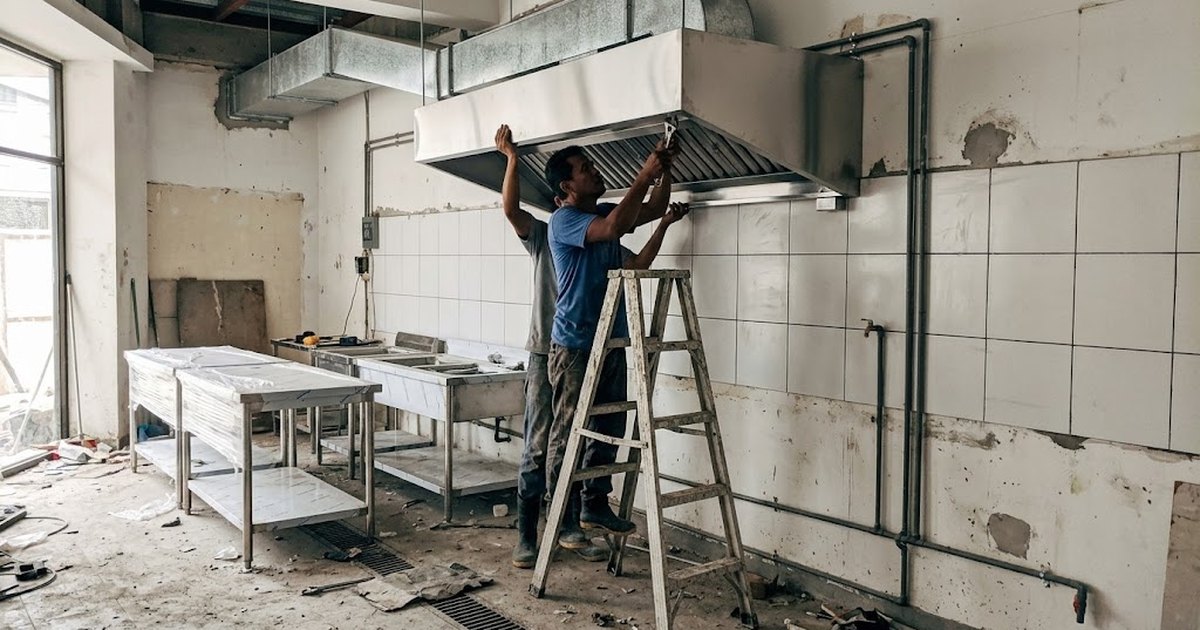
The exhaust hood and duct run take a big share of a commercial kitchen's fit-out cost. Illustrative photo.
Short answer: a commercial kitchen fit-out uses the same published 2026 cost bands as any other commercial fit-out, but a full-cook kitchen lands toward the higher end of those bands because of three systems an office never needs: an LPG gas line and storage, an exhaust hood with makeup air, and a grease trap ahead of the sewer or septic connection. Each of those carries its own permit, and none of them are optional line items you can value-engineer away.
Operators budgeting off an office fit-out quote per square metre usually get surprised twice: once when the mechanical contractor prices the hood and exhaust run, and again when the Fire Marshal's office asks for a separate clearance for the LPG installation before they'll sign off occupancy.
Bands are the published 2026 figures from Alphabuild and J.I. Raymundo Builders, written for office fit-outs. The full-cook uplift is AEDO's own estimate for the added kitchen M&E scope, not a cited market figure.
The published bands below are the same ones AEDO cites for office and clinic fit-outs, because no market source has published a kitchen-specific rate for the Philippines. What changes for a restaurant kitchen isn't the base finish rate, it's the systems layered on top: a dedicated gas line from an outdoor cylinder bank or bulk tank, an exhaust hood sized to the cook line with makeup air to replace what it pulls out, heavier water and floor-drain rough-in than any office needs, and a grease trap ahead of the drainage connection. That's why a full-cook kitchen should be priced toward the top of a band, or above it once the hood, gas line and grease trap are quoted as separate mechanical and plumbing scopes.
| By finish level | ₱ per sqm | By location | ₱ per sqm |
|---|---|---|---|
| Basic / cosmetic | 10,000–20,000 | BGC / Makati CBD | 25,000–45,000+ |
| Mid-range | 20,000–35,000 | Ortigas / Mandaluyong | 20,000–38,000 |
| High-end / premium | 35,000–45,000+ | Quezon City / Alabang | 15,000–32,000 |
| J.I. Raymundo planning range: ₱20,000–35,000/sqm | Cebu / Clark / Iloilo: 12,000–28,000 | ||
AEDO's own estimate for the full-cook uplift is 15 to 25 percent on top of the base band, to cover the exhaust hood and makeup air run, the LPG gas line, and the grease trap and heavier drainage. That figure isn't from Alphabuild or J.I. Raymundo; it's our engineering judgement for the extra scope, and it should be checked against an actual mechanical and plumbing take-off once the cook line is laid out.
An LPG cooking setup, whether it's cylinder bank or bulk tank, needs its own Fire Safety Clearance from the City or Municipal Fire Marshal having jurisdiction, on top of the building's general Fire Safety Inspection Certificate. That's a requirement of RA 9514, the Fire Code of the Philippines, under its 2019 Revised IRR's LPG standards. Cylinders must sit where they won't see excessive temperature rise, physical damage or tampering, and never near open flames — exact storage distances and quantities should be confirmed with the local Fire Marshal rather than assumed from a generic table, since enforcement varies by LGU.
Separately, the cylinders themselves need to conform to PNS 03, the Philippine National Standard for transportable and refillable steel LPG cylinders, and whoever supplies or installs them needs a Safety Compliance Certificate from the DOE or DTI before commercial operation. That's usually the gas supplier's or installer's paperwork to carry, but it's a real approval your project timeline needs to track, not something the fit-out itself designs.
On the plumbing side, the Code on Sanitation of the Philippines (PD 856) sets general requirements for food establishment sanitation and wastewater disposal, and in practice LGU sanitary and plumbing permitting for a food establishment commonly requires a grease trap before kitchen wastewater discharges to the sewer or septic system. See our national plumbing code guide and septic tank sizing guide for how that connects to the rest of the drainage design.
Is the hood and exhaust priced as its own line item, sized to the actual cook line and BTU load, not a generic allowance. Who's pulling the Fire Safety Clearance for the LPG and is that timeline built into the project schedule. Where does the grease trap sit in the drainage run, and is it upstream of every fixture that can carry fats and oils. A change of use into a restaurant also triggers a building permit alteration; see our fit-out permit guide for that process.
Finish-level and location bands are from Alphabuild's 2026 Manila office fit-out guide; the ₱20,000–35,000 planning range is from J.I. Raymundo Builders' 2026 guide. Both are published for office fit-outs, used here as a floor for a kitchen. The 15–25% full-cook uplift is AEDO's own estimate, not a cited market figure. LPG and fire figures are from RA 9514's 2019 Revised IRR and DTI's PNS 03; the grease-trap requirement is general practice under PD 856, not a specific section citation.
What makes a commercial kitchen fit-out different from an office fit-out?
The added mechanical, electrical and plumbing scope specific to cooking: an LPG gas line and storage, an exhaust hood and makeup air, heavier water and drainage rough-in, and a grease trap. That extra scope pushes cost toward the higher end of standard fit-out ranges.
Do I need a separate permit for the LPG installation in my restaurant kitchen?
Yes. RA 9514, the Fire Code of the Philippines, and its 2019 Revised IRR set LPG standards under Sec. 10.3.7.8, and any installation, storage or handling of LPG needs its own Fire Safety Clearance from the City or Municipal Fire Marshal, on top of the building's general Fire Safety Inspection Certificate. Cylinders also need a DOE or DTI Safety Compliance Certificate and must conform to PNS 03, the Philippine National Standard for transportable and refillable steel LPG cylinders.
Do commercial kitchens need a grease trap?
In practice, yes. LGU sanitary and plumbing permitting for a food establishment commonly requires a grease trap before kitchen wastewater reaches the sewer or septic system, to keep fats, oils and grease out of the drainage line. See our plumbing code and septic tank sizing guides for the technical side.
How much does a commercial kitchen fit-out cost in the Philippines?
The same published 2026 bands used for offices and clinics apply as a starting point: Alphabuild's guide puts Manila fit-outs at roughly 10,000 to 20,000 pesos per square metre basic, 20,000 to 35,000 mid-range and 35,000 to 45,000 or more high-end, and J.I. Raymundo Builders gives a planning range of 20,000 to 35,000. A full-cook kitchen typically lands toward the higher end of those bands because of the extra LPG, exhaust and grease-trap scope.
Published references used in this article. Links open in a new tab.
Fit-out cost bands are published figures for office fit-outs, used here as a floor for a commercial kitchen. The full-cook uplift is AEDO's own estimate, not a cited market figure. This guide does not cover food-business or health-permit licensing.
Get the front-of-house fit-out and the kitchen M&E scoped separately, with the LPG and grease-trap permits mapped against your project timeline.