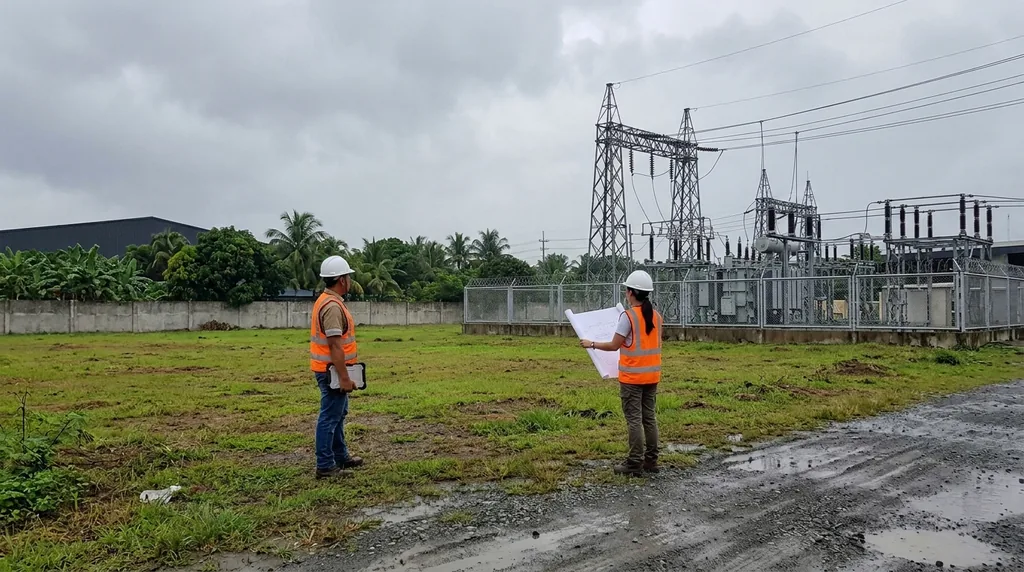
The first question on any data center lot: how far is the substation, and what will the utility put in writing? Illustrative photo.
Short answer: a Philippine site works for an AI data center when the utility will put in writing that it can deliver the MVA you need, at a voltage and date you can plan around, and when the land clears five other tests: no active fault trace within the buffer, low flood, storm surge and liquefaction exposure, two separate fibre routes, water with a permit, and a road and zoning that allow heavy plant. A 10 MW IT load needs roughly 16.7 MVA from the grid on AEDO's planning assumptions. Location also changes the tax holiday: six years in Metro Manila, seven years elsewhere under RA 12066.
Our data center construction guide covers the building: tiers, cooling, floor loads, permits and cost per MW. This page comes before that one. It is about the land, and about the handful of questions that decide whether a lot is worth designing anything on. The Philippines has momentum here: BMI counted about 140 MW live across 44 facilities in September 2026, 43 MW under construction and 221 MW in the pipeline, and it named power availability as one of the biggest constraints. AI changes the arithmetic. GPU racks pack far more power into each square metre than the server rooms many landowners have seen, so a site that would have suited a 2 MW enterprise hall can be hopeless for 20 MW.
We've built the screening into a scorecard. Answer what you know, mark what you don't, and it gives you a weighted score, the red flags that override the score, and a list of what to chase next. The weights are ours and you can change them. The hard stops can't be outvoted.
Enter the IT load you are planning for and what you know about the site. You get the utility MVA to ask for, a score for each of six categories, an overall verdict, the red flags and a next-step list. "Don't know" is always an option, and it costs points, because an unknown is a risk you are still carrying.
Each bar is one category out of 100, with its weight in brackets. A red marker means that category holds a red flag or a hard stop, whatever its bar says.
Start with the number the utility actually cares about. Your IT load is not your grid load: cooling, UPS losses, lighting and everything else ride on top, and the utility sizes the connection in MVA, not MW. The scorecard uses IT MW x design PUE ÷ power factor. With our planning defaults of 1.5 and 0.9, 10 MW of IT becomes about 16.7 MVA, and a 50 MW AI campus becomes about 83 MVA. Use the designer's figures once you have them, and always ask for the full build-out, not phase one. A utility that can serve your first 6 MW and nothing after that hasn't given you a site for 36 MW.
Then get it in writing. A useful letter says how many MVA, at what voltage, from which substation, by what date, and what works the customer pays for. A verbal "kaya 'yan" from a district office is not a power answer. BMI's September 2026 note says hyperscalers previously needed six to nine months to put power, land and connectivity together on their own, which the government is trying to shorten. Plan for that kind of lead time, not weeks.
Look at how a working project did it. Meralco signed a switching-station agreement with A-FLOW in September 2024 for a dual feed from a 115 kV substation to the ML1 data center in Biñan, Laguna, with completion targeted for December 2025. ML1's first 6 MW opened in November 2025, the first phase of a campus planned for 36 MW, and the BOI approved it for incentives on 18 November 2025. That is one working example: a sub-transmission connection with two feeds, agreed more than a year before the hall went live.
Voltage and distance. Small loads can live on a distribution feeder. AI loads usually can't. The scorecard flags a mismatch when the MVA you need is above what we'd expect a connection at that voltage to carry. Those thresholds (10 MVA for distribution voltage, 100 MVA for 69 or 115 kV) are AEDO screening rules of thumb, not utility rules, and they're editable. Distance matters because every kilometre of new line needs a route, right-of-way and money, and the line can be the slowest part of the whole project.
Grid region. The country runs three main grids, Luzon, Visayas and Mindanao, and NGCP operates the transmission system. The Visayas and Mindanao grids were linked when NGCP energized its 450 MW Mindanao-Visayas Interconnection Project in April 2023, a 184 circuit-km high-voltage DC submarine line. That helps, but an AI campus outside Luzon still has to win capacity from a regional grid and a local distribution utility or electric cooperative that may never have connected a load its size. Ask early, and ask both.
An AI training cluster can tolerate more latency than a trading platform, but it can't tolerate being cut off. The test we use is simple: at least two carriers, on routes that don't share a road, a bridge or a duct. One carrier, or two carriers in the same trench, is one backhoe away from an outage. Ask each carrier for a route map to your gate and a quote, in writing, before the land is bought.
Further out, the international links matter for anyone selling capacity abroad. BMI notes that the Philippines sits on subsea cable routes linking developed Asian markets. On Luzon, BCDA built the Luzon Bypass Infrastructure with DICT and Meta, a 240 km fibre corridor from Baler, Aurora on the east coast to San Fernando, La Union on the west. In March 2026 BCDA announced that InfiniVAN will run the Poro Point landing station in La Union as an open cable landing station, and that the CANDLE cable, a 24-fibre-pair intra-Asia system, is expected to land at a new Baler station and operate from 2028. Being near a landing station isn't a requirement for a data center, but being on a short, diverse path to one is worth points with some tenants.
A data center is the building that is supposed to stay up when the town around it goes dark. So the lot gets screened harder than a warehouse lot. The tools are the same ones in our lot hazard check guide: HazardHunterPH, the GeoRisk Philippines tool led by DOST-PHIVOLCS, gives a site report on seismic, volcanic and hydrometeorological hazards from one pin, with no account needed; the MGB geohazard maps add landslide and flood susceptibility; the LGU's zoning ordinance tells you what is allowed at all.
Active faults. PHIVOLCS Director Teresito Bacolcol said in October 2025 that the agency's recommendation is a five-metre buffer zone on both sides of a fault. HLURB Board Resolution R-515-92 of 17 August 1992 made that five-metre easement binding for subdivision and condominium projects under PD 957, naming the Marikina Valley fault trace and other traces PHIVOLCS identifies, and many LGUs have adopted it in their zoning. For a data center the rule matters less than the physics. Shaking can be designed for. Ground that tears apart under a building can't. Treat the band as land you don't build on, and keep the generators, fuel and cable routes out of it too. A mapped trace is not a surveyed line, so a site within a few hundred metres of one deserves a site-specific fault study before the layout is fixed. That is stricter than our house-lot check, because a data center has less tolerance for near-fault effects.
Flood and storm surge. Electrical rooms, UPS batteries and generators can't get wet, and a data hall that floods is down no matter how many spares it has. NSCP 2015 Section 211 covers flood loads. In practice the hazard report's depth sets the finished floor of everything electrical, plus freeboard. A moderate rating can be designed around; a high rating or a storm surge advisory of 3 or 4 usually means the site is spending money on earthworks that a better lot wouldn't need.
Liquefaction. Loose, saturated sand near rivers, bays and reclaimed land can lose its strength when it shakes. It isn't a reason to walk away on its own, but it means borings, a liquefaction analysis and likely piles or ground improvement under a building full of heavy, settlement-sensitive plant. See our soil boring test guide for what that investigation costs.
Typhoon wind. NSCP 2015 sets the basic wind speed from three maps by occupancy category, and an owner who writes the facility into the Essential Facilities category for continuity reasons designs to the strictest map, Figure 207A.5-1C. Roof plant, louvres and cooling equipment are where the wind finds the weak points; our NSCP wind load guide covers the method.
Volcanic. HazardHunterPH reports the nearest active volcano and the mapped volcanic hazards at the pin. Ashfall is a design problem for air intakes, filters, cooling coils and roof loads. A site inside a mapped lahar, pyroclastic-flow or danger zone is a different matter, and the scorecard treats it as a red flag.
Why "not checked" costs points. An unknown hazard isn't a low hazard. The scorecard scores every "don't know" at 30 out of 100, below most real answers, so an unscreened site can't look better than a screened one. Running HazardHunterPH takes minutes and is usually the fastest way to lift a score.
Lot area is not buildable area. A fault buffer, a Water Code easement along a creek (3 m in urban areas, 20 m agricultural, 40 m forest under Article 51 of PD 1067) and the zoning setbacks each take land from a different edge. Work out what's left before you price the lot. A campus that needs a generator yard, a switching yard and room for later halls can run out of land long before it runs out of title.
Water. Evaporative cooling uses a lot of water; closed-loop systems with dry coolers use far less but spend more power on hot afternoons, and Philippine afternoons are hot most of the year. Either way, decide where the make-up water comes from before the design does. A connection from the local water utility needs a supply commitment. Your own well or surface source needs a water permit: Article 13 of the Water Code says no one, government agencies included, may appropriate water without one. Our deep well guide covers the well side.
Zoning. The LGU's zoning ordinance and Comprehensive Land Use Plan decide whether a data center is allowed on the lot at all. Industrial land and IT parks are the easy cases. Agricultural land is the slow one: conversion or reclassification can take longer than the construction, and the scorecard flags it red for that reason.
The road in. Main transformers, MV switchgear and large generator sets arrive on heavy trailers. Before you commit, drive the route from the port or the main highway and look at every bridge, culvert, sharp turn and overhead line on the way. A weight-limited bridge found after the transformer is on the truck is an expensive week.
RA 12066, the CREATE MORE Act of 8 November 2024, lists data-center facilities with cyber-security and artificial intelligence as examples of Tier III activities in Section 296. The address then decides the holiday. In the National Capital Region, a Tier III project gets a six-year income tax holiday; in the metropolitan areas next to NCR and in all other areas it gets seven years. Either way the holiday is followed by ten years of enhanced deductions, or for exporters the 5 percent special corporate income tax as an alternative. Projects that completely relocate out of NCR get three more years. One of the enhanced deductions is an extra 100 percent deduction on power expense, limited to power used for the registered activity, and for an AI hall the power bill is the biggest line in the budget.
BOI or PEZA. The law names both as investment promotion agencies. If the site sits inside a proclaimed ecozone or IT park, the project registers with the zone authority, and Section 309 requires the registered activity to be conducted within the zone's boundaries. PEZA's ecozones include information technology parks and centers as well as manufacturing zones, so check which kind your site sits in. Outside an ecozone the route is usually the BOI, as with ML1. Section 297 lets an investment promotion agency grant incentives to projects with investment capital of ₱15 billion and below; above that, approval goes to the Fiscal Incentives Review Board on the agency's recommendation. AI campuses can pass that figure, so it is worth knowing which path you are on early.
The green lane. Executive Order No. 18 of February 2023 set up green lanes for strategic investments: a project endorsed by the BOI's One-Stop Action Center for Strategic Investments gets a single point of entry and an account officer at each agency and LGU. It speeds up processing. It doesn't waive the zoning clearance, the environmental papers or the fire safety evaluation. Talk to a tax adviser before choosing a structure or a location; this page is about the site, not tax advice.
BMI describes the market's core as Greater Manila and the southern industrial corridor, spreading into Laguna, Santa Rosa and Cavite, with an eastward extension to Cainta in Rizal. New Clark City has a large announced project. The table keeps to facts we could read in the sources; it is not a ranking of locations.
| Area | Public examples | What to check on a lot there |
|---|---|---|
| Metro Manila (Quezon City) | STT GDC Fairview campus, planned for 124 MW of IT load across four buildings (BMI) | Six-year ITH, not seven. Land cost and lot size. Distance to the Marikina Valley fault trace named in HLURB R-515-92. |
| Laguna (Santa Rosa, Biñan) | ePLDT VITRO Santa Rosa, 50 MW operational (BMI). A-FLOW ML1, Biñan: 6 MW first phase of a planned 36 MW, Meralco 115 kV dual feed (BOI; Daily Tribune) | Flood and liquefaction near Laguna de Bay and rivers. Whether the lot is inside an ecozone. |
| Cavite | STT GDC Cavite 2 expansion, 6 MW; a prospective ePLDT facility of at least 100 MW (BMI) | Storm surge and flood on low coastal ground. Substation capacity for the full build-out. |
| Rizal (Cainta) | Digital Halo hyperscale campus opened (BMI; no MW given) | Fault distance, flood and slope. |
| New Clark City, Tarlac | Narra Technology Park: 300 MW hyperscale campus announced June 2024 in three 100 MW phases on 47 hectares, first phase then targeted for Q4 2026 (GMA News). We found no later construction update. | Power and fibre to a greenfield site. BMI notes opposition to a separate AI and semiconductor hub at New Clark City over forests, watersheds and farmland. |
| Northern and eastern Luzon coast | Luzon Bypass Infrastructure, Baler to San Fernando, La Union; Poro Point open landing station; CANDLE expected at Baler in 2028 (BCDA) | A landing station is a connectivity asset, not a data center site. Typhoon wind and storm surge on the coast. |
The order matters. Each step is cheaper than the one after it, and each can end the process. Click through.
A Laguna-type industrial lot. The scorecard's defaults: 10 MW of IT, a utility letter that covers part of the load, a 115 kV substation 2 to 5 km away, a fault 1 to 5 km off, low flood, ashfall possible, two carriers, utility water, industrial zoning inside an ecozone outside NCR. It needs about 16.7 MVA and scores 85 out of 100, a strong candidate with two cautions: get the rest of the MVA in writing, and design the intakes and filters for ash. The ITH would be seven years.
The bargain with a fault through it. Same lot, but HazardHunterPH puts it within five metres of a trace and the utility hasn't answered. The weighted score still comes out at 68, which looks workable. The verdict is stop, with two hard stops listed. That is the point of hard stops: a good road and cheap water don't make up for a trace under the generator yard.
The big plan on farmland. 50 MW on agricultural land, a verbal yes from the utility, 10 to 20 km from the nearest substation, which runs at distribution voltage only, one fibre carrier, and the hazards, water and road not checked. It needs about 83 MVA, scores 35, and comes back weak: a red flag on zoning, four cautions on power and fibre, and seven items still unchecked. Not impossible, but every one of those items is a year-long question.
Where AEDO fits in. We're a small team and we'll say what that means. AI and hyperscale campuses are designed by specialist mission-critical firms and built by contractors who do nothing else. We don't size utility connections, certify tiers or design cooling plants for them.
What we do, anywhere in the Philippines: screen sites for hazards and work out the buildable area after buffers, easements and setbacks; review the access route and the structural questions a site raises (foundations on soft or liquefiable ground, generator and fuel-tank supports, roof plant in typhoon wind); run a structural assessment of an existing building before anyone puts a data hall in it; and prepare the architectural, structural, electrical and plumbing design for small and edge facilities, with remote oversight of a locally hired contractor. In Negros Oriental the AEDO team also builds. On a large campus we can support the specialist's site due diligence and the structural side.
Market and clusters: BMI, as reported by TNGlobal on 28 September 2026 (140 MW live across 44 facilities, 43 MW under construction, 221 MW pipeline, the named projects and locations, power as a constraint, six to nine months to assemble power, land and connectivity, subsea routes, the New Clark City opposition); DTI-BOI release of 4 December 2025 on A-FLOW ML1; Daily Tribune, 14 September 2024, on the Meralco 115 kV switching-station agreement for ML1; GMA News, 11 June 2024, on Narra Technology Park. Grid: GMA News, 3 May 2023, on the Mindanao-Visayas Interconnection Project (450 MW, 184 circuit-km HVDC). Cables: BCDA, 24 March 2026, on Poro Point, the Luzon Bypass Infrastructure and CANDLE. Law: RA 12066 Sections 294, 295, 296, 297 and 309; Executive Order No. 18, s. 2023; PD 1067 Articles 13 and 51; HLURB Resolution R-515-92 (secondary copy). Zones: PEZA, on the kinds of ecozone.Hazards: HazardHunterPH; MGB; PHIVOLCS Director Bacolcol as quoted by SunStar on 5 October 2025. Structure: NSCP 2015 Section 211 and Figure 207A.5-1C, AEDO's copy. PUE reference: Uptime Institute Global Data Center Survey 2025 (1.54). AEDO assumptions with no source, edit them: design PUE 1.5; power factor 0.9; 10 MVA and 100 MVA screening limits for distribution and 69/115 kV connections; every answer's 0 to 100 score; "don't know" = 30; category weights 35, 25, 15, 10, 10, 5; the verdict bands.
What makes a site suitable for an AI data center in the Philippines?
Power comes first: a written answer from the distribution utility on how many MVA it can deliver, at what voltage and by when, and a substation of adequate voltage close by. After that the site needs at least two separate fibre routes, a clean hazard screen (no active fault trace within the buffer, low flood, storm surge and liquefaction exposure), a water source with a permit, a road that can carry transformers and generators, and zoning that allows the use.
How much utility power does a 10 MW AI data center need?
More than 10 MW. Multiply the IT load by the design PUE and divide by the power factor. With AEDO's planning assumptions of a 1.5 PUE and a 0.9 power factor, 10 MW of IT needs about 16.7 MVA from the utility. Use the designer's figures once they exist, and ask the utility for the full build-out rather than the first phase alone.
Can a data center be built near a fault line in the Philippines?
Not on it. PHIVOLCS recommends a five-metre buffer on both sides of an active fault trace. HLURB Resolution R-515-92 made that five-metre easement binding for subdivision and condominium projects under PD 957, and many LGUs have written it into their zoning. Shaking can be designed for; ground rupture on the trace cannot. A site that plots within a few hundred metres of a mapped trace should get a site-specific fault study before design.
Is the income tax holiday for data centers longer outside Metro Manila?
Yes, by one year. RA 12066 lists data-center facilities among Tier III activities. Tier III projects in the National Capital Region get a six-year income tax holiday; in the areas next to NCR and everywhere else it is seven years, followed by ten years of enhanced deductions or, for exporters, the special corporate income tax. Projects that completely relocate out of NCR get three more years. Confirm the details with a tax adviser.
Can AEDO help choose a data center site?
Yes, on the site and structural side. Anywhere in the Philippines the AEDO team screens sites for hazards, reviews the power, access and zoning questions, checks existing buildings, and prepares architectural, structural, electrical and plumbing design for small and edge facilities, with remote oversight of a local contractor. In Negros Oriental AEDO also builds. Large AI and hyperscale campuses are designed by specialist mission-critical firms; AEDO can support their site due diligence and structural work.
Documents read for this article on 28 October 2026. External links open in a new tab. Where we used a news report or a secondary copy, the entry says so.
Scores, weights and thresholds in the scorecard are AEDO's judgement for screening, not a standard. This article is general information for planning, not a design, tax or legal advice.
Send us the location, the target MW and whatever you have: the HazardHunterPH report, the lot plan, the utility's reply. Our team will tell you what the site needs and what to resolve before you sign.