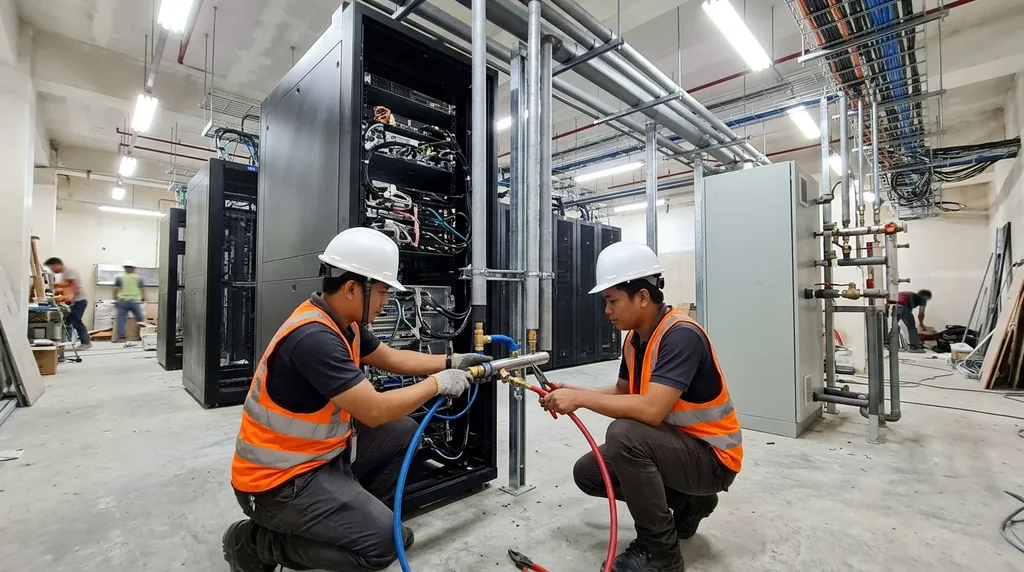
Connecting a rack to its coolant loop: in an AI hall the plumbing reaches every rack. Illustrative photo.
Short answer: an AI rack draws about as much power as a dozen or more ordinary racks. NVIDIA puts its GB200 rack at about 120 kW, and most of that heat leaves through pipes, not air. For eight such racks, the calculator below works out about 1,220 litres per minute of coolant, two coolant distribution units with one as a spare, a main pipe of about DN125, 273 tons of heat to reject outside, and roughly 20 kPa on the slab under each rack. That's more than eight times what NSCP 2015 designs an office floor for. In the Philippines' heat and humidity, the water temperature the IT vendor accepts decides most of the cooling plant.
The data center construction guide covers the whole building: power, tiers, permits and cost. This page picks up one part of it that changes fastest. Uptime Institute's 2025 survey found that more than 80 percent of operators still had no racks above 30 kW, and that the average typical rack, leaving out the dense sites, was 7.5 kW. Meanwhile NVIDIA's user guide for its DGX GB200 rack says the rack draws approximately 120 kW. Supermicro lists 132 kW for its version. That gap is what this article is about.
Telcos, BPOs, banks and developers in the Philippines are being asked for AI capacity now, and most halls worldwide, per Uptime, still run single-digit kW racks. When a 120 kW rack shows up, it brings its own cooling water, its own pumps, a heavier floor load and a fatter power feed. The building has to be ready for all four before the hardware arrives. The calculator turns a rack count into those building numbers, and the rest of the page explains each one for a hot, humid, typhoon-exposed and seismically active site.
Enter the rack power, how many racks and how much of the heat goes to liquid. You get the coolant flow per rack and in total, the heat left for air cooling, the total heat to reject outside, the number of CDUs, an indicative main pipe size, water lost if a cooling tower rejects the heat, and a floor-load check, with a row drawing that redraws from your inputs. Every assumption is editable.
A row of racks fed by a coolant distribution unit through supply and return headers, with the CDU passing the heat to the building's facility water. The numbered tags match the key below.
A planning sketch, not to scale and not for construction. Pipe routes, valves, isolation, CDU location, redundancy and leak detection are per the cooling designer.
Every kilowatt a rack draws becomes a kilowatt of heat. Nothing is stored. An ordinary 7.5 kW rack can be cooled by blowing air through it at the ASHRAE recommended inlet range of 18 to 27 °C, and a hall full of them is cooled by air handlers along the walls. Push one rack to 120 kW and that air would have to move at a rate the rack's fans, the floor tiles and the aisles were never sized for.
Water solves it by carrying much more heat in much less volume. The physics is one line: heat = mass flow x specific heat x temperature rise. With the calculator's defaults, 102 kW per rack goes to liquid, and in 25 percent propylene glycol with a 10 °C rise that takes about 152 litres per minute. That's roughly what a 2-inch pipe carries, not a wind tunnel. NVIDIA's guide describes how it gets to the chips: liquid runs up and down the rack through manifolds and then through cold plates attached to the CPUs and GPUs, while networking and storage are still cooled by fans. So even a "liquid-cooled" hall keeps some air cooling. On the defaults that's 144 kW for eight racks, about 41 tons, which is a small server room's worth of air conditioning inside the AI hall.
Notice the trade in the formula. Halve the temperature rise and the flow doubles, and so does the pipe area. Swap glycol for treated water and the flow drops by about 4 percent, because water holds slightly more heat per litre. The IT vendor sets the allowed fluid and temperatures; the building sizes its pipes from them.
Two loops, kept apart. The loop that runs through the racks (often called the technology cooling system) holds a small volume of clean, treated fluid that the IT vendor specifies. The coolant distribution unit, or CDU, pumps it, filters it and controls its temperature, and passes its heat across a heat exchanger to the building's own facility water. The facility water then takes the heat outside.
How it does that depends on how warm the facility water is allowed to be. ASHRAE groups liquid-cooled equipment into classes named after the maximum facility water supply temperature they're designed for: W17, W27, W32, W40 and W45, meaning 17, 27, 32, 40 and 45 °C, and W+ for above 45 °C. Equipment rated for a class runs at full performance anywhere in it. Supermicro says its newest direct liquid cooling allows inlet liquid up to 45 °C.
Now put that against our weather. PAGASA gives the country a mean annual temperature of 26.6 °C, with May the warmest month at a mean of 28.3 °C, and monthly average relative humidity between 71 percent in March and 85 percent in September. Those are averages that include the nights, so a summer afternoon is hotter. A dry cooler, which is basically a big radiator with fans, can only cool water to somewhat above the outdoor air temperature. So:
That's the single most useful question to ask an IT vendor before a cooling plant is designed in the Philippines: what facility water class does this hardware accept, at full performance? A warm-water rack can save years of chiller electricity and a lot of tower water. A cold-water rack locks the building into chillers. Humidity matters too. Any pipe, rear door or manifold running colder than the room's dew point will sweat, and our air is wet; ASHRAE's recommended envelope keeps the room's dew point at or below 15 °C, which the room air units have to hold.
Click through the four. The density ranges are AEDO planning ranges, not figures from a standard: equipment, containment and climate move them.
On the defaults, eight 120 kW racks put 816 kW into the rack loop and need about 1,220 litres per minute, or 73 m³ an hour. At a maximum of 2 metres per second the main supply and return each need a bore of about 114 mm, which the calculator rounds up to DN125. Those pipes run the length of the row, overhead or under a raised floor, with a branch and quick-disconnect hoses to every rack. NVIDIA's guide puts the manifold inlets and outlets at the back of the rack, next to the power bus bar, so the hot aisle is where the plumbing and the power meet.
The CDUs follow from the liquid heat. At 1,300 kW each, one unit carries the 816 kW, and a second one is the spare. Losing a CDU with no spare means the racks it feeds throttle or shut down within seconds, not minutes, because a cold plate has very little thermal mass. That's also why the CDU pumps usually ride on the UPS. Supermicro lists both an in-rack CDU rated at 250 kW and an in-row CDU at 1.3 MW for its GB200 rack; in-rack units save hall space, in-row units serve several racks from one place. The cooling designer picks.
Then leaks. NVIDIA's guide covers leak detection in the rack's own cooling system, and the building needs its own: sensing cable under pipe runs and CDUs, drip trays where pipes pass over equipment, isolation valves per row so a leak shuts one row and not the hall, and floor drains or bunds sized for the loop volume. Pipe joints should not sit above switchgear or UPS. Write those as rules in the design brief, because a leak test during commissioning is too late to move a pipe.
Pipes are a structural load too. A DN125 steel pipe full of coolant, two of them, plus valves, insulation and the facility water mains, adds up along a row. Overhead runs hang from the slab above; under-floor runs sit on the slab with the racks. Either way, the supports need designing, not improvising, and in Seismic Zone 4 (which NSCP 2015 applies to the whole country except Palawan apart from Busuanga, Sulu and Tawi-Tawi) they need bracing so the pipes don't swing into the racks in an earthquake. The racks themselves should be anchored to the floor for the same reason.
CDUs, pumps and buffer tanks are heavy point loads in the hall. Dry coolers, cooling towers and chillers usually go on the roof or a podium, where they need a frame designed for their operating weight, vibration and typhoon wind. NSCP 2015 picks the basic wind speed map by occupancy category, and an owner who wants the building to keep working through the storm will often ask for the stricter Essential Facilities map. Our NSCP wind load guide explains how that's read.
NSCP 2015 Table 205-1 designs an office floor for 2.4 kPa of live load, light storage for 6.0 and heavy storage for 12.0. The data center standards ANSI/BICSI 002 and TIA-942 are commonly cited for 7.2 kPa minimum and 12 kPa recommended, plus 1.2 to 2.4 kPa for loads hung from the slab above, which is where overhead coolant pipes go; both are sold, and we've read those figures in published summaries rather than the standards themselves.
An AI rack is heavier than an ordinary one because it's full of copper, cold plates, manifolds and coolant. We couldn't find a manufacturer weight for a full GB200 rack that we could read and cite, so the calculator uses 1,500 kg as an AEDO planning assumption. Get the real figure from your vendor's site-preparation documents. At 1,500 kg on a 600 by 1,200 mm footprint the slab under the rack sees about 20.4 kPa. Spread over the rack and its share of the aisles it's about 10.7 kPa. That's within 12 kPa as an average, but the load right under each rack is well above it, and more than eight times an office floor's 2.4 kPa. A rack also stands on four levelling feet or casters, not its whole footprint, so the local stress on a topping or a raised floor is higher still.
Put that next to what a hall used to hold. The 900 kg rack in our data center planner at 7.5 kW gave about 12.3 kPa under the rack. The AI rack weighs more, but more importantly it packs the load into a few racks next to each other, where the old hall spread it over many. A row of eight sits across one or two slab panels, not the whole floor. The calculator's average assumes every rack position is full, which with AI racks it usually is.
The practical options for an existing building are the ones in our racking and floor load guide: put the AI rows on the ground-floor slab on grade, line the rows up over the beams and girders, use a steel base frame that spreads the load to the beams, or strengthen the floor. Any of those starts with knowing what the floor was designed for, which means the structural plans or a structural assessment with core tests if the plans are lost.
NVIDIA's guide says the GB200 rack takes power through eight power shelves of six 5.5 kW supplies each, in N+N redundancy, each shelf needing 33 kW of input. The building side of that is a remote power panel or busway feeding every rack position with a lot of current, two independent paths for an N+N rack, and a UPS and generator plant sized for racks that can swing from idle to full load quickly. NVIDIA's DGX SuperPOD reference architecture gives each scalable unit of eight GB200 racks a thermal design power of 1.2 MW, above the 960 kW the calculator counts for eight racks; NVIDIA doesn't break that figure down. Size the electrical from the vendor's full bill of equipment, not rack power times count.
The cooling plant itself needs power, and on the UPS for the pumps. Our commercial generator sizing guide covers how standby sets are sized, and the pillar guide shows how PUE turns IT load into a utility request.
If the heat goes out through a cooling tower, it goes out mostly as evaporated water. Water's heat of vaporisation at 30 °C is about 2,430 kJ per kilogram, so the calculator's 960 kW, rejected entirely by evaporation, boils off roughly 34,000 litres a day. That's a physics estimate; tower blowdown and drift come on top. A dry cooler or air-cooled chiller carrying part of the load reduces it. A water-cooled chiller adds its compressor heat to the tower, so the figure rises. In a city where the water district already rations in the dry months, that's a supply question for the water district and a storage tank question for the structure, and it's another reason to ask the IT vendor for warm-water equipment. Supermicro claims up to 40 percent water savings from running its liquid cooling at warmer inlet temperatures; that's a vendor figure, not an independent test.
Fire protection in an AI hall follows the same standards the pillar post named, NFPA 75 for IT equipment and NFPA 2001 for clean-agent gas systems, and the Bureau of Fire Protection reviews it under RA 9514 before issuing the Fire Safety Evaluation Clearance. Two things are new. Immersion tanks hold large volumes of fluid that the fire protection designer has to account for, and glycol loops need their fluid's safety data sheet on file. Neither is something to settle on site.
Cooling towers, chillers and their tanks also need the mechanical and plumbing permits under PD 1096 like any building plant. The MEPFS design fee guide shows how that design work is usually scoped and priced.
Converting an existing hall for AI racks? Four questions come before the purchase order. What facility water class does the hardware need, and can the existing chillers make it? Where do the CDUs and pipe headers go, and does anything electrical sit under the pipe route? What was the floor designed for, and where are the beams? Can the incoming power and the generators carry the new racks plus the cooling plant at peak?
A common answer is to build a small liquid-cooled zone on the ground floor, with its own CDUs and a dedicated dry cooler or tower on a new frame in the yard, and leave the old hall on air. It's less elegant than retrofitting the whole floor, but it keeps the risky work out of a live data hall.
We don't design liquid cooling systems. AI-scale cooling plants are designed by specialist mission-critical MEP firms, and the CDU, fluid and temperatures come from the IT vendor. That's how it should be. What every one of those projects also needs is a building that can carry it, and that's where the AEDO team is useful.
Anywhere in the Philippines we run a structural assessment of an existing floor before AI racks go on it, design the supports and frames for CDUs, pipe racks, cooling towers, dry coolers and tanks, and prepare the complete design package (architectural, structural, electrical and plumbing) for small and edge facilities. We can review a local contractor's work through project oversight. Inside Negros Oriental the AEDO team can design and build small server rooms and edge sites; see design-build. On a large AI project we can work alongside the cooling designer on the structural side.
Rack power and cooling: NVIDIA DGX GB200 user guide (rack power approximately 120 kW; eight power shelves of six 5.5 kW supplies, N+N, 33 kW input per shelf; liquid through manifolds and cold plates on CPUs and GPUs, networking and storage air cooled; leak detection section; manifold connections at the rear); NVIDIA DGX SuperPOD GB200 reference architecture (8 racks per scalable unit, 1.2 MW TDP per unit, hybrid liquid and air cooling); Supermicro SRS-GB200-NVL72 page (132 kW total power, 600 x 1,068 x 2,236 rack, 250 kW in-rack and 1.3 MW in-row CDU options); Supermicro DLC-2 release of 14 May 2025 (up to 98% heat capture, inlet up to 45 °C, up to 40% water savings, vendor claims). Density: Uptime Institute Global Data Center Survey 2025 (7.5 kW average modal density excluding 30 kW-plus sites; more than 80% of operators with no racks above 30 kW; some cabinets above 100 kW, rare). Temperatures: ASHRAE W-classes as defined in The Green Grid glossary; ASHRAE Thermal Guidelines 5th edition reference card (18 to 27 °C inlet, dew point up to 15 °C). Climate: PAGASA, Climate of the Philippines (26.6 °C mean annual, May 28.3 °C, humidity 71 to 85%). Fluids: Recochem OAT PG-25 Computer Coolant data sheet (25% propylene glycol at 30 °C: 1,019.3 kg/m³, 3.938 kJ/kg·K); Engineering ToolBox (water at 30 °C: 995.65 kg/m³, 4.1801 kJ/kg·K, heat of vaporisation 2,429.8 kJ/kg). Structure: NSCP 2015 Volume I, Table 205-1 and Section 208.4.4.1, read in AEDO's copy; BICSI 002 and TIA-942 floor loads (7.2 and 12 kPa) read in published summaries, not the standards. AEDO assumptions with no source, edit them: 85% of heat to liquid; 10 °C coolant rise; 2.0 m/s maximum pipe velocity; 1,500 kg loaded rack; 600 x 1,200 mm footprint; 1.38 m² of floor per rack; the density ranges in the cooling-method selector.
How much power does an AI rack use?
NVIDIA's user guide for its DGX GB200 rack system gives the rack power consumption as approximately 120 kW, and Supermicro lists 132 kW total power for its GB200 NVL72 rack. Uptime Institute's 2025 survey found the average typical rack across operators was 7.5 kW (leaving out sites at 30 kW and up), and more than 80 percent of operators had no racks above 30 kW. One AI rack can draw as much as a dozen or more ordinary racks.
Why do AI data centers need liquid cooling?
Water carries far more heat per litre than air, so a 120 kW rack can be cooled with roughly 150 litres per minute of coolant through cold plates on the chips, which air cannot do in the same space. In NVIDIA's GB200 racks the CPUs and GPUs are cooled by liquid through manifolds and cold plates, while the power supplies, networking and storage stay air cooled, so the hall still needs some air cooling.
What is a CDU in a liquid-cooled data center?
A coolant distribution unit is a pump and heat exchanger set that keeps the clean coolant loop going to the racks separate from the building's facility water loop. It controls the coolant's flow, temperature and pressure. CDUs come in-rack (Supermicro lists a 250 kW in-rack unit) or in-row (Supermicro lists a 1.3 MW option), and are usually installed with at least one spare.
Can an existing office floor carry AI racks?
Usually not without checking and strengthening. NSCP 2015 designs an office floor for 2.4 kPa live load. A 1,500 kg rack on a 600 by 1,200 mm footprint puts about 20 kPa on the slab under it, and about 11 kPa averaged over the rack and its share of the aisles, before pipes full of coolant and the CDUs. Data center standards are commonly cited for 12 kPa. A structural assessment comes before the racks.
Does AEDO design liquid cooling systems?
No. Liquid cooling plants for AI halls are designed by specialist mission-critical MEP firms. AEDO checks whether an existing floor can carry the racks, designs supports for heavy plant, and prepares architectural, structural, electrical and plumbing design for small and edge facilities anywhere in the Philippines. In Negros Oriental AEDO can also design and build small server rooms and edge sites. On a large project AEDO can work alongside the cooling designer on the structural side.
Documents read for this article on 28 October 2026. External links open in a new tab. Vendor claims are marked as such.
Rack power and cooling specifications change with each hardware generation; use your vendor's current site-preparation documents. This article is general information for planning, not a cooling, structural or electrical design.
Send us the rack count, the vendor's rack weight and the floor they'll sit on. Our team will check whether the structure carries the racks, the CDUs and the roof plant before you sign for the hardware.