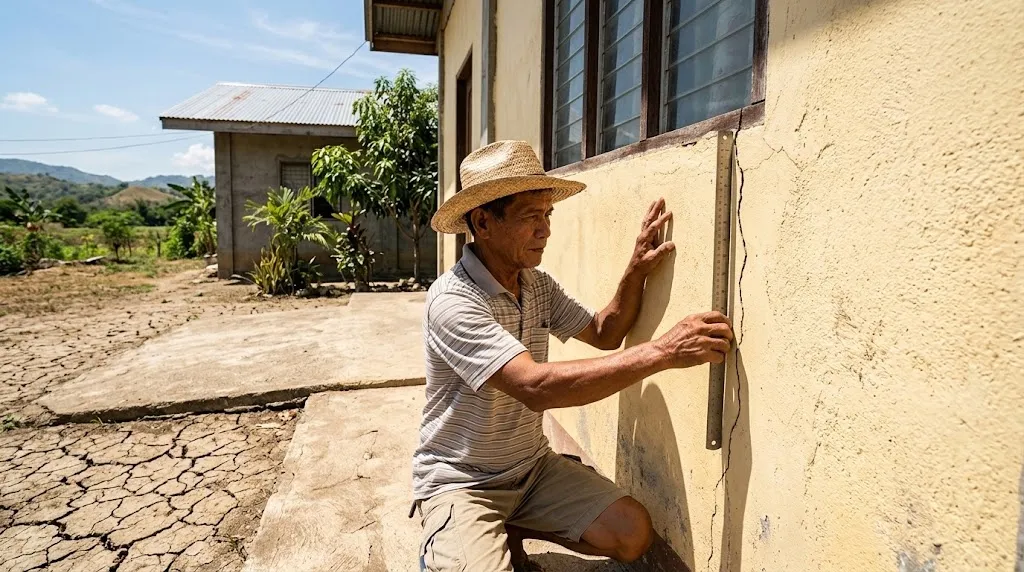
A ruler against the crack and a date in pencil: that is already better evidence than a photo from across the yard. Illustrative photo.
If a new line showed up in your plaster this month, the weather is a fair suspect. PAGASA's El Niño monitoring page (updated 7 October 2026) describes the current event as strong to very strong, possibly peaking before the end of 2026 and lasting into the first half of 2027. PAGASA's drought and dry spell assessment issued 1 October 2026 lists Negros Oriental under drought as of September. Its outlook does not list the province for the end of October or November, then has it back under dry condition by the end of December, dry spell by the end of January 2027 and drought by the end of February. PAGASA defines drought as three months of way below-normal rainfall or five months of below-normal rainfall. An outlook is a forecast, not a promise that the rain comes back, and we are not going to guess.
What owners see in the meantime is a new line in the plaster beside a window, a gap where the apron meets the wall, a tile that cracked overnight, a door that now rubs. Then comes the thought: is it the ground, or is it the "big one"? Most such lines are small. A few are not, and the difference shows in three things you can measure in an afternoon: how wide, what shape, and whether it is changing. The checker below sorts your crack on those three. The rest of the post explains why dry ground can crack a house at all, what the sources we read do and do not say, and how to build a crack gauge with a pencil and a card.
Describe one crack. You get a verdict, the reading interval and how many gauge marks to make. It scores width, pattern and change, and two things in the house that point to structural movement. The weights are AEDO's screening judgement, not a code method, and the checker cannot see your wall.
A house is several materials that do not move together. Plaster and mortar shrink as they lose water. A concrete slab shrinks and, in sun, expands. The ground below can move too, if it is the wrong kind of ground. The ASCE Geo-Institute's homeowners' guide to shallow foundations puts the mechanism plainly: clayey soils that draw in water can swell, and "drying outside your foundation reverses the process", so moist soils "will lose volume (shrink)" and the foundation can settle. It adds that uniform changes in soil moisture are less damaging than localized ones, and lists drought as a cause of "non-uniform drying or shrinkage settlement". Its list of moisture sources is practical: roof runoff dumped against one wall, ponding, trees whose roots dry the soil, and leaking lines.
Two honest limits. First, that guide was written for American homeowners on expansive clay, and it is explicitly general information. We have read no survey saying how much of Negros Oriental sits on shrink-swell clay, so we cannot tell you your lot does. A lot on rock, coral limestone or well-graded fill behaves differently from a former paddy. Second, the Philippine code does address the clay case: our sinking floor and settlement guide, which reads the printed NSCP 2015 Chapter 3, notes that Section 303.5 classifies a soil as expansive only when it passes a set of tests (plasticity index, fines content and an expansion index), and Section 303.5.2 then requires foundations on or within the active zone of such soil to be designed to resist differential volume changes. If your house was designed with a soil investigation, the answer is already in the report. If it was not, a soil boring is how you find out, and most single cracks do not justify one.
The weather side. PAGASA's 1991 to 2020 climatological normals for Dumaguete City give 1,322.6 mm of rain a year over 124 rainy days. The lowest monthly normal is April at 49.1 mm over 5 rainy days, and every month from February to May sits below 100 mm (73.7, 68.2, 49.1 and 84.5 mm). Those are 30-year averages, not a record, and an El Niño year is by definition not an average year. The point is that even a normal year has a dry stretch, and a house that cracked in an ordinary April may widen the same cracks in a drought. We do not claim a date for the end of this one.
Take the three in order of how much they tell you. Change is the most useful: a crack that has not moved in a month is a different animal from one that has. Pattern comes next, because a diagonal line from a window corner and a hairline map in the plaster have different causes. Width is the weakest on its own. BRE, the UK building research body, groups cracks of categories 0 to 2, up to 5 mm wide, as aesthetic, needing only redecoration, and says its classification can also depend on whether crack widths are increasing with time. Our own warning signs guide uses the same idea: under 1 mm usually cosmetic, 1 to 5 mm watch, over 5 mm a red flag.
| What you see | Usual reading | Do this |
|---|---|---|
| Hairline, random or map-like, in plaster | Plaster shrinkage and heat movement. Our crack repair guide calls fine random plaster cracks that have not changed almost always plaster shrinking as it dried. | Date it. Fill after readings hold. |
| Vertical line where CHB meets a column | Concrete frame and block infill move differently. The same guide calls it one of the most common cracks in a Philippine house. | Bridge the joint with mesh when you repair; do not just re-plaster. |
| Diagonal from a window or door corner | The classic pattern of differential movement: one part of the foundation moving more than another, or racking. Dry-ground shrinkage is one possible cause. | Gauge it now. Get it looked at if it grows, passes 1 mm or the doors rub. |
| Stair-step along block joints | The ASCE guide lists diagonal, stair-stepping cracks in masonry among its indicators of shrink-swell movement. | Same as diagonal. |
| Horizontal part-way up a wall | Suggests a push from the side (soil, wind) rather than shrinkage, per our warning signs guide. | Call a licensed engineer at 1 mm or more. |
| Crack in a column or beam | Concrete members crack under load in ordinary service; ASCC says reinforced concrete is designed to crack. But a crack through a column or one that keeps growing is a different case. | Call at 1 mm or more, or if growing. |
On the tolerable-width question people always ask: the ASCC position statement, published in Concrete International, quotes ACI 224R-01 as giving 0.016 in. (about 0.4 mm) as a reasonable crack width for reinforced concrete under service loads in dry air exposure, notes that some cracks will exceed it, and that the width can double with time. We did not read ACI 224R itself, so that is a second-hand quote. It describes cracks in loaded concrete members, not a crack in a plastered block wall, and it is not a pass mark for your house. The same statement quotes ACI 224R-01 as saying cracking from drying shrinkage "can never be eliminated in most structures". A little cracking in a concrete house is the normal condition, not the exception.
Ground floors in most Philippine houses are a slab poured on compacted fill, separate from the footings. In a dry spell the fill and the soil below lose moisture, concrete slabs shrink, and tiles bonded to them crack or lift. The ASCE guide lists "cracks in ceramic or vinyl tile flooring", "cracks in concrete floor 1/16 inch across or wider" (about 1.6 mm), "bottom of wall separating from the floor" and separation of a concrete driveway, patio or walkway from the foundation among its shrink-swell indicators, and says the likelihood that a foundation has moved rises with the number of indicators, how often they appear and where they are. One cracked tile proves nothing. A cracked tile plus a diagonal crack plus a rubbing door is a pattern.
Tiles also crack for reasons that have nothing to do with soil: poor adhesive coverage, no movement joints, a heavy point load. Our floor tile guide covers that side. If the slab has dropped away from walls that are still straight, the likely problem is the fill under the slab rather than the footings, and our sinking floor guide has a symptom checker for that exact split. What this post adds is only the timing: a dry spell can start or widen either one.
Readings beat opinions, and you do not need a purchased monitor to start. For a more exact record a plastic tell-tale monitor fixed across the crack is the standard tool, and our crack repair guide describes how one works. For a first month, do this:
How to read the record: a crack that opens in the hot dry weeks and narrows after rain but is no wider overall after a month is breathing. That points to a flexible repair later, not a rigid one. A crack that is longer or wider than the marks each time you look is moving, and that is the case for a site visit, not for a bigger tube of filler. The ASCE guide gives the same advice in one line: "Monitor existing cracks for progressive or seasonal movements." Once you have a record, the repair choices and their ranges are in our wall crack repair guide; we have not repeated them here.
Diagonal and stair-step cracks are not a signature of dry ground. Shaking leaves the same patterns, and so does a footing undermined by a neighbour's excavation, fill that was never compacted, or a leaking septic tank. If any earthquake has shaken your house this year, or the cracks run through columns, beams or the top of a CHB wall, treat the dry spell as the second suspect. Our Big One guide covers what shaking does to a building, and our CHB wall rebar guide explains what keeps a block wall from cracking apart in the first place: an unreinforced or thinly reinforced block wall is the likeliest to show you its distress.
Which brings up the question the checker cannot answer: why is a house like yours cracking? That needs someone to look at it. AEDO's structural assessment is a site visit by a licensed civil engineer and a signed and sealed written report, with findings of no action, monitor, restrict use, repair or retrofit; the page lists visits in Negros Oriental, Cebu, Luzon and NCR, and sites outside Negros Oriental add mobilisation. If the cause turns out to be soil, the report tells you what to do next, and repair is a separate quote. In Negros Oriental, AEDO does the repair itself; elsewhere we design it and check the contractor you hire. The page has the current fees; we quote none here. You can also read the Dumaguete and Bais local pages for Dumaguete and Bais.
What AEDO does. We assess, design and review nationwide, and we build and repair only in Negros Oriental. We do not diagnose from a photo alone. We are not a soil laboratory: a soil boring is done by a testing firm to a design engineer's scope. Nothing in this post is an inspection, and the checker's verdict is a screening result, not an engineering finding.
Climate, read 20 October 2026, PAGASA rechecked 25 October 2026: PAGASA El Niño/La Niña monitoring page (updated 7 October 2026); PAGASA drought and dry spell assessment and outlook, issued 1 October 2026; PAGASA climatological normals, Dumaguete City, 1991 to 2020 (annual 1,322.6 mm, 124 rainy days; monthly normals as quoted); Asia News Network report of PAGASA's 23 September 2026 statement (Negros Oriental under drought as of 21 September, a secondary source). Soil: ASCE Geo-Institute, Living With Shrink/Swell Soils, a homeowners' guide to maintenance of shallow foundations (US guidance). Cracks: BRE, Assessing cracks in houses (page; we did not read Digest 251 itself); ASCC Position Statement 33 quoting ACI 318 and ACI 224R-01 (second-hand; we did not read ACI 224R). AEDO guides: the warning signs width bands, the pencil-mark method and 2 to 4 week interval, the NSCP 303.5.2 reading, and the repair-method guidance are from our own earlier posts, which cite FEMA 308, ACI RAP Bulletin 1 and NSCP 2015. AEDO judgement, not sourced: every point value and the verdict thresholds in the checker, the one-mark-per-metre rule, reading at the same time of day, and the cause notes. What we could not confirm: what soils are under any particular Negros Oriental lot, any Philippine tolerable crack width, how El Niño dryness maps to crack width, and when the dry spell ends. No price is quoted for any AEDO service.
Why do cracks appear in my house during the dry season?
Plaster, mortar and concrete shrink as they lose moisture and expand and contract with heat, and in clay soil the ground itself can shrink as it dries. An ASCE guide to shallow foundations says that as moist soils lose volume, the foundation can settle, and that drought can cause non-uniform drying. Whether your lot has that kind of clay is a question for a soil test, not a guess.
How wide can a crack be before I should worry?
Width is a screen, not a verdict. AEDO's guide to structural warning signs treats hairline cracks under 1 mm as usually cosmetic, 1 to 5 mm as watch and re-measure, and over 5 mm as a red flag, and BRE groups cracks up to 5 mm as aesthetic. A narrow crack that is growing, diagonal or paired with sticking doors still needs a licensed engineer.
Are the cracks in my floor tiles caused by the soil drying out?
Sometimes. The ASCE shrink-swell guide lists cracks in ceramic tile flooring and cracks in a concrete floor 1/16 inch (about 1.6 mm) wide or more among the signs of shrink-swell soil movement. Tiles also crack from poor adhesive, missing movement joints and heavy point loads, so check the walls and doors too before blaming the ground.
Should I fill the cracks now or wait?
Wait until you have readings. A crack that is still moving will split a rigid filler again, and a covered crack cannot tell you anything. Mark and date it, read it every 2 to 4 weeks, and seal it only once the readings hold.
Could these cracks come from an earthquake instead of the dry spell?
Yes. Diagonal and stair-step cracks can come from foundation movement or from shaking, and the crack alone does not say which. If a quake preceded the cracks, or they run through columns and beams, have a licensed engineer look at the structure rather than assuming soil.
Does AEDO assess cracked houses in Negros Oriental?
AEDO's structural assessment is a site visit by a licensed civil engineer with a signed and sealed written report, and the page lists visits in Negros Oriental, Cebu, Luzon and NCR. Repairs are carried out by AEDO in Negros Oriental only. Elsewhere AEDO designs the repair and checks the work of a contractor you hire.
All pages below were opened on 20 October 2026, and the PAGASA pages again on 25 October 2026; links go to the original sources.
We found no Philippine source on how much of Negros Oriental sits on shrink-swell soil, no Philippine tolerable crack width, and no forecast of when the dry spell ends. The checker's weights and thresholds are AEDO's screening judgement. This article is general information, not an inspection of your house.
Send the checker result, a photo of the crack beside a ruler, and the dates of your marks. A licensed engineer will tell you whether it needs a site visit.