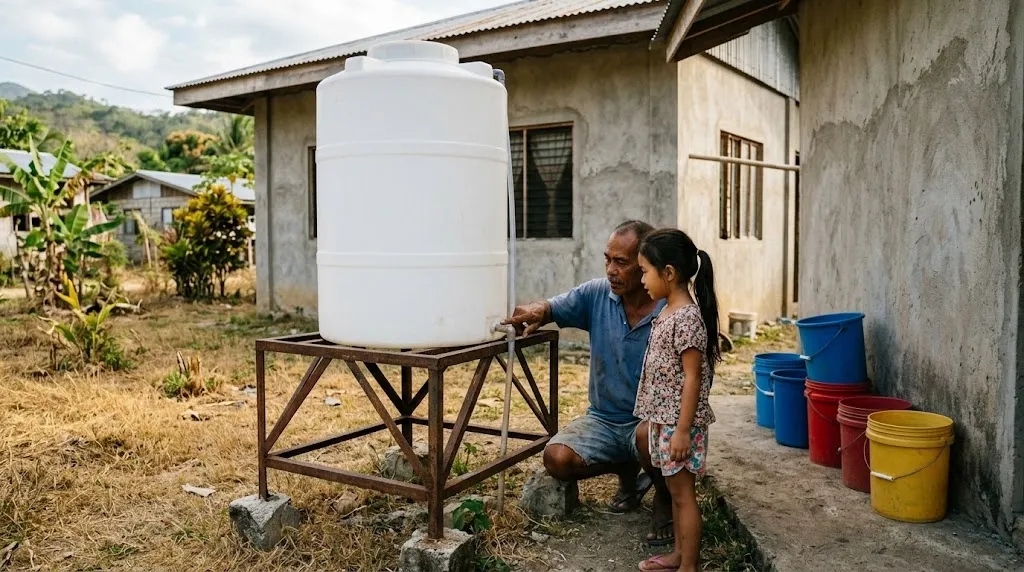
A full tank weighs a tonne for every cubic metre. Illustrative photo.
If the tap here goes dry or runs a few hours a day this dry season, the question is a blunt one: how many days does what is in your tank actually last? PAGASA's El Niño page (updated 21 October 2026) puts the backdrop plainly: "A strong to very strong El Niño is present in the Tropical Pacific," most models keep it going until the first quarter of 2027 with a peak before the end of 2026, and its effects may last through the first half of 2027. That is the reason to know your number now.
That is a different question from the one our tank and cistern sizing post answers. That post sizes a tank to the Plumbing Code's one-day storage rule where supply is intermittent. This one starts from a tank you already own (or are about to buy) and runs the clock backwards: persons, litres each, what the roof might add, how many truck deliveries cover the rest, and what all that water does to the stand under it.
Enter your household, tank and the length of dry spell you want to cover. You get the days your stored water lasts, the litres and truck trips you would still need, and an elevation of the tank and stand drawn from your numbers. The defaults assume the worst case: nothing from the tap, nothing from the roof. A planning aid, not a design.
A vertical tank of your capacity and diameter on a four-post stand of your height. The water line follows the starting fill. Footing width is worked from the full tank weight and the soil value you picked, and is never drawn smaller than the 300 mm minimum of Table 304-1.
Planning sketch, not for construction, not to scale (NTS). Stand members, bracing, base plates, anchorage, tank seating and the footing design are per design by a licensed engineer. The footing check covers the tank water and the empty weight you enter, not the stand's own weight, wind or earthquake.
Four things we read, each on its own page. As of 28 October 2026:
We found no statement of a 2026 state of calamity for the province, and we are not claiming one. Nor did we find a utility announcement of rationing in your town. What we can say is that the province was already in drought in September, PAGASA expects it back in drought by February, and the event is expected to persist, which is a reason to know your number now rather than in March.
For scale, the PAGASA 1991-2020 normals for Dumaguete City, a 30-year average and not a forecast, put February at 73.7 mm, March at 68.2 mm and April at 49.1 mm in a normal year, against 1,322.6 mm for the whole year. Even in a normal year those are the thin months.
People argue about the number, so use someone else's. The WHO report Domestic Water Quantity, Service Level and Health (Howard and Bartram, 2003) works from the bottom: a minimum of 7.5 litres per person per day for drinking and food preparation will meet the needs of most people under most conditions, based on a lactating woman doing moderate work in above-average heat. Above that it describes levels of service by the average quantity people actually use: basic access unlikely to exceed 20 litres, intermediate access about 50 litres (handwashing and food hygiene assured, and laundry and bathing too), and optimal access 100 litres and above. The same report cautions that 20 litres is a statement about access, not a recommended quantity.
The sizing post's 150 litres is AEDO's planning default for normal household use. In a dry spell almost nobody lives at 150. Rationing makes people carry water, and carried water is used carefully. So the calculator's presets run from the WHO floor to the normal-use default, and the useful exercise is to see the whole range at once.
A roof catches one litre per square metre per millimetre of rain, less losses. The rainwater post works that through month by month with the PAGASA normals and the Texas Water Development Board manual: collection surface is the roof's plan area, and most installers assume 75 to 90 percent efficiency. We reuse both here.
The catch for this post is the default. In an El Niño dry spell the rain is below normal by definition, and below normal is not zero but it is not something you can bank. So the calculator starts the window at 0 mm. Take the normal-year Dumaguete figures for February to April (191 mm together) on a 60 sqm roof at 80 percent: about 9,168 litres, if the year were normal. A below-normal spell cuts that, and the first flush of each shower is thrown away on top (the Texas manual recommends diverting 1 to 2 US gallons per 100 sq ft, which is 0.41 to 0.81 litres per square metre). Enter whatever rainfall you believe in and watch the days move, but do not plan the household around it. If you want the sizing and cost side of rain capture, that post is the one to read, and it also covers why a roof tank should not be plumbed into the drinking supply without treatment and testing.
Whatever the tank and roof do not cover, someone has to bring. The calculator turns the shortfall into a number of deliveries and, if you enter a price, a cost. We give no default price: delivered water varies by town, distance, season and supplier, and we have no published source we trust for a Negros Oriental figure. Call two suppliers, ask what one delivery is in litres and in pesos, and type both in.
The default case shows why the number matters. Five people at 50 litres each use 250 litres a day. Over 90 days that is 22,500 litres. A full 2,000 litre tank covers 2,000 of it, so 20,500 litres have to arrive, which is 11 deliveries if each fills the tank. The same household held to the WHO basic level of 20 litres each needs 7,000 litres and four deliveries after the tank. That spread, 11 trips against 4, is the whole argument for deciding the household's rule on water before the tank is empty, not after.
One more number the calculator prints: if you get no delivery at all, a 2,000 litre tank spread across 90 days gives each of five people 4.4 litres a day. That is below the WHO 7.5 litre floor for drinking and food preparation alone, before any washing. A tank of that size alone does not carry a household through a three-month dry spell.
Water weighs about 1,000 kilograms per cubic metre, so a 2,000 litre tank holds about 2 tonnes of water, roughly 19.6 kN, before you add the tank and the stand. People who raise a tank on a steel or timber stand to get pressure (height is pressure, 9.81 kPa per metre) are putting a tonne or two on four legs. The usual failures are boring ones: legs standing on a thin slab or loose fill, base plates unanchored, bracing missing, and a stand welded for an empty tank and then filled and left full for a season.
The drawing and the check in the calculator are deliberately modest. They divide the full tank weight over four posts and ask what bearing area each needs at the soil value you pick. For clay at the 50 kPa NSCP 2015 gives in Table 304-1 (Allowable Foundation and Lateral Pressure, p. 3-13 of the Volume I scan), the default 2,000 litre tank needs about 0.10 sqm per post, a pad around 0.31 m on a side. That is only just over the 300 mm minimum width the table's values are based on, so the pad is small either way, and it says nothing about the frame. Section 304.2 allows these presumptive values only when no exhaustive geotechnical investigation is done and only if the foundation design engineer has at least inspected the site; it also says mud, organic silt, organic clays, peat and unprepared fill are not to be assumed to have any presumptive capacity. Fill that was dumped last year is not a footing.
A dry spell has a second structural wrinkle. NSCP 2015 section 303.5 defines expansive soils (plasticity index of 15 or more, more than 10 percent of particles passing the No. 200 sieve, more than 10 percent finer than 5 micrometres, and expansion index above 20, all four) and requires footings on them to resist differential volume change. Clay that shrinks in a long dry spell and swells in the next wet one is the case that clause is about. A stand on a small pad in clay can settle unevenly, and a tank that tilts a little at 2 tonnes is a tank to empty and look at. For anything taller than a couple of metres, or a tank on a roof deck, see our elevated tank tower guide: NSCP 2015 treats tank towers as their own seismic case and the empty tank can govern uplift in wind. Our tower inspection guide covers what to look for on one already standing.
WHO's dengue fact sheet recommends covering, emptying and cleaning domestic water storage containers on a weekly basis. For a closed tank, the practical version is a tight lid, a screen on the vent and the overflow, a clean tap, and no open pails or drums standing beside it filled from the tank. The Texas manual's tank basics say the same in engineering terms: tanks must be opaque to inhibit algae and covered with screened vents to discourage mosquito breeding. Deliveries stretch the time between refills, so a drum that sits for weeks is where this goes wrong. We found no Philippine rule that sets a cleaning interval for a household tank, so the weekly line is WHO's recommendation for containers, not a local requirement.
Weather, read 28 October 2026: PAGASA ENSO monitoring page (updated 21 October 2026); PAGASA drought and dry spell assessment (issued 1 October 2026); PAGASA Seasonal Climate Outlook July to December 2026 (issued 8 July 2026); GMA News report of the 28 July 2026 outlook (secondary source); PAGASA climatological normals for Dumaguete City, 1991 to 2020. Litres per person: WHO/SDE/WSH/03.02, Domestic Water Quantity, Service Level and Health (2003). Dengue: WHO dengue fact sheet. Roof catch: Texas Water Development Board, Texas Manual on Rainwater Harvesting, 3rd edition. Soil: NSCP 2015 Volume I, sections 303.5 and 304.2, Table 304-1, read from the printed volume. Plumbing Code: the one-day storage rule is quoted from AEDO's own NPC reference page for section 601, not from the code volume. Our arithmetic: every litre, day, trip and kilopascal here is computed from the inputs, shown in the calculator notes. AEDO planning assumption, edit it: 150 L per person per day for normal use, the 90-day default window, the 80 percent roof efficiency default (inside the Texas 75 to 90 range), and the 4-post equal-load split on the stand. Left for you to enter, no AEDO figure: tap litres per day, rain over the window, delivery size and price, empty tank weight. What we could not confirm: any current utility rationing schedule, any local delivered-water price, and any Philippine rule on cleaning a household tank.
You can do this week: measure your actual use (read the tank level at the same hour for three days with the household behaving normally, and divide); fill the tank and see how long it really lasts; fit a lid and insect screen if either is missing; check that the base is level and that the stand legs sit on concrete, not loose fill; write down two delivery suppliers and what a delivery costs; agree the household's priorities (drinking, cooking, toilet flush, laundry) before the tank is low. Our gutter and downspout guide covers the roof side if you do collect rain.
Do not do yourself: raise a tank onto a new stand, put a tank on a roof deck or a slab that was not designed for it, bury a tank, or tie a roof tank into the drinking supply. Those need a licensed engineer for the load path, and for the plumbing, a master plumber under the Plumbing Code. If a deep well is the longer-term answer, the deep well guide covers cost and permits. A tank or stand that already shows cracks, a tilt or rust at the base can be looked at through a structural assessment; see the structural assessment service page for scope and current pricing.
AEDO designs, checks and reviews nationwide and builds only in Negros Oriental. In the province, from Dumaguete to Bais, we can design and build a tank stand or a cistern through our design-build service. Elsewhere we review your stand and tank layout remotely and check milestones of the contractor you hire. We do not supply water and give no price for it. The timing of rain and the wording of any local advisory belong to PAGASA, your water district and your LGU, and the climate context for the province is covered in our rainy-season painting schedule post, which cites the same PAGASA normals.
What AEDO does. We size and check household tank, stand and cistern layouts, review the load path and bearing for a full tank, and in Negros Oriental we build them. We do not sell water, do not publish any delivery price, and do not give legal or health opinions. Quote after a plan review or site visit.
How many days will a 2,000 litre tank last for a family of five?
It depends on what the family uses per person per day. At 50 litres each (250 litres a day) a full 2,000 litre tank lasts 8 days, at 20 litres each it lasts 20 days, and at 150 litres each it lasts about 2.7 days. Those assume nothing flows back into the tank.
How much water does a person need per day in a dry spell?
The WHO report Domestic Water Quantity, Service Level and Health puts the minimum for drinking and food preparation at 7.5 litres per person per day, and describes about 50 litres as the average at intermediate access, where laundry and bathing are also assured. Treat 7.5 as a survival floor, not a plan.
Can I rely on my roof to refill the tank during El Niño?
Not in a dry spell. PAGASA's seasonal outlook for October to December 2026 expects generally below-normal rainfall over most of the country, and a roof only collects what falls on it. The calculator defaults rain over the window to zero so the answer is the worst case, and you can type a rainfall figure if you want to see a better one.
How much does a full water tank weigh and what should it sit on?
Water is about 1,000 kilograms per cubic metre, so a 2,000 litre tank holds about 2 tonnes of water before you add the tank and the stand. It needs a level, firm base or a stand designed for that load, with the bearing of the soil checked. NSCP 2015 Table 304-1 gives presumptive values of 50 kPa for clay, 75 kPa for sands and 100 kPa for gravel when no geotechnical investigation is done.
Does a stored water tank cause dengue?
An open or poorly covered one can. WHO's dengue fact sheet recommends covering, emptying and cleaning domestic water storage containers on a weekly basis. Keep the lid on, screen the vent and overflow, and do not leave tank-side buckets uncovered.
Pages, reports and codes read for this article between 20 and 28 October 2026 (web pages returned HTTP 200). External links open in a new tab.
We found no utility rationing schedule, no delivered-water price source and no Philippine rule on cleaning a household tank. This article is general information, not a water supply design or a health or legal opinion.
Send the tank size, stand height, a photo of the base and the soil if you know it. The AEDO team will check the load path and bearing for a full tank and tell you what to fix before it sits full for months.