A concealed wall, a tiled floor, and a plumbing system installed without a permit — that's the exact combination that gets homeowners a stop-work order and an order to break open finished walls, months after the contractor already got paid. It happens because most people have never heard of the single law that governs every water line, drain, and septic connection in a Philippine building.
That law is Republic Act No. 1378, the Plumbing Law ("An Act to Regulate the Trade of Master Plumber"), and its current implementing text, the Revised National Plumbing Code. It sits alongside the National Structural Code (NSCP) and the National Building Code as one of the three codes a project must satisfy before it gets an occupancy permit — yet it is by far the least written about.
This guide covers what the code actually is, who is legally required to sign off on plumbing work, how the permit and inspection process runs, and a chapter-by-chapter map — with links into AEDO's free, illustrated NPC Visual Reference for anyone who needs the full detail.
The legal basis and history of the code, how it differs from the Sanitation Code and Building Code, who is allowed to do plumbing work, the 8-step permit process with a visual flow diagram, trap & vent anatomy, a free WSFU fixture-unit calculator, and a direct link to every chapter of AEDO's free interactive NPC reference. No paywall. No signup.
The National Plumbing Code of the Philippines governs the design, installation, alteration, repair, and inspection of plumbing systems in every building in the country — water supply piping, sanitary drainage, venting, traps, storm drainage, and the fixtures connected to them. Its legal foundation is Republic Act No. 1378, signed by President Ramon Magsaysay on June 18, 1955, which created the Board for Master Plumbers and made plumbing a regulated, licensed trade.
| Milestone | Year | What Happened |
|---|---|---|
| RA 1378 | 1955 | "Plumbing Law" enacted, creating the Board of Examiners for Master Plumbers |
| Original Code | 1959 | First National Plumbing Code promulgated under RA 1378 |
| Revised Code ("NPC 2000") | 1999–2000 | Drafted by NAMPAP, reviewed by the Board of Master Plumbers, approved by the PRC — the current governing text |
The revision was drafted by the National Master Plumbers Association of the Philippines (NAMPAP), submitted to the Board for Master Plumbers in October 1999, and adopted by the Professional Regulation Commission — modernizing a code that had not been updated in roughly 40 years. In practice, engineers and plumbers refer to this text as NPC 2000.
A recurring source of confusion: there are three different national codes that touch a building's water and waste systems, each with its own scope and its own governing body.
| Code | Legal Basis | Covers |
|---|---|---|
| National Plumbing Code | RA 1378 | Plumbing system design/installation — pipe sizing, fixture units, venting, traps, permits |
| Code on Sanitation | PD 856 | Public health — water potability, sewage/excreta disposal standards, food sanitation |
| National Building Code | PD 1096 | Overall building permit umbrella; references NSCP for structural design |
A building permit application under PD 1096 typically requires clearances tied to all three codes — structural plans compliant with NSCP, plumbing plans compliant with RA 1378, and septic/sewage design compliant with PD 856's sanitation standards. Missing any one of them is a common cause of permit delay.
RA 1378 makes plumbing a registered trade: only a Registered Master Plumber may practise plumbing as defined in Sec. 2 — consultation, design, plans, specifications, estimates, installation and supervision — under the PRC Board for Master Plumbers:
| License | Can Do | Eligibility |
|---|---|---|
| Master Plumber (RLMP) | Prepares, signs, and seals plumbing plans; applies for permits; supervises installation | 21+ years old, Filipino citizen, high school graduate, 5 years of documented plumbing experience, passed the PRC board exam |
| Plumber working under supervision | Performs installation and repair work under a Registered Master Plumber's supervision | RA 1378 does not create a separate licence for this role — the Registered Master Plumber supervising the work remains accountable under Sec. 2 and Sec. 20 |
Only a Registered and Licensed Master Plumber (RLMP) may sign and submit plumbing plans to the local Building Official or Engineering Office. This is the same principle as the "signed and sealed" requirement for structural plans under NSCP — the license exists so someone accountable and qualified stands behind the design. Plumbing plans are one of the five systems in a MEPFS design set, and they have to agree with the mechanical, electrical and fire protection plans filed beside them.
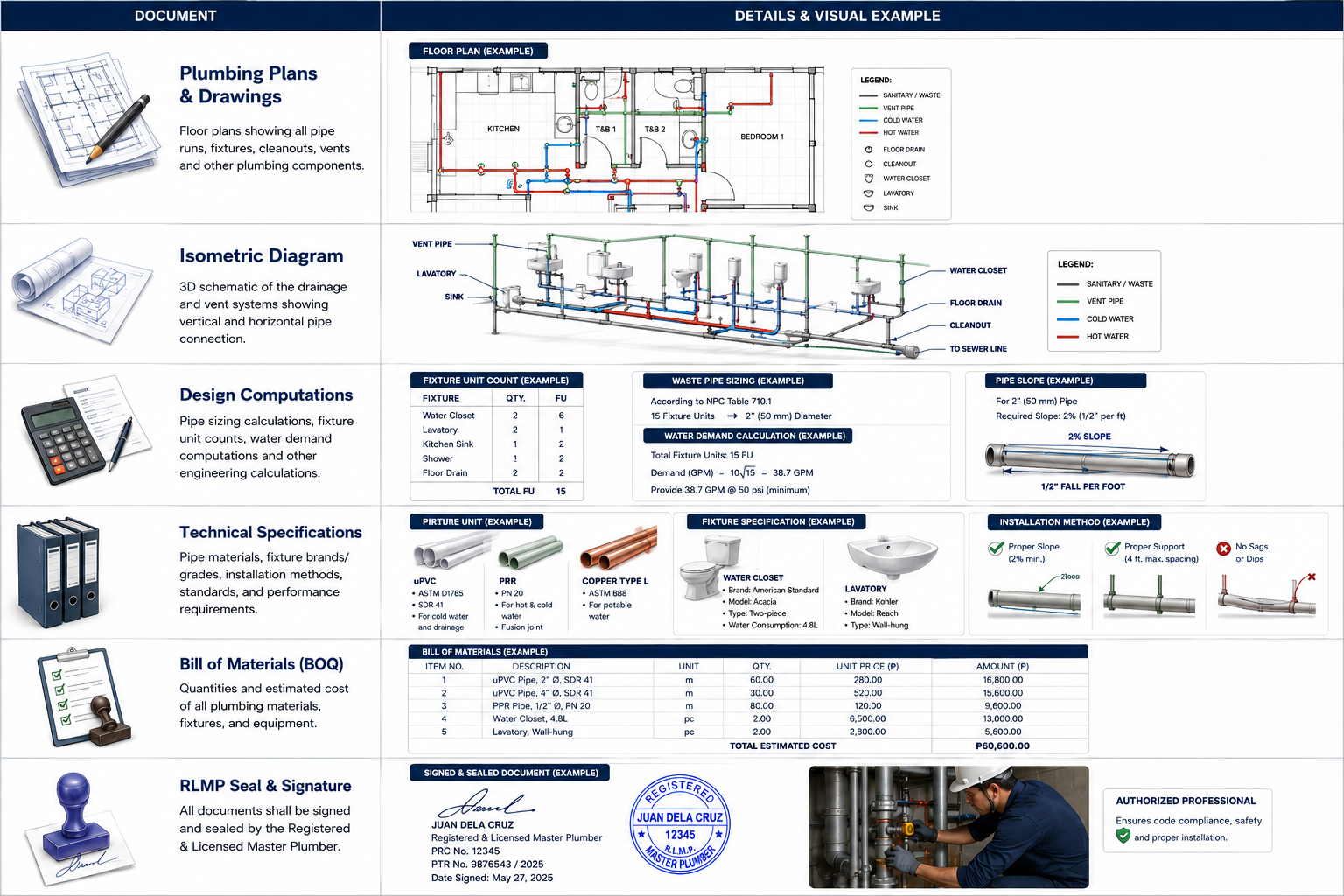
A complete plumbing permit submission: signed & sealed floor plans, an isometric drainage/vent diagram, fixture-unit and pipe-sizing computations, technical specifications, a bill of materials, and the RLMP's PRC-registered seal and signature.
Plumbing installed without a permit or without an RLMP's signature can be ordered removed, fined, or disconnected from utilities — even after the work is finished and paid for. On a house or commercial project, this is one of the cheapest problems to avoid up front and one of the most expensive to fix after concealment (walls closed, floors tiled, ceilings installed).
Coordinating plumbing with a new build or renovation? AEDO coordinates RLMP-signed plumbing plans alongside structural and architectural design — one submission, code-compliant on all three fronts.
Most plumbing failures in Philippine buildings — sewer gas odor, gurgling drains, low water pressure, burst fittings — trace back to one of a handful of numeric requirements in NPC Chapters 6, 9, and 10. Every fixture trap needs a water seal, that seal needs a vent to protect it, and the water supply needs to stay within a defined pressure band:
| Requirement | Value | Why It Matters |
|---|---|---|
| Trap seal depth | 51–102mm | Too shallow evaporates and lets sewer gas through; too deep won't self-siphon clean (Ch. 10, §1005) |
| Trap types | S-traps & bell traps prohibited | Both lose their seal easily to siphonage — only approved trap geometries may be installed (§1004) |
| Water supply pressure | 103–551 kPa | Below 103 kPa, fixtures starve; above 551 kPa, a pressure-reducing valve (PRV) is required (Ch. 6, §601/§610) |
| Water piping pressure test | 125% of working pressure, or 344.5 kPa (50 psi) minimum, held 15 minutes | Confirms no leaks before concealment — required at rough-in inspection (Ch. 5) |
| Cross-connection air gap | 2–3× pipe diameter (Table 6-1) | Prevents back-siphonage of contaminants into the potable supply (§604) |
A trap seal is the small pocket of standing water sitting in every P-trap under your sink, toilet, and floor drain. It's a physical plug that blocks sewer gas from coming back up into the room. The vent's only job is to let air in from the roof so draining water doesn't suck that plug dry. Skip the vent, or get the seal depth wrong, and the fix isn't a fitting — it's the smell of a sewer every time someone flushes.
Per NPC Chapter 1 (Administration), the plumbing permit process runs in parallel with — but separately from — the building permit process:
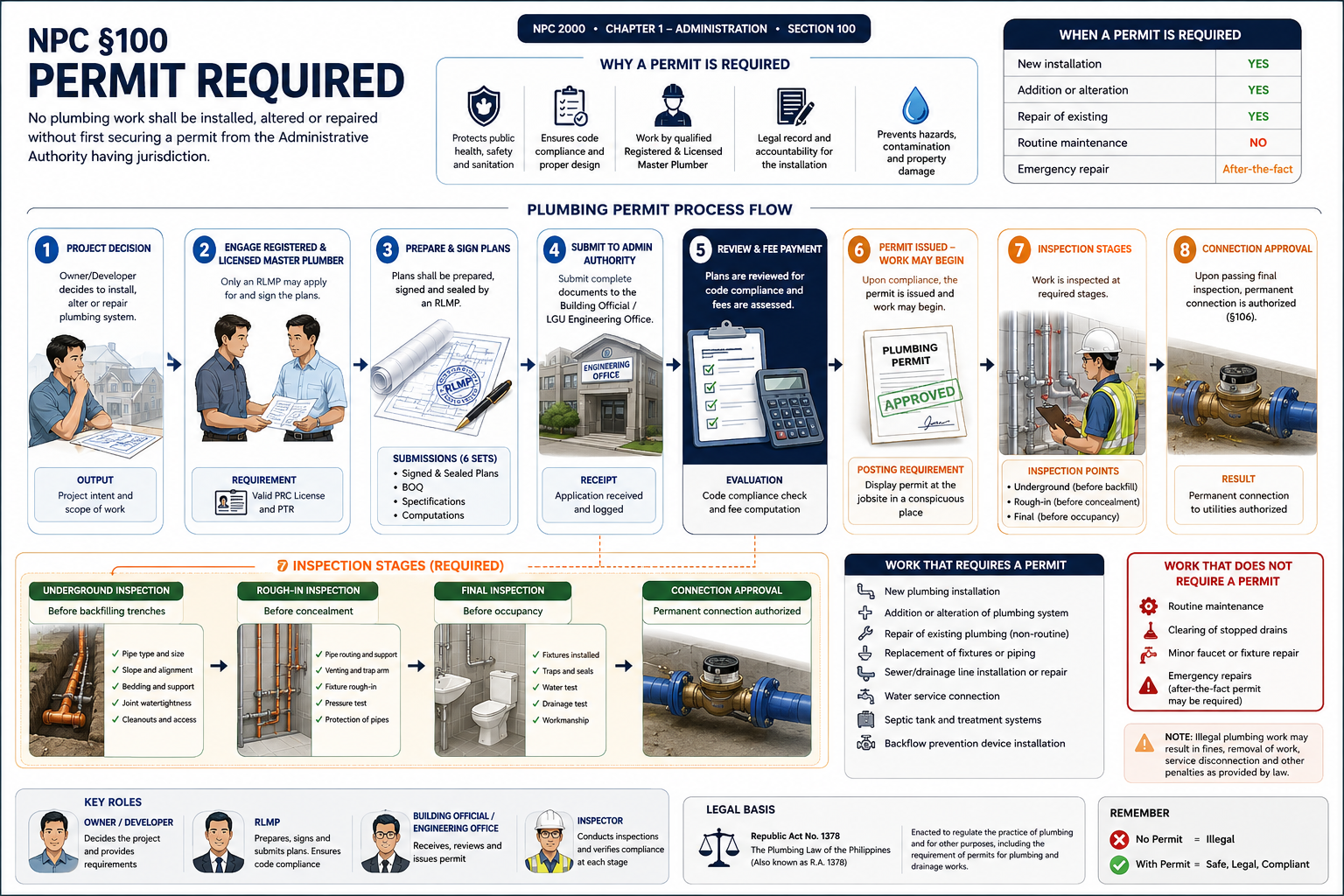
NPC §100 in full: why a permit is required, the complete process flow, the 4 required inspection stages, key roles (owner, RLMP, building official, inspector), and which work does — and doesn't — need a permit.
Work that requires a permit: new plumbing installation, addition or alteration, non-routine repair, fixture replacement, sewer/drainage line installation, water service connection, septic tank and treatment systems, and backflow prevention devices.
Work that does not require a permit: routine maintenance, clearing stopped drains, and minor faucet or fixture repair. Emergency repairs may proceed immediately but generally need an after-the-fact permit.
A homeowner wants to move a bathroom sink 1.5 meters over during a kitchen-and-bath renovation, tying into the existing drain line at a new point. Does this need a permit signed by an RLMP?
The Revised National Plumbing Code is organized into 14 chapters plus reference appendices. Each links to AEDO's free illustrated reference:
| Ch. | Title | Covers |
|---|---|---|
| 1 | Administration | Permits, RLMP requirement, inspections |
| 2 | Definitions | 200+ technical terms used throughout the code |
| 3 | General Regulations | Pipe materials, grades, fittings, workmanship |
| 4 | Plumbing Fixtures | Fixture requirements, minimum fixture counts by occupancy |
| 5 | Inspection & Testing | Pressure tests, required inspection points |
| 6 | Water Supply | Pipe sizing, water pressure, distribution |
| 7 | Excreta Drainage System | Sanitary drainage design and sizing |
| 8 | Indirect & Special Wastes | Grease traps, industrial/special waste handling |
| 9 | Vents & Venting | Vent stack sizing and configuration |
| 10 | Traps & Interceptors | Trap seals, grease and oil interceptors |
| 11 | Storm Drainage | Roof drains, gutters, storm sewer sizing |
| 12 | House Drains & Sewers | Building drain and sewer connection design |
| 13 | Joints & Connections | Approved jointing methods by pipe material |
| 14 | Quality & Materials | Approved pipe/fitting materials and standards |
| App. B | Private Sewage Disposal | Septic tank design where no public sewer exists |
Pipe sizing under NPC Chapter 6 starts by tallying Water Supply Fixture Units (WSFU) for every fixture on a branch or main — one WSFU is roughly a demand flow of 28.3 L/min. Add your fixture counts below for a quick residential (Private Use) tally per NPC Table 6-5:
Enter how many of each fixture the unit has. This tallies total WSFU per NPC Table 6-5 — a starting point, not the final pipe size.
Treat the WSFU count above as a planning number, not a permit number. Final pipe sizing also depends on your local supply pressure band and the developed length of pipe run — two site-specific factors this quick counter can't see. Confirm final sizing with an RLMP before it goes on a permit submission; getting pipe size wrong at rough-in means cutting into a wall that's already closed.
AEDO built a full illustrated companion site for the code — the same free-tool approach used for NSCP and BP344 on this blog:
Every requirement in NPC 2000 — trap seals, vent sizing, pressure tests, an RLMP's signature — exists to catch a problem while it's still an open wall, not after the tile is set and the paint is dry.
Get it checked before concealment, and it's a line item. Get it checked after, and it's a demolition.
If you need plumbing coordinated with your structural and architectural plans, AEDO Construction is ready to help.
A quick overview of what the National Plumbing Code of the Philippines covers. From the AEDO YouTube channel, uploaded 2026-06-15.

The National Plumbing Code of the Philippines governs the design, installation, and inspection of plumbing systems nationwide — water supply, drainage, venting, fixtures, and related work. It was created under Republic Act No. 1378 (1955), and its current governing text is the Revised National Plumbing Code, commonly referenced as NPC 2000, adopted by the Board for Master Plumbers under the PRC.
No. The National Building Code (PD 1096) is the umbrella permit code and references NSCP for structural design. The Code on Sanitation (PD 856) covers public health matters like water potability and sewage disposal standards. The National Plumbing Code (RA 1378) specifically governs plumbing system design and installation. A project typically needs to satisfy all three.
Only a Registered and Licensed Master Plumber (RLMP) may apply for and sign plumbing permits, and plumbing installation, alteration and repair must be performed or supervised by a Registered Master Plumber — RA 1378 creates no separate journeyman licence. Unlicensed plumbing work is illegal and can be ordered removed or disconnected even after it's finished.
New installation, alterations, non-routine repair, fixture replacement, sewer/drainage work, septic systems, and backflow devices all require a permit signed by an RLMP. Routine maintenance, clearing stopped drains, and minor faucet repairs generally don't. Emergency repairs may proceed immediately but usually need an after-the-fact permit.
NPC 2000 has 14 chapters — Administration, Definitions, General Regulations, Plumbing Fixtures, Inspection & Testing, Water Supply, Excreta Drainage System, Indirect & Special Wastes, Vents & Venting, Traps & Interceptors, Storm Drainage, House Drains & Sewers, Joints & Connections, and Quality & Materials — plus Appendix B on private sewage disposal. AEDO's free visual reference covers all 14.
When we publish a new NSCP breakdown, NPC guide, or structural incident analysis, we'll send it directly to you.
No spam. One email per insight. Unsubscribe anytime.
Statutes, codes, official tools and references used or referred to in this article, linked to their source. Links open in a new tab.
Prices, cost bands and rate figures in this article are AEDO Construction's own market and practice figures for Philippine work unless a source is named beside them. Code and statute references above link to the primary text.