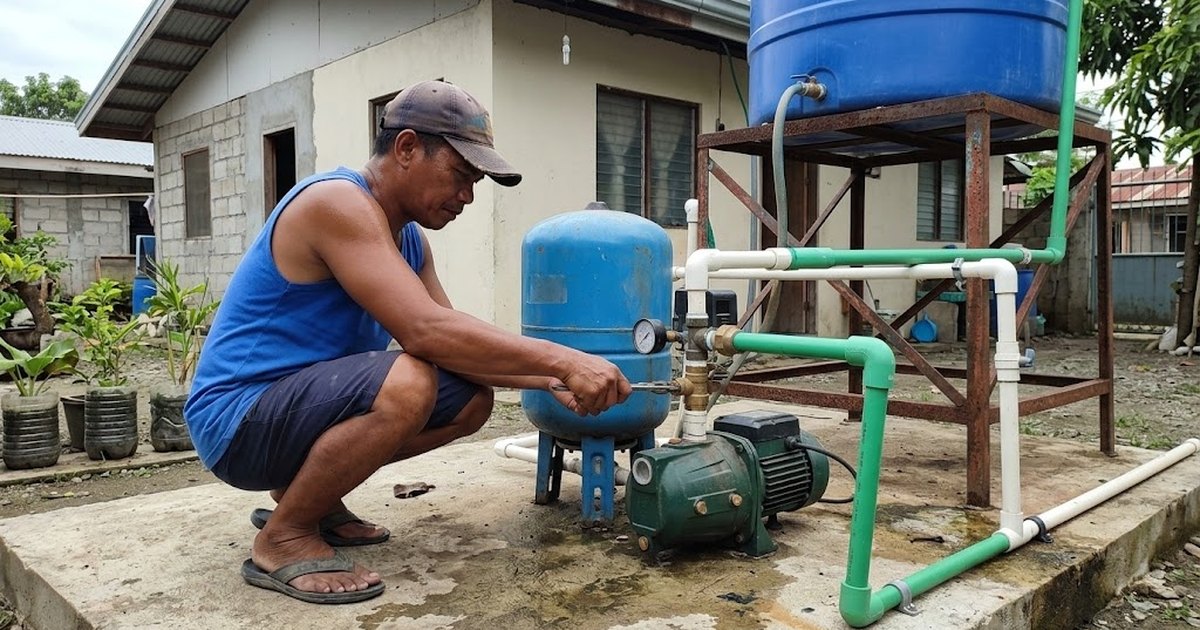
A pump and pressure tank only fix low pressure if the supply can keep up. Illustrative photo.
Short answer: pressure from a tank is height. Every metre of water column is worth about 9.81 kPa. Moving a fixture up to the second floor removes roughly three metres of that height, which is why the shower upstairs dribbles while the ground-floor tap is fine. If your pump only fills the tank, replacing it changes nothing.
In the usual Philippine setup the pump lifts water from a cistern into an overhead tank, and the house runs by gravity from the tank. In that arrangement the pump is not in the path between the tank and your shower, so its power is irrelevant to the pressure you feel. Only the water level in the tank and the pipework below it matter.
Works out the pressure your worst fixture actually sees from an overhead tank, or the pump head you need if gravity cannot do it. Friction is estimated by the Hazen-Williams method with the roughness coefficient stated below.
Pressure from a static column of water is p = ρgh. With water at about 1,000 kg/m³ and gravity at 9.81 m/s², that comes to roughly 9.81 kPa per metre of height, or about 1.42 psi per metre.
| Height of water above the fixture | Static pressure | How it feels |
|---|---|---|
| 1 m | ≈ 9.8 kPa | A trickle |
| 3 m — tank on a low roof, ground-floor tap | ≈ 29 kPa | Usable, weak shower |
| 6 m | ≈ 59 kPa | Acceptable |
| 10 m | ≈ 98 kPa | Comfortable shower |
| Above 56 m | > 551 kPa | Pressure-reducing valve required |
Now subtract. A tank whose water level is 3 m above the ground floor is only about 0.2 m above a second-floor shower head once you account for the floor-to-floor height and the shower rose. That is essentially zero pressure, and it is the entire explanation for most complaints.
Static head is what you start with. Friction along the pipe is what you lose on the way, and it climbs steeply with flow — roughly with flow to the power of 1.85 in the Hazen-Williams method. That is why pressure collapses the moment a second tap opens on the same undersized riser, and why the plumbing code sizes supply pipes by water supply fixture units rather than by counting outlets.
| Arrangement | Where pressure comes from | Best for |
|---|---|---|
| Overhead tank, gravity feed | Tank height only | Single storey, or upper tank on a tower |
| Cistern + pump to overhead tank | Still tank height. The pump only fills | Unreliable mains. Does not fix upstairs pressure |
| Booster pump with pressure tank | The pump, on the line feeding the house | Two storeys and up. The usual real fix |
| Variable-speed booster | The pump, modulating to hold pressure | Steady pressure with several fixtures at once |
The second row is where the money gets wasted. A more powerful pump filling the same tank gives you a faster fill and identical showers. If the complaint is pressure rather than supply, the pump has to sit between the storage and the house.
There is an upper limit as well, and this one is a code requirement rather than a comfort preference. Where the water pressure exceeds 551 kPa, a pressure-reducing valve is required. That matters on tall buildings, on steep sites fed from a high tank, and on mains-fed houses in areas with strong municipal supply. High pressure is not a bonus: it wastes water and destroys flexible connectors and cartridge seals.
Our water tank and cistern sizing calculator covers how much storage you need under the plumbing code, and the National Plumbing Code guide covers fixture-unit pipe sizing, which is the other half of this problem.
The 551 kPa threshold above which a pressure-reducing valve is required, and pipe sizing by water supply fixture units, are from the National Plumbing Code of the Philippines as set out in AEDO's own NPC reference. The 9.81 kPa per metre figure is p = ρgh with water at 1,000 kg/m³ and g = 9.81 m/s². Friction loss uses the Hazen-Williams equation with the C value selected in the calculator and a fittings multiplier, which is an estimating method, not a code procedure. The residual pressure target is a comfort choice, not a code minimum — we have not asserted a code minimum here because we did not verify one.
Why is my water pressure weak on the second floor?
Because pressure from a tank comes from height, and the second floor removes most of it. A column of water produces about 9.81 kilopascals of pressure for every metre of height, so an overhead tank whose water level sits three metres above a ground-floor tap delivers roughly 29 kilopascals there. Move the same tap to the second floor and you have removed about three metres of that height, leaving very little. Nothing is wrong with the pump. The tank is simply not high enough above the fixture it is trying to serve.
Will a bigger pump fix weak pressure from an overhead tank?
Not if the pump only fills the tank. In the common Philippine arrangement the pump lifts water from a cistern into an overhead tank, and the house is then fed by gravity from that tank. In that setup the pump has no influence at all on the pressure at your shower, because it is not in the path between the tank and the fixture. Replacing it with something more powerful fills the tank faster and changes nothing downstream. The fixes are to raise the tank, or to add a booster pump on the line that actually feeds the house.
How high should an overhead tank be?
Work backwards from the highest and furthest fixture rather than from a rule of thumb. Decide the residual pressure you want at that fixture, add the friction loss along the pipe run to it, and convert the total back into metres at 9.81 kilopascals per metre. A shower on the second floor wanting a comfortable 100 kilopascals needs roughly ten metres of water column above it once friction is allowed for, which is well beyond a tank sitting on a typical roof. That arithmetic is why most two-storey Philippine houses end up needing a booster pump rather than a taller tower.
What is the difference between a booster pump and a pressure tank?
The pump makes the pressure and the pressure tank stops the pump from cycling on and off every time someone opens a tap. The tank holds a cushion of compressed air above a diaphragm, so small draws are served from stored water while the pump stays off. Without one, a pressure-switch pump starts and stops constantly, which is noisy and shortens its life. With a modern variable-speed pump the tank can be much smaller, because the pump modulates instead of switching.
Can water pressure be too high?
Yes, and the plumbing code sets the point at which you must do something about it. Where the water pressure exceeds 551 kilopascals, a pressure-reducing valve is required. High pressure wastes water, makes fixtures noisy, and is hard on flexible connectors, cartridges and seals — the failures usually show up first at the cheapest connector in the house.
Why does the pressure drop when someone else opens a tap?
Because friction loss rises steeply with flow. Doubling the flow in a given pipe raises the loss along it by roughly a factor of three and a half, so a pipe that is adequate for one fixture can starve two. This is a pipe sizing problem rather than a pump problem, and it is the reason the plumbing code sizes supply pipes by water supply fixture units rather than by the number of taps. A single undersized riser feeding a whole upper floor is the most common version of it in Philippine houses.
References used or referred to in this guide. Links open in a new tab.
The Hazen-Williams friction method, the C values offered and the fittings multiplier are standard estimating practice, not code procedures. The residual pressure target in the calculator is a comfort choice. No code minimum pressure is asserted here because none was verified for this article.
Tank height, storage volume, pipe sizes and pump duty are one calculation. Solved separately they produce the house you already have.