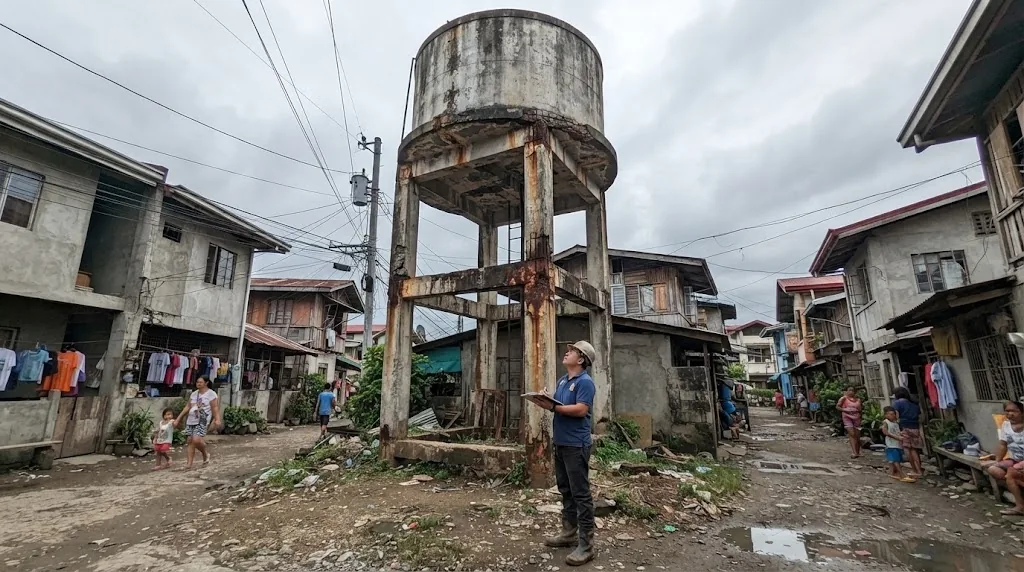
Rust streaks and spalling on the columns of an occupied neighbourhood tower are a reason to inspect, not wait. Illustrative photo.
Short answer: a water tank tower that's been standing for years without visible problems is not automatically safe — it's a structure that carries a huge, concentrated weight on a small number of slender legs, and the failure modes that matter (corrosion at the base connections, an added tank the frame was never sized for, a lean that's grown slowly enough to become normal-looking) don't always announce themselves before something gives. If you manage a subdivision, resort, school, factory or barangay water system with a tower more than 10–15 years old, or one that's had its tank replaced or upsized, treat that as a reason to get it looked at — not because towers are inherently unsafe, but because the ones that fail tend to fail with very little warning while full of water.
This is not a piece about how towers are built. It's about deciding whether the one you already have needs attention now, needs routine maintenance, or needs a full engineering assessment before you find out the hard way.
Answer what you can see and know about your tower. This flags urgency based on the risk factors engineers actually look for — it is not a substitute for a physical inspection.
On a steel angle-bar tower, the base plates, anchor bolts, and the leg-to-brace connections near the ground are where load concentrates and where corrosion is worst — splash zone moisture, standing water at footing level, and (for towers near the coast or in the humid conditions common across Negros Oriental and the Visayas) salt-laden air all attack steel fastest exactly where the tower can least afford to lose section. A tower can look reasonably intact overall — paint mostly holding on the upper legs, no obvious sag — while the connections at the base have quietly lost enough steel to matter. That mismatch between "looks fine from a distance" and "compromised at the one point that carries everything" is why base connections get checked first in a real inspection, not the tank or the upper bracing.
A hold point, stated honestly: we did not find a Philippine or international standard corrosion-rate table to cite for exactly how fast this happens — that depends on coating type, maintenance history, and micro-site exposure too much for one number to be meaningful, and we're not going to invent one. What we can say, as AEDO's own field-based illustrative range rather than an official statistic: mild steel that's only painted, on a tower with no maintenance program, has shown meaningful section loss at connections within roughly 10 to 15 years in humid coastal-adjacent conditions in our own project experience. Hot-dip galvanized steel, properly detailed, has typically held up well past 25 years before similar loss appears. These are AEDO's practice-based observations, not a published standard — treat them as a reason to look, not as a precise clock.
A tower that visibly leans — even slightly, even if it's "always been like that" — is telling you one of two things: the footing has settled unevenly, or a leg or connection has lost stiffness or capacity on one side. Neither self-corrects, and both get worse under load, especially during wind events when the tank is full and the whole structure is being pushed sideways on top of whatever asymmetry already exists. A slow lean that residents or staff have gotten used to seeing is exactly the kind of thing that gets normalized until it isn't — "it's been like that for years" is not the same statement as "it's safe."
This is the risk factor that's easiest to miss because it has nothing to do with how the tower looks. NSCP 2015 Table 208-12, item 1 assigns vessels and tanks on braced or unbraced legs a seismic force-reduction factor of R = 2.2, with an overstrength factor Ω₀ = 2.0 — far lower than a typical building frame, meaning the tower has to resist proportionally more earthquake force for its weight. Section 208.8.5 then sets minimum base shear requirements specific to non-building structures like tanks (Eq. 208-25, and for Seismic Zone 4, Eq. 208-26) that run above the ordinary building minimums. These are specific, tank-and-vessel provisions — not a generic small-structure rule of thumb. The same provisions govern plant silos and process tanks, which we cover in our industrial tank and silo structural assessment guide.
The practical issue: a meaningful number of towers standing today were built before these provisions were commonly applied to small, informally-engineered structures like a subdivision or barangay water tower — or were built to a generic "small structure" assumption rather than the specific tank/vessel category. An older tower isn't automatically unsafe just because of its age, but age is a legitimate reason to ask the question that its original builder may never have been asked: was this actually designed against the seismic and wind demand a tank on legs specifically generates, or against a general assumption borrowed from house or fence-post design? That's not something you can tell by looking at the steel — it requires either the original design calculations (rarely kept for structures like this) or an engineering assessment against current provisions.
This is a real, common, and dangerous practice: the original tank cracks, corrodes, or simply becomes too small for growing demand, and it gets swapped for a larger one — sometimes considerably larger — on the exact same legs, bracing, and footing that were sized for the original capacity. The tower usually keeps standing afterward, which is precisely what makes this dangerous: nothing about swapping a tank announces that the frame is now carrying more dead load than it was designed for, more wind area if the new tank is larger in plan, and a different (usually worse) full-versus-empty load case at the footing. A structure that has spare capacity might absorb this without incident for years. One that doesn't may not give any warning before it doesn't.
If your tower has ever had its tank replaced with a bigger one — even once, even years ago — that alone is a reason for an engineering check against the original design, regardless of how the tower looks today.
| Check | What it's looking for |
|---|---|
| Base plates & anchor bolts | Section loss from corrosion, bolt tightness, concrete spalling or cracking around the anchors |
| Legs & bracing | Corrosion, bent or missing members, previous field repairs, weld condition |
| Verticality | Actual measured plumb, not a visual guess — even a small lean matters at height |
| Footings | Settlement, cracking, exposed or corroded reinforcement, drainage around the base |
| Load history | Has the tank been replaced or upsized; is it used for anything beyond its original purpose |
| Original design basis | If drawings/calcs exist, do they show the tower was designed against tank/vessel-specific seismic and wind provisions |
| Connections | Leg-to-brace and leg-to-platform joints — bolted or welded, and their condition specifically, not just the members either side of them |
| Situation | What it typically means |
|---|---|
| Visible tilt, or visible corrosion at base/connections | Get it assessed now. These are classic precursors — don't wait for the next scheduled check |
| Tank ever replaced with a bigger one | Engineering check against original design before assuming it's fine, regardless of appearance |
| Older tower, no known design basis, no recent inspection | Schedule a structural assessment — age plus unknown design basis is a real gap, even with no visible symptoms |
| Younger tower, known design, inspected within the last year or two, no distress | Routine maintenance — recoat as needed, watch for early corrosion, keep drainage clear at the footing |
| Extensive base corrosion or confirmed section loss found on inspection | Repair, strengthen, or replace depends on the extent — an engineer weighs remaining capacity against repair cost versus a new tower |
AEDO's structural capability on this structure type. AEDO has designed elevated steel water tank towers using NSCP 2015's specific non-building-structure seismic and wind provisions (Table 208-12, Sec. 208.8.5) — sizing legs, bracing, connections and footings against the actual demand a tank on legs generates, not a rule of thumb borrowed from building or fence-post design. That same engineering basis is what a proper assessment of an existing tower is checked against.
AEDO's role outside Negros Oriental. Structural safety assessment and design for an existing water tank tower is a service AEDO provides nationwide. Self-performed repair, strengthening or reconstruction work is limited to Negros Oriental; elsewhere, AEDO provides the assessment and design plus remote oversight of a contractor or fabricator the client hires locally to carry out the physical work.
How do I know if my water tank tower needs inspection now instead of later?
Two signs mean now, not later, regardless of the tower's age: any visible tilt or leaning, and visible corrosion or rust staining at the base plates, anchor bolts, or leg-to-brace connections. Both are classic precursors to a leg or connection losing capacity, and a tower carrying a full tank of water has very little warning between visible distress and failure.
What is the biggest structural risk in an old water tank tower?
Corrosion at the base of the legs and at the anchor bolts is the classic failure point, especially in coastal and humid Visayas/Negros Oriental conditions where mild steel that is only painted, not galvanized, and never touched up, loses section over time. A tower doesn't need to look badly rusted overall to have lost critical capacity right at the base connections, which is where load concentrates.
Can I just install a bigger tank on my existing tower?
Not without checking the original design. A tower's legs, bracing, connections and footings were sized for a specific tank weight, full, plus wind and seismic force on that geometry. Swapping in a larger tank adds dead load the frame may not have capacity for, and it is a common, dangerous practice precisely because the tower usually looks fine right up until it doesn't. This needs an engineering check against the original design, not a visual judgment call.
Does AEDO inspect and assess water tank towers outside Negros Oriental?
Yes. AEDO provides structural safety assessment and design services nationwide. Self-performed retrofit or repair construction work is limited to Negros Oriental; outside that province, AEDO delivers the assessment and design and provides remote oversight of a contractor the client hires locally to carry out the physical work.
Codes and references used in this article, and what was verified where.
Hold point, stated honestly: corrosion timelines cited above (steel losing meaningful section at connections within roughly 10–15 years painted-only vs. 25+ years hot-dip galvanized, in humid coastal-adjacent conditions) are AEDO's own field-based illustrative range from project experience, not figures from a published corrosion-rate standard — we did not find and are not citing an official table for this, and the real rate depends heavily on coating quality, maintenance history and site-specific exposure.
A visual opinion isn't the same as an engineering check against the loads the tower actually carries.