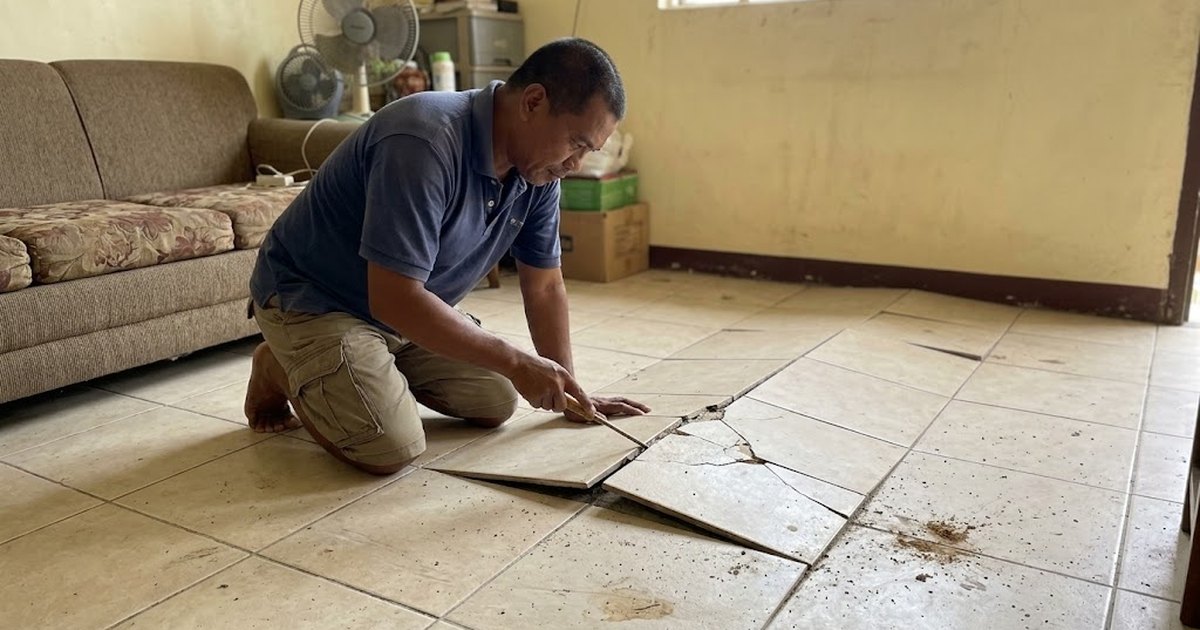
Tiles that tent up in a ridge have usually lost their bond to the slab, often because there were no expansion joints. Illustrative photo.
Short answer: a row of tiles that suddenly lifts with a bang is almost never an earthquake or a failing house. It's the tile layer being squeezed. The slab shrinks a little as it dries, the tiles grow a little with heat and moisture, and if they were laid tight to the walls there's nowhere for that movement to go. Eventually the weakest bond lets go and the tiles tent up. The fix is re-tiling with a soft joint at the walls and proper adhesive coverage, not structural work.
There are two exceptions worth knowing. A crack that runs in a straight line across several tiles is usually telling you about a crack or cold joint in the slab underneath. And cracked tiles showing up at the same time as new wall cracks or doors that suddenly stick can mean the house is settling. The straight crack needs checking before anyone re-tiles over it. The settlement signs need an engineer. The checker below sorts out which situation you're in.
Tick what you're actually seeing. It ranks the likely causes and flags the combinations that point past the tile to the structure. It's a screening tool, not a diagnosis.
A tiled floor is a sandwich: concrete slab, a layer of mortar or tile adhesive, then the tiles and grout. Those layers don't move together. A new slab keeps shrinking as it cures and dries (TCNA tenting FAQ). Tiles expand when they heat up in the afternoon sun and when they take on moisture. The adhesive is what holds the two together, and the grout joints between tiles are rigid, so they can't absorb much.
The Tile Council of North America puts it plainly on its tenting FAQ: tile that's heaved off the floor "is often a sign that movement joints were not used sufficiently." It also notes that for tile over concrete, the curing of the concrete itself puts the tile under compression, and that how fast tile tents depends on the slab's shrinkage, the strength of the adhesive bond, and expansive forces like heat.
Tiles that tent within the first year usually had a bond problem from day one. TCNA notes that when tile is poorly bonded it can tent very quickly, and that if the adhesive had been applied wrongly, the tile "would have tented long before" an installation that lasts years. A floor that was fine for a decade and then pops on a hot April afternoon is more a movement-joint story.
The calculator reuses our 2026 tile and painting cost bands for the tile, adhesive, grout and setting labour. Removal, hauling, joints and crack repair are AEDO market estimates, labeled as such. Two things drive the number more than the tile grade: whether you can re-set the existing tiles, and whether the slab needs work first.
| Item (AEDO 2026 bands) | ₱ per m² | Notes |
|---|---|---|
| Ceramic floor tile, material | 350–600 | Default residential choice |
| Porcelain / homogeneous, material | 650–1,100 | Lower absorption; common in wet areas |
| Large format 60×120 / 80×80, material | 1,100–2,200 | Needs a flat substrate |
| Tile adhesive, standard grade | 46–64 | Wilcon ₱321 per 25 kg bag ÷ 5–7 m² |
| Tile adhesive, heavy-duty grade | 76–106 | Wilcon ₱529 per 25 kg bag ÷ 5–7 m² |
| Grout, spacers, trims, sealant | 40–90 | Often missing from verbal quotes |
| Tile setting labour | 350–600 | Pakyaw; add ~30% for large format |
Low and high ranges line by line. The total is the exact sum of the rows shown.
Re-setting works when a handful of tiles have lifted, most come up whole, and the rest of the floor sounds solid when you tap it. Expect some breakage, and buy matching tiles early. Dye lots change between batches, so an exact match isn't guaranteed.
Go for full removal when hollow spots run across most of the room and tiles are already lifting or cracking, or when the floor was spot-bonded throughout. Re-setting ten tiles in a floor like that just moves the next pop a meter over. Hollow spots alone over a rigid concrete slab are different. TCNA's hollow tile FAQ says they don't necessarily mean failure is imminent, as long as the floor isn't deflecting, there are enough movement joints and shear forces are minimal. In our view, those can be monitored instead of ripped out.
Either way, ask the contractor three things before work starts. Will you cut back the tiles at every wall and fill the gap with sealant instead of grout? Will you scrape the old mortar dabs off completely and bed each tile with full coverage? And if a crack shows in the slab, will you stop and call me before tiling over it? A contractor who shrugs at those questions is quoting the same job that failed. If you can, hold back part of the payment until the floor has been through a hot month. For the rest of the renovation budget, see our house renovation cost guide.
Buying replacement tiles? There's a Philippine standard. Ceramic tiles were relisted in 2021 under DTI-BPS mandatory certification (DAO No. 20-09, s. 2020), and the required box markings reference PNS ISO 13006:2019 (Ceramic tiles: definitions, classification, characteristics and marking). BPS has also adopted the ISO 10545 test methods, including moisture expansion, and the ISO/TR 17870 installation guidelines as PNS. A certified tile is a quality baseline; it won't save a floor that was laid tight with dabs of mortar.
Who does what, stated plainly. In Negros Oriental, AEDO can assess the floor and carry out the repair or re-tiling directly. Everywhere else in the Philippines, AEDO provides the assessment (site visit by arrangement), the repair design and written specification (joints, adhesive, slab crack treatment), and remote oversight of a contractor you hire locally. We don't do the re-tiling ourselves outside Negros Oriental.
Why do floor tiles suddenly pop up with a loud sound?
Almost always because the tile layer has been squeezed with nowhere to go. The concrete slab shrinks slightly as it cures and dries, while heat and moisture make the tiles expand. If the tiles are laid tight against the walls with no soft perimeter joint, that compression builds until the bond gives and a row of tiles lifts into a ridge, often with a crack like a gunshot. The Tile Council of North America describes tented tile as often a sign that movement joints were not used sufficiently. It happens faster where the tiles were poorly bonded to begin with.
Is popping or tenting floor tile a sign of an earthquake or structural problem?
Usually not. Tenting on its own is a finishing failure, not a structural one. The two combinations that do deserve a closer look are a crack running in a straight line across several tiles, which often reflects a crack or cold joint in the slab below, and cracked tiles together with new wall cracks or doors and windows that have started to stick, which can point to settlement. The straight crack needs checking before anyone re-tiles over it. The settlement signs need an engineer.
How much does it cost to fix popped or cracked floor tiles in the Philippines?
It depends on whether you can re-set the loose tiles or need to remove and re-tile the whole area. Using AEDO's 2026 tile cost bands, new ceramic floor tile supplied and installed runs roughly 800 to 1,400 pesos per square metre, porcelain roughly 1,100 to 1,900, and large format roughly 1,700 to 3,200. Removal of the old tile, debris hauling, movement joints and any slab crack repair are added on top. Use the calculator on this page for a line-by-line range.
Can I just re-glue the tiles that popped?
You can re-set them, but if you put them back tight to the wall with the same thin spots of mortar, the stress that lifted them is still there and they tend to come up again. A lasting repair scrapes off the old mortar, beds the tile with full adhesive coverage and full support, especially under the corners, and cuts back the tiles at the walls to leave a soft perimeter joint that is filled with a flexible sealant rather than grout.
Does AEDO do re-tiling outside Negros Oriental?
No. AEDO carries out repair and re-tiling work only in Negros Oriental. Everywhere else in the Philippines, AEDO provides the assessment (site visit by arrangement), the repair design and specification, and remote oversight of a contractor you hire locally, so the work is done to a written scope instead of guesswork.
Standards and technical references used in this article. External links open in a new tab.
Removal and old-mortar cleanup, debris hauling, perimeter movement joints, slab crack repair and the re-set breakage allowance are AEDO market estimates, not taken from a published price list. Actual cost varies with access, province and the condition found once tiles come up.
If the checker flagged a slab crack or settlement, a licensed-engineer assessment tells you whether the floor is a tile job or a structural one before you pay to re-tile.