📚 Part of our Why Buildings Fail series →
This article covers the first hours of the event on June 8, 2026, with early casualty and damage estimates that have since been significantly revised upward. For later figures — 46+ dead, 346,000+ affected, 45,556 homes damaged, 3,860+ aftershocks as of June 14, since exceeded (the NDRRMC counted 81 dead by June 26 and 92 by early July) — read the Week 1 Situation Report (updated June 14, 2026) →
At 7:37 in the morning — the first day of the school year — the ground under southern Mindanao moved for roughly 30 seconds. By midday there were tsunami sirens in nine provinces, a three-storey building flattened in General Santos, and a hospital being evacuated bed by bed. This is what actually happened beneath our feet, and why it matters for every structure standing on it.
At 7:37 AM on Monday, June 8, 2026, a powerful earthquake struck offshore about 32 km south-southwest of Maasim, Sarangani province, in southern Mindanao's Soccsksargen region. PHIVOLCS placed the magnitude at 7.8 and the depth at 33 km (the USGS estimated a deeper hypocentre of around 55 km, and other agencies including Indonesia's BMKG measured it as high as 8.2). PHIVOLCS recorded a peak Instrumental Intensity VIII at Malapatan, Sarangani, and a destructive Intensity VII in General Santos City, with shaking felt as far north as Leyte. It was reported as among the strongest to hit the Philippines since the 1990 Luzon earthquake. (PHIVOLCS, SunStar, NPR)
Casualty counts were still being verified through the day and varied by agency: the Office of Civil Defense was initially confirming around 8 deaths, while news outlets reported the toll climbing to at least 15–16 killed and more than 100 injured — most of the damage and casualties concentrated in General Santos City (population ~722,000), the nearest large urban centre to the epicentre, where roughly 130 people were reported hurt and several were missing. The quake knocked out power across multiple provinces, set off tsunami warnings around the region, and temporarily shut General Santos International Airport (17 flights cancelled). Because it landed on the first day of classes, President Marcos ordered school suspensions; DepEd reported impacts across more than 30 school divisions. (CBS News, Rappler, Al Jazeera)
Did your building feel this earthquake? A licensed AEDO engineer can assess whether your structure needs a post-quake inspection — no commitment.
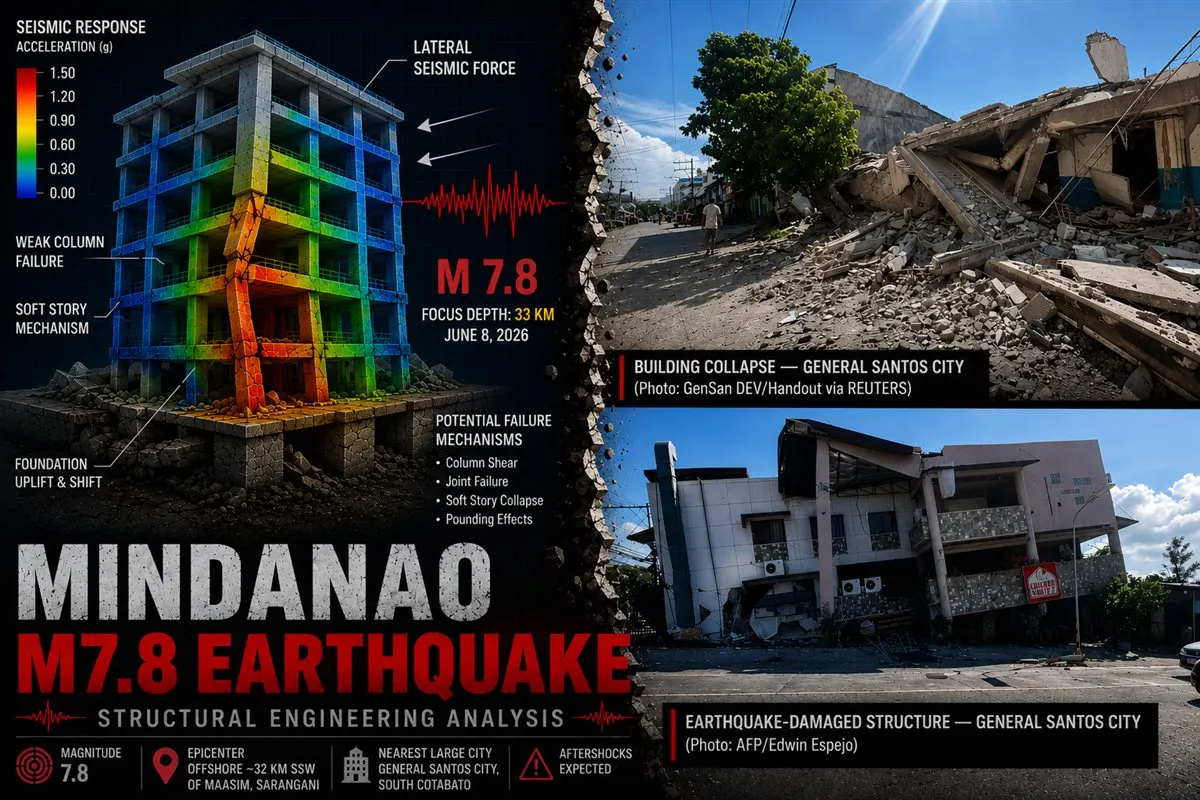
AEDO Construction structural-engineering breakdown of the June 8, 2026 M7.8 Mindanao earthquake — a seismic-response model illustrating soft-storey and weak-column failure, beside actual building damage in General Santos City (photos: GenSan DEV/Handout via Reuters; AFP/Edwin Espejo).
This earthquake was not a fault you can walk up to and photograph, like the West Valley Fault that threatens Metro Manila. It happened offshore, on the Cotabato Trench — a zone where the Sunda plate and the Philippine Sea plate grind into each other in a process geologists call oblique convergence. The rock there doesn't slide smoothly; it locks, builds up strain for decades, and then releases it all at once in a sudden thrust — one block of crust lurching up and over another.
A thrust fault under the sea does two things at once. First, it shakes the ground violently across a wide area — this is what damages buildings inland in cities like General Santos. Second, because the seabed itself is suddenly shoved upward, it displaces the water column above it, which is what generates a tsunami. That is exactly why a single offshore event triggers both a structural emergency on land and a coastal evacuation at the same time — and why coastal communities have only minutes, not hours, to move.
Depth matters too. PHIVOLCS put the focus at about 33 km (the USGS estimated deeper, ~55 km) — an intermediate depth that still delivered destructive shaking near the epicentre while spreading the felt area wide enough to reach Leyte. None of this is exotic: the Philippines sits on the Pacific Ring of Fire, and this is precisely the seismic environment that NSCP 2015 Section 208 is written to design against.
Strong shaking plus 130+ aftershocks is exactly the scenario where hidden structural damage turns dangerous. A licensed engineer's post-earthquake inspection — before re-occupation — is the cheapest safety decision you will make this year.
Request a Post-Quake Inspection →After every major earthquake — and after events like the Angeles City building collapse — the same question gets asked: why did this building collapse while the one next door barely cracked? The honest engineering answer is that collapse is almost never random. The structures that fail in strong shaking tend to share a small set of well-understood weaknesses — and recognising them in your own building is the single most useful thing you can take from a day like today.
The classic killer. When the ground floor is mostly open — parking, a showroom, a dining area with glass walls — while the floors above are full of walls, the bottom level has far less stiffness to resist sideways forces. The whole building rocks on that weak storey until the ground-floor columns fail and the upper floors drop straight down. The partial collapses reported in General Santos — a multi-storey school and a four-storey office building — are exactly the profile where a soft or weak lower storey is a prime suspect, pending formal investigation.
Hollow-block walls with no vertical rebar, no bond beams, and no proper ties to the frame are heavy and brittle. In shaking they crack diagonally, shed blocks, and pull away from the structure — a leading cause of injuries from falling debris even when the main frame survives. How CHB is reinforced is not a detail; it is life-safety.
NSCP 2015 deliberately requires a "strong-column, weak-beam" philosophy so that, if anything yields, it yields in a controlled, survivable way rather than crushing the columns that hold the building up. Older or undersigned structures often have the opposite — slender columns with inadequate ties — so the joints shatter and the building loses its vertical support all at once.
Even a well-framed building can fail if the ground beneath it amplifies the shaking or loses strength (liquefaction) during the quake. Coastal and reclaimed sites near the epicentre are especially exposed — which is one reason a structure's geotechnical foundation design matters as much as the frame above it.
It isn't luck. Structures that ride out a magnitude-7.8 event almost always share the same traits: a continuous, well-detailed lateral-force-resisting system; ductile beam-column connections that can flex without snapping; reinforced masonry tied into the frame; a regular, balanced layout without sudden weak storeys; and foundations matched to the actual soil. That package is what NSCP 2015 §208 seismic design exists to deliver — and the difference between a building that cracks and one that collapses is usually whether that design was done, and detailed, and actually built as drawn.
Five questions, based on the failure modes above. You'll get an instant risk read — not a substitute for a real inspection, but a fast way to know whether you should book one.
1. When was your building constructed?
2. Is the ground floor much more open than the floors above? (parking, retail, glass frontage)
3. Do you have structural drawings with explicit seismic (NSCP §208) load calculations?
4. Are your walls CHB with no visible vertical rebar or bond beams?
5. Is the building on soft, coastal, or reclaimed soil, or near a known fault/trench?
A common misunderstanding is that a code-compliant building is "earthquake-proof." It isn't, and it isn't meant to be. The goal of seismic design under NSCP 2015 Section 208 is life safety: in a major earthquake, the building is allowed to be damaged — sometimes badly — but it must not collapse, so that everyone inside can get out alive. It achieves this through a few core ideas:
| Principle | What it does in an earthquake |
|---|---|
| Lateral-force-resisting system | A defined, continuous path (frames, shear walls, or braces) that carries sideways earthquake forces all the way down to the foundation — no weak link, no gap. |
| Ductility & detailing | Reinforcement detailed so the structure can bend and absorb energy without breaking — closely spaced ties in columns, proper anchorage, strong-column/weak-beam hierarchy. |
| Seismic zone & soil factors | Design forces scaled up for high-seismicity zones (most of the Philippines is Zone 4) and for soft soils that amplify shaking. |
| Regularity | Penalising irregular, top-heavy, or soft-storey configurations that concentrate damage in one weak spot. |
| Redundancy | Multiple load paths, so the loss of one element doesn't trigger progressive collapse. |
An earthquake doesn't test your building's age, its paint, or its permit on the wall — it tests how it was designed and detailed, and whether it was actually built that way. A structure that survived this morning's quake intact passed one test. The aftershocks, and the next Big One, are the next ones. The only way to know where your building really stands is a structural assessment by a licensed engineer — not a guess, and not "it's always been fine."
If your home, building, or facility felt today's quake, don't assume it's safe because it's still standing. AEDO Construction's licensed engineers assess earthquake-affected structures for hidden damage — cracked columns, sheared joints, foundation movement — and tell you plainly whether it's safe to use, repairable, or not. Message us and we'll respond within hours.
The BuildX NSCP Kit puts the complete NSCP 2015 structural code in your pocket — including the Section 208 seismic provisions, zone factors, and load tables that decide whether a building rides out a quake or comes down. Built by AEDO engineers, for Philippine engineers, students, and owners who want to understand how their structures are supposed to perform.
If you're in an affected area, the priorities in the hours and days after a major quake are concrete:
At AEDO Construction, every structure we design assumes the earthquake will come — because in the Philippines, it always does. We don't treat seismic design as a box to tick on a permit; we treat it as the reason the building gets to keep standing when a morning like June 8 arrives.
Statutes, codes, official tools and references used or referred to in this article, linked to their source. Links open in a new tab.
Prices, cost bands and rate figures in this article are AEDO Construction's own market and practice figures for Philippine work unless a source is named beside them. Code and statute references above link to the primary text.
AEDO Construction provides structural assessment, seismic design, and retrofit nationwide, plus design-build services in Negros Oriental, for residential, commercial, and institutional projects. Whether you need a quake-affected building cleared today or a new one designed to survive the next 50 years, we treat structural safety as the non-negotiable foundation of every recommendation we make.
The Philippines didn't choose to sit on the Ring of Fire, and no engineer can stop a fault from slipping. What we can control is what we build on top of it — and whether, when the shaking starts, our buildings are designed to bend, hold, and let people walk out, or to fail in the dark.
Today's earthquake off Sarangani is a tragedy for the families who lost people, and a hard morning for everyone who felt it. It is also, in the most literal sense, a structural lesson written across an entire region. The buildings that stood and the ones that fell are telling us exactly what works. The only real failure now would be to not listen.
If you're responsible for a building that felt today's quake, or planning one that needs to survive the next, partner with engineers who treat seismic safety as the whole point — not a formality. AEDO Construction is ready to help today.
Why a building that survived the 2026 Mindanao earthquake can still have damage that needs an engineer's assessment. From the AEDO YouTube channel, uploaded 2026-06-12.

It struck at 7:37 AM local time on June 8, 2026, offshore about 32 km south-southwest of Maasim, Sarangani province. PHIVOLCS placed it at magnitude 7.8 and a depth of 33 km (the USGS estimated a deeper ~55 km, and Indonesia's BMKG measured up to 8.2). PHIVOLCS recorded a peak Instrumental Intensity VIII at Malapatan, Sarangani, and a destructive Intensity VII in General Santos City. It was generated by thrust faulting along the Cotabato Trench and reported as among the strongest to hit the Philippines since the 1990 Luzon earthquake.
Collapse in strong shaking is rarely random. Buildings that fail usually share a small set of weaknesses: soft-storey ground floors (open parking/retail under solid floors), unreinforced or poorly tied CHB masonry, weak columns with inadequate ductility, irregular layouts, and foundations on soft or liquefiable soil. Buildings designed and detailed to NSCP 2015 §208 — with a continuous lateral-force-resisting system, ductile connections, and appropriate seismic and soil factors — are specifically engineered to survive this. The damage pattern after a major quake is essentially an audit of which buildings had that and which didn't.
Yes. PHIVOLCS issued tsunami warnings for nine coastal provinces and ordered evacuations to higher ground. Waves of roughly one metre ("yard-high," about 3 ft) were observed along the Sarangani and Sultan Kudarat coasts — some reports up to ~1.4 m — with smaller waves in Indonesia and Palau. Authorities declared the threat passed by around midday. Note that aftershocks can still occur for days, so coastal residents should continue following official PHIVOLCS advisories.
Not automatically. A building can look intact yet have hidden structural damage — cracked columns, sheared beam-column joints, damaged shear walls, or foundation movement — that sharply reduces its ability to survive aftershocks. Watch for new diagonal (X-shaped) cracks in columns or walls, crushed concrete with exposed rebar, jammed doors/windows, tilting, or out-of-level floors. Any of these mean the structure should be inspected and cleared by a licensed engineer before re-occupation — which is exactly the assessment AEDO Construction provides.
When a new structural incident or seismic event matters to Philippine builders, we'll send it to your inbox first.
No spam. One email per insight. Unsubscribe anytime.