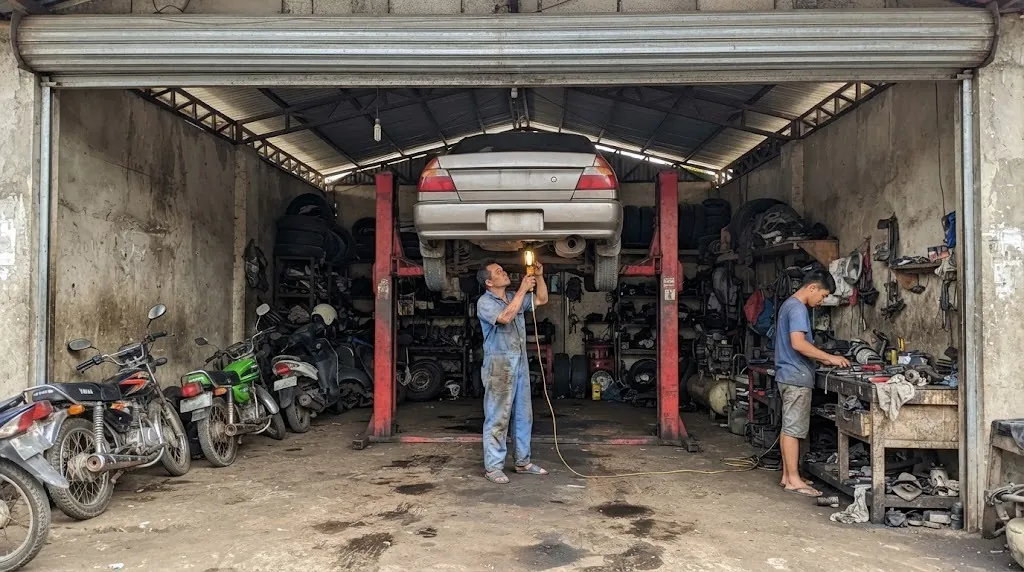
The lift is only as good as the slab it is bolted to, and the slab is only legal if it drains to an oil separator. Illustrative photo.
Short answer: a talyer is a warehouse-type shell with four things a warehouse doesn't have. Lift anchors that need a specific slab. A floor the Fire Code says must be liquid-tight and sloped to drains that run through an oil separator. A used-oil stream that DENR lists as hazardous waste (codes I101–I104). And a DTI accreditation you need before you open. Build cost starts from AEDO's published warehouse bands, roughly ₱14,000–₱22,000/sqm in steel frame or ₱22,000–₱32,000/sqm in reinforced concrete, plus the shop-specific items above. Lifts and tools are extra.
The calculator turns your bay mix into a floor area, a lift-pad checklist, a rough electrical load, the Fire Code sprinkler trigger and a cost band.
The 2-post bay size, lift pad and lift motor figures come from a lift maker's installation manual. Floor loads are NSCP 2015 and sprinkler triggers are the Fire Code's. Other bay sizes, electrical allowances and every peso figure are AEDO planning estimates.
No Philippine code sets a repair bay size. The honest reference is the lift maker's installation drawing, because the lift decides the bay. Rotary's instructions for its 10,000 lb (4,536 kg) two-post lift give a minimum bay size of 12 × 24 ft (3,658 × 7,315 mm), with a note to verify it against the site plan and the vehicles you service. The same drawing puts the columns 2,921 mm apart inside (2,769 mm on the narrow setting) and the overall floor width at 3,480 mm.
| Bay type | Planning size used here | Where it comes from |
|---|---|---|
| Car bay, 2-post lift | 3.66 × 7.32 m | Rotary 10K two-post lift, minimum bay size |
| Car bay, 4-post or alignment lift | 4.0 × 8.0 m | AEDO planning estimate (longer runways, alignment equipment) |
| Car bay, floor work | 3.5 × 6.5 m | AEDO planning estimate (door swing and a trolley jack on both sides) |
| Motorcycle work bay | 2.0 × 3.0 m | AEDO planning estimate (bike, lift table or stand, bench space) |
Motorcycle shops are where most owners overbuild the roof and underbuild the floor. A bike bay is small, but the shop turns many units a day, so the space that matters is the front apron where bikes queue and the parts counter. Car shops are the opposite: the bay is big, and the drive aisle in front of it is what eats the lot. The calculator adds a circulation allowance on top of the bays for that reason.
If customers park on site, the parking slots are a separate count under the building code. Our parking requirements guide covers it.
NSCP 2015 Table 205-1, item 9 (Parking Garages and Ramps) has a row written for this building: "General storage and/or repair" — 4.8 kPa uniform live load. Footnote 7 points to Section 205.3.3, which requires, where vehicles are used or stored, concentrated loads of two or more loads spaced 1.5 m nominally on centre, without uniform live load, each equal to 40% of the gross weight of the largest vehicle to be accommodated. The lighter 9 kN private-garage load in that section is limited to garages "with no repair or refueling", so it does not apply to a talyer. These are the same figures our parking building guide quotes for public decks.
The code load is not what cracks a shop floor, though. The lift does. A two-post lift stands on two base plates held down only by anchors drilled into the slab. Rotary's words: "Columns are supported only by anchors in floor." So the slab has to meet the lift maker's spec, in addition to the NSCP loads. From the Rotary 10K anchor reference guide:
| Rotary 10K two-post lift (Hilti Kwik Bolt III anchor) | Requirement |
|---|---|
| Minimum concrete thickness | 4-1/4 in (108 mm) |
| Minimum concrete strength | 3,000 psi (20,684 kPa) |
| Minimum anchor edge distance / embedment | 3-3/8 in (86 mm) / 3-1/4 in (83 mm) |
| Anchor installation torque | 110 ft-lbs (149 Nm) |
| If anchors won't hold torque | Replace concrete under each column with a 4 × 4 ft × 6 in (1219 × 1219 × 152 mm), 3,000 psi minimum pad, keyed under and flush with the floor |
| Surfaces not allowed | Asphalt or similar unstable surfaces; not in a pit or depression |
| Seismic anchoring | "Varies by location. Consult with your structural engineer and manufacturer's representative" |
Treat that table as one manufacturer's numbers, not a universal rule. Heavier lifts and other brands ask for more, and the manual itself says to follow ANSI/ALI ALIS, the US lift installation standard. In practice we detail thickened, reinforced pads at the column positions when the slab is poured, so a later lift upgrade doesn't mean saw-cutting a finished floor. We don't rely on the lift installer to discover a 100 mm residential slab on the day. Our slab thickness calculator covers suspended slabs; a shop floor on grade is designed from the soil up.
A two-post lift is taller than people expect. The Rotary 10K standard-height model stands 3,645 mm overall and needs a minimum floor-to-ceiling height of 3,658 mm; the low-height version needs 3,518 mm. That is clear height to the lowest thing overhead: the underside of a purlin, a light fitting, a ceiling fan, a conduit run. Then lift a van or a pick-up with a roof rack and you want more. We plan the eaves of a car shop from the tallest lift and vehicle combination you expect to service, and keep lights and fans off the lift zone.
A motorcycle shop can sit under a much lower roof, which is one reason a mixed shop usually puts the bikes along the side or front of the building and the lifts under the high bay.
The 2019 Revised IRR of RA 9514 lists repair garages among the hazardous operations in Rule 10, Chapter 4, and gives them their own Division 10. It's short and practical, and nearly every line has a building consequence:
| RIRR provision | What it requires |
|---|---|
| 10.4.10.1 B | A repair garage attached to a building used for another purpose needs walls and floors with at least 2-hour fire resistance between them |
| 10.4.10.1 C, E | Showrooms, offices and similar spaces, and parts storage, separated from repair areas by 2-hour construction |
| 10.4.10.1 F | Repair-area floors noncombustible, liquid-tight, and sloped to floor drains |
| 10.4.10.1 G, H | Where vehicles are serviced, floor drains trapped and discharging through an oil separator; separator contents collected often enough that oil doesn't reach the sewer |
| 10.4.10.1 I | Pits: noncombustible construction, at least two unobstructed means of egress, and a ventilation system giving a complete air change every 5 minutes, intake near the floor |
| 10.4.10.1 K | Below-grade repair areas: continuous mechanical exhaust of at least 1 m³/min per m² of floor, with equal outdoor air supply |
| 10.4.10.2 B | Spray painting only in spray booths, rooms or areas; no open flame or spark-producing equipment within 6.1 m |
| 10.4.10.3 A.1 | Automatic sprinklers: one-storey garage over 1,115 m²; over 743 m² if more than one storey or beneath another occupancy; below-grade floors |
| 10.4.10.3 A.3 | Standpipes if over 15.2 m tall, with parking below grade, or unsprinklered and more than one storey |
| 10.4.10.3 B | Daily inspection, clear aisles, metal receptacles with self-closing covers for oil-soaked rags, "No Smoking" signage |
Two of those catch owners out. The first is the shophouse talyer: a repair bay on the ground floor with the family upstairs is exactly the "attached to a building used for another purpose" case, and the 2-hour floor between them is a real design item. The second is the pit. Pits are cheap to dig and expensive to make compliant, and the lift manual quoted above says not to put a lift in one. For ventilation in an ordinary at-grade shop, the RIRR asks for "proper ventilation" in line with the rest of the code. Wide openings and cross-flow do most of the work in our climate, but exhaust from engines running indoors needs a planned path out.
Our FSIC guide covers the permit side, and the gas station guide covers the fuel-dispensing rules if you plan to sell fuel on the same lot.
RA 6969, the Toxic Substances and Hazardous and Nuclear Wastes Control Act of 1990, is the law, and DENR Administrative Order 2013-22 (Revised Procedures and Standards for the Management of Hazardous Wastes) is the working rulebook. Its procedural manual lists "Used or Waste Oil" under codes I101–I104 and sizes generators by what they produce each year:
| Used or waste oil (I101–I104) | kg per year |
|---|---|
| Small generator | below 18,000 |
| Medium generator | 18,000–36,000 |
| Large generator | above 36,000 |
Small doesn't mean exempt. The manual says generators "are required to register online" with the EMB regional office, get a DENR ID number, and designate a full-time Pollution Control Officer. The storage rules are where the building comes in. A hazardous-waste storage area has to be enclosed but ventilated, secured, and have floors impermeable to liquids, resistant to chemical attack, not slippery and built to retain spillage. Drums stand upright on pallets, no more than two high. The maximum accumulation time is one year, and the waste then goes to an EMB-registered transporter and treater.
So the used-oil corner in the back of the shop is a small room with a bunded floor and a lockable door, not a patch of ground behind the building. The Fire Code sends the oil-separator contents to the same place.
Presidential Decree No. 1572 (1978) requires enterprises that service and repair motor vehicles, heavy equipment and engines, among others, to apply for accreditation with the Department of Trade, and says no such enterprise "shall be licensed or permitted to operate in the Philippines for the first time without first being accredited". DTI's Fair Trade Enforcement Bureau cites PD 1572 and Article 128 of the Consumer Act (RA 7394) as its basis. Accreditation runs to 31 December and must be renewed by 31 January each year to avoid a 25% late fee. PD 1572's own penalty is a fine of ₱100 to ₱5,000, imprisonment of 30 days to one year, or both. Put it on the opening checklist alongside the building, occupancy and FSIC paperwork.
AEDO's role on a repair shop. Nationwide, AEDO designs the shop: architectural, structural, electrical and plumbing, with the bays laid out around the lifts you're actually buying, a slab and pads that meet the lift maker's spec and the NSCP loads, the drainage and oil separator the Fire Code requires, and the used-oil store DENR expects to see. Elsewhere in the country we can also oversee a local contractor you hire. In Negros Oriental, AEDO builds it.
The workshop is priced like a warehouse, using AEDO's published 2026 bands, and the office and customer lounge like a shophouse at roughly ₱27,000–₱38,000/sqm. What moves a shop off the bottom of those bands:
Repair-garage provisions are quoted from Rule 10, Chapter 4, Division 10 of the 2019 Revised IRR of RA 9514, read in full for this article. Floor loads are NSCP 2015 Table 205-1 item 9 and Section 205.3.3, read from the code text. Used-oil codes, generator categories and storage rules are from the DAO 2013-22 procedural manual. Bay, anchor, pad, height and motor figures are from Rotary's installation instructions for its 10,000 lb two-post lift. They're an example, and your lift maker's manual governs. The 4-post, floor and motorcycle bay sizes, circulation and support-room allowances, electrical allowances, adders and every peso figure are AEDO planning estimates, not code values or a published index.
How thick should the concrete floor be for a 2-post car lift?
Follow the manual of the lift you're buying, since requirements differ by make and capacity. As one example, Rotary's 10,000 lb two-post lift instructions require at least 4-1/4 in (108 mm) of 3,000 psi (20,684 kPa) concrete, a 3-3/8 in (86 mm) minimum anchor edge distance and 110 ft-lbs anchor torque; where the floor falls short, the concrete under each column is replaced with a 4 × 4 ft × 6 in (1219 × 1219 × 152 mm) pad keyed under and flush with the floor. The manual references ANSI/ALI ALIS and rules out asphalt.
What floor live load does a repair shop need under the NSCP?
NSCP 2015 Table 205-1 item 9 gives "general storage and/or repair" 4.8 kPa. Footnote 7 sends you to Section 205.3.3: two or more concentrated loads 1.5 m on centre, without uniform live load, each 40% of the gross weight of the largest vehicle. The lighter 9 kN private-garage load applies only where there is no repair or refueling.
What does the Fire Code require for a repair garage?
The 2019 Revised IRR of RA 9514, Rule 10 Chapter 4 Division 10: 2-hour separation where the garage is attached to another use, and between repair areas and offices, showrooms or parts storage; noncombustible, liquid-tight floors sloped to trapped drains that discharge through an oil separator; pits with two means of egress and a full air change every five minutes; and automatic sprinklers in one-storey garages over 1,115 m², or over 743 m² where the garage is more than one storey or sits beneath another occupancy.
Is used engine oil a hazardous waste in the Philippines?
Yes. Under RA 6969 and DENR DAO 2013-22, used or waste oil is listed under codes I101–I104. Generators below 18,000 kg a year are small, 18,000–36,000 kg medium, above 36,000 kg large, but all must register with the EMB regional office, get a DENR ID and designate a Pollution Control Officer. Storage floors must be impermeable and retain spills, and the maximum accumulation time is one year.
Does a repair shop need DTI accreditation?
Yes. PD 1572 says service and repair enterprises for motor vehicles, heavy equipment and engines shall not be licensed or permitted to operate for the first time without DTI accreditation. DTI's Fair Trade Enforcement Bureau cites PD 1572 and Article 128 of RA 7394, issues the accreditation, and requires renewal by 31 January each year to avoid a 25% late fee.
How much does it cost to build an auto repair shop in the Philippines?
On AEDO's published 2026 bands, the workshop shell runs roughly ₱14,000–₱22,000 per sqm in steel frame or ₱22,000–₱32,000 per sqm in reinforced concrete, and the office or customer lounge roughly ₱27,000–₱38,000 per sqm. Lift pad upgrades, trench drains and an oil separator, and a bunded used-oil store come on top, as AEDO estimates. Lifts, compressors, tools, land, permits and fees are extra.
Laws, regulations, code provisions, manufacturer documents and AEDO references used in this guide.
Bay sizes other than the 2-post lift bay, circulation and support-room allowances, electrical load allowances and demand factor, cost adders and all peso figures are AEDO's own planning estimates. DAO 2013-22 is the procedural manual in force as we write; EMB has consulted on revisions, so confirm the current rules with your EMB regional office. Business permit and zoning requirements for repair shops are set by your LGU.
Lay the shop out around the lifts, the drains and the oil store, not around a generic warehouse drawing.