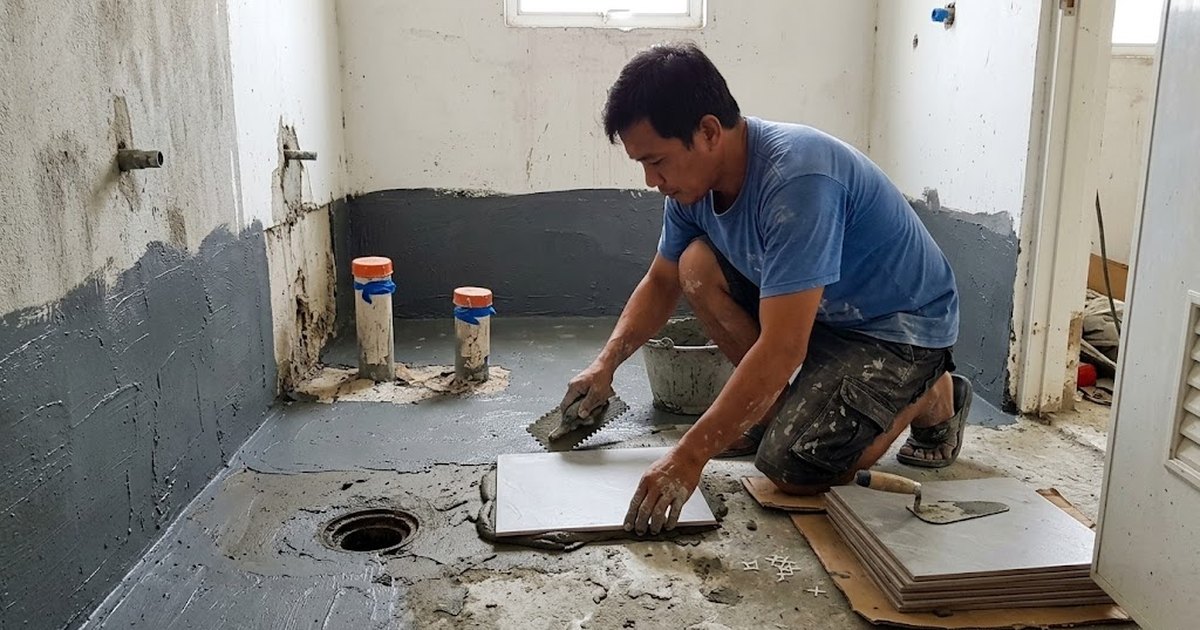
Waterproofing goes on before the tiles, and it's the step most often skipped in a CR renovation. Illustrative photo.
Short answer: a small CR, around 1.5 × 2.0 m, fully retiled in ceramic with waterproofing, a new toilet, lavatory, shower set and exhaust fan, runs roughly ₱43,000 to ₱90,000 including demolition. Porcelain, a water heater, a glass enclosure or moving the toilet each add real money. Use the calculator below for your own room.
The more expensive mistake isn't the tile you pick. It's paying for a nice retile over the same floor that was already leaking into the room below. Tile and grout don't stop water. The membrane underneath does, along with the slope of the screed it sits on and the way the floor drain is set. Get those wrong and the stain on the ceiling below is back within a rainy season, regardless of what tile went on top.
Line-item low/high range for a full CR renovation. The total is the exact sum of the rows shown.
Floor area is the smallest number in the room. A 1.5 × 2.0 m CR has 3 m² of floor and, tiled to 2.4 m, about 15 m² of wall. That's five times the floor, and it's why the wall tile line is the biggest single row in the calculator. Our tile and painting guide walks through the same trap for whole rooms.
After tile, it's fixtures. On Wilcon Depot's online catalog the cheapest tank-type water closets are Pozzi two-piece units at ₱4,347 (Nolan) and ₱4,550 (Cedar), both special prices when we checked, while mid-range one- and two-piece units sit at ₱13,802 to ₱16,300 (Atelier Dubienn). The Pozzi flush-valve bowls at ₱5,110 and ₱5,770 are not the budget pick: they're flush-valve bowls with no tank, so the flush valve is a separate item. Wall-hung lavatories start around ₱1,075, and pedestal types run ₱2,432 to ₱3,060. A basic two-way faucet with telephone shower is ₱2,616 and an exposed shower set ₱7,020. An instant electric heater from a reputable brand is published at ₱7,000 to ₱14,000 plus ₱1,500 to ₱3,000 to install, and it needs its own properly sized circuit, which is an electrician's job and not the plumber's.
Then the stuff nobody sees. Moving a water closet means breaking the slab or the wall to reroute the soil line (typically 100 mm in practice) with enough fall. Moving a drain is the same problem, only smaller. Both are AEDO market estimates in the calculator because every existing house is different underneath.
If the CR is part of a bigger job, our house renovation cost guide puts kitchens and bathrooms in the mid-range tier for a reason. For how small a CR can legally be before you start, see minimum CR size under PD 1096.
We get the same call a lot: "we retiled last year and the ceiling below is stained again." In most CRs we open up, the new tile went on the old bed, over no membrane, or over a membrane that stopped at the floor. Here's what that looks like in section.
Tile then goes on the cured membrane with thin-set tile adhesive. A thick mortar bed on top of the membrane is the old habit, and that bed soaks up water and holds it under the tile.
Under the Revised National Plumbing Code, each fixture directly connected to the drainage system needs a water-seal trap (§1001). That includes the floor drain. Section 1005 sets the trap's water seal at not less than 51 mm and not more than 102 mm. Too shallow and it evaporates or gets pulled out, too deep and it collects solids. Section 1006 requires each floor drain to have a trap, a removable strainer, and in waterproofed floors, a clamping device or flange that keeps the membrane intact. Section 1002 requires each fixture trap to be protected against siphonage and back-pressure by venting built to Chapter 9, because an unvented trap can lose its seal while water drains. Section 1007 adds a trap-seal primer or approved equivalent for traps that dry out from little use. Our National Plumbing Code guide covers the trap and vent anatomy in more detail.
The section wording above is taken from AEDO's NPC reference at npc.aedoconstruction.com, which paraphrases the Revised National Plumbing Code. We didn't find a free official full text online to cross-check it this time, so treat the section numbers as a pointer for your master plumber, who signs the plumbing plans, and not as the final word. We also don't quote a specific slope percentage for shower floors here for the same reason.
Pick the one that best matches what you're seeing. This narrows down the likely source. It doesn't replace opening it up.
If the leak has been going for years, look at the slab soffit below before you pick tile. Rust stains or concrete flaking off around the stain means water has reached the rebar, and that's a different, structural conversation. Our structural warning signs guide covers what to look for.
How much does a CR renovation cost in the Philippines?
For a 1.5 by 2.0 m CR with full-height ceramic tile, cementitious waterproofing, a new water closet, lavatory, shower set and exhaust fan, plus demolition and hauling, the calculator on this page gives about ₱43,047 to ₱90,188. Porcelain or large-format tile, a water heater, a glass enclosure or moving the toilet all push that up. Tile rates and waterproofing rates (AEDO's roof and wall rates, used as a proxy for indoor wet areas) come from AEDO's 2026 cost guides, fixture prices from Wilcon Depot's online listings, and labor, plumbing moves and demolition are AEDO market estimates.
Why does my CR keep leaking to the room below even after retiling?
Because tile and grout are not waterproof. Water gets through the grout joints and into the mortar bed, and if there is no membrane under it, or the membrane stops at the floor instead of turning up the wall, or the floor slopes away from the drain, that water finds the slab and comes out below. Retiling over the same substrate replaces the part that was never keeping the water out. The fix is to strip down to the slab, lay a new screed sloped to the floor drain, apply a membrane on that screed turned up the walls and into the drain's clamping flange, flood test it, then tile on thin-set adhesive.
Does a floor drain need a trap under the National Plumbing Code?
Yes. The Revised National Plumbing Code requires each fixture directly connected to the drainage system to have a water-seal trap, and floor drains are included. The trap's water seal must be not less than 51 mm and not more than 102 mm deep. A floor drain with no trap, or a trap that has dried out, lets sewer gas into the CR, which is why a smell with no visible leak usually points to the trap or venting rather than the tiles. For a floor drain that sits unused long enough to dry out, the code's trap seal protection section (§1007) calls for a trap-seal primer or an approved equivalent.
How do I tell if the leak is a pipe or the shower floor?
Close every faucet and fixture valve in the house and watch the water meter. If it still moves, a pressurized supply pipe is leaking, often inside the wall. If the meter is still but the stain below grows only after someone showers, the water is coming through the floor or wall tiling. If the stain sits directly under the toilet, check the water closet's floor connection first.
Does AEDO renovate CRs outside Negros Oriental?
No. AEDO designs and builds only in Negros Oriental. Everywhere else, AEDO provides the complete design, architectural, structural, electrical and plumbing, and oversees remotely a contractor you hire locally, so the membrane, slope and trap details get built the way they were drawn.
Pricing and code references used in this article. External links open in a new tab.
Tile rates (₱800–₱1,400, ₱1,100–₱1,900 and ₱1,700–₱3,200 per m² supplied and installed) are AEDO 2026 planning ranges from our tile and painting cost guide. The ₱560–₱760/m² (concrete roofs / flat slabs) and ₱530–₱720/m² (external walls) waterproofing rates and the 20–25% polyester reinforced membrane premium are AEDO planning ranges from our waterproofing cost guide, written for roofs and walls and used here as a proxy for indoor wet areas. Fixture installation labor, floor drain and supply-line replacement, plumbing relocation, glass enclosures, demolition and hauling are AEDO market estimates, not sourced to a published price list. We found no published installed price for glass shower enclosures we could rely on.
In Negros Oriental, AEDO designs and builds the renovation: strip-out, membrane, slope, drain, flood test, tile, fixtures. Outside Negros Oriental, we don't build. We give you the complete design, architectural, structural, electrical and plumbing, and oversee remotely the contractor you hire locally, with the flood test on the checklist.