📚 Part of our Why Buildings Fail series →
This is a week-one update to our June 8 engineering breakdown of the M7.8 Sarangani earthquake. Figures below are sourced from the NDRRMC, PHIVOLCS, DSWD, and verified news coverage. Casualty and damage counts continue to be updated as rescue teams reach isolated areas. Aftershocks are still occurring — do not re-enter damaged buildings without a licensed engineer's clearance.
Six days ago, a magnitude 7.8 earthquake shook southern Mindanao before most families had finished breakfast. The first hours were about survival and tsunami warnings. The first week has been about counting: the dead, the displaced, the homes destroyed, and the aftershocks that keep coming. With the NDRRMC now reporting at least 46 dead and the OCD reporting 47 — and a Manila Times report flagging discrepancies between agency counts still being reconciled — the numbers are large enough to understand the scale, and to talk clearly about what responsible recovery actually looks like.
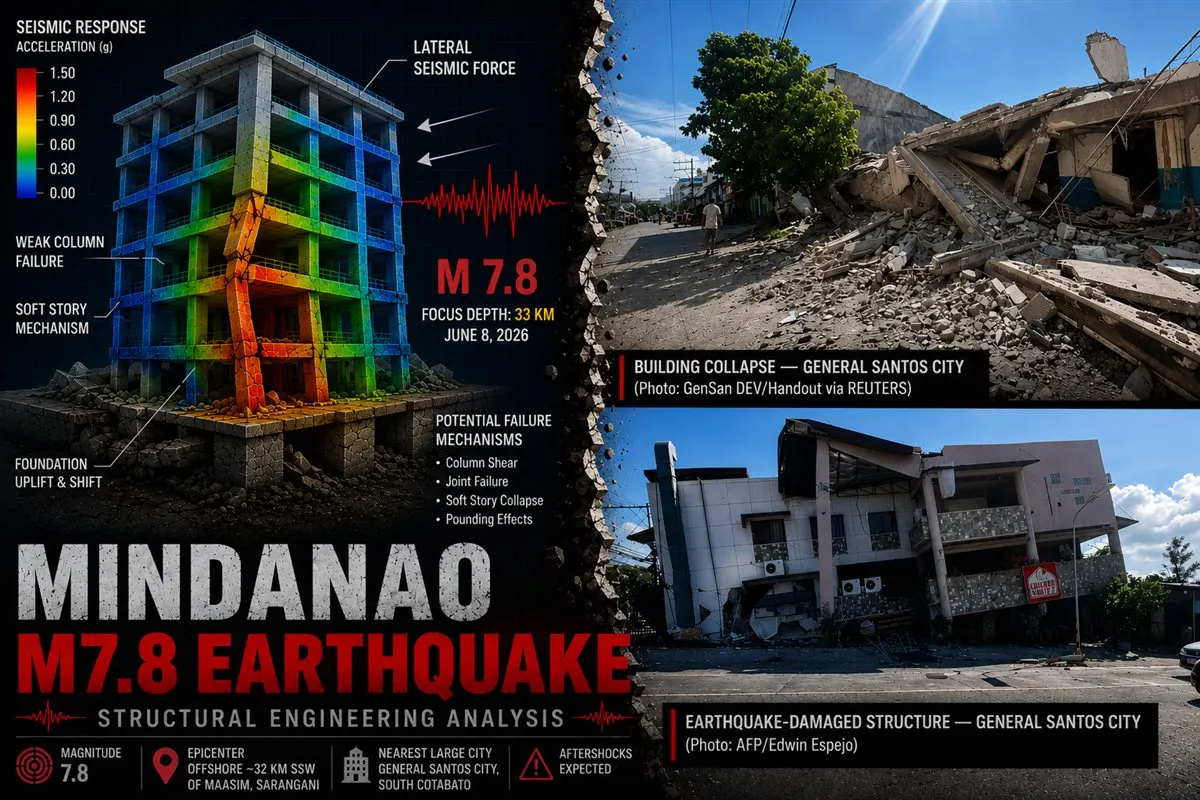
Week-one damage assessment of the June 8, 2026 M7.8 Mindanao earthquake — engineers cataloguing collapse patterns in General Santos City and Sarangani Province (photos: AFP/Edwin Espejo; GenSan DEV/Handout via Reuters).
The picture that emerges from the first week of official reporting is significantly larger than Day 1 estimates suggested. As rescue teams reach more remote barangays — some of them helicopter-only due to landslides and damaged roads — both casualty and damage numbers have climbed steadily. Here is the current state as verified by NDRRMC, OCD, and PHIVOLCS:
The human and structural scale of this is hard to compress into a table. Close to 46,000 people are displaced — either in one of 31 evacuation centers or sheltering in other people's homes and makeshift sites — and the areas hit hardest, particularly Malapatan and Glan in Sarangani province, are still only reachable by helicopter. Communities there have been without potable water and regular food supply for days. This is not a fast-moving crisis that is winding down; it is a long, slow disaster entering its most logistically difficult phase.
As of June 14, 2026, the NDRRMC's validated count stands at 46 dead after removing duplicate and unverified field reports. The Office of Civil Defense (OCD) separately reported 47 dead, with 31 missing and 688+ injured. A third agency tally cited 61. The Manila Times reported specifically on these discrepancies on June 14. We cite the NDRRMC/OCD range of 46–47 as the most verified figure available at time of publication. All figures continue to be updated.
One of the least reported and most structurally significant facts of this event is the aftershock sequence. PHIVOLCS recorded at least 3,860 aftershocks between June 8 and June 12 alone — an average of nearly 800 per day. Three of those exceeded magnitude 6.0. The largest single aftershock reached M6.4.
This matters structurally because a building weakened by the mainshock is not the same building it was on June 7. A structure that absorbed the M7.8 and appears intact may have suffered cracking in columns, shearing in beam-column joints, or loosening of reinforcement anchorage — damage that is invisible behind plaster and paint but that sharply reduces its capacity to survive the next big shake. A magnitude 6.0 aftershock into an already-compromised building is not the same as a 6.0 into an intact one.
If your building is in the affected area and has not been formally assessed by a licensed engineer, treat it as potentially compromised regardless of visible appearance. The three confirmed M6.0+ aftershocks — and the ongoing sequence — are exactly the scenario where hidden mainshock damage becomes a collapse event. A structure that looks fine is not the same as a structure that is safe.
The structural damage from this earthquake was not limited to buildings. 45 road sections and 8 bridges sustained damage across the affected provinces — contributing directly to the access crisis in Sarangani. Some damage isolated entire communities; government teams have been forced to rely on Philippine Coast Guard vessels and helicopters to deliver relief supplies to barangays that would otherwise be an hour's drive away.
The 37 recorded landslides compound the road problem significantly. In mountainous barangays of Malapatan and the interior of Sarangani, slope failures have blocked routes and introduced new hazards — particularly relevant for any structural work in those areas, where the soil itself is now a different thing than it was before June 8.
The school impact — 8,642 affected school buildings across more than 30 DepEd school divisions — is the number that will shape recovery longest. These aren't just damaged rooms; they are evacuated communities, displaced families, and students whose school year was interrupted on its literal first day. Rebuilding them quickly and to code is not optional — these are the structures that serve the most vulnerable population in the next earthquake, whenever it comes.
DepEd, LGUs, and private school administrators in the affected areas need licensed engineers to assess, clear, or condemn structures before students return. AEDO provides documented structural condition reports suitable for DepEd, DPWH, and local government requirements.
Request a Structural Clearance Report →As of this writing, the response has been substantial but unevenly distributed — with the most remote areas still waiting for their share:
The gap between what has been deployed and what remote communities say they need — specifically potable water and financial assistance for Malapatan and Glan — reflects the logistical reality: you cannot move aid faster than you can move people and vehicles, and both are constrained by landslides and damaged roads. This is expected to persist for several more weeks.
The headline numbers — 45,556 homes damaged, 8,865 destroyed — represent an enormous amount of construction work that will be undertaken across Mindanao over the next 12 to 24 months. From a structural engineering perspective, how that work gets done matters as much as how fast.
After every major earthquake in the Philippines, the same pattern emerges: damaged homes are rebuilt quickly, by the same methods and the same informal builders, on the same sites, with little or no change in structural design. Then the next earthquake comes — as it always does — and the rebuilt houses fail the same way the originals did. In areas of ongoing aftershock activity on an active subduction zone, this is not a distant risk. The Cotabato Trench does not stop generating earthquakes after a large event. Post-seismic periods often see elevated activity for months to years.
The specific structural failures this event revealed — and that the rebuild phase must address — break down across the same categories we identified in the Day 1 breakdown, now with confirmed damage at scale:
The commercial and school buildings that partially or fully collapsed in General Santos were overwhelmingly consistent with the soft-storey profile: open ground floors (retail, parking, assembly) under solid upper floors, insufficient lateral stiffness in the first level, and inadequate column ties. In rebuilding, ground-floor configuration needs to be treated as a seismic design parameter — not a commercial preference.
Most of the homes counted in that 45,556 figure are CHB construction with inadequate or absent vertical reinforcement and no bond beams. These walls crack early and shed blocks — they are the mechanism behind most earthquake injuries even when the main frame survives. Rebuilt homes need properly reinforced CHB (vertical rebar at every third cell, horizontal bond beams at lintel and slab levels) or equivalent alternatives. We've covered the CHB vs AAC comparison in depth here.
The 37 recorded landslides are a direct indicator of soil instability across the affected zone. Liquefaction, slope failure, and soil settlement from the mainshock and aftershocks can change what the ground under a building looks like dramatically. Rebuilding on a site that showed landslide or liquefaction signs without new geotechnical investigation is a serious structural risk. Foundation design needs to reflect what the soil is now, not what it was before June 8.
Every structure rebuilt in the affected provinces — home, school, commercial building — falls in NSCP 2015 Seismic Zone 4, the highest hazard classification in the Philippine code. This means seismic design under Section 208 is not optional or aspirational; it is the legal baseline. That includes correct zone factors, appropriate soil profile classification, ductile detailing of columns and beam-column joints, and a complete lateral-force-resisting system from roof to foundation.
Before a single column is poured in the rebuilt areas of Sarangani and General Santos, the engineer — or the owner — should be able to answer: What is the seismic design base shear for this building under NSCP 2015 §208, and how is the lateral-force-resisting system designed to resist it all the way to the foundation? If that question doesn't have a documented answer, the structure is not yet designed. It is guessed.
AEDO Construction provides post-earthquake assessment, geotechnical-aware foundation design, and NSCP 2015 §208-compliant structural design for rebuilding in the affected areas. We'll tell you what the site can hold, what the code requires, and how to build it so that the structure earns the next earthquake rather than failing it.
Get a Rebuild Structural Consultation →Based on the damage profile and the ongoing aftershock sequence, here is a realistic picture of how the next several weeks unfold structurally:
If your property is in Sarangani, South Cotabato, Sultan Kudarat, General Santos, or any area that experienced significant shaking from the June 8 earthquake and its aftershocks:
Whether you need a formal structural clearance report before your family moves back in, a geotechnical-aware rebuild design that meets NSCP 2015 Zone 4 requirements, or a school building assessment for DepEd re-occupancy clearance — AEDO Construction's licensed engineers provide documented, defensible, and code-compliant structural services. We respond within hours.
As of June 14, 2026, the NDRRMC's validated toll is 46 dead; the Office of Civil Defense separately reported 47 dead. Both agencies list 31 missing and 688+ injured. A Manila Times report flagged ongoing discrepancies between agency counts as duplicate field reports are eliminated. All figures continue to rise as rescue teams reach more remote barangays in Sarangani and surrounding provinces.
PHIVOLCS recorded at least 3,860 aftershocks between June 8 and June 12, ranging from magnitude 1.2 to as high as M6.4. Three aftershocks exceeded mb 6.0. This ongoing sequence means damaged buildings remain at risk — a structure weakened by the mainshock has reduced capacity to survive strong aftershocks, which is exactly why structural inspection before re-occupancy is essential.
At least 45,556 homes were damaged (8,865 totally destroyed, 36,691 partially damaged) across the affected provinces. 8,642 schools were affected across more than 30 DepEd school divisions. Infrastructure damage includes 45 road sections, 8 bridges, and 37 recorded landslides — contributing to access difficulties in the hardest-hit areas of Sarangani.
Not without a proper assessment first. Before rebuilding, owners should: (1) have a licensed engineer assess any remaining structure and foundation, (2) confirm soil stability where landslides or liquefaction signs occurred, and (3) ensure the new design complies with NSCP 2015 §208 for Seismic Zone 4. The Cotabato Trench remains active — the next significant earthquake in this zone is a matter of when, not if. Rebuilding to the same standard that failed is rebuilding to fail again.
Yes. The Bureau of Internal Revenue has extended all tax filing, payment, and document submission deadlines to June 30, 2026 for taxpayers registered in the provinces of South Cotabato and Sarangani, as well as General Santos City. Businesses and individuals in those areas with deadlines falling before June 30 should confirm their specific obligations with BIR.
The BuildX NSCP Kit puts the complete NSCP 2015 structural code in your pocket — including the Section 208 seismic provisions, zone factors, and load tables that govern how buildings in this earthquake zone must be designed. Built by AEDO engineers, for Philippine engineers, students, and building owners who need to understand what their structures are supposed to withstand.
The magnitude 7.8 earthquake that struck Sarangani on June 8 was not the last earthquake that will affect Mindanao. The Cotabato Trench is one of the most active subduction systems in the Philippine archipelago. In the geological and human timescales that building design operates on — 50 years, the standard design life of a structure under the Philippine Building Code — multiple major earthquakes from this system should be expected.
The 37 people who died in this event almost certainly died in structures that were not designed to survive what the Cotabato Trench can produce. The 8,865 homes that were destroyed weren't destroyed by bad luck. They were destroyed because they were built in a way that makes them vulnerable to exactly this kind of event — and the Cotabato Trench was going to produce exactly this kind of event eventually.
The window between now and the completion of reconstruction is the only window that matters. The structures built in the next 12 months will be the ones standing when the next significant earthquake hits this zone — whether that is in two years or twenty. The engineering choices made in that window, building by building, site by site, will determine whether Mindanao's answer to the next Cotabato Trench event is different from this one.
AEDO Construction provides structural assessment, NSCP 2015 §208-compliant seismic design, geotechnical-aware foundations, and full design-build services for owners rebuilding in earthquake-affected areas. Whether you are clearing a damaged structure or starting over from a cleared site, the engineering decisions made now are the ones that will matter in the next event.
Statutes, codes, official tools and references used or referred to in this article, linked to their source. Links open in a new tab.
Prices, cost bands and rate figures in this article are AEDO Construction's own market and practice figures for Philippine work unless a source is named beside them. Code and statute references above link to the primary text.