📚 Part of our Why Buildings Fail series →
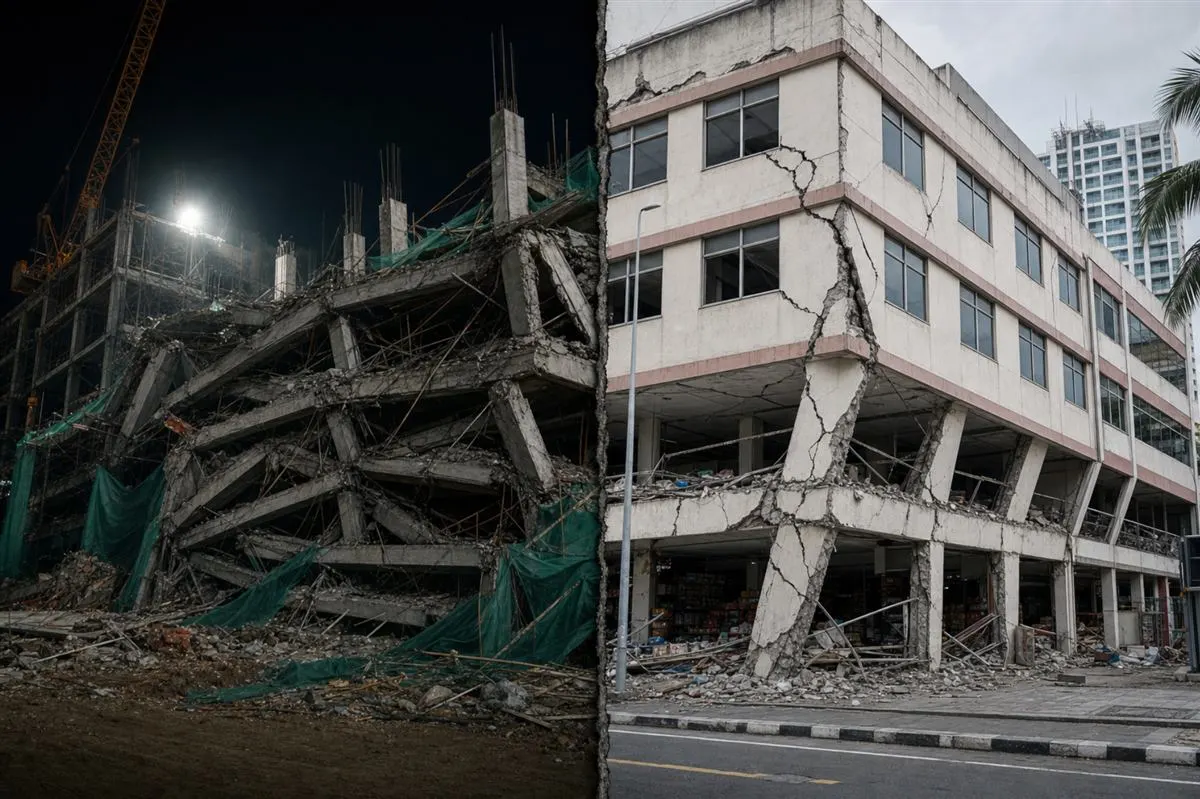
Two disasters, fifteen days apart — one from negligence, one from nature. Both exposed the same gaps in how Philippine buildings are designed, inspected, and verified.
On May 24, 2026, a building fell because of what people did. On June 8, buildings fell because of what the ground did. Fifteen days apart, two disasters — and underneath them, the exact same engineering question: does this building actually perform the way its paperwork says it does?
First, in Barangay Balibago, Angeles City, Pampanga, a nine-storey building under construction collapsed at approximately 3:00 AM while workers slept inside. The death toll had climbed to at least 30 by June 9, with retrieval operations continuing well into the second week. Then, on the morning of June 8, a magnitude 7.8 earthquake struck offshore of Maasim, Sarangani — and buildings came down across General Santos and the Soccsksargen region, including a two-storey school with students trapped inside and a commercial complex housing a Jollibee branch.
One was preventable negligence. The other was a natural hazard no one could stop. But ask any engineer what actually killed people in both cases, and the answer converges on the same three gaps — not bad luck, not "just an earthquake," but specific, checkable engineering failures.
Figures cited as of the dates noted; both death tolls were still being updated by authorities at publication time. See Sources below.
It is tempting to treat a construction-site collapse and an earthquake as unrelated categories of disaster — one a workplace failure, the other an act of nature. Engineers who reviewed both events, and the experts consulted by Rappler in the aftermath, point to a different conclusion: the trigger was different, but the building's vulnerability was created the same way, well before either event occurred.
Read those two lists again. Both are design-versus-reality gaps. In Pampanga, what was built no longer matched what was designed. In General Santos, what was designed never accounted for how the actual ground would behave under load. Different disasters, identical root cause: a building's real performance was never verified against its real conditions.
Most owners have never had their building checked against what it's actually carrying today — not what the original permit said in year one. A short assessment answers that question with documentation, not guesswork.
Request a Structural Review →Worried about a specific building? A licensed AEDO engineer will personally answer — free, no commitment.
The term came up repeatedly after the Sarangani quake, and it is one of the most common — and most overlooked — vulnerabilities in Philippine buildings.
A soft-storey building has one or more floors — almost always the ground floor — with wide openings, large unobstructed commercial or parking space, where a shear wall or other vertical structural support would normally be. That floor is far more flexible than the floors stacked on top of it. Under lateral earthquake load, nearly all of the building's drift and damage concentrates in that one weak floor, which can fail first and bring everything above it down with it.
This pattern is everywhere in the Philippines by design, not accident — ground-floor retail with glass storefronts, open parking podiums under residential towers, lobby-level commercial space with minimal walls. None of that is inherently wrong. It becomes dangerous when the structural design does not explicitly compensate for the lost stiffness with stronger columns, moment frames, or shear walls elsewhere on that floor — and when no one ever goes back to check.
PHIVOLCS found that 38% of barangays in General Santos City sit on unstable ground following the M7.8 quake — a finding that matters regardless of how well a building above that ground was designed. Liquefaction occurs when saturated, loose sandy soil temporarily loses strength and behaves like a liquid during strong shaking — typically in low-lying areas, near rivers, coastlines, or reclaimed land. A structure can have a perfectly adequate structural frame and still fail or tilt severely if its foundation sits on ground that liquefies beneath it.
A geotechnical investigation (soil boring test) is what identifies liquefaction risk — and it is sometimes treated as an optional cost on smaller projects rather than a baseline requirement. A building can be structurally sound on paper and still be sitting on ground that was never properly tested.
Experts who reviewed both disasters for Rappler's explainer converged on the same recommendation: the National Structural Code of the Philippines (NSCP) needs updating, and — just as critically — the gap between permit issuance and actual construction needs to close. A permit approved on paper is not a guarantee of what eventually gets built. The Angeles City case is the starkest version of this: an approved 9-storey design, a 10th floor under construction anyway, and a regulatory system that issued one inspection order in 2025 and never returned.
Strict implementation of existing regulations would have caught most of what failed in both events — undersized columns flagged at design review, an unauthorized floor flagged at site inspection, a soft-storey ground floor flagged at structural sign-off, liquefiable soil flagged at the geotechnical stage. The code gaps matter. But in both cases, the more immediate failure was that nobody followed through on the checks the system already requires.
Whether your building predates both disasters or you are planning a new one, these are the questions an engineer should be able to answer about it today — not from memory, with documentation.
| Area | What to Check |
|---|---|
| Design vs. As-Built | Does the sealed structural design match what was actually constructed — floor count, floor loads, and any additions made after the original permit? |
| Soft-Storey Risk | Does the ground floor have significantly less shear wall or column area than the floors above it? If yes, was that explicitly compensated for in the structural design? |
| Foundation & Soil | Was a geotechnical investigation performed? Is the site on low-lying, reclaimed, or sandy ground near water — and if so, was liquefaction potential assessed? |
| Code Vintage | Was the structure designed under NSCP 2010 or later? Older buildings designed under earlier seismic provisions carry materially higher risk and should be prioritized for review. |
| Inspection Trail | Is there a documented record of construction-phase inspections — concrete testing, rebar checks, formwork schedules — or did oversight stop after the permit was issued? |
A licensed AEDO engineer visits your site, checks design-versus-as-built condition, soft-storey risk, and foundation concerns, and delivers a written report within 5 business days. Flat ₱5,000. We take 3 assessments per month to keep turnaround fast — message us to claim a slot.
The BuildX NSCP Kit puts the complete NSCP 2015 structural code in your pocket — wind load calculator (§207), seismic base shear (§208), dead and live load tables, load combinations, and design aids. Built by AEDO engineers, for Philippine engineers and developers.
At AEDO Construction, every project is designed against the conditions it will actually face — not the conditions assumed at the start.
Statutes, codes, official tools and references used or referred to in this article, linked to their source. Links open in a new tab.
Prices, cost bands and rate figures in this article are AEDO Construction's own market and practice figures for Philippine work unless a source is named beside them. Code and statute references above link to the primary text.
Planning a new project? Send your floor area, location, and storey count and we'll reply with a fixed structural design price within 1 business day. Already built and unsure if it holds up against what we just saw in Pampanga and Sarangani? Start with the ₱5,000 Structural Assessment above.
Two disasters in 15 days, two different triggers, the same underlying lesson: a building is only as resilient as the gap between what its paperwork says and what it actually is. Close that gap before the next event tests it for you.
A soft-storey building has one or more floors — usually the ground floor — with large openings, wide doors, or unobstructed parking and retail space where a shear wall or other vertical structural support would normally be. This makes that floor far more flexible than the floors above it. Under lateral load from an earthquake, that soft floor absorbs almost all the drift and damage, and is far more likely to fail first, sometimes triggering a full collapse of the floors above. Ground-floor garages, open-front retail strips, and lobby-level commercial space are the most common soft-storey configurations in the Philippines.
Different triggers, same underlying gaps. The Angeles City building collapsed from what investigators describe as undersized columns, an unauthorized extra floor, and a construction site that fell off DOLE's inspection radar after a 2025 work-stoppage order was lifted. The Sarangani M7.8 earthquake brought down buildings linked to soft-storey ground floors, weak unreinforced masonry, and foundations on soil later confirmed to be liquefiable in large parts of General Santos. Both disasters trace back to the same three failure points: design that does not match what was actually built, inspection and enforcement gaps after permits are issued, and ground or load conditions that were never properly verified.
A geotechnical investigation (soil boring test) will identify liquefaction-prone soil — typically loose, saturated, sandy soil near rivers, coastlines, or reclaimed land. An engineer can visually and analytically assess soft-storey risk by checking whether the ground floor has significantly less shear wall or column area than the floors above. Buildings built before NSCP 2010 or without a sealed structural design are at higher risk and should be prioritized for assessment, especially in seismic zones like Mindanao, Metro Manila, and the West Valley Fault corridor.
Start with a structural assessment by a licensed engineer covering: structural drawing compliance versus as-built condition, column and shear wall adequacy including any soft-storey ground floor, foundation type and soil conditions, and any unauthorized additions or load changes since original construction. If your building was built before NSCP 2010, sits on reclaimed or low-lying land, or has an open ground floor, treat the assessment as a priority rather than a precaution.
When another structural incident or code update matters to Philippine builders, we'll send it to your inbox first.
No spam. One email per insight. Unsubscribe anytime.