📚 Part of our Why Buildings Fail series →
Two weeks after the magnitude 7.8 earthquake off Sarangani, PHIVOLCS confirmed that quake came from the Cotabato Trench — and warned the Philippines has five more like it. If you haven't read our breakdown of what happened on June 8, start with the Mindanao Earthquake analysis → before this one.
A magnitude 7.8 earthquake off Sarangani made headlines for a week. What got far less attention is the sentence PHIVOLCS's own director said days later: that trench was one of six — and the other five are still fully loaded. If you live or build anywhere near the Philippine coastline, one of them is closer than you think.
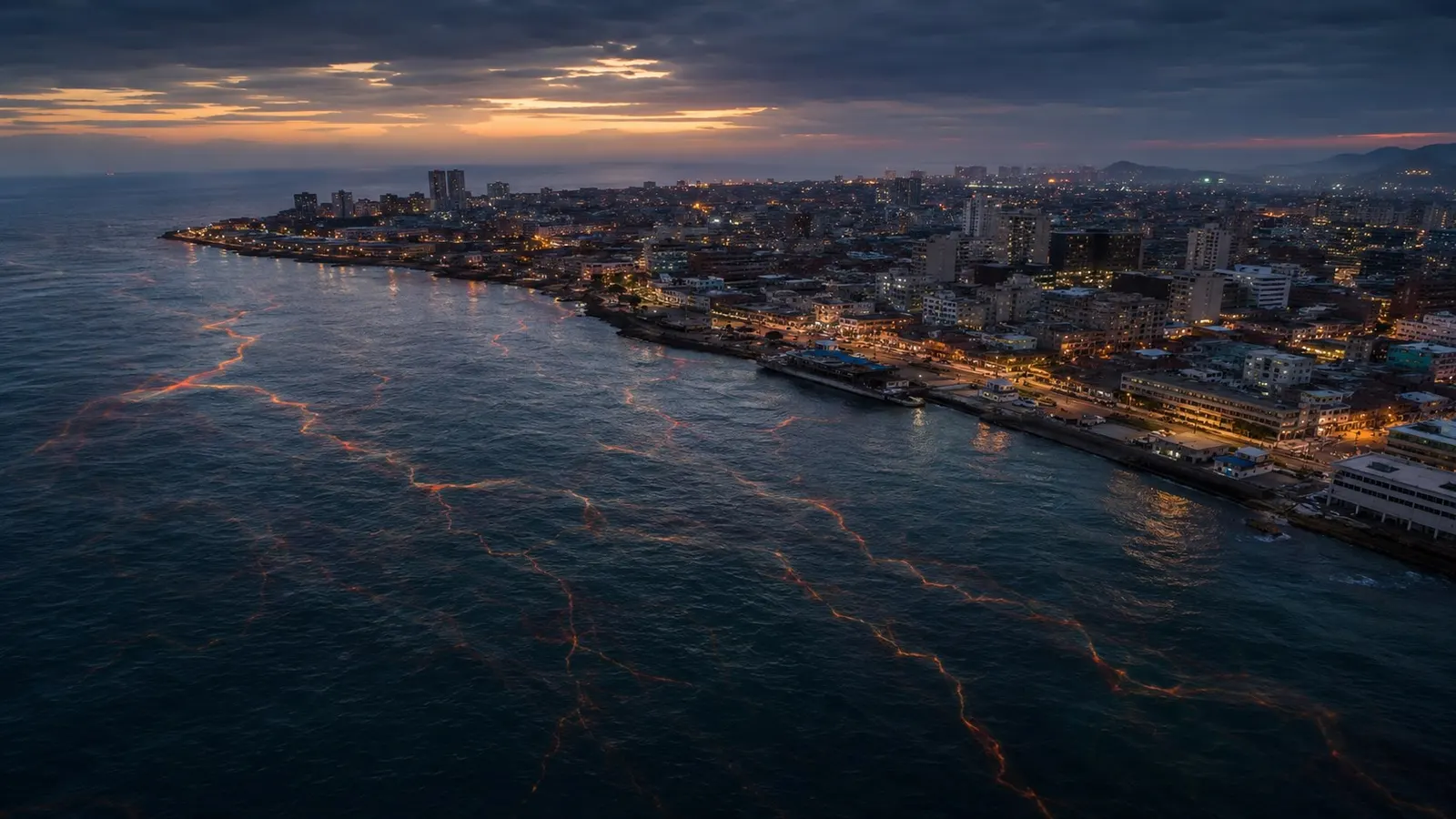
Conceptual illustration — the Philippines is bounded by six active trenches PHIVOLCS has identified as capable of producing a magnitude 8+ earthquake.
On June 9, 2026 — the day after the magnitude 7.8 earthquake struck off Sarangani — PHIVOLCS Director Teresito Bacolcol told reporters that the Cotabato Trench, the structure responsible for that quake, "is actually long, more than 300 kilometers." Days later, at a follow-up briefing on June 12, 2026, he gave the fuller picture: PHIVOLCS has identified six active trenches around the Philippine archipelago, each with its own "maximum credible earthquake" estimate ranging from magnitude 8.1 to 8.5. "Nobody can predict when an earthquake can happen or how strong it is," Bacolcol said, "but we know that these trenches are active and they are capable of the said maximum credible earthquake." (Philippine News Agency, Philstar)
Not sure if your building was designed for an event like this? A licensed AEDO engineer can review your structural drawings or inspect the building itself.
These aren't six versions of the same risk in different cities — they're six separate fault systems, hundreds of kilometers apart, that happen to ring almost the entire Philippine coastline. A rupture on one does nothing to relieve the strain quietly building on the others.
Runs over 300 km off southwestern Mindanao. Nearest to Sarangani, General Santos City, South Cotabato, Sultan Kudarat, and Maguindanao. The same trench produced the M8.1 Moro Gulf earthquake in 1976 — meaning its June 8 rupture, while devastating, was still below its own credible ceiling.
Sits offshore west of Luzon, roughly facing Zambales down through Bataan, Cavite, and Mindoro. The fault structure closest to Metro Manila and the National Capital Region's western seaboard.
The longest of the six, running the entire eastern seaboard from East Luzon through Bicol, Eastern Visayas (Samar, Leyte), and down to Southeast Mindanao (Davao Oriental, Surigao).
Sits off the northeastern coast of Luzon, near Aurora, Isabela, and Cagayan — the structure that effectively continues the Philippine Trench's risk profile further north.
Lies in the Sulu Sea west of Negros, within reach of Negros Occidental, Negros Oriental, and parts of Antique and Panay — a Visayas-facing hazard that gets far less public attention than its Luzon and Mindanao counterparts.
Runs through the Sulu Sea between the Sulu Archipelago and Borneo, closest to Tawi-Tawi, Sulu, the Zamboanga Peninsula, and southern Palawan.
Magnitude figures: PHIVOLCS Director Teresito Bacolcol, June 12, 2026 briefing, as reported by Philstar. These are long-term "maximum credible earthquake" hazard ceilings PHIVOLCS uses for planning, not short-term forecasts.
Use the self-check below — pick your region and answer five quick questions about your building to get an instant risk read, the same way we did for the Mindanao earthquake.
Take the 60-Second Self-Check ↓The most natural reaction to the Mindanao earthquake is relief mixed with a quiet assumption: that was the big one for this cycle, the pressure's released, we're due for a break. Seismically, that assumption is wrong, and PHIVOLCS's own statement is the reason they issued this warning after the Cotabato Trench had already ruptured, not before.
Each of the six trenches is an independent fault system, accumulating strain from plate movement on its own schedule, over decades to centuries. The Cotabato Trench releasing energy on June 8 changed nothing about how much strain has built up on the Manila Trench off Luzon, or the Negros Trench in the Visayas. They are not connected pressure valves — they are six separate structures that each, eventually, will need to release what they've been storing. The only thing the Mindanao quake proved is that the mechanism PHIVOLCS described is real and active right now, on at least one of the six.
The Cotabato Trench has done this before. PHIVOLCS's own historical archive records the August 17, 1976 Moro Gulf earthquake — magnitude 8.1, generated by the same Cotabato Trench — as the deadliest tsunami disaster in Philippine history: roughly 8,000 people killed or missing, 10,000 injured, 90,000 left homeless, with tsunami waves reported up to 9 meters along the Moro Gulf coast. Most of the casualties came from the tsunami, not the shaking itself. None of the six trenches is a hypothetical risk on a hazard map — the Cotabato Trench alone has already produced its own credible-maximum event once, within living memory. (PHIVOLCS official archive — 1976 Mw8.1 Moro Gulf Earthquake)
Earthquake magnitude is logarithmic: each full whole-number step up the scale (say, M7 to M8) releases roughly 32 times more energy — not twice, not ten times, but thirty-two. The June 8 quake was M7.8; the worst-case scenario PHIVOLCS has modeled for some of these trenches is M8.5. That gap of 0.7 magnitude steps works out to roughly 11 times more energy than what already devastated General Santos. The structural weaknesses that doomed specific buildings there — a soft ground storey, unreinforced CHB masonry, weak column-beam connections, and foundations on soft soil — don't become safer at a higher magnitude. They become more dangerous, faster.
| What NSCP 2015 §208 requires | Why it matters at M8+, not just M7 |
|---|---|
| Continuous lateral-force-resisting system | At higher magnitudes, any gap in the load path — a missing shear wall, a soft storey — becomes the single point where collapse initiates first. |
| Ductile detailing | The structure must absorb more energy by bending without breaking; under-detailed connections that "got away with it" in a moderate quake won't survive a major one. |
| Zone 4 design forces | Nearly the entire Philippines is classified Seismic Zone 4 — the code already assumes a major event is possible everywhere, not just near a known fault. |
| Site-specific soil factors | Soft or reclaimed soil amplifies shaking; a building's foundation design has to match the actual ground it sits on, not a generic assumption. |
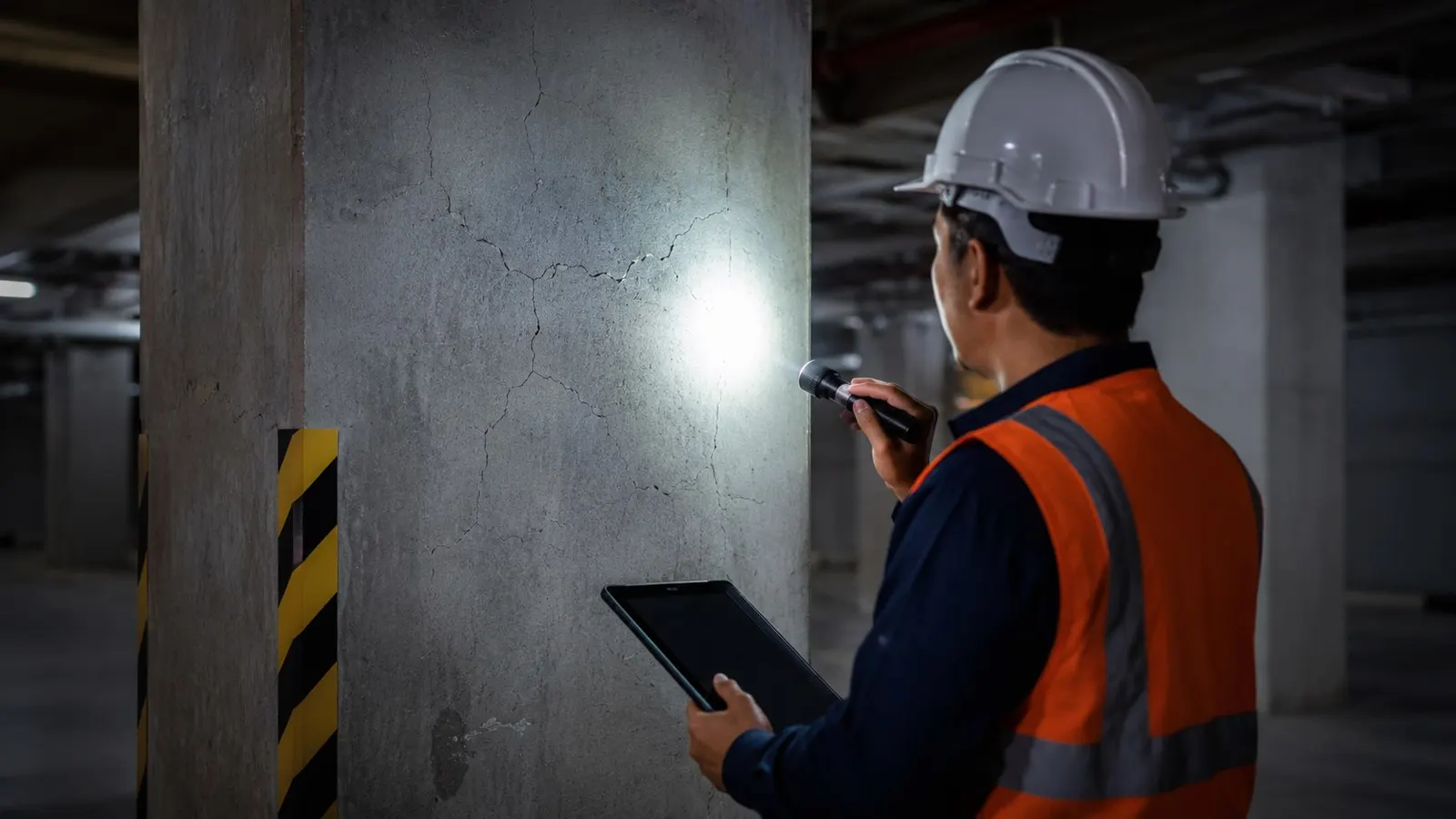
Conceptual illustration — the kind of close visual inspection a licensed engineer performs to check for hairline cracks and hidden damage before clearing a building.
Pick the region closest to your building, then answer four quick structural questions. You'll get an instant risk read — not a substitute for a real inspection, but a fast way to know whether you should book one.
1. Which region is your building in?
2. When was your building constructed?
3. Is the ground floor much more open than the floors above? (parking, retail, glass frontage)
4. Do you have structural drawings with explicit seismic (NSCP §208) load calculations?
5. Are your walls CHB with no visible vertical rebar or bond beams?
PHIVOLCS didn't release this list to cause alarm about Mindanao specifically — they released it because the Cotabato Trench rupture was a live demonstration of a mechanism that exists, unreleased, in five other places. The earthquake already happened once this year. The engineering question for the rest of 2026 and beyond is simple: when one of the other five lets go, will the buildings around it look like the ones that survived General Santos, or the ones that didn't?
Whether you're near the Manila Trench, the Philippine Trench, or any of the other four, AEDO Construction's licensed engineers can review your structural drawings or inspect your building and tell you plainly where it stands against a major seismic event. Message us and we'll respond within hours.
The BuildX NSCP Kit puts the complete NSCP 2015 structural code in your pocket — including the Section 208 seismic provisions, zone factors, and load tables that decide whether a building survives whichever of these six trenches goes next. Built by AEDO engineers, for Philippine engineers, students, and owners.
At AEDO Construction, every structure we design assumes a major earthquake is a matter of when, not if — because with six independent trenches ringing the country, it always is. We don't treat seismic design as a regional concern for "earthquake-prone areas." Under NSCP 2015, nearly the whole Philippines already is one.
Statutes, codes, official tools and references used or referred to in this article, linked to their source. Links open in a new tab.
Prices, cost bands and rate figures in this article are AEDO Construction's own market and practice figures for Philippine work unless a source is named beside them. Code and statute references above link to the primary text.
AEDO Construction provides structural assessment, seismic design, and retrofit nationwide, plus design-build services in Negros Oriental, for residential, commercial, and institutional projects. Whether you're near the Cotabato Trench, the Manila Trench, or any of the other four, we treat structural safety as the non-negotiable foundation of every recommendation we make.
The Philippines didn't choose to sit where the Sunda Plate, the Philippine Sea Plate, and the South China Sea Basin all converge — and no engineer can stop a fault from slipping. What can be controlled is what gets built on top of it, and whether, when one of the remaining five trenches finally lets go, the buildings nearby are designed to bend, hold, and let people walk out.
PHIVOLCS gave the country a map of where the next one is most likely to come from. The only real failure now would be reading it as news about Mindanao, instead of as a checklist for wherever you actually are.
If you own, manage, or are planning a building anywhere along the Philippine coastline, partner with engineers who treat seismic safety as the whole point — not a formality. AEDO Construction is ready to help today.
On June 9, 2026 — a day after the magnitude 7.8 Mindanao earthquake — PHIVOLCS Director Teresito Bacolcol named six active trenches around the Philippines that are each capable of producing an earthquake of magnitude 8 or higher: the Philippine Trench (East Luzon to Southeast Mindanao), the East Luzon Trough, the Manila Trench, the Negros Trench, the Sulu Trench, and the Cotabato Trench — the same structure that ruptured off Sarangani on June 8.
According to PHIVOLCS Director Teresito Bacolcol (June 12, 2026 briefing), yes — each trench has its own "maximum credible earthquake" estimate: the Philippine Trench and East Luzon Trough up to magnitude 8.5 (the highest), the Manila Trench up to 8.4, the Sulu Trench up to 8.3, the Negros Trench up to 8.2, and the Cotabato Trench — the one that produced the M7.8 Mindanao quake — up to 8.1. Bacolcol was clear these are long-term hazard ceilings, not predictions: "Nobody can predict when an earthquake can happen or how strong it is, but we know that these trenches are active and they are capable of the said maximum credible earthquake."
No. The six trenches are largely independent fault systems hundreds of kilometers apart. A rupture on the Cotabato Trench releases stress that had built up specifically along that structure — it does not relieve stress on the Manila Trench, Philippine Trench, Negros Trench, Sulu Trench, or East Luzon Trough. Each continues accumulating strain on its own timeline, which is exactly why PHIVOLCS issued this warning days after the Mindanao quake rather than standing down.
Very likely yes. The six trenches collectively run along almost the entire Philippine coastline: the Manila Trench faces Metro Manila and Central Luzon from the west, the Philippine Trench and East Luzon Trough run along the eastern seaboard from Aurora down through Bicol and Eastern Visayas to Mindanao, and the Negros and Sulu Trenches sit off the Visayas and southwestern Mindanao. Most population centers in the country are within striking distance of at least one. The relevant question isn't "am I near Mindanao" — it's "which trench is nearest me, and is my building designed for it."
When a new structural incident or seismic event matters to Philippine builders, we'll send it to your inbox first.
No spam. One email per insight. Unsubscribe anytime.