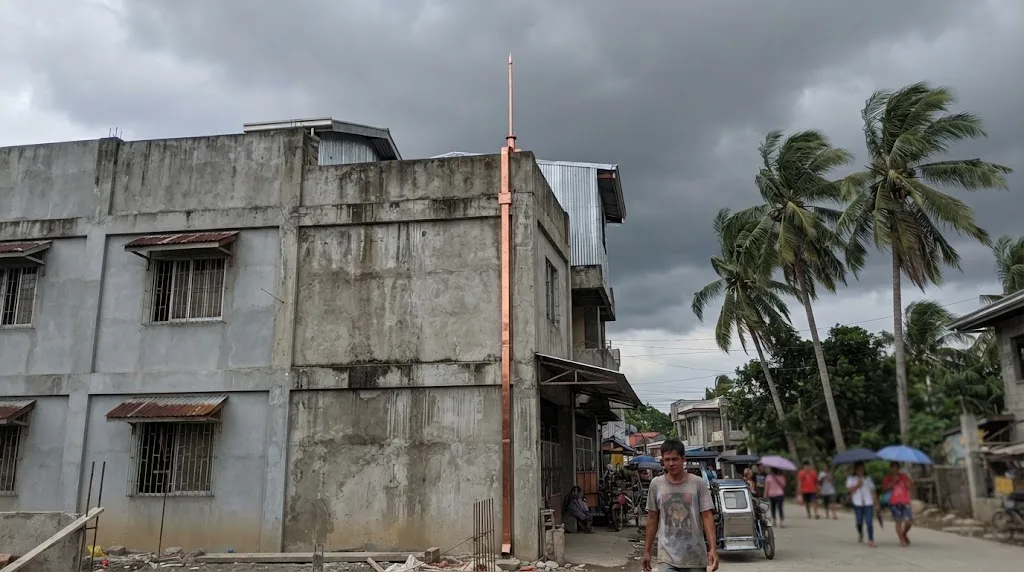
The rod on the roof gets the attention, but the copper conductor running down the wall and the ground rods at its foot do most of the work. Illustrative photo.
Short answer: for most Philippine buildings, no rule says in plain words "install a lightning protection system." The Fire Code 2019 RIRR requires one for cryogenic fluid containers installed outdoors, lists it as required for structures at water and wastewater treatment plants (under the RIRR's special measures for those plants), sets the standard for wind turbines, and lets the fire marshal require it for organic coatings plants. The Glossary of the Revised IRR of PD 1096 defines high-rise buildings, 16 storeys or 48 m and up, as ones for which "arresters" and other safety systems are mandatory, which we read as lightning arresters. The Philippine Electrical Code doesn't list who needs one. It says how an installed system must be bonded to the building's grounding. For houses, offices, schools, churches and warehouses it's a risk decision, and the numbers usually point one way for big roofs. Our checker below, using the NFPA 780 Annex L screening method, puts a 40 × 20 m steel warehouse, 8 m high, standing alone at about one direct strike every 18 years at an assumed 10 flashes per km² per year. That's 18.3 times the tolerable rate, and the screen says "protect it" at any flash density above 0.55. A basic conventional system for it plans at ₱180,000–330,000 (AEDO 2026 planning range).
The checker screens your own building, lists what the rules say for its use, and gives a planning cost. Below it: what the parts of a system do, what each Philippine rule actually says, the reader questions we get most (steel warehouses and houses), the ESE debate, who signs, and how to test it.
A simplified screening using the collection-area method of NFPA 780 Annex L, as implemented in a published Los Alamos National Laboratory calculator. It is not an IEC 62305-2 risk calculation and not a design. It also lists what the Philippine rules we read say for your building's use, and gives an AEDO 2026 planning cost for a basic conventional system.
A lightning protection system (LPS) doesn't stop lightning or "attract" it from far away. It gives a strike that was going to hit the building anyway a planned path to earth, so the current doesn't find its own way through a concrete column, a steel purlin or the wiring. A conventional system has five parts:
Designers work out where the terminals go with a protection method. The one most people have seen drawn is the rolling sphere: imagine a big ball rolled over and around the building. Anywhere the ball touches needs a terminal or conductor; anything the ball can't touch is inside the protected zone. The sphere radius is set by the standard the designer uses and the level of protection chosen.
We searched the full text of the Fire Code 2019 Revised IRR (RA 9514) and the 2004 Revised IRR of PD 1096 for every mention of lightning, and read Article 2.50 of the PEC 2017 Part 1. Here's everything that bears on buildings, split into what's required and what isn't.
| Where | What it says | Legal effect |
|---|---|---|
| Fire Code RIRR 10.5.1.8 F.2, water and wastewater treatment plants | Lightning protection "shall be provided for structures" per the latest PEC and NFPA 780 | Listed as required (item 2 of the "special fire protection and miscellaneous" measures that "shall be considered" for plants "having unique problems or situations") |
| RIRR 10.3.7.6 B.3.b, cryogenic fluids | Containers and systems "shall be equipped with lightning protection when installed outside the building" | Required (outdoor installations) |
| RIRR 10.2.19.4 D, wind turbine facilities | Lightning protection for blades, nacelles, towers, power lines, transformers and support structures per IEC TR 61400-24 | Required |
| RIRR 10.2.19.1 A, aerodrome fuel servicing | Electrical system design per PEC, NFPA 70 and NFPA 780, "signed and sealed by a Professional Electrical Engineer" | Required design basis for these facilities |
| Revised IRR of PD 1096, Glossary, "High-rise" | For 16 storeys or taller (from 48 m): "elevators, fire escapes, sprinkler systems, arresters, beacons and other safety systems, particularly if near airports, are mandatory" | Stated as mandatory in the Glossary definition ("arresters", read with 707.3(c)(vii) as lightning arresters) |
| RIRR 10.4.15.7 F, organic coatings manufacturing | "Where required by the C/MFM having jurisdiction," an LPS meeting the PEC and NFPA 780 | If the fire marshal requires it |
| RIRR 10.4.11.3 B.3.c, wood processing and woodworking | "Lightning protection, if necessary, shall be installed in accordance with" the PEC | If necessary |
| RIRR 10.4.4.2 D, dust-producing machines | Electrical wiring, power equipment "and lightning protection system installed, shall conform to" the PEC | If installed, it must follow the PEC |
| Revised IRR of PD 1096, Section 707.3(c)(vii) | Lists the "need for applicable building safety and maintenance systems, e.g., lightning arresters" among the factors in setting building height | A design consideration |
| Revised IRR of PD 1096, Section 2004.1(b)(iii), roof signs | "Adequate provisions for grounding metallic parts of roof signs exposed to lightning shall be provided" | Required for roof signs |
| PEC 2017 Part 1, 2.50.5.17 and 2.50.3.11 | How an installed LPS is bonded to, and kept separate from, the electrical grounding (Section 3 below) | Required if an LPS is installed |
What we did not find. No clause requiring lightning protection for houses, offices, schools, hospitals, churches, general warehouses or malls as such. The LPG (10.3.7.8) and CNG (10.3.7.9) sections of the RIRR have no lightning protection requirement; the CNG section only points to API RP 2003 for protection against stray and impressed currents. The medical and compressed gases section even says, for manufacturing, that "containers and systems containing compressed gas under pressure are not required to be equipped with lightning protection" (10.3.7.7 B.10). The flammable and combustible liquids section (10.3.7.5) doesn't mention lightning. The 25-ohm figure in the RIRR (10.4.15.7 E.1.b) is for dissipating static in coatings plants, not for lightning.
That doesn't mean a fuel depot or a school doesn't need protection. It means the requirement, where there is one, comes from the engineer's risk assessment, the fire marshal's evaluation during FSEC review, the owner's insurer, or a client's standard, not from a line in the national rules. The 2019 RIRR is still the current Fire Code IRR; our BFP violations and FSIC guide covers how the inspection works, and the fire sprinkler requirements guide shows how the RIRR sets other systems by occupancy division.
The Philippine Electrical Code is published by the IIEE and sold, not posted free. We read Article 2.50 (Grounding and Bonding) of the 2017 Part 1 from the Filipino Engineer wiki, which labels itself "not an official copy," so check the wording against your own copy. PEC 2017 Part 1 is still the current edition; a revision based on the 2023 NEC has been discussed (Filipino Engineer, May 2026) but not released as far as we could find. What it says that matters here:
So the PEC doesn't decide whether you need an LPS. It decides that, if you have one, it's bonded to the electrical grounding and doesn't replace it.
Outside the cases in Section 2, the decision is engineering. Two standards families are used for it, and both are sold, so we describe them rather than quote them:
What drives the result in both, and what engineers look at first:
Typical buildings that end up protected on risk, not by a specific rule: tall buildings, hospitals, larger schools, fuel and LPG depots, warehouses holding flammables, telecom and other steel towers, and churches with steeples or bell towers. For a church, our church and chapel cost guide covers the bell tower as its own structure; it's also the part most exposed to strikes.
A risk assessment needs ground flash density (Ng): cloud-to-ground flashes per km² per year at the site. We couldn't find an official Philippine map of it. What PAGASA does publish, in its 1991–2020 climatological normals, is the average number of thunderstorm days (thunder heard at the station) and days with lightning (lightning seen) per year:
| PAGASA station (1991–2020) | Thunderstorm days / year | Days with lightning / year |
|---|---|---|
| Dumaguete City, Negros Oriental | 85 | 145 |
| Mactan International Airport, Cebu | 102 | 110 |
| Tacloban City, Leyte | 108 | 79 |
| Davao City, Davao del Sur | 125 | 152 |
| Science Garden, Quezon City | 106 | 51 |
| Port Area, Manila | 62 | 30 |
Those are counts of days, not flashes, and they depend on what an observer at one station can see and hear. Current practice prefers flash density measured by lightning location networks over conversions from thunderstorm days, so we don't do that conversion in the checker. For a sense of scale, Vaisala's global statistics count 56.59 lightning events per km² over Philippine land in 2021, but that's total lightning (in-cloud plus cloud-to-ground) for one year, not a ground flash density. That's why the checker asks you to pick Ng and also shows the break-even value: the flash density above which the screen recommends protection. For many buildings the break-even is so low that the exact value hardly matters.
This is the question we get most, usually after the steel is already up. The electrical side of a new warehouse, in the order it's required:
The electrical line in our warehouse cost guide covers wiring and lighting, not an LPS; add it if you decide to protect. Once the warehouse operates, the yearly electrical inspection is its own obligation; see annual electrical safety inspection.
No Philippine rule we found requires one on a house, and most houses here don't have one. On risk, run the numbers honestly: a 10 × 8 m two-storey house, 7 m to the ridge, concrete with a metal roof, among houses of similar height, collects about 2,221 m². At an assumed Ng of 10 it expects a direct strike about every 90 years, and the simplified screen says it's 7.4 times the tolerable rate, with a break-even of 1.35 flashes per km² per year. Read that as a flag, not a verdict: the simplified screen doesn't count protection measures or actual losses the way a full IEC 62305-2 assessment does. What we tell homeowners:
Rooftop solar changes the picture: panels, frames and DC cables on the roof become things the strike can reach. The array frame has to be bonded or kept separated from any LPS conductors as the designer specifies, and the inverter needs surge protection. Our rooftop solar structural check covers the mounting side.
"An ESE (early streamer emission) terminal protects a whole compound with one rod." This is the most common sales pitch, and it's disputed. ESE terminals are designed under their own national standards, such as France's NF C 17-102, which give them a larger protection radius than a plain rod. In 1995 the NFPA Standards Council rejected a proposed ESE standard, NFPA 781, after a NIST literature review; the Council found that "a sound technical basis for proposed NFPA 781 has not been demonstrated," while agreeing with the NIST finding that properly designed ESE terminals "perform at least as well as conventional terminals with the same geometrical configuration," and noting that nothing in NFPA 780 prohibits such terminals if they otherwise comply with it. NFPA 780, the standard the Fire Code RIRR cites, has no ESE design method of its own. Our position: we don't sell a brand. If you're offered ESE, ask the designer which standard the layout follows, get it in writing and sealed by a PEE, and check that the down conductors, earthing and bonding are designed as carefully as the terminal. A single expensive head on a thin cable to one rod isn't a system under any standard.
"A lightning rod attracts lightning to the building." It gives the strike a place to attach on a building that was going to be hit anyway. A building's exposure is set by its height, size and surroundings, not by the rod.
"The lightning rod also protects my appliances." No. Surges on the incoming power and data lines need surge protective devices; the PEC treats them in separate articles.
"A metal roof grounds itself." A metal roof on a steel frame is the least vulnerable combination in the Annex L table, but the frame still has to be bonded per PEC 2.50.5.15(c), and whether the roof sheets and frame can serve as part of an LPS is the designer's call under the standard used, not an assumption.
A lightning protection system is part of the electrical design. Section 31(a) of RA 7920, the Electrical Engineering Law, gives the Professional Electrical Engineer "the sole authority to seal electrical plans," and the Revised IRR of PD 1096 requires electrical documents for the permit to be signed and sealed by a PEE (302.3). The Fire Code RIRR, where it touches lightning at aerodrome fuel facilities, asks specifically for a design per the PEC, NFPA 70 and NFPA 780 "signed and sealed by a Professional Electrical Engineer" (10.2.19.1). A supplier's layout is not a design until a PEE takes responsibility for it.
Three things to ask for: the standard the design follows (NFPA 780, IEC 62305 or an ESE standard), the risk assessment or the reason protection was chosen, and the earthing test value the installation must meet at handover. The structural engineer has a smaller role: conductor fixings on the parapet, rods near footings, and anything mounted on a steel tower or a tank stand. Our guide to DOLE-accredited PE inspections explains the separate yearly inspection.
The 25-ohm number. The figure everyone quotes comes from PEC 2.50.3.7, and it's about the electrical grounding electrode: a single rod, pipe or plate that doesn't reach 25 ohms or less gets a second electrode. It isn't a lightning protection target. The LPS design should state its own earthing arrangement and acceptance value from the standard it follows, and that's the number the test is measured against. Ask for it before you pay the final billing.
What to check, and when (AEDO practice, not a code schedule):
Our building preventive maintenance guide puts the earthing and grounding resistance test on a semi-annual schedule with the readings logged; the lightning system's test points go on the same sheet.
We couldn't find published Philippine price data for complete lightning protection systems, so these are AEDO 2026 planning assumptions, installed, for a conventional rod-and-conductor system. They're for budgeting whether to protect, not quotations:
| Item (AEDO 2026 planning assumption) | Rate | 40 × 20 m warehouse, 8 m |
|---|---|---|
| Air terminals with bases, one per 7 m of roof-edge and centre run | ₱2,500–4,500 each | 23 terminals |
| Roof conductor, installed | ₱450–800 per m | 160 m |
| Down conductors, one per 30 m of perimeter, minimum two | ₱500–900 per m | 4 × 8 m |
| Ground rod with test point and clamps, per down conductor | ₱4,000–7,000 each | 4 |
| Surge protective device at the main panel | ₱8,000–20,000 | 1 |
| Bonding of rooftop solar, antennas or equipment, if any | ₱5,000–15,000 | none |
| PEE design, risk assessment and handover earth test | ₱10,000–20,000 | 1 |
| Planning total, rounded | ₱180,000–330,000 |
The same assumptions give about ₱70,000–130,000 for the 10 × 8 m house in Section 7. What moves the price: roof size and shape (every ridge and parapet needs a run), height (down conductor length), soil (rocky or dry ground may need more electrodes to reach the design value), copper versus aluminium, and whether the work is done during construction or retrofitted around finished walls and ceilings. Towers and high-rise buildings need a full design before any figure means anything, so the checker doesn't give one.
What AEDO does. Our Professional Electrical Engineer, DOLE-accredited, runs the risk assessment and prepares signed and sealed lightning protection and grounding designs as part of the electrical plans; see our MEPFS design service. Design and review are offered nationwide, remotely where a site visit isn't needed. Installation and testing we do only in Negros Oriental, where we build. Elsewhere we can review a supplier's proposal against the design standard before you sign.
Fire Code clauses were read from the full text of the 2019 Revised IRR of RA 9514; PD 1096 clauses from the 2004 Revised IRR (Sections 302, 707, 2004 and the Glossary). PEC 2017 Part 1 Article 2.50 was read from an unofficial transcription, since the official IIEE text isn't free. The screening formulas and factors are NFPA 780 Annex L as implemented in LANL's published calculator. Thunderstorm and lightning days are PAGASA's 1991–2020 normals. Costs are AEDO planning assumptions, stated as such.
Does my building need a lightning rod in the Philippines?
For most buildings no rule says so directly. In the rules we read, the Fire Code 2019 RIRR expressly requires lightning protection for cryogenic fluid containers installed outdoors, lists it as required for structures at water and wastewater treatment plants (under the RIRR's special measures for those plants), makes wind turbines follow IEC TR 61400-24, and lets the fire marshal require it for organic coatings plants. The Glossary of the Revised IRR of PD 1096 defines high-rise buildings, 16 storeys or 48 metres and up, as ones for which arresters and other safety systems are mandatory; we read arresters there as lightning arresters. For houses, offices, schools, churches and warehouses it is a risk decision: tall, isolated or hilltop buildings, large roofs, crowded or critical occupancies and flammable contents push toward protection. A Professional Electrical Engineer makes that call with a risk assessment.
Is lightning protection required by the Philippine Electrical Code?
The PEC 2017 Part 1 text we read does not list which buildings must have one. It says how an installed system ties into the wiring: Section 2.50.5.17 requires the lightning protection system ground terminals to be bonded to the building grounding electrode system, and Section 2.50.3.11 says air terminal conductors and the rods that ground them cannot be used in place of the grounding electrodes of the electrical system. A fine-print note points to NFPA 780 and gives typical separations of 1,800 mm through air or 900 mm through concrete, brick or wood. We read these from an unofficial transcription, because the official IIEE text is sold, not published free.
What electrical work is required in a new steel warehouse?
Electrical plans signed and sealed by a Professional Electrical Engineer for the building permit, with the layout, schedule of loads, design analysis and one-line diagram listed in Section 302 of the Revised IRR of PD 1096. The installation follows the Philippine Electrical Code, including a grounding electrode system (a single rod, pipe or plate that does not reach 25 ohms or less gets a second electrode at least 1,800 mm away) and bonding of an interconnected metal building frame that is likely to become energized. No rule we found requires a lightning protection system for a general-goods warehouse, but a large metal-roofed warehouse standing alone usually screens as recommended, so price it at design stage.
Who can design a lightning protection system in the Philippines?
A lightning protection system is part of the electrical design, and Section 31(a) of RA 7920 gives the Professional Electrical Engineer the sole authority to seal electrical plans. The Revised IRR of PD 1096 likewise requires electrical documents for the building permit to be signed and sealed by a Professional Electrical Engineer. The Fire Code RIRR asks for a PEE-signed design that complies with the PEC, NFPA 70 and NFPA 780 at aircraft fuel servicing facilities. The installer can be an electrical contractor, but the design and the standard it follows should carry a PEE's seal.
What ground resistance should a lightning protection system have?
The PEC figure people quote, 25 ohms, is for the electrical system's grounding electrode: Section 2.50.3.7 says a single rod, pipe or plate that does not have a resistance to ground of 25 ohms or less must be augmented by another electrode at least 1,800 mm away. It is not a lightning protection target. The lightning protection design should state its own earthing arrangement and test value from the standard it follows. Ask the designer for that number, have it measured at the test points when the system is handed over, and keep the readings.
Are early streamer emission (ESE) lightning rods better?
It is a disputed question. ESE terminals are designed under their own national standards, such as France's NF C 17-102, and claim a larger protected area than a plain rod. In 1995 the NFPA Standards Council declined to adopt a proposed ESE standard, NFPA 781, finding that a sound technical basis had not been demonstrated, and NFPA 780, the standard the Fire Code cites, has no ESE design method of its own. Whichever type you buy, the down conductors, earthing and bonding still have to be right, and the design should name the standard it follows.
How much does a lightning protection system cost in the Philippines?
For a basic conventional system, AEDO's 2026 planning range for a 40 by 20 metre steel warehouse 8 metres high is about 180,000 to 330,000 pesos, including air terminals, roof and down conductors, ground rods with test points, a surge protective device at the main panel, and design and testing by a Professional Electrical Engineer. A 10 by 8 metre two-storey house comes out at about 70,000 to 130,000 pesos. These are planning assumptions, not quotations; towers and high-rise buildings need a full design before any figure means anything.
Rules, data and methods read for this article. External links open in a new tab.
We could not read the official IIEE text of the PEC, so its clauses are quoted from a transcription and should be checked against a purchased copy. We found no official Philippine ground flash density map, so the checker takes Ng as your input. No NFPA 780 or IEC 62305 values (sphere radii, conductor sizes, terminal spacing) are given here, because we did not read those standards; the cost layout rules are AEDO planning assumptions. Amendment check: we found no later law changing Section 31(a) of RA 7920, and no later issuance changing the 2004 Revised IRR provisions cited here (JMC 2018-01 changed the number of permit sets, not who signs them). This article is general information, not a design for your building.
Send us the building's size, use and a roof photo, or the supplier's proposal. Our Professional Electrical Engineer will tell you whether protection is warranted and what the design has to include.