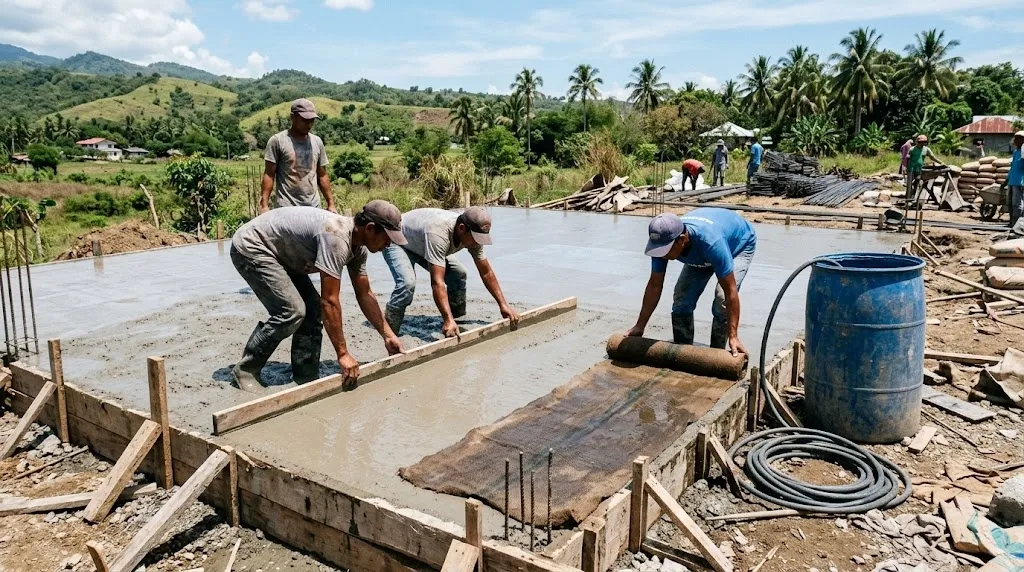
The pour is the easy part. The next seven days of water, shade and attention decide what the surface turns into. Illustrative photo.
On 7 October 2026 PAGASA updated its ENSO page to say that a strong to very strong El Niño is present in the tropical Pacific, that it may peak before the end of 2026, and that forecasts have it continuing into the first half of 2027. Its July to December outlook, issued 8 July, calls for generally below-normal rainfall over most of the country from October to December. PAGASA's drought and dry spell assessment issued 1 October 2026 lists Negros Oriental under drought as of September. Its outlook does not list the province for the end of October or November, then has it back under dry condition by the end of December, dry spell by the end of January 2027 and drought by the end of February. For a site in Negros Oriental that means one thing about concrete: the slab you cast this month is more likely to meet a hot, dry, breezy morning than a wet one, and nobody is going to wait until next year to pour.
Hot, dry and windy are the three things that pull water out of a fresh surface faster than the mix can bleed it back up. The result is plastic shrinkage cracking, a map of fine cracks that can open within the first hours, and the weak, dusty top that comes from a surface that dried before it cured. The checker below turns four site readings into an evaporation rate, a risk verdict and a water budget for the curing week. The sections after it explain what is behind each number and where the code stops giving them.
Enter the readings you would take on the slab on the morning of the pour, and the element you are casting. You get the evaporation rate, a verdict on plastic shrinkage risk, what changes the number most, and the litres of water the curing week needs. A planning aid, not a specification.
Start with the rule most people assume exists. NSCP 2015 has no hot-weather temperature limit. We read Section 426.5.5, "Concreting in Hot Weather", in AEDO's copy of Chapter 4. Under design information it lists the temperature limits for concrete as delivered in hot weather, which means the design documents are supposed to state them. Under compliance it says two things: materials and production methods shall be selected so the concrete temperature at delivery meets those limits, and handling, placing, protection and curing procedures shall limit concrete temperatures or water evaporation that could reduce strength, serviceability and durability. No degrees, no evaporation figure, no hour of the day. If your plans and specification do not name a maximum concrete temperature, the code has not given you one to fall back on.
Curing is the part that does carry numbers. Section 426.5.3.2 requires concrete other than high-early-strength to be kept at 10 °C or more and moist for at least the first 7 days after placement, and high-early-strength concrete for at least 3 days, unless accelerated curing is used. Our formwork removal guide works the same clause into stripping times, and our best time to build guide quotes both clauses. In El Niño heat the clause is not a formality: seven days of "moist" is seven days of water you have to bring.
For the practice behind the clause the usual reference is ACI 305R, Guide to Hot Weather Concreting. We could read only the public preview of the 2020 edition (cover, contents, chapters 1 to 3), not the full text. Three things in it matter here. It defines hot weather as any mix of high air temperature, high concrete temperature, low humidity and high wind that tends to impair fresh or hardened concrete. It says that setting one maximum as-placed temperature is too simple a rule, and that a windy, sunny day calls for stricter precautions than a calm, humid one at the same air temperature. And it lists, among the measures, scheduling placement for the time of day or night when the weather suits, and protecting the concrete from moisture loss during placing and curing. It also notes that if the first 24 hours of curing for test specimens is at 38 °C, their 28-day strength may come out 10 to 15 percent lower than standard-cured ones, which is why the cylinders need shade and moisture too. The mix design chapters (retarders, cement type, chilled water) are in the paid part, so for those we lean on NRMCA below.
Contractors tend to ask "how hot is it?". The better question is how fast the surface is losing water, because that is what cracks a slab in the first hours. The ACI 305 evaporation chart combines four readings: air temperature, relative humidity, concrete temperature and wind speed. In metric form, as reproduced by Kestrel Meters, it is:
E is in kilograms of water per square metre per hour (the same as litres), Tc and Ta are the concrete and air temperatures in °C, r is relative humidity as a fraction (55 percent is 0.55) and V is wind speed in km/h. As ACI 305R-20 defines the readings, air temperature and humidity are taken 1.2 to 1.8 m above the concrete, on the windward side and shaded from the sun, and wind speed 0.5 m above the surface. We could not read ACI's own chapter 4, so we cross-checked the formula another way: Kestrel also prints an English-unit version, and for the conditions in our default case below it gives 0.65 kg/m² per hour against 0.62 from the metric form, a difference of about 5 percent, which is the size of the unit conversions, not a different relationship.
What E means is a rule of thumb. Euclid Chemical says plastic shrinkage cracking becomes a strong possibility when the rate exceeds 1.0 kg/m² per hour (0.2 lb/ft² per hour) and that control measures should generally be considered from 0.5. An FHWA curing guide for concrete pavements says definite action to retard evaporation is necessary above 1.0 and that 0.5 warrants caution. Those are the two marks the verdict uses.
Four caveats come with the number. The chart models evaporation from a bare water surface, in practice bleed water, so once the sheen is gone the surface is drying differently. The FHWA guide reports that the chart tends to overestimate above about 0.5. The formula has no sun term, and NRMCA lists solar radiation among the hot-weather factors, so a slab in direct sun deserves a margin the chart does not show. And plastic shrinkage depends on the mix, the bleed rate and the finishing as well as the weather. Use the number to compare situations and to decide when to add wind control, not as a pass-fail test.
PAGASA's climatological normals for Dumaguete City (station at 7 m elevation, period 1991 to 2020) are the only long local record we could read for this, and they need careful use. They are 30-year averages, and an El Niño year is by definition not average. Mean maximum temperature in the table is the daily high, averaged. Relative humidity is the average of the station's observations, which does not tell you the afternoon figure on a sunlit slab.
| Month | Rainfall (mm) | Rainy days | Mean maximum (°C) | Relative humidity (%) |
|---|---|---|---|---|
| Jan | 96.7 | 11 | 29.2 | 84 |
| Feb | 73.7 | 8 | 29.4 | 83 |
| Mar | 68.2 | 7 | 30.2 | 81 |
| Apr | 49.1 | 5 | 31.2 | 79 |
| May | 84.5 | 8 | 31.9 | 79 |
| Jun | 144.0 | 12 | 31.7 | 81 |
| Jul | 146.0 | 14 | 31.5 | 82 |
| Aug | 104.6 | 11 | 31.9 | 80 |
| Sep | 116.8 | 12 | 31.7 | 81 |
| Oct | 158.6 | 13 | 31.2 | 82 |
| Nov | 146.4 | 11 | 30.7 | 82 |
| Dec | 134.0 | 12 | 30.1 | 83 |
| Year | 1,322.6 | 124 | 30.9 | 81 |
Two things come out of it. In a normal year Dumaguete's driest month is April (49.1 mm, 5 rainy days) and its hottest daily highs, 31.9 °C, come in May and August. So an El Niño that shifts the October to December rainfall below normal, as PAGASA's outlook says, pushes a season that is already warm toward conditions the table does not describe, and we would not borrow any figure from it as a forecast. And a station average humidity of 79 to 84 percent says nothing about 2 p.m. beside an exposed slab. Take your own readings on the day; that is what the checker is for.
Is there a drought in Negros Oriental now? We can only report what we read. GMA News, reporting PAGASA's 28 July 2026 outlook, listed Negros Oriental among the provinces forecast to be in drought by the end of August, with PAGASA defining drought as five consecutive months of below-normal rainfall or three of way below normal. PAGASA's own assessment issued 1 October 2026 settles the question for September: it lists Negros Oriental under drought as of that month. The same outlook does not list the province for the end of October or November, then has it under dry condition by the end of December, dry spell by the end of January 2027 and drought again by the end of February. An outlook is a forecast, so check PAGASA's drought and dry spell page before a big pour. Below-normal rain also does not mean no rain, so keep plastic sheet on site for the pour regardless.
None of this needs special equipment. It needs somebody who owns the checklist. These are the measures NRMCA's hot weather guide and ACI 305R-20 name, put in the order a crew meets them:
A word on timing against other works. Painted or coated surfaces, tiles and screeds go over this slab, and a slab that was left to dry out in its first days is a poor base for them. Our court painting schedule post shows how long a new slab has to wait before it takes paint. If the program is tight, the curing week is the wrong place to save time. For how long a whole house takes and where the pours fall, see our build timeline guide.
Take the default case in the checker: a 6 by 8 m, 100 mm slab (48 m², 4.8 m³) poured at 32 °C air, 55 percent humidity, 33 °C concrete and a 10 km/h breeze. E comes out at about 0.62 kg/m² per hour, which is in the "control measures recommended" band. Kept bare and wet for 10 hot hours a day, the slab loses about 300 litres a day, about 2,100 litres over 7 days. Under wet burlap and plastic, with our 0.25 planning factor, the same slab needs about 75 litres a day, about 520 litres. Neither figure is a measurement. They are what the arithmetic says if the surface is treated as a wet surface, so they show the order of magnitude and the benefit of covering, nothing more.
Scale it to a bigger job to see the point. AEDO's 2-court slab in Manjuyod, Negros Oriental is 352.63 sqm (the figure in our court surface options post). At the same 0.62 kg/m² per hour and 10 hours, a bare wet surface of that area would take about 2,200 litres a day, or about 15,000 litres over a week. That is arithmetic on our own sibling number, not a record of how that slab was cured. The point is that a large slab in a dry spell is a water-hauling job, and PAGASA's outlook lists water resources among the sectors an El Niño affects. Fix the water source and the delivery days before the pour date, not on day three.
What AEDO does. In Negros Oriental we design and build, and we write the pour-day plan, the curing method and the water source into the programme. Elsewhere in the Philippines we design, review a contractor's pour plan and mix submittal remotely, and check milestones; a Single Milestone Check starts at PHP 7,500 per visit. For a project in Negros Oriental, see design-build, and the local pages for Dumaguete and Bais. We do not give a concrete specification from a blog post, and no hot-weather limit here replaces your design documents.
Code: NSCP 2015 Volume I, 7th Edition (ASEP), Sections 426.5.3.2 (curing) and 426.5.5 (hot weather), read in AEDO's text copy of Chapter 4. Guidance: ACI 305R-20 public preview (cover, contents, chapters 1 to 3) for the definition, the notation and the listed measures; NRMCA CIP 12 for the pour-day rules and the 3-day minimum; Euclid Chemical (blog dated 8-10-2020) and the FHWA curing guide FHWA-HRT-05-038 (2006) for the 1.0 and 0.5 kg/m² per hour marks and the overestimate caveat; Kestrel Meters (17 Jul 2015) for the metric and English formulas. News and climate: PAGASA ENSO page updated 07 October 2026; PAGASA Seasonal Climate Outlook July to December 2026, issued 8 July 2026; GMA News report of PAGASA's 28 July 2026 outlook; PAGASA drought and dry spell assessment issued 1 October 2026 (rechecked 25 October 2026); PAGASA climatological normals, Dumaguete City, 1991 to 2020. AEDO figures: the 352.63 sqm Manjuyod slab area from our pickleball posts, and the Single Milestone Check price from the project oversight page. Our computations: every evaporation rate, area and litre figure is arithmetic on the formula and your inputs. AEDO assumptions with no source, edit them: 10 hot hours a day, the 0.25 covered-curing factor, treating a wet surface as an upper bound on water demand, and the what-if changes in the results (concrete 5 °C cooler, wind halved, a cooler and more humid pour). What we could not confirm: ACI 305R's own chapter 4 equation and any numeric temperature limit in it (paid part); any Philippine rule on night work or on concrete temperature; the 2026 Negros Oriental declarations, if any. We cite no figure from the 2024 El Niño.
How hot is too hot to pour concrete in the Philippines?
NSCP 2015 gives no number. Section 426.5.5 asks that temperature limits for delivered concrete be set in the design documents and that handling, placing, protection and curing limit concrete temperature and water evaporation. ACI 305R-20 says a single maximum concrete temperature is too simple a rule for hot weather, because wind, humidity and sun matter as much. Ask your designer what limit the specification sets, then check the evaporation rate on the day.
What evaporation rate causes plastic shrinkage cracks?
The figure most often used in the United States is 1.0 kilogram per square metre per hour (0.2 pounds per square foot per hour): above it, cracking becomes a strong possibility, and control measures should be considered from about 0.5. It is a rule of thumb read off a chart for bleed water on the surface, not a code limit, and the chart tends to overestimate above about 0.5.
How many days should concrete be cured in hot weather?
NSCP 2015 Section 426.5.3.2 requires at least the first 7 days moist at 10 degrees C or more for ordinary concrete, and 3 days for high-early-strength concrete. NRMCA's hot weather guide asks for at least 3 days of curing. For a structural pour in Negros Oriental we would plan the 7 days and treat 3 as the floor, not the target.
Should I pour concrete at night during the dry season?
Night or early morning placing is one of the measures ACI 305R-20 lists, and NRMCA says to avoid the hottest part of the day when possible. It only helps if the site has lighting, a supervisor and finishers who can see the surface, and a truck schedule that does not leave the crew waiting. Cooler air does not cure the slab: the water still has to go on in the morning.
How much water does it take to cure a slab?
There is no single code figure. As an upper bound, a surface kept bare and wet loses about as much water as the evaporation rate says. The checker above applies that to your slab with editable hours and a cover factor: for a 6 by 8 metre slab in the default conditions it comes to about 300 litres a day if left bare and wet, and about 75 litres a day under wet burlap and plastic, both AEDO planning figures rather than measured values.
Does AEDO plan and check pours in Negros Oriental?
AEDO designs and builds in Negros Oriental, with the pour-day plan, curing method and water supply written into the programme. Elsewhere in the Philippines AEDO designs, reviews a contractor's pour plan remotely and checks milestones, with a Single Milestone Check from 7,500 pesos per visit.
Pages and documents read for this article on 20 October 2026; the PAGASA entries rechecked on 25 October 2026. External links open in a new tab. Where a document could only be read in part, the entry says so.
We found no Philippine standard that sets a hot-weather concrete temperature, evaporation limit or night-work rule. This article is general information, not a concrete specification.
Send the date, element, mix and curing method. A licensed engineer will check the pour-day plan against this post and tell you what to settle before the trucks arrive.