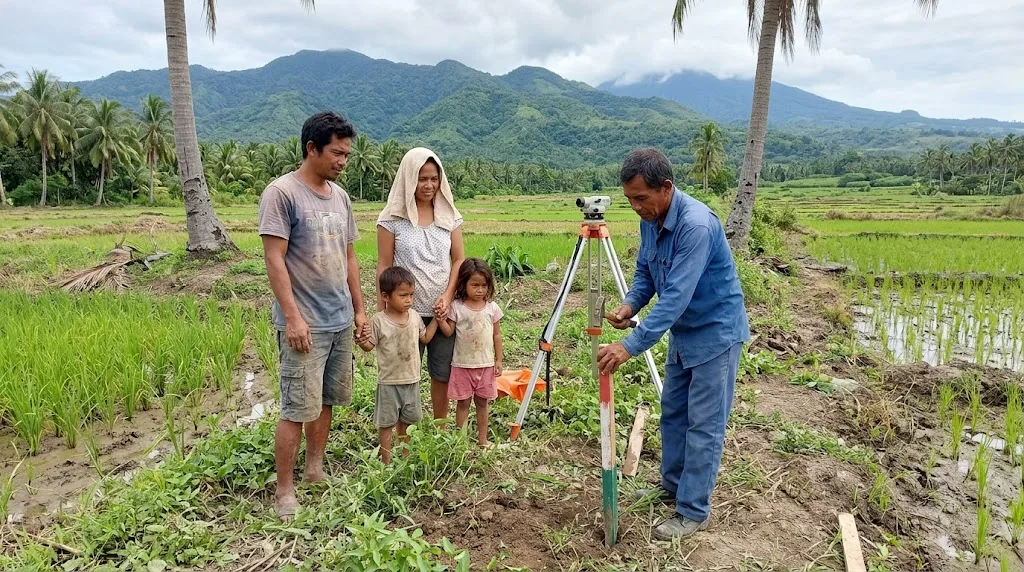
A surveyor's corner stake is the easy part. The papers behind the lot decide whether the house can go on it. Illustrative photo.
Short answer: you can, but only on land that is legally allowed to carry a house, and that is a different question from whether the land looks like a farm. Several separate offices each hold a different label for the same lot: the assessor (tax declaration class), the LGU zoning office (what use the ordinance allows), DAR (whether it is still agricultural land that needs conversion, or was reclassified before 15 June 1988) and the Register of Deeds (what kind of title it is, and whether it is a CLOA). For land that is still agricultural in law, RA 6657 Section 65 sends the change of use to DAR conversion. DAR's 2002 rules have a short homelot route for an owner's own dwelling on a lot of not more than 500 square meters. Irrigated and irrigable land cannot be converted, and CLOA land carries a ten-year transfer bar. With the checker's default case (an inherited farm lot with a regular title, an agricultural tax declaration, 400 sqm for the house, zoning not yet asked) the result is Get these papers first.
The checker below scores your lot against what we could read in the law and DAR's rules and tells you which office to ask. After it: the five labels, what DAR conversion is, the small-house route and the farmhouse question, what LGU reclassification can and cannot do, CLOA land, what the building permit asks for, and the order to check things in before you pay for a lot.
Answer from the papers you actually hold. The result is one of three: Likely OK to apply for a permit, Get these papers first, or Stop and verify, with the rule behind each reason and the office to ask. This is AEDO's own scoring of what we read, not an official test and not a legal opinion.
Most confusion comes from treating these as one thing. They are kept by different offices, answer different questions and can disagree.
| Label | Kept by | What it answers | Where you see it |
|---|---|---|---|
| DENR land classification | DENR (the CENRO in the field) | Whether the land is alienable and disposable at all, as against forest or timber land | A CENRO certification. DAR asks for it when the land is untitled (AO 1-2002, Sections 10.4.1 and 30.3.1) |
| Title or tenure | Register of Deeds, and DAR for awards | Who owns it and what is annotated on it. A title awarded under agrarian reform "must indicate that it is an emancipation patent or a certificate of land ownership award" (RA 6657 Section 27 as amended by RA 9700) | The face and back of the OCT, TCT, CLOA or EP |
| Tax declaration class | Assessor | The tax class: "residential, agricultural, commercial, industrial, mineral, timberland or special" (RA 7160 Section 215), assessed on actual use (Section 217) | The tax declaration and the tax receipt |
| Zoning | City or municipal sanggunian and its zoning office; DHSUD sets standards | What uses the ordinance allows. Comprehensive land use plans enacted through zoning ordinances are "the primary and dominant bases for the future use of land resources" (RA 7160 Section 20(c)) | A zoning certification or locational clearance |
| DAR status | DAR | Whether it is agricultural land that needs a Conversion Order, or was reclassified before 15 June 1988, or has already been converted | A Conversion Order, an exemption clearance, or a DAR certification |
The law's own definition is short: "Agricultural Land refers to land devoted to agricultural activity as defined in this Act and not classified as mineral, forest, residential, commercial or industrial land" (RA 6657 Section 3(c), unchanged by the later amendments we read). DAR's conversion rules sharpen it. Agricultural land there means land devoted to or suitable for agriculture "and not classified by law as mineral land, forest or timber, or national park, or classified for residential, commercial, industrial or other non-agricultural uses before 15 June 1988" (AO 1-2002, Section 2.1). So a tax declaration that says "residential" does not by itself take a lot out of DAR's hands. What counts is how the land was classified by law, and when.
Also in the way, whatever the label. The Water Code easement along the banks of rivers and streams and the shores of seas and lakes (PD 1067 Article 51) is 3 m in urban areas, 20 m in agricultural areas and 40 m in forest areas, as our setback guide and lot hazard guide set out, and a farm lot behind another owner's land may have no legal access until a right of way is settled (see right of way and neighbour rules).
Scope. RA 6657, the Comprehensive Agrarian Reform Law, covers "all public and private agricultural lands" regardless of tenurial arrangement and commodity produced (Section 4, as amended by RA 9700). A proviso added in 2009 says landholdings of landowners with a total area of five hectares and below "shall not be covered for acquisition and distribution to qualified beneficiaries." That is about land redistribution. We found nothing in the texts we read that excuses a small landowner from DAR's conversion rules, so do not treat the five-hectare proviso as a building permit.
Section 65. As amended by RA 9700 (Section 22, approved 7 August 2009):
The rulebook. DAR's working rules are the "2002 Comprehensive Rules on Land Use Conversion," DAR Administrative Order No. 01, Series of 2002, dated 28 February 2002, issued "pursuant to Section 65 and 49" of RA 6657. Its policy line is that conversion "shall be strictly regulated and may be allowed only when the conditions prescribed under RA 6657 and/or RA 8435 are present and complied with" (Section 1.3). What it says that matters to a house builder, from the 2002 text we read:
Has it been amended? Yes. A November 2025 training deck of the Chamber of Real Estate and Builders' Associations (CREBA), a secondary summary, lists AO 1-2002 as "amended by A.O. 5-2007, A.O. 7-2015, A.O. 1-2016, A.O. 1 & 6-2019, A.O. 3 and 3-A-2021, and A.O. 2-2022." We read AO 1, s. 2019, AO 3, s. 2021 and AO 3-A, s. 2021 on DAR's own legal information site. None is a replacement rulebook. AO 1-2019 is titled "Streamlining the Processing of Applications for Land Use Conversion under DAR Administrative Order No. 1, Series of 2002", and it and AO 3-2021 both end with a clause that the provisions of AO 1-2002 "which are inconsistent with this Administrative Order are hereby amended and/or repealed accordingly." We found no newer order that replaces AO 1-2002 outright, so it remains the base rulebook, as amended. The changes that matter for a house lot, from the orders themselves:
We found no change in these orders to the homelot criteria (Section 29), disturbance compensation (Section 28, which AO 3-2021 Section 11.10 still cites) or the pre-1988 exemption clearance (Section 3.4). The 2002 section numbers quoted above therefore still apply. We have not read AO 5-2007, 7-2015, 1-2016, 6-2019 or 2-2022, so ask your DAR office for the current checklist.
The penalty side. RA 9700 Section 24 rewrote Section 73 of RA 6657. Two prohibited acts bear on building: "(c) Any conversion by any landowner of his/her agricultural land into any non-agricultural use with intent to avoid the application of this Act to his/her landholdings and to dispossess his/her bonafide tenant farmers," and "(e) The sale, transfer, conveyance or change of the nature of lands outside of urban centers and city limits either in whole or in part after the effectivity of this Act, except after final completion of the appropriate conversion under Section 65." Section 74 (RA 9700 Section 25) sets imprisonment of six years and one day to twelve years, or a fine of 200,000 to 1,000,000 pesos, or both, for violations of subparagraphs (c), (d), (e) and (i). Subparagraph (e) is worded broadly. We read the text, not the cases on how far it reaches for one family home on a small lot, so this is a question for DAR and a lawyer, not for this page.
Homelot conversion. Article IV of the 2002 rules (Sections 29 to 31) is a shorter lane for exactly your case. Section 29: "Conversion to a homelot is allowable when: the applicant owns the lot that he proposes to convert; he intends to establish a dwelling place for himself on said lot; the lot has an area not exceeding five hundred (500) square meters; and the conversion shall be from agricultural to purely residential use."
The 2002 text asks for fewer papers than a full conversion: a sworn application, a copy of the OCT or TCT certified by the Register of Deeds not earlier than 30 days before filing (for untitled land, CENRO certifications that the land is alienable and disposable and that titling has started with no adverse claimants), the title as of 15 June 1988 and its successors, and a directional sketch map for the inspection team (Section 30). The Municipal Agrarian Reform Officer checks CARP coverage and posts notices, the provincial office inspects, and the DAR Regional Director decides (Section 31). Fees, filing and clocks have changed since 2002. The 2002 text charged P500 filing and P1,000 inspection (Section 31.3). AO 3, s. 2021 Section 2 now makes a 500 sqm homelot "Free/ Exempt" of both, and AO 1, s. 2019 accepts an electronic copy of the title. We found nothing in the 2019 and 2021 orders that changes the homelot criteria in Section 29. Ask your DAR municipal office for the current checklist.
What it is not. It is for your own dwelling on a lot of 500 sqm or less. It is not a route for a rental, a resort, a second house for sale, or a bigger parcel. Those go through the full application, which asks for a project feasibility study, a development plan certified by a licensed professional and proof of capability (Sections 10.7 to 10.10 of the 2002 text), or, for housing to sell, the rules in our PD 957 guide.
The farmhouse question. People ask whether a farmer can put a house or a shed on his own farm without conversion. We could not answer that from the texts we read, and we won't guess. What we found: agriculture means "the cultivation of the soil, planting of crops, growing of fruit trees, including the harvesting of such farm products, and other farm activities and practices performed by a farmer in conjunction with such farming operations" (RA 6657 Section 3(b), as amended by RA 7881). DAR defines land use conversion as "changing the current physical use of a piece of agricultural land into some other use" (AO 1-2002, Section 2.12). Neither text says whether a farm shed or caretaker's hut is part of the farming use or a change of use, and neither text carves out the permanent family house. For that house, the homelot lane is the one DAR wrote. For a shed, ask the DAR municipal office and your Building Official in writing. Whether your Building Official exempts small farm structures from a permit is also theirs to say, and we did not read an exemption that settles it.
"The barangay already made it residential" or "the town zoned it commercial" is the usual claim, and it is worth checking, because RA 7160 Section 20 does let a city or municipality reclassify agricultural land, but with limits:
| Local government | Reclassification cap (RA 7160 Section 20(a)) |
|---|---|
| Highly urbanized and independent component cities | 15% |
| Component cities and first to third class municipalities | 10% |
| Fourth to sixth class municipalities | 5% |
The Supreme Court settled how this fits with DAR in CREBA v. Secretary of Agrarian Reform (G.R. No. 183409, 18 June 2010), which dismissed the real-estate builders' challenge to DAR AO 01-02. Restating the earlier Ros v. DAR (G.R. No. 132477, 31 August 2005) and Junio v. Garilao (G.R. No. 147146, 29 July 2005), the Court said that "after the passage of Republic Act No. 6657, agricultural lands, though reclassified, have to go through the process of conversion, jurisdiction over which is vested in the DAR. However, agricultural lands, which are already reclassified before the effectivity of Republic Act No. 6657 which is 15 June 1988, are exempted from conversion." It added that the 1988 effectivity date "served as the cut-off period for automatic reclassifications or rezoning of agricultural lands that no longer require any DAR conversion clearance or authority," and relied on Department of Justice Opinion No. 44, Series of 1990.
DAR's current rules say the same: "Agricultural lands that are reclassified to non-agricultural uses do not ipso facto allow the landowner thereof to use the same for such purpose" (AO 1, s. 2019 Section 7, as rewritten by AO 3, s. 2021 Section 9).
What that means for a lot buyer. Two very different lots can both carry a "residential" zoning certificate today. One was zoned before 15 June 1988 and DAR does not need to convert it (AO 1-2002 Section 3.4 still has an exemption clearance for such lands). The other was rezoned later and still needs a DAR Conversion Order before the use really changes. The certificate alone does not say which one you have. Ask the zoning officer for the zoning ordinance's date of adoption and ask DAR whether it has an exemption or conversion on record for the lot's title number. RA 11201 (2019) folded the Housing and Land Use Regulatory Board into DHSUD, which formulates "land use planning and zoning standards and regulations for the guidance of cities and municipalities in the formulation of their respective CLUPs" (Section 5, II(e)). DHSUD sets standards. Your zoning officer applies the ordinance to your lot.
A CLOA (Certificate of Land Ownership Award) or an Emancipation Patent is the title given to an agrarian reform beneficiary. RA 9700 made these Torrens titles, "indefeasible and imprescriptible after one (1) year from its registration" but "subject to the conditions, limitations and qualifications of this Act" (Section 24 as amended), and requires that the title "must indicate that it is an emancipation patent or a certificate of land ownership award," and so must any later transfer title (Section 27 as amended). Look at the title itself.
So buying a farm lot from a CLOA holder who is inside the ten-year window is where people lose money. A deed of sale does not cure a transfer the law says "shall not be" made. If you are looking at CLOA land, get DAR's written position before you pay anything.
The building permit sits downstream of all this. Our building permit guide walks the four stages, and the fee calculator prices them. What matters here is Stage 1, locational clearance. DILG-DPWH-DICT-DTI Joint Memorandum Circular No. 2018-01 has the LGU's zoning office issue the locational clearance and give a copy to the Building Official "as a documentary requirement to the building permit application" (Section 6.1.7). The one-stop shop then releases the permit "together with the locational clearance" for applications "that satisfy the requirements of the Zoning Ordinance, Fire Code, the National Building Code and its referral codes" (Section 6.1.14). The same circular has the assessor issue the tax declaration the Code requires (Section 6.1.5). So a lot whose zoning does not allow a house will not get a permit however good the plans are.
Does the OBO ask for DAR papers? In what we read, no national issuance lists a DAR Conversion Order among the building permit documents. Some LGUs add checklist items of their own, and a zoning officer who sees an agricultural zone will not issue the clearance. That is why the zoning certification comes first. Ask your OBO and zoning office for their written checklist for a house on a lot classified agricultural.
After the permit. The official who issues a building permit must send a copy to the assessor within 30 days (RA 7160 Section 210), so the new house will be assessed. That is a tax record following the building. It is not a conversion.
Once the papers are clear, the engineering side starts: the lot hazard checks, a relocation survey by a geodetic engineer, a soil boring where the lot calls for one, and plans signed by the right professionals (who can sign and seal). If a foreign national is involved in owning the lot, that has its own limits: see foreigners building a house.
This is the order we would check things in, cheapest and most decisive first. Every step is a document request, not a legal opinion.
Land rules in the Philippines are being revisited. In April 2026 the Save Agrarian Reform Alliance, an advocacy coalition, objected to an unnumbered DAR Administrative Order signed by the Secretary on 27 January 2026 that would remove the DAR clearance requirement on the sale and transfer of private agricultural lands and awarded agrarian reform lands. The alliance itself calls it "officially unissued and non-final." We could not confirm its status from a DAR source, and it concerns clearance for sale and transfer, not conversion. Do not assume it changes anything for your lot. Ask DAR what applies on the day you buy.
What AEDO does, and does not. AEDO designs, checks and reviews nationwide, and builds only in Negros Oriental. We review a lot for hazards, access and buildability, design the house, seal the plans, prepare the permit set and, in Negros Oriental, build it. Elsewhere in the Philippines we design, seal, review remotely and check milestones of a contractor you hire. We do not give legal opinions and we do not process DAR conversion, LGU reclassification, titling or estate settlement. Confirm land status with DAR, the LGU zoning office and a lawyer before you pay for a lot. Our published prices: a PHP 5,000 structural assessment if there is already a building on the lot, and complete permit-ready plans at PHP 250 to 450 per sqm of floor area.
Statutes were read on LawPhil on 1 October 2026: RA 6657 (original text, approved 10 June 1988), RA 7881 (1995), RA 9700 (7 August 2009, which rewrote Sections 24, 27, 65, 73 and 74), RA 11953 (7 July 2023), RA 7160 and RA 11201. Where RA 9700 replaced a section, we quote the 2009 text. DAR Administrative Order No. 01, Series of 2002 was read in full from the Supreme Court E-Library, and AO 1, Series of 2019, AO 3, Series of 2021 and AO 3-A, Series of 2021 on DAR's legal information site. AO 1-2019 and AO 3-2021 amend parts of AO 1-2002 rather than replace it, and AO 3-A-2021 amends AO 3-2021. The other amendments are known only from the CREBA slide deck, a secondary summary, so anything attributed to them is marked and should be confirmed with DAR. The Supreme Court quotations are from the CREBA v. Secretary decision as posted by ChanRobles. JMC 2018-01 was read as posted by Lawyerly. The Water Code figures come from our sibling guides. The checker's scoring is AEDO's own, built on those texts, and has no peso amounts. There are no invented rates on this page.
Can you build a house on agricultural land in the Philippines?
Sometimes, and it depends on the land's legal status rather than how it looks. RA 6657 defines agricultural land as land devoted to agricultural activity and not classified as mineral, forest, residential, commercial or industrial (Section 3(c)). Changing such land to a house lot goes through DAR land use conversion under Section 65, as amended by RA 9700, and your LGU must still confirm through a locational clearance that its zoning allows a house. Land reclassified to non-agricultural use before 15 June 1988 is exempt from conversion, according to the Supreme Court in CREBA v. Secretary of Agrarian Reform (G.R. No. 183409, 18 June 2010), though DAR's rules still have you get an exemption clearance for it (AO 1-2002 Section 3.4). Irrigated and irrigable land cannot be converted, and land awarded under agrarian reform has extra limits. Confirm your own lot with DAR and the LGU zoning office.
Do I need DAR conversion before building a house on my own farm lot?
If the lot is still agricultural in law, DAR's Comprehensive Rules on Land Use Conversion (DAR Administrative Order No. 1, Series of 2002, as amended) require a DAR Conversion Order, and developing the land without one, or while the application is still pending, is premature conversion (Section 2.15, widened by AO 3, s. 2021 Section 13.1). The rules have a short route for a homelot: the applicant owns the lot, will build a dwelling for himself, the lot is not more than 500 square meters, and the use changes from agricultural to purely residential (Section 29 of the 2002 text). DAR has amended these rules several times since 2002. The 2019 and 2021 orders we read leave the homelot criteria as they were and make a 500 sqm homelot free of filing fee and inspection cost, but ask your DAR municipal office what it requires today. In the texts we read we found no rule that lets you simply start building on agricultural land with no DAR paper.
Is a tax declaration that says residential enough to build?
No. Assessors classify property for taxation as residential, agricultural, commercial, industrial, mineral, timberland or special (RA 7160 Section 215), and they do it on the basis of actual use (Section 217). It is a tax record, not a land-use approval. DAR's conversion rules look at whether the land was reclassified by the LGU before 15 June 1988 or has a Conversion Order, and the building permit needs the zoning office's locational clearance. Bring the tax declaration to the zoning officer and to DAR as one clue, not as the answer.
Can I build on or buy land with a CLOA?
Land awarded under agrarian reform may not be sold, transferred or conveyed for ten years except through hereditary succession, to the government, to the Land Bank, or to other qualified beneficiaries through DAR (RA 6657 Section 27, as amended by RA 9700). Conversion of awarded land is possible only after five years from award, only the beneficiary may apply, and the beneficiary must fully pay the price of the land upon conversion (Section 65 as amended; AO 1-2002 Sections 8.4 and 9.2, Section 8.4 as amended in 2019). RA 11953 of 2023 condoned agrarian reform debts but says it does not remove existing limits on transfer, ownership and agricultural use (Section 11). Whether condonation counts as fully paid for conversion is not answered in the texts we read, so ask DAR. Do not pay a seller for CLOA land without DAR's written position.
Can the municipality reclassify my farm lot as residential?
A city or municipality can reclassify agricultural land by ordinance after public hearings, but only when the land is no longer economically feasible for agriculture as determined by the Department of Agriculture, or has substantially greater economic value for residential, commercial or industrial use as determined by the sanggunian. It is capped at 15 percent of agricultural land for highly urbanized and independent component cities, 10 percent for component cities and first to third class municipalities, and 5 percent for fourth to sixth class municipalities (RA 7160 Section 20). Land distributed to agrarian reform beneficiaries is not affected by the reclassification, and Section 20(e) says nothing in it modifies RA 6657. In CREBA v. Secretary of Agrarian Reform (2010) the Supreme Court restated that agricultural land reclassified after RA 6657 took effect on 15 June 1988 still has to go through DAR conversion.
Can I build a farmhouse or farm shed on agricultural land?
The texts we read give no automatic pass for a farmhouse. RA 6657 defines agriculture as cultivation of the soil, planting of crops, growing of fruit trees, including harvesting, and other farm activities and practices performed by a farmer in conjunction with such farming operations (Section 3(b), as amended by RA 7881). Whether DAR and your Building Official treat a farm shed or caretaker's hut as part of that or as a change of use is not answered there. A permanent family house is a dwelling, which is the case the homelot rule is written for. Ask the DAR municipal office and the Building Official in writing before you build.
What happens if I build before the conversion is approved?
DAR calls it premature conversion: undertaking development that modifies or alters the land's physical characteristics to make it suitable for non-agricultural purposes without an approved Conversion Order (AO 1-2002, Section 2.15). Since AO 3, s. 2021 (Section 13.1), that also covers development done while the application is pending. RA 9700 amended Section 73 of RA 6657 to prohibit, among other acts, conversion by a landowner to avoid the Act and dispossess bona fide tenant farmers (73(c)) and the sale, transfer, conveyance or change of the nature of lands outside urban centers and city limits except after final completion of conversion (73(e)). Section 74 sets imprisonment of six years and one day to twelve years or a fine of 200,000 to 1,000,000 pesos, or both, for violations of subparagraphs (c), (d), (e) and (i). How those provisions apply to one family home is a legal question we did not research, so ask a lawyer before you break ground.
Can AEDO process my DAR conversion or give a legal opinion?
No. AEDO is an engineering firm, not a law office. We review the site for hazards and access, design and seal the plans, check a contractor's work at milestones, and build in Negros Oriental only. We do not give legal opinions or process DAR conversion, LGU reclassification or titling. Confirm those with DAR, the LGU and a lawyer, then bring us the papers and we will design the house and prepare the permit set.
Laws, rules and decisions read for this article in October 2026. External links open in a new tab.
Apart from AO 1-2019, AO 3-2021 and AO 3-A-2021, we did not read the amending DAR orders (AO 5-2007, 7-2015, 1-2016, 6-2019, 2-2022), so the 2002 text may differ from today's rules on fees, offices, clocks, supporting papers and irrigable land. We did not read RA 6657 Section 6 (retention) beyond its limits, DAR's rules on clearance for the sale of agricultural land, or any local zoning ordinance. We did not find an amendment to RA 7160 Section 20, but LawPhil shows the 1991 text and we cannot rule one out. This article is general information, not legal advice. Confirm your lot with DAR, your LGU zoning office and a lawyer.
Send us the lot location, the title face and the tax declaration. Our team will tell you what the site and plan side looks like: hazards, access, what the house could be, and what the permit set needs. We do not give legal opinions or process DAR papers, so confirm those with DAR, the LGU and a lawyer.