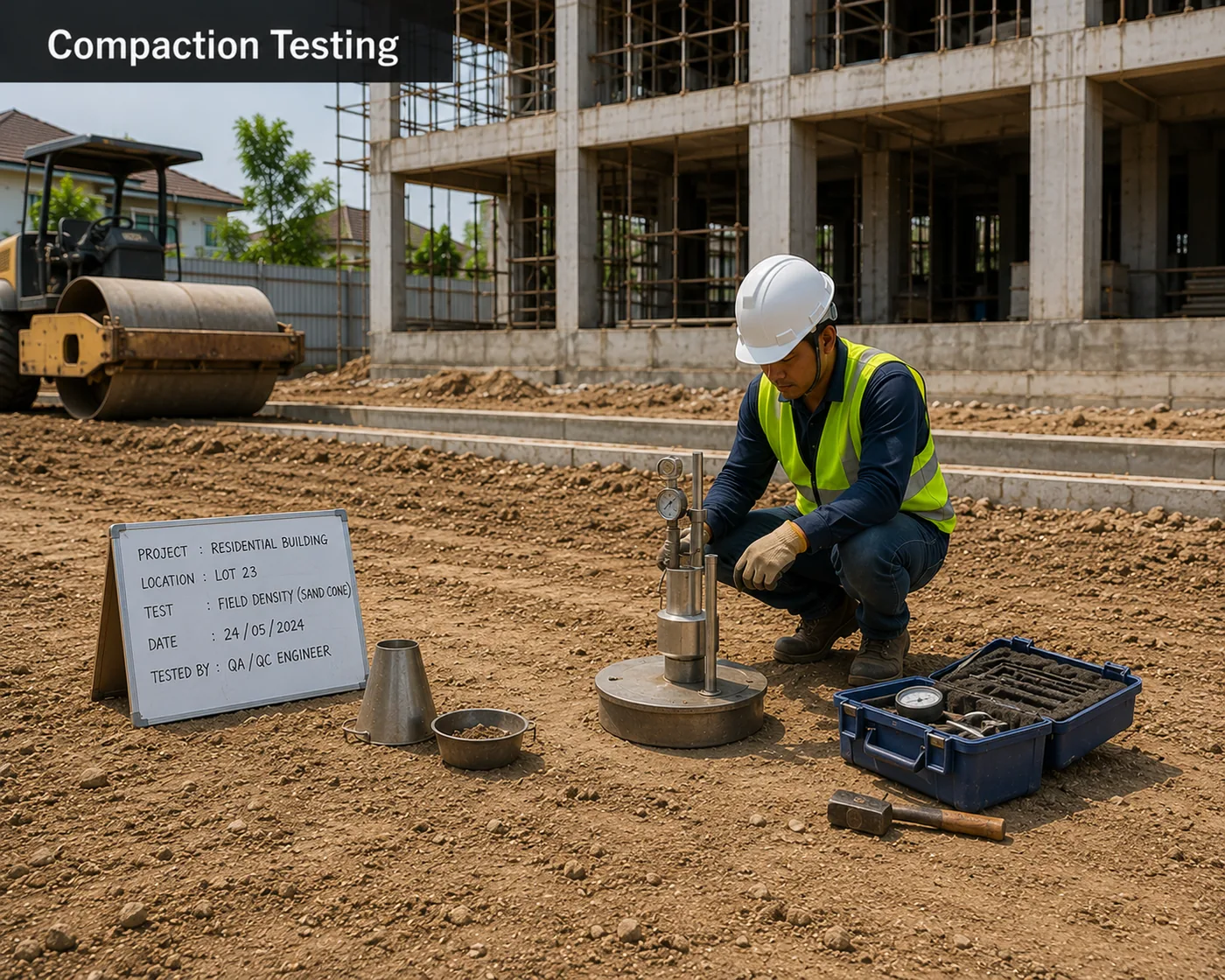
A field density test on placed fill. This is the difference between engineered fill and dumped fill — and it is the step owners are most often talked out of.
Short answer: every construction cost per square metre you have ever been quoted excludes site development. It is quoted against the floor area of the building, and the lot is somebody else's problem. On a flat, clear lot with services at the boundary that exclusion is worth a couple of hundred pesos per square metre. On a lot that sits a metre below road level it can be worth more than a million.
A 500 m² lot, raised by one metre, needs 500 m³ of finished fill. Fill loses volume when it is compacted, so you have to buy about 625 m³. At ₱900–1,400 per cubic metre for base course, delivered, that alone is ₱560,000 to ₱875,000 — before a single peso of placing, compacting, testing or retaining. The lot was cheap because of exactly this.
Site development is not one cost. It is seven, and on any given lot only two or three of them matter — but which two is not obvious until someone measures.
| Item | When it dominates | Priced by |
|---|---|---|
| Fill and compaction | Lot below road level, or a paddy or reclaimed plot | Cubic metre, plus a compaction allowance |
| Retaining | Sloping lot, or fill held back from a boundary | Linear metre, scaling hard with height |
| Clearing and grubbing | Overgrown lot, mature trees, old foundations | Lot area, plus disposal trips |
| Drainage | Flat lot with nowhere for water to go | Linear metre of canal or pipe |
| Perimeter fence | Always, eventually | Linear metre of perimeter |
| Driveway and paving | Long frontage setback, or a steep approach | Square metre of paved area |
| Utility connections | Rural lot, or a long run from the main | Lump sums plus distance to the main |
Notice that only one of the seven is priced by lot area. That is why "site development cost per square metre" is a figure worth treating with suspicion, and why the tool below prices the items separately and only divides at the end.
Prices the seven site-work items for a Philippine residential or small commercial lot, including the compaction allowance most fill estimates forget. Material prices are AEDO's published 2026 rates; installed rates are planning bands. Set an item to zero if it does not apply.
This is the part that turns a site-work saving into a structural problem three years later.
The DPWH Standard Specifications, Item 104 — Embankment, clause 104.3.3, requires layers placed not exceeding 200 mm in loose measurement, or as set by compaction trials. The contractor must then compact every layer, and the material scarified below subgrade in cut sections, to "not less than 95 mass percent of the maximum dry density determined by AASHTO T 99 Method C", at a moisture content the Engineer judges suitable for that density.
Private building work is not automatically bound by a road specification, but this is the benchmark Philippine practice writes to, and a looser specification is hard to defend to anyone. Note the moisture clause too — fill compacted dry of optimum will pass a passing-looking roller and still settle.
Fill tipped in one lift and levelled by the bucket of the truck meets none of that. It looks identical on the day. The difference shows up as a slab that cracks along the fill boundary, a driveway that dishes, and a perimeter fence that leans — all of them visible in our structural warning signs checklist, and all of them far more expensive to fix than the compaction would have been.
The Case Where Fill Makes Things Worse
If the natural ground under the lot is a soft compressible layer — old paddy, reclaimed ground, soft clay near a water table — then the fill you place becomes a load on that layer. It is called a surcharge, and the soft soil beneath consolidates under it for months or years.
The platform sinks. Not the building on it, the platform, taking the driveway, the fence, the drainage and every buried service with it. This is the one site-work problem that no amount of compacting the fill itself will solve, because the problem is underneath. It is also the one that a soil boring test finds before the money is spent, which is why we push that test hardest on exactly the lots whose owners feel it is least necessary.
Raising a lot moves water, it does not remove it. If your lot sits in a low pocket and you raise it 800 mm, the water that used to sit on your lot now sits on your neighbour's, and that is a dispute as well as a drainage failure.
Two things actually resolve it: an outfall the water can reach by gravity, and storage or infiltration if it cannot. Both are design work, not haulage. And along rivers, streams, lakes and shorelines, the easements in PD 1067, the Water Code — three metres in urban areas, twenty in agricultural, forty in forest — are public land you may not build on and may not fill, a constraint we cover in our setback requirements guide.
Earthworks are regulated. The relevant ones on a residential lot are usually:
The building permit fees themselves are a separate exercise, priced in our permit fee calculator.
The discount on a difficult lot is frequently smaller than the cost of fixing it. Before you sign, get three numbers:
Run those three into the calculator above and the lot either stays cheap or stops being cheap. If it stops being cheap, you have learned that for the price of a survey rather than the price of a platform. And if the lot already has something standing on it, our demolition cost guide prices the step before this one.
Compaction requirements are quoted from the DPWH Standard Specifications for Highways, Bridges and Airports (the Blue Book), Item 104 — Embankment, clause 104.3.3: 200 mm maximum loose layer thickness and 95 mass percent of maximum dry density by AASHTO T 99 Method C. The Blue Book is not published as a free download, so that clause is corroborated across several independent reproductions rather than read from a primary PDF — treat it as reliable but not first-hand. The Ground Preparation and Excavation Permit and the excavation cash bond are Section 304 of the 2004 Revised IRR of PD 1096, read from the IRR itself. Water Code easements are Article 51 of PD 1067. Fill material prices are AEDO's published 2026 sand and gravel rates and retaining wall rates come from our retaining wall cost guide. The compaction allowance, placing rate, and the clearing, fence, driveway, drainage and utility bands are planning assumptions from ordinary practice, printed inside the tool rather than hidden in it.
How much does site development cost in the Philippines?
On a flat, clear, road-level lot with services at the boundary it can be almost nothing, perhaps two to four hundred pesos per square metre of lot area for clearing and a driveway. On a lot that sits below road level and needs a metre of engineered fill, the same lot can pass two thousand pesos per square metre, because fill is bought by the cubic metre and a metre of depth over five hundred square metres is five hundred cubic metres of material before compaction allowance. The two dominant variables are how much fill you need and whether the ground has to be retained.
Is site development included in the construction cost per square metre?
No. Cost per square metre figures are quoted against the floor area of the building and cover the building only. Site development, land, professional fees, permits, utility connections and loose furniture and equipment are conventionally excluded. This is the single most common reason a budget that looked comfortable at the quotation stage runs out before the house is finished, because site works are discovered after the lot is bought rather than before.
How much fill material do I need for my lot?
Multiply the lot area by the average depth of fill to get the compacted volume, then add an allowance for the material that is lost to compaction. Fill delivered loose and then compacted to ninety five per cent of maximum dry density occupies noticeably less space than it did on the truck, so the volume you have to buy is roughly twenty to twenty five per cent more than the finished volume. A five hundred square metre lot raised by one metre needs about five hundred cubic metres finished and therefore about six hundred and twenty five cubic metres delivered.
What compaction is required for fill under a building?
The DPWH Standard Specifications for embankment, Item 104 clause 104.3.3, require layers not exceeding two hundred millimetres in loose measurement, compacted to not less than ninety five mass percent of the maximum dry density determined by AASHTO T 99 Method C, at a moisture content the Engineer judges suitable. Private building work is not automatically bound by DPWH road specifications, but this is the benchmark Philippine practice uses and a specification written to anything looser is difficult to defend. The important point for an owner is that dumped fill is not engineered fill, and a slab built on dumped fill will settle.
Do I need a permit for lot filling or earthworks?
Excavation and earthworks are regulated under Presidential Decree 1096 and by local ordinance. Section 304 of the Revised Implementing Rules lets the Building Official issue a Ground Preparation and Excavation Permit while the building permit application is still being processed, and for excavations over fifty cubic metres and more than two metres deep it requires a cash bond of fifty thousand pesos for the first fifty cubic metres plus three hundred pesos for every cubic metre beyond that. Such an excavation may not exceed one hundred cubic metres or three metres in depth, and if it is left open with no work for more than one hundred and twenty days the bond is forfeited to pay for backfilling. Local government units commonly require their own earthmoving or excavation clearance, and work near a river or shoreline is further restricted by the easements in the Water Code.
Should I buy a cheap low-lying lot and fill it?
Price the fill before you sign, because the discount on a low lot is often smaller than the cost of raising it. Filling also does not by itself solve flooding, since raising your lot above a neighbour's moves water rather than removing it, and it can create a legal problem as well as a drainage one. A low lot with soft underlying ground is the harder case again, because the fill itself becomes a surcharge that consolidates the soft layer beneath and the whole platform keeps settling for years after handover.
Statutes, codes, official tools and references used or referred to in this article, linked to their source. Links open in a new tab.
Prices, cost bands and rate figures in this article are AEDO Construction's own market and practice figures for Philippine work unless a source is named beside them. Code and statute references above link to the primary text.
Site works are cheap to design and expensive to guess. We can tell you what your lot actually needs, in writing, before it becomes a change order.