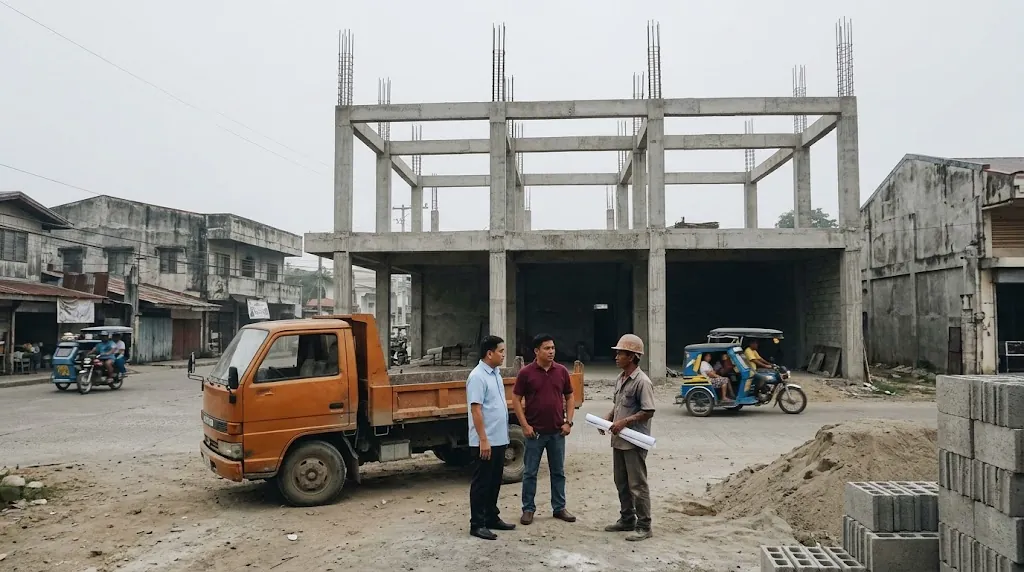
A frame with rebar up and a decision still pending. Illustrative photo.
If your shophouse, office or rental building is fully designed and priced, six months of waiting will probably cost you more than it saves. On a ₱6 million, 200 sqm shophouse that would clear ₱45,000 a month, the calculator below puts a six-month wait at about ₱371,000, and most of that is rent you never collect, not prices. If the building isn't designed yet, "now or later" is the wrong question.
A common version of this decision goes like this. A family owns a lot on a main road, has a two-storey shophouse in mind, and keeps hearing that "construction is down, wait for prices to drop." The wait stretches. The lot earns nothing. When they finally call contractors, nothing is drawn, so every bid prices a different building, and the cheapest one is cheap because it left things out.
The market news from late October is real. The PSA's count of approved construction for August 2026 was 10,968 projects, 31% fewer than a year earlier and the lowest since May 2020, as BusinessMirror reported on 22 October 2026. Value fell further than the count: non-residential projects were worth ₱19.35 billion, 35.2% less, and all approved construction ₱39.22 billion, down 38.9%, according to BusinessWorld's report of the same PSA release. Government spending is down too: DBM data reported by the Manila Times on 26 October show infrastructure and other capital outlays at ₱522 billion for January to August, 34.6% below last year, which budget officials tied to tighter compliance and monitoring of public works. Fewer jobs on both sides means contractors have more room in their schedules than they did a year ago.
What the news doesn't say is that building will get cheaper. Material prices are still rising, and the BSP has been raising rates. Put your own building into the calculator and see what your wait costs.
Enter the building, what it would earn, and how long you're thinking of waiting. The tool adds up what the wait costs and tells you how much cheaper a later bid would have to be to make it worth it. Planning arithmetic, not a forecast.
Three things move in the owner's favour when fewer projects are starting. They're all about the contractor, not the materials.
There's a fourth reason specific to this year. Contractors who live on public works had a thin 2026. DBM said its tighter checks are meant to make sure payments go only to works that are properly validated and documented. A firm that knows how to document its work to that standard is exactly what you want on a private job, and some of them are looking for private work right now. That's our reading of the numbers, not something the reports state.
Owners who wait usually wait for one of these to improve. None of them follows the permit count.
| Thing you might be waiting on | What the late-2026 figures say |
|---|---|
| Material prices | Still rising. The PSA's wholesale index for construction materials in Metro Manila was up 3.4% year on year in September 2026 and 3.6% in August. By group: fuels and lubricants 8.9%, asphalt 6.8%, sand and gravel 5%, concrete products 4.8%, structural steel 3%, reinforcing steel 2.9%, cement 2.5% (BusinessMirror, 13 October 2026). The retail index rose 2% in September (BusinessMirror, 14 October 2026). |
| Fuel | The 2026 energy crisis followed the closure of the Strait of Hormuz in the Iran war; by 24 March diesel had passed ₱130 a liter, according to Wikipedia's summary of the crisis (a secondary source). Fuel moves hauling, asphalt and anything trucked to a provincial site. For the month-by-month PSA numbers, see our 2026 material price tracker. |
| Borrowing | More expensive, not less. The BSP raised its policy rate by 50 basis points to 5.50% on 22 October 2026, its fourth hike in a row, and the governor said the bank expects inflation to accelerate further (Daily Tribune, 22 October 2026). If a loan funds the build, waiting may mean a higher rate, not a lower one. |
| The code and the permit | No change. The Building Official checks the same plans against the same rules whatever the market is doing, and a slow month doesn't shorten the review. An incomplete set gets returned either way. |
One figure in the permit report can confuse people. BusinessMirror also reported the average cost of new buildings in August at ₱14,357.01 per sqm, up 21.9%. That is the value owners declared on their permits divided by floor area. It shifts with the mix of buildings approved that month, so it isn't a price index and shouldn't go into the calculator. Our commercial cost bands are a better starting point, and a real bid beats both.
Ateneo economist Ser Percival Peña-Reyes, in the same report, said part of the August drop may be seasonal, with bad weather cutting working days, and BusinessMirror quotes him suggesting that the Chinese Ghost Month may have made some Chinese businessmen in construction hold back spending. So treat one month as one month. The calculator doesn't depend on the permit count anyway; it depends on your building.
A slow market only helps the owner whose project can be priced properly. A "cheap" bid is very often an incomplete one.
We're not saying every project should start this quarter. Waiting makes sense when the problem is demand or money, not price.
For a mixed-use building with shops below and units above, our shophouse cost guide has the cost side in more detail.
In Negros Oriental we design and build. If your lot is in Dumaguete, Bais, Tanjay, Sibulan or elsewhere in the province, we can take the project from design to turnover under one contract; see design and build.
Everywhere else in the Philippines we don't build. We prepare the complete design (architectural, structural, electrical and plumbing, plus mechanical and fire protection where the building needs them), the bill of quantities your bidders all price, and a review of the bids you get back. Once you've hired a local contractor, our remote construction oversight checks progress, cost and quality against the plans; a single milestone check starts at ₱7,500 per visit.
Either way, the design is the part you can do now without committing to a start date.
News reports of official data, read 5 November 2026: PSA approved building permits for August 2026 (10,968 projects, down 31%, lowest since May 2020; average cost of new buildings ₱14,357.01/sqm, up 21.9%), and the PIDS and Ateneo comments, from BusinessMirror, 22 October 2026; total value ₱39.22 billion, down 38.9%, and non-residential value ₱19.35 billion, down 35.2%, from BusinessWorld, 21 October 2026. DBM capital outlays of ₱522 billion for January to August, down 34.6%, from the Manila Times, 26 October 2026. PSA construction materials wholesale index for NCR, September 2026, overall and by group, from BusinessMirror, 13 October 2026; retail index from BusinessMirror, 14 October 2026. BSP policy rate of 5.50% from the Daily Tribune, 22 October 2026. Diesel above ₱130/L by 24 March 2026 from Wikipedia (secondary). Law: Civil Code Article 1724, read on LawPhil. From our own pages: the 200 sqm example and the ₱27,000–38,000/sqm shophouse band (calculator default ₱30,000, inside it) from the commercial cost guide; complete design from ₱250/sqm and a milestone check from ₱7,500 per visit, from our service pages. Inputs with no source, edit them: the ₱45,000 monthly net income (example only), the 0% bid advantage, ₱0 holding costs and 0% interest. Use with care: the 3.4% escalation default is a Metro Manila wholesale materials index, not total construction cost, and not provincial prices.
Is late 2026 a good time to start a commercial building in the Philippines?
If the design and bill of quantities are finished, the arithmetic usually runs against waiting. The number of approved construction projects fell 31% year on year in August 2026 (PSA data as reported by BusinessMirror), so contractors are chasing fewer new jobs, while the PSA's Metro Manila wholesale index for construction materials was still rising 3.4% a year in September. In AEDO's worked example, a 6 million peso, 200 sqm shophouse that would earn 45,000 pesos a month, waiting six months costs about 371,000 pesos, mostly in income not earned.
Will construction prices go down if I wait?
Nothing we read points that way. The PSA's Metro Manila construction materials wholesale index rose 3.4% year on year in September 2026, with fuels and lubricants up 8.9%, as reported by BusinessMirror on 13 October 2026, and the BSP raised its policy rate to 5.50% on 22 October 2026, saying it expects inflation to rise further. A slow market can bring sharper bids, but that is about contractor margins, not material prices.
How do I get a contractor's bid that won't change later?
Bid out a complete, coordinated design with a bill of quantities, so every contractor prices the same thing and nothing is left to assume. Sign a stipulated-price contract, decide in writing whether there is an escalation clause and how it works, and tie payments to verified progress. Under Civil Code Article 1724, a contractor building to agreed plans for a stipulated price cannot demand more for higher labor or material costs without a written change and a written price.
When is waiting the right call for a commercial project?
When the demand is the problem, not the price: no tenant interest, a market already full of the same units, or financing that does not work at current rates. Also when the design is not finished. In that case, use the waiting months to finish the design, the bill of quantities and the permit, so you can bid the day you decide to go.
My lot is outside Negros Oriental. Can AEDO still build it?
No. AEDO only builds in Negros Oriental. Everywhere else in the Philippines AEDO prepares the complete design (architectural, structural, electrical and plumbing, plus mechanical and fire protection where needed) and the bill of quantities, reviews contractors' bids, and provides remote construction oversight of the contractor the owner hires.
Each page below was opened and checked against the figures above on 5 November 2026.
The PSA's own construction statistics pages blocked our automated request, so the permit and price-index figures are as reported by BusinessMirror, which we cite for each. BusinessMirror prints the August non-residential value as ₱193.5 billion; BusinessWorld gives ₱19.35 billion for the same release, which fits the other figures, so we use BusinessWorld's figure. We did not find a published figure for how much lower bids run in a slow market, so the calculator leaves it at 0%. This article is general information, not a forecast, a quotation, or financial or legal advice.
Send the lot, the brief and anything already drawn or quoted. The AEDO team will tell you what it takes to get the project bid-ready and what the design would cost.