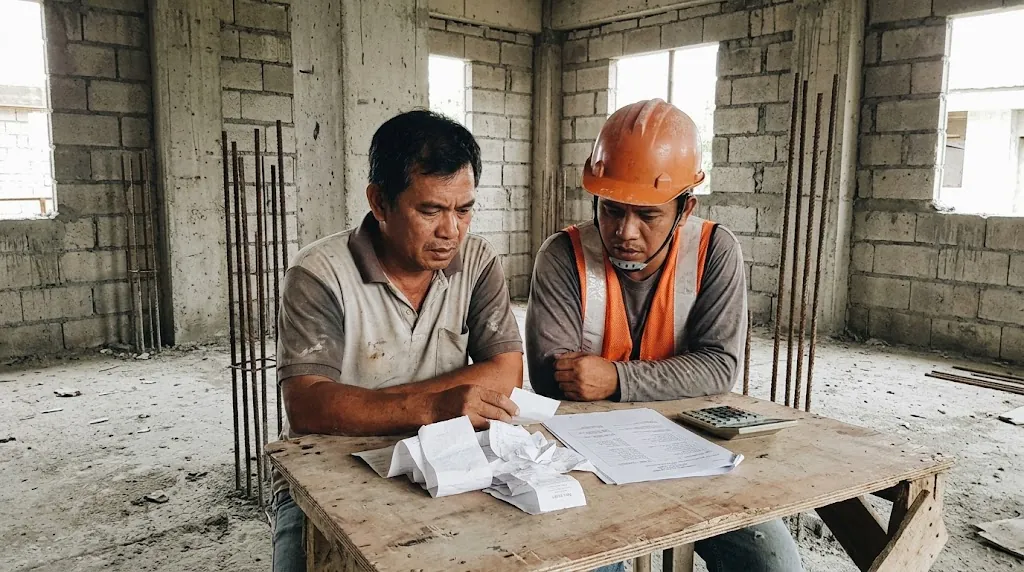
Before anyone signs a price increase, put the base-date receipts next to today’s and ask which items, how much, and for which part of the work. Illustrative photo.
Short answer: on a fixed-price (stipulated-price) building contract, the contractor carries the risk of fuel, steel and cement going up. Article 1724 of the Civil Code says such a contractor can neither withdraw from the contract nor demand an increase in the price on account of the higher cost of labor or materials. The only way past that in the article is a change in the plans that you authorized in writing, with the added price agreed in writing by both of you, and the Supreme Court calls those two writings a condition precedent (Leighton Contractors v. CNP Industries, 2010). Force majeure and rebus sic stantibus almost never rescue a contractor from a bad price. What changes the answer is a written escalation clause, either in the original contract or in a signed amendment. Government projects have their own rule: under RA 12009 Section 89, bid prices are fixed, and escalation may be authorized, with prior GPPB approval, when the cost of construction components rises by more than 10% of the unit price of work items, measured against PSA price indices, on a no loss, no gain basis.
The calculator below shows what a sample clause would pay on your project and, beside it, what Article 1724 lets a contractor demand without any written agreement: zero. With its default inputs (a ₱3,000,000 contract, 40% done, a 12% index rise against a 10% trigger) the sample clause pays ₱10,800. That small number is the point. A fair clause adjusts only the fuel-sensitive materials still to be bought, and only the part of the rise above the trigger.
Enter your contract and the index movement since the base date. The calculator applies the sample clause in section 5 to the fuel-sensitive materials in the work still to be done, and shows beside it what Article 1724 allows with no written escalation agreement. Planning arithmetic, not legal advice.
Contractors who priced jobs in 2025 have had a hard year. On 24 March 2026 the President signed Executive Order No. 110, declaring a state of national energy emergency because of the Middle East conflict and the closure of the Strait of Hormuz. The order stays in force for one year from issuance unless extended or lifted. Pump prices have moved in both directions since: the Department of Energy’s figures, as reported by Philstar on 28 September 2026, put diesel up a cumulative ₱18.31 per liter in September before a ₱7.57 rollback on 29 September. GMA News reported on the same day that, before that rollback, the previous week’s hikes had brought diesel to a net increase of ₱73.68 per liter for the year to date.
Construction material indices moved far less than pump prices. The PSA’s Construction Materials Wholesale Price Index for the National Capital Region rose 2.9% year on year in June 2026, with fuels and lubricants up 6.4%, structural steel 3.7%, concrete products 4.1%, sand and gravel 3.3% and cement 1.2% (as reported by BusinessMirror, 14 July 2026). The PSA’s retail index for construction materials rose 2.0% in August (BusinessMirror, 16 September 2026). Those are year-on-year figures for NCR. Hauling to a provincial site can move more, which is why the clause should name exactly what is adjusted. Our material price tracker follows the PSA series.
The result on site is a familiar letter: the contractor says the price no longer works and asks for more. Sometimes it is fair. Sometimes it is a padded number on work that should have been done months ago. The law gives the owner a strong position. Using it well means knowing what the law says and checking the numbers.
Civil Code, Article 1724 (text as on LawPhil). “The contractor who undertakes to build a structure or any other work for a stipulated price, in conformity with plans and specifications agreed upon with the land-owner, can neither withdraw from the contract nor demand an increase in the price on account of the higher cost of labor or materials, save when there has been a change in the plans and specifications, provided: (1) Such change has been authorized by the proprietor in writing; and (2) The additional price to be paid to the contractor has been determined in writing by both parties.”
Three things follow from the text, and the Supreme Court has applied it strictly.
Two limits on that. First, Article 1724 covers a stipulated price for work built in conformity with plans and specifications agreed upon with the owner. Where there were never agreed plans, or the price was never fixed, the article fits less well and the contract’s own terms matter more. On a cost-plus contract you reimburse actual costs, so price rises reach you by design; on a labour-only arrangement you buy the materials yourself. Our contract types guide shows who carries escalation under each. Second, the parties can agree otherwise. Article 1306 lets contracting parties establish “such stipulations, clauses, terms and conditions as they may deem convenient”, provided they are not contrary to law, morals, good customs, public order or public policy. A written escalation clause signed by both is an agreement on how the price moves. It is the thing that changes the answer, which is why section 5 exists. Whether a particular clause is enforceable as written is a question for a lawyer.
Article 1724 cuts both ways in practice. The same two writings that stop an unagreed increase also decide whether a contractor gets paid for genuine extra work: in Leighton the subcontractor lost its claim for additional costs because the writings were missing. The habit that protects both sides is the same: no change starts until the scope change and its price are both in writing. See change-order rules for the variation side of the same article.
When a contractor’s letter mentions “force majeure”, “fortuitous event” or “unforeseen circumstances”, it is reaching for one of two articles. Neither is a good fit for a price increase.
| Provision | What the text says | Why it rarely helps on price |
|---|---|---|
| Art. 1174 (fortuitous event) | “Except in cases expressly specified by the law, or when it is otherwise declared by stipulation, or when the nature of the obligation requires the assumption of risk, no person shall be responsible for those events which could not be foreseen, or which, though foreseen, were inevitable.” | It excuses liability; it does not create a right to be paid more. And on a stipulated-price contract the law already puts the cost risk on the contractor: that is what Article 1724 does. We did not read a Supreme Court decision applying Article 1174 to material price rises, so this is our reading of the text. |
| Art. 1267 (difficulty of performance) | “When the service has become so difficult as to be manifestly beyond the contemplation of the parties, the obligor may also be released therefrom, in whole or in part.” | The Court applies it narrowly (below), and the remedy it names is release, not a higher price. |
What the Supreme Court said about Article 1267. In Philippine National Construction Corporation v. Court of Appeals (G.R. No. 116896, 5 May 1997) the Court said the article “enunciates the doctrine of unforeseen events” but “is not, however, an absolute application of the principle of rebus sic stantibus, which would endanger the security of contractual relations. The parties to the contract must be presumed to have assumed the risks of unfavorable developments. It is therefore only in absolutely exceptional changes of circumstances that equity demands assistance for the debtor.” That case was a lease of land for a rock-crushing plant, not a building contract, but the principle is general. The Court rejected PNCC’s plea of changed political and financial conditions, quoting the lessors’ point that PNCC had signed the contract “with open eyes of the deteriorating conditions of the country”.
In Tagaytay Realty v. Gacutan (G.R. No. 160033, 1 July 2015), a subdivision developer that had not built promised amenities pleaded the peso’s depreciation, higher labour and construction costs and the economic turmoil of the 1980s. The Court listed four requisites that must concur: (a) the event or change could not have been foreseen when the contract was signed; (b) it makes performance extremely difficult but not impossible; (c) it is not due to the act of any party; and (d) the contract is for a future prestation. It then said that “mere inconvenience”, unexpected impediments or “increased expenses did not suffice to relieve the debtor from a bad bargain.”
Apply that to 2026. A contract signed after March 2026, with the energy emergency already declared, is hard to call unforeseen. A contract signed in 2025 is a better argument, but “the job now costs more” is the increased-expenses case the Court rejected. We are not saying no contractor could ever succeed. We are saying it is a narrow door, decided by a court on facts, and not a basis for an owner to sign a blank increase. Executive Order No. 110 does not change that: the text we read directs government agencies, urges the private sector to conserve energy and cooperate against profiteering, and does not mention private construction contracts or Article 1724.
Public contracts follow procurement law, not just the Civil Code, and the escalation rule there is written into the statute. Our RA 12009 guide covers the wider law; this is the escalation part.
| Law | What it says on escalation | Applies to |
|---|---|---|
| RA 12009, Sec. 89 (New Government Procurement Act, 20 July 2024) | Bid prices are fixed prices and not subject to escalation during implementation. In the event of an extraordinary increase in prices of specific components of an infrastructure project, escalation may be considered, subject to prior approval of the GPPB. If the cost of construction components increases by more than 10% of the unit price of work items, as determined against the prevailing PSA price indices, escalation may be authorized at a no loss, no-gain basis, using the formula the GPPB prescribes. The PSA is to make its indices region-specific and monthly. | Procurement under RA 12009 and its IRR |
| RA 12009 IRR, Sec. 89 (GPPB, 1st Edition as of 30 March 2026) | Repeats the section and adds that the rules for price escalation, including the formula, “shall be included in the Guidelines to be issued by the GPPB”. | Same |
| RA 9184, Sec. 61 (2003) | Bid prices are fixed, not subject to escalation, except under extraordinary circumstances and upon prior approval of the GPPB. “Extraordinary circumstances” are events that may be determined by the National Economic and Development Authority (now the Department of Economy, Planning, and Development) in accordance with the Civil Code, upon the recommendation of the procuring entity. | Procurement published before 25 Feb 2025 (circular approved by GPPB Res. 05-2025, item 5.1) |
What this means in practice. Escalation on public work is an approval process, not a contractor’s right. Under both laws it needs the GPPB’s prior approval, and the GPPB’s list of resolutions shows those approvals given one project at a time (for example Resolution 02-2024, approving escalation requests for buildings of the Authority of the Freeport Area of Bataan). The GPPB adopted Guidelines for Contract Price Escalation in Resolution 07-2004 (July 2004), under RA 9184, and has reiterated that the procuring entity’s endorsement is a condition for reviewing an escalation request (Resolutions 28-2013 and 02-2014).
What we could not find. On the GPPB resolutions page we read on 3 October 2026, the newest entry was Resolution 20-2026 (dated 14 August 2026), and we found no price-escalation guidelines or formula issued under RA 12009. The circular approved by GPPB Resolution 05-2025 (item 5.2.1) tells procuring entities to keep using the guidelines and forms issued under RA 9184 until the RA 12009 ones are issued. Whether the old escalation guidelines fit Section 89’s new 10% test is not something we can answer, so check with the procuring entity or the GPPB before relying on either. The procuring entity and the GPPB decide, not this article.
For private owners the useful part is the design of Section 89: a named public index, a threshold, specific components rather than the whole contract, and no loss, no gain. That is a sensible template for a private clause, though nothing in the law requires private parties to copy it.
Article 1306 gives private parties room to agree how the price moves. Article 1308 sets a limit worth designing around: the contract’s “validity or compliance cannot be left to the will of one of them”. A clause that lets the contractor decide the increase is weak for that reason. A clause tied to a public index and a formula is not. These are the parts we would expect to see.
| Part | What to write | Why |
|---|---|---|
| Base date | The bid date or contract signing date, stated as a date | Every change is measured from here. Price rises before the base date are already in the price. |
| Index | A named PSA series and sub-index (for example the Construction Materials Wholesale Price Index for NCR, sub-index for structural steel, cement or fuels and lubricants), or a signed base price list for named items | Objective, published, checkable by both sides. The PSA series we read about are NCR figures, so for a provincial site a signed base price list from local suppliers may fit better. |
| Adjustable items | A short list from the BOQ with base quantities: rebar, cement or ready-mix, aggregates, asphalt, hauling | Labour, overhead, profit and items already bought are not exposed to the index. |
| Threshold | A percentage change below which nothing happens (RA 12009 uses 10% for government work) | Normal price movement is the contractor’s ordinary risk; the clause is for extraordinary moves. |
| Excess or full | Whether only the change above the threshold is adjusted, or the whole change once triggered | “Excess only” avoids a cliff where 9.9% pays nothing and 10.1% pays 10.1%. |
| Both ways | If the index falls past the threshold, the owner gets a credit on the same terms | No loss, no gain. A one-way clause is a price floor for the contractor. |
| Cap | A maximum total adjustment, as a peso amount or a % of the contract sum | The owner’s budget needs a ceiling. Above the cap, the parties renegotiate in writing. |
| Delay rule | Work done late through the contractor’s fault is adjusted at the index for the month it was scheduled | Otherwise a slow contractor is paid for being slow. |
| Documents and timing | Claims monthly with the progress billing, with invoices, delivery receipts and the index printouts; owner or its engineer verifies within a set number of days | Keeps escalation inside the progress billing cycle instead of one big claim at the end. |
| Signature per adjustment | Each adjustment is signed by both before it is paid | Keeps the Article 1724 habit: nothing changes the price until it is in writing. |
Price adjustment. The Contract Price is fixed except as provided here. The Base Date is [date]. The Adjustable Items are listed in Annex [ ] with their base quantities and base unit prices. For each Adjustable Item, the Index is [named PSA index and sub-index, or the signed base price list in Annex [ ]].
If, at the date an Adjustable Item is purchased for the Works, its Index has changed from the Base Date by more than [10]% (up or down), the base unit price of the quantity purchased is adjusted, up or down, by the percentage change in excess of [10]%. No adjustment is made for a change of [10]% or less, for labour, overhead or profit, or for materials purchased before the Base Date or before this clause was signed. Works delayed by the Contractor are adjusted using the Index for the month in which they were scheduled.
The total of all adjustments shall not exceed [5]% of the Contract Price in either direction. Each adjustment is claimed with the monthly progress billing, supported by invoices, delivery receipts and the published Index, and becomes payable or creditable only when signed by both parties.
Bracketed numbers are examples. The calculator above runs this clause. Pair it with the rest of the paperwork in our construction contract checklist, where an escalation formula belongs with the price and contract-type clause.
Most owners reading this already have a fixed-price contract with no escalation clause and a letter asking for more. The law is on your side, but a stalled site costs money too. Our guide to the cost of finishing a stalled house shows how fast weather damage, restart costs and a lapsed permit add up. Decide on numbers.
Article 1724 is not a trap if you see it coming. If you are pricing a job in a year like this one, you have three honest options: price the risk into a firm lump sum, offer a lower price with a written escalation clause like the one above, or propose a cost-plus contract with a ceiling. Owners comparing bids should be told which one they are getting. If you are already mid-job and losing money, the strongest request is a documented one: the items, the base prices, current invoices, the remaining quantities, and a capped number, presented before you buy, not after. A request that reads as “pay more or I stop” invites the Article 1724 answer, and after Leighton a verbal assurance is a weak thing to rely on later: get any agreed adjustment signed. For the pricing side, see our rebar price guide.
What AEDO does and does not do. Our team can check a contractor’s escalation claim or remaining-cost estimate against the BOQ, the measured progress on site, what was already delivered, and the invoices, and give you a written finding to negotiate with. AEDO’s published Project Oversight prices are a single milestone check from ₱7,500 per visit with a written report, and monthly oversight from ₱15,000 per month, nationwide. Contractors and developers running several projects who need ongoing design review and plan-checking can use the ₱15,000-per-month design retainer on our design packages page; payment-claim review itself sits under Project Oversight. AEDO designs, checks and reviews nationwide, and builds only in Negros Oriental; elsewhere the contractor is one you hire, and we review and check milestones. We are not lawyers. We do not give legal opinions, draft binding contracts or act in arbitration or court for either side. For a dispute, talk to a lawyer.
Articles 1174, 1267, 1306, 1308 and 1724 are quoted, and Articles 1191 and 1725 cited, from the Civil Code (RA 386) on LawPhil; we found no later law amending them. The case holdings are from the decisions on LawPhil: Leighton (G.R. No. 160972, 2010), PNCC (G.R. No. 116896, 1997) and Tagaytay Realty (G.R. No. 160033, 2015). RA 12009 Section 89 is from LawPhil and from the GPPB’s 1st Edition of the law and IRR (as of 30 March 2026), which also gives IRR Section 89. RA 9184 Section 61 is from LawPhil. The RA 9184 cut-off date is item 5.1 of the circular approved by GPPB Resolution 05-2025. Resolution 07-2004 is from the Supreme Court E-Library, and Resolutions 28-2013, 02-2014, 02-2024 and 20-2026 from the GPPB resolutions page. Executive Order No. 110 is from LawPhil. Pump price movements are DOE figures as reported by Philstar, and oil companies’ announced adjustments as tallied by GMA News, both on 28 September 2026. Index readings are PSA figures as reported by BusinessMirror on 14 July and 16 September 2026; we could not open the PSA pages themselves. The 60% materials share is the planning default in our contract-types guide, not a published figure. The fuel-sensitive share, the 12% index change, the 5% cap and the sample clause are AEDO examples for illustration.
Can my contractor charge more because fuel, steel or cement prices went up?
Not on a stipulated-price contract, unless you agreed to it in writing. Article 1724 of the Civil Code says a contractor who builds for a stipulated price, in conformity with agreed plans and specifications, can neither withdraw from the contract nor demand an increase in the price on account of the higher cost of labor or materials. The only exception in the article is a change in the plans and specifications authorized by the owner in writing, with the additional price determined in writing by both parties. In Leighton Contractors v. CNP Industries (G.R. No. 160972, March 9, 2010) the Supreme Court called those two written requisites a condition precedent to recovering additional costs. If your contract has its own escalation clause, that clause governs how much can be added.
Is the 2026 fuel price spike a force majeure or fortuitous event?
Article 1174 of the Civil Code excuses a person from events that could not be foreseen, or which, though foreseen, were inevitable, except where the law, the contract or the nature of the obligation requires the assumption of risk. On a stipulated-price construction contract the law already puts that risk on the contractor: Article 1724 bars a price increase on account of the higher cost of labor or materials. Article 1174 is about being excused from liability, not about being paid more. We did not read a Supreme Court decision applying Article 1174 to fuel or material price increases, so treat this as our reading of the text and ask a lawyer about a specific dispute.
Can a contractor use rebus sic stantibus or Article 1267 to get out of a fixed price?
Rarely. Article 1267 says that when the service has become so difficult as to be manifestly beyond the contemplation of the parties, the obligor may be released, in whole or in part. In PNCC v. Court of Appeals (G.R. No. 116896, May 5, 1997) the Supreme Court said the article is not an absolute application of rebus sic stantibus, that parties are presumed to have assumed the risks of unfavorable developments, and that equity helps the debtor only in absolutely exceptional changes of circumstances. In Tagaytay Realty v. Gacutan (G.R. No. 160033, July 1, 2015) the Court listed four requisites that must concur and said mere inconvenience, unexpected impediments or increased expenses do not relieve a debtor from a bad bargain. Article 1267 also speaks of release, not of a higher price.
How does price escalation work on government construction projects?
Under Section 89 of RA 12009, the New Government Procurement Act, bid prices are fixed and not subject to price escalation during contract implementation. In the event of an extraordinary increase in prices of specific components of an infrastructure project, escalation may be considered with prior approval of the GPPB. If the cost of construction components increases by more than 10 percent of the unit price of work items, as determined against the prevailing price indices of the Philippine Statistics Authority, escalation may be authorized on a no loss, no gain basis using the formula the GPPB prescribes. The IRR says the rules and formula will be in GPPB guidelines. For projects published before the RA 12009 IRR took effect on 25 February 2025, RA 9184 still applies, and its Section 61 allows escalation only under extraordinary circumstances determined by NEDA in accordance with the Civil Code, on the procuring entity's recommendation and with prior GPPB approval.
What should a private construction escalation clause contain?
A base date, a named public index or a fixed base price list, the specific items that can be adjusted with their base quantities, a threshold below which nothing changes, whether only the excess over the threshold or the whole change is adjusted, a cap on the total adjustment, adjustment in both directions so the owner gets a credit if prices fall, a rule that work delayed by the contractor is adjusted at the index for the date it should have been done, the documents the contractor must submit, and a signature line for each adjustment. Article 1308 of the Civil Code says compliance with a contract cannot be left to the will of one party, so the clause should use an objective index rather than the contractor's own say-so.
Should I just pay the contractor's escalation claim to keep the project moving?
Sometimes a fair, written adjustment is cheaper than a stalled site, but decide on numbers, not pressure. Ask for the items affected, the base prices with proof, current invoices, and the quantities still to be bought. Check what was already delivered and paid for, and whether the contractor is behind schedule, because price rises on work that should already have been done are the contractor's own cost. If you agree, sign a specific written amendment with an amount and a cap, not a blanket increase. A contractor who stops work over an unagreed increase faces Article 1724, which says the contractor cannot withdraw from the contract on account of higher costs. This is general information, not legal advice.
Does the state of national energy emergency change private construction contracts?
Not by its own terms, as far as we read it. Executive Order No. 110, signed on 24 March 2026, declared a state of national energy emergency because of the Middle East conflict and the closure of the Strait of Hormuz, set up the UPLIFT response package, and stays in force for one year from issuance unless extended or lifted. The text we read directs agencies on fuel supply, transport, social assistance and price monitoring of basic necessities. It does not mention private construction contracts or Article 1724, so it does not by itself entitle a contractor to a higher price.
What can AEDO do about an escalation claim?
Our team can review a contractor's escalation claim or remaining-cost estimate against the BOQ, the measured progress on site and the invoices, and give you a written finding you can negotiate with. AEDO's published Project Oversight prices are a single milestone check from 7,500 pesos per visit with a written report, and monthly oversight from 15,000 pesos per month, nationwide. Contractors and developers with several projects who need ongoing design review and plan-checking can use the 15,000 pesos per month design retainer; payment-claim review itself sits under Project Oversight. AEDO builds only in Negros Oriental. We are not lawyers and do not give legal opinions or act in arbitration for either side.
Laws, decisions, government issuances and news reports read for this article on 3 October 2026. External links open in a new tab.
We did not find RA 12009 price-escalation guidelines or a GPPB formula under Section 89, a Supreme Court decision applying Article 1174 to material price increases, or any provision of Executive Order No. 110 on private construction contracts, so none is cited. We could not open the PSA index pages or the DEPDev page on contract price escalation (both blocked an automated request). This article is general information, not legal advice.
Send us the contract, the BOQ, the latest progress billing and the contractor’s letter with its invoices. Our team will check the claimed items against what is still to be built and what was already bought, and give you a written finding.