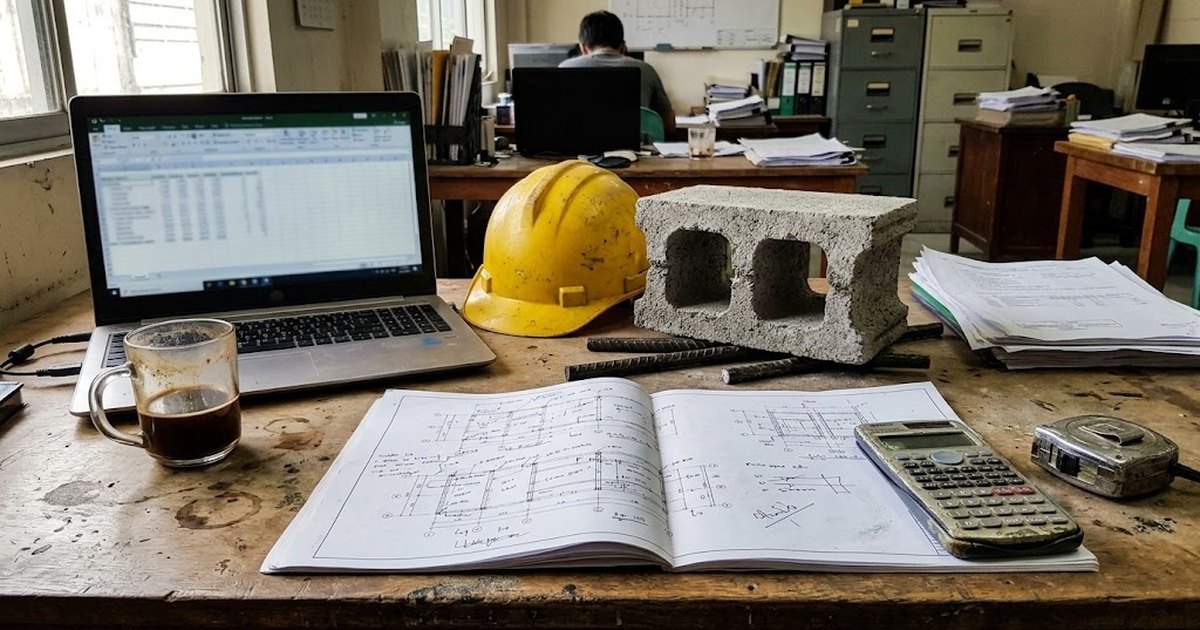
A BOQ turns the plans into quantities someone can check line by line. Illustrative photo.
Short answer: these are four different documents that answer four different questions. A BOM says what to buy. A DUPA says how one unit price was built. A BOQ says what the work costs, item by item. A POW assembles the project, and the ABC is the ceiling a bidder cannot exceed. Contractors lose bids and owners lose arguments because these get used interchangeably when they are not interchangeable.
EDC up to ₱5M: OCM 15% + Profit 10% = 25% · ₱5M–₱50M: 12% + 8% = 20% · ₱50M–₱150M: 10% + 8% = 18% · Above ₱150M: 8% + 8% = 16% · then VAT on the sum of EDC + OCM + CP
| Document | Organised by | Answers | Who uses it |
|---|---|---|---|
| BOM Bill of Materials |
Material | What do I have to buy, and how much of it? | Site engineer, purchaser, owner buying materials directly |
| DUPA Detailed Unit Price Analysis |
Pay item, one at a time | How was this single unit price built up? | Estimator preparing the bid; client checking it |
| BOQ Bill of Quantities |
Work item | What does the finished work cost, line by line? | Both sides — for tendering, comparing, paying and varying |
| POW Program of Works |
The whole project | What is the full scope and what does it total? | The procuring entity, prepared from approved design plans |
| ABC Approved Budget for the Contract |
The whole project | What is the ceiling a bid cannot exceed? | Bidders — exceed it and you are disqualified |
This is the confusion that costs contractors work. A BOQ line prices finished work. "Structural concrete, Class A, 150 cu.m at ₱X per cu.m" is one line whose unit rate already swallows the cement, sand, gravel, formwork, rebar fixing labour, mixer time, overhead and profit. A BOM line lists a thing you buy: 1,350 bags of cement, 75 cu.m of sand, 150 cu.m of gravel.
They are not rival formats and neither replaces the other — a BOQ rate is built on top of a materials take-off. The practical rule:
If you need the materials side of this, our house Bill of Materials generator produces the quantities, and our CHB quantity estimator does the same for masonry walls specifically.
DPWH Department Order No. 30, Series of 2025 — Guidelines in the Preparation of Program of Works (POW) and Approved Budget for the Contract (ABC) — is the current reference. It supersedes D.O. 197 s.2016 and D.O. 133 s.2019, and it applies to the preparation of cost estimates beginning CY 2026. The build-up has two halves.
OCM is Overhead, Contingencies and Miscellaneous, and D.O. 30 gives the three components their own ranges as a percentage of the Estimated Direct Cost:
Contractor's Profit is 8% of EDC for projects with an EDC above ₱5 million, and 10% for an EDC of ₱5 million and below. For ease of calculation, D.O. 30 fixes the combined mark-up in a table:
| Estimated Direct Cost (EDC) | OCM (% of EDC) | CP (% of EDC) | Total (% of EDC) |
|---|---|---|---|
| Up to ₱5 Million | 15 | 10 | 25 |
| Above ₱5 Million to ₱50 Million | 12 | 8 | 20 |
| Above ₱50 Million to ₱150 Million | 10 | 8 | 18 |
| Above ₱150 Million | 8 | 8 | 16 |
Note the direction of travel: the smaller the project, the higher the permitted mark-up. That is not generosity — it reflects that a small job carries nearly the same fixed overhead as a large one, spread over far less revenue. Contractors who price small work at large-project mark-ups are quietly losing money on every one.
What Changed in 2025 — and What Didn't
The mark-up table did not change. D.O. 30 s.2025 carries the same 25 / 20 / 18 / 16 percentages that D.O. 197 s.2016 used. If you have been working from the old order, your OCM and profit numbers are still right.
The VAT component did change. D.O. 197 stated plainly that the VAT component "shall be 5% of the sum of the EDC, OCM and Profit." D.O. 30 replaces that with: the VAT component "shall be a percentage of the sum of the EDC, OCM, and CP," with the applicable rate based on the latest guidelines issued by the DPWH Finance Service, in adherence to the National Internal Revenue Code. The 5% figure is no longer written into the guideline itself — it is now a pointer to a separate issuance. Check the current Finance Service guidance rather than assuming.
Builds one pay item the way DPWH D.O. 30 s.2025 does it — material, labour and equipment into an Estimated Direct Cost, then OCM and contractor's profit at the bracket rate, then VAT — and gives you the BOQ unit rate and line total at the end.
This is where estimators quietly inflate a bid without meaning to. D.O. 30 keeps the rule its predecessor established: some pay items are not subject to OCM and profit mark-up at all.
Applying the full mark-up to these three is one of the most common reasons a DUPA gets kicked back for revision.
Whether the job is government or private, the columns are recognisably the same, and a BOQ missing any of them is hard to evaluate:
| Column | What goes in it |
|---|---|
| Item number | The pay item reference, tied to the specification |
| Description of work | Specific enough that two bidders price the same thing |
| Unit | cu.m, sq.m, l.m, kg, each, lot |
| Quantity | From the take-off against the drawings — and the drawing revision matters |
| Unit cost | The DUPA output, inclusive of mark-up and VAT |
| Amount | Quantity × unit cost |
Below the items sit the summary lines — direct cost, OCM, contractor's profit, VAT, total project cost. Government BOQs also carry the bidder's name and logo, project title, total project cost and project duration in a header block.
The Quantity Is Only As Good As the Drawing Revision
The most expensive estimating error in Philippine practice is not a wrong rate — it is a right rate applied to a quantity taken off a superseded drawing. Write the drawing number and revision on every take-off sheet. When the architect issues Rev C after you priced Rev B, that note is the difference between a legitimate variation claim and absorbing the cost yourself. This is also the most common failure in outsourced estimating work, which we cover in what actually goes wrong when engineering is outsourced.
The DPWH guidelines govern the preparation of government cost estimates. A private contractor can set whatever overhead and profit it can justify, and many carry higher overhead than 15% because they do not have government's volume to spread it across.
The table is still the most useful number in the room, for one reason: it is public and written down. When an owner says a 22% mark-up on a ₱3 million house sounds like a lot, being able to point at a government schedule that permits 25% on that size of work moves the conversation from feelings to a document. It works in the other direction too — a contractor claiming 35% on a ₱40 million project is a long way outside a published benchmark and should expect to be asked why.
If the project is government work, the procurement rules that sit above all of this changed recently. Our guide to RA 12009, the New Government Procurement Act, covers what shifted for bidders.
The OCM and contractor's profit brackets, the component ranges for overhead, contingencies and miscellaneous expenses, the 5% wastage cap, the 1% mobilization cap, the items excluded from mark-up and the VAT treatment were read directly from DPWH Department Order No. 30, Series of 2025, Guidelines in the Preparation of Program of Works (POW) and Approved Budget for the Contract (ABC), which supersedes D.O. 197 s.2016 and D.O. 133 s.2019 and applies to cost estimates from CY 2026. The material, labour and equipment rates used in the calculator are illustrative placeholders, not published rates — replace them with your own. Private-sector mark-ups are not governed by these guidelines.
A short demo of building up a unit cost analysis with the BuildX unit cost tool. From the AEDO YouTube channel, uploaded 2026-05-23.

What is the difference between a BOQ and a BOM?
A Bill of Quantities is organised by work item and prices the finished work — one line might read 150 cubic metres of Class A structural concrete at a unit rate that already contains cement, sand, gravel, formwork, labour, equipment and mark-up. A Bill of Materials is organised by material and lists what you have to buy — so many bags of cement, so many pieces of concrete hollow block, so many lengths of rebar. Owners and site engineers order from a BOM. Clients tender and pay against a BOQ. They are not competing formats; a BOQ line is built on top of a materials take-off.
What are the current DPWH OCM and contractor's profit percentages?
Under DPWH Department Order No. 30, Series of 2025, the mark-up on the Estimated Direct Cost is 15 percent OCM and 10 percent contractor's profit for an EDC up to 5 million pesos, 12 and 8 percent above 5 million up to 50 million, 10 and 8 percent above 50 million up to 150 million, and 8 and 8 percent above 150 million. Those totals are 25, 20, 18 and 16 percent of EDC respectively. The same table appeared in the superseded D.O. 197 s.2016, so the percentages themselves did not change in 2025.
Is the VAT component in a DPWH estimate still 5 percent?
Not as a fixed figure any more. D.O. 197 s.2016 stated the VAT component as 5 percent of the sum of EDC, OCM and profit. D.O. 30 s.2025 instead states that the VAT component shall be a percentage of the sum of the EDC, OCM and CP, with the applicable rate based on the latest guidelines issued by the DPWH Finance Service in adherence to the National Internal Revenue Code. In practice estimators have carried the 5 percent figure forward, but the rate is now a reference to a separate issuance rather than a number written into the guideline, so confirm it against the current Finance Service guidance before you submit.
What is a DUPA in Philippine construction?
A Detailed Unit Price Analysis is the worksheet behind a single pay item. It breaks that item into its material, labour and equipment components, applies the allowances the guidelines permit — wastage of not more than 5 percent of the materials requirement, for example — to arrive at an Estimated Direct Cost, then adds OCM, contractor's profit and VAT to produce the unit price that appears in the Bill of Quantities. If a client asks for your DUPA, they are asking you to show your working.
What is the difference between a POW and an ABC?
The Program of Works is the scope and cost document for the project — the pay items, quantities and costs assembled into one programme, prepared from approved design plans. The Approved Budget for the Contract is the ceiling for acceptable bid prices under RA 9184 and its successor procurement law. The ABC consists of direct cost and indirect cost, and it is the figure a bidder cannot exceed. In practice the POW is the working document and the ABC is the number published to bidders.
Do private projects have to follow the DPWH mark-up table?
No. The DPWH guidelines govern the preparation of government cost estimates. A private contractor is free to set its own overhead and profit. The table is still the most useful reference point in Philippine practice, because it is public, it is written down, and both sides of a private negotiation recognise it — which makes it a reasonable benchmark for arguing that a mark-up is or is not defensible.
Statutes, codes, official tools and references used or referred to in this article, linked to their source. Links open in a new tab.
Prices, cost bands and rate figures in this article are AEDO Construction's own market and practice figures for Philippine work unless a source is named beside them. Code and statute references above link to the primary text.
An itemised bill of quantities and cost breakdown: the document that lets a client compare contractor quotes honestly instead of guessing which one padded what, and lets a contractor bid from analysis instead of instinct.