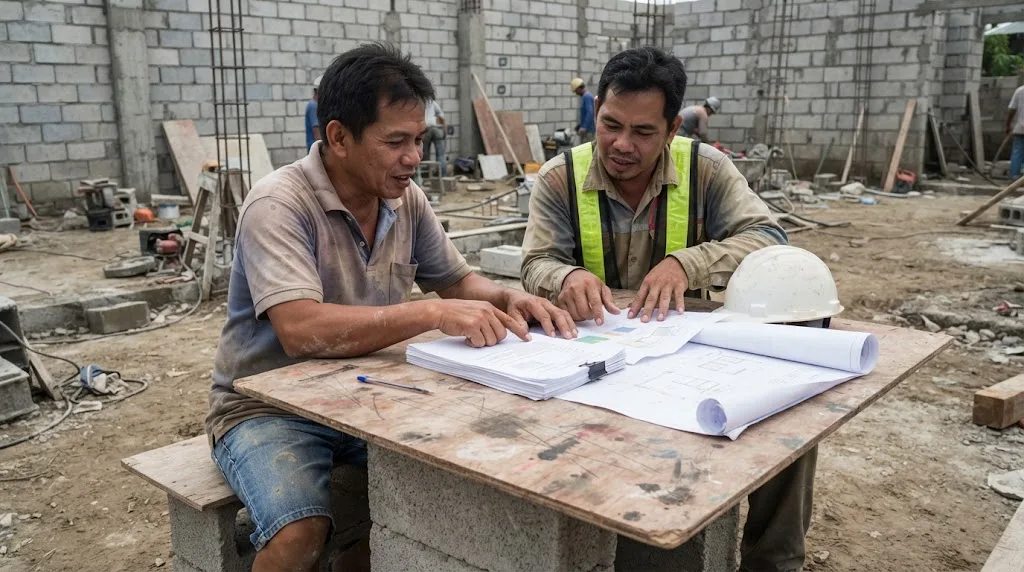
Most site arguments start with a page that was never written: no scope annex, no billing rule, no date with a consequence. Read the contract with the plans open beside it. Illustrative photo.
Short answer: a construction contract in the Philippines should pin down fifteen things: who (the parties and the contractor's PCAB licence), what (scope, with the signed plans and specs attached), how much (price and contract type), how you pay (a recouped downpayment, progress billings against measured work, and retention), what happens when things change (written change orders, a completion date with liquidated damages, and fair extensions), quality and site (material standards and tests, permits and a licensed supervisor, insurance and safety), and how it ends (turnover and a defects period, termination, and where disputes go). CIAP has published a free Short Form of Construction Contract that covers most of this. Most contracts we're shown in the province are a quotation with a signature line, and in the checker below a typical one scores a risk score of 53 out of 100, high risk: parties, scope, price, downpayment, a billing schedule and a one-year warranty, and nothing else. On a ₱3,000,000 job the missing lines would have given you ₱300,000 of retention and a delay penalty of ₱3,000 a day.
Tick what your draft has. After the checker: what the Civil Code already does for you, each clause with what it prevents and sample wording, what the CIAP template and CIAP Document 102 actually are, the extra clauses a fit-out needs, and the red flags.
Tick each clause your draft contract actually has in writing, not what the contractor promised. Enter the price and duration to see the retention, delay penalty and bond figures that belong in it. The weights are AEDO's judgement of how much each clause protects an owner. They are not a legal test.
Before writing anything, know what the law fills in when your contract is silent. A private building contract is a contract for a piece of work under the Civil Code (RA 386). A few articles do a lot of the work:
Does it have to be notarised? Article 1356 says contracts are obligatory "in whatever form they may have been entered into," provided the essential requisites are present, unless the law requires a form. Article 1358 says contracts above ₱500 "must appear in writing, even a private one", but that is for convenience, not validity: under Article 1357 either side can compel the other to put a perfected deal in writing. One real trap: under the Statute of Frauds (Article 1403(2)(a)), an unwritten agreement that by its terms is not to be performed within a year is unenforceable by action, though that defense generally falls away once the work has started or been paid for. So a verbal deal can bind, but you can't prove a scope nobody wrote down. Notarising turns the contract into a public document, which helps as evidence. It isn't what makes it valid.
Prevents: signing with someone the licence doesn't cover, or with a person you can't find later. Write the full legal names, addresses and, for a company, who signs for it and on what authority. For the contractor add the PCAB licence number, the classification and the Valid To date. RA 4566 Section 35(a), as amended by RA 11711 in 2022, fines contracting without a licence ₱100,000 to ₱500,000 plus 0.1% of the project cost, and Section 13 exempts minor work under ₱10,000, and not a job split up to stay under it. Look the licence up yourself; our PRC and PCAB verification guide shows how. A pakyaw crew usually has no licence, so a labour-only agreement puts more of the risk, and the paperwork, on you.
Prevents: "that wasn't included." This is the clause that decides most disputes, and it's usually one line: "construction of two-storey residence per plans." Which plans? Which revision? The CIAP Short Form lists the contract documents that form part of the contract: the contract, specifications, drawings, the breakdown of work and value, the schedule, bonds, insurance and change orders. It ranks them in that order for when they conflict. Attach the signed and sealed drawings (with sheet numbers and revision dates), the specs and the bill of quantities as numbered annexes, and have both parties initial every page. List the exclusions too. Owner-supplied items, landscaping, the water connection fee and furniture are the usual fights.
Prevents: arguing about what the number includes. Say whether it's a lump sum (fixed price for the defined scope), cost-plus (actual cost plus a fee) or labour only. It matters legally, because Article 1724's protection against price-increase claims is written for a stipulated price built to agreed plans. Our contract types guide compares the three. For cost-plus, put a ceiling and an open-book rule in writing.
Then taxes. State whether the price is VAT-inclusive. On withholding: Revenue Regulations No. 11-2018 (amending RR 2-98) sets a 2% creditable withholding tax on gross payments to general engineering, general building and specialty contractors. The withholding agents under Section 2.57.3 of RR 2-98 are juridical persons (corporations, partnerships) and individuals paying "in connection with" their trade or business. So a company fitting out its clinic or shop usually has to withhold 2% and issue the certificate. A private individual building a family home generally doesn't. RR 11-2018 also lets an individual payee with a lone payor and less than ₱250,000 of income payments in the year skip withholding by submitting a sworn declaration, which rarely fits a contractor. Confirm with your accountant, because BIR rules change. The CIAP Short Form handles this well: the contractor pays its own taxes, and the owner may withhold "any amount the Owner is required to withhold by law."
Prevents: a big payment up front that is never worked off. In the CIAP Short Form, the advance is "recouped from every Request for Payment" in proportion to work done "until the advance payment is fully liquidated." It also asks for a surety bond equal to the advance. In house building in the province, 20% to 30% down with no security is normal. Government infrastructure caps it at 15%, and only against a bond or bank guarantee (see our progress billing guide). Anything above 15% is credit you're extending. Tie it to a mobilisation and materials schedule with dates.
Prevents: paying 70% for a house that's 40% built. Payment should follow a breakdown of work and value (the CIAP template asks the contractor for one within five days of signing), with each billing computed from it and checked by your engineer before you pay. Calendar billings ("₱200,000 every 15th") and stage billings with no measurement are how owners get ahead of the work. The CIAP template also gives the owner 10 days to evaluate and pay, with 1% a month interest if the owner pays late. That's fair both ways, and a contractor who asks for it isn't being difficult.
Prevents: an ignored punch list. Retention is the last money you hold when the contractor's attention has moved to the next job. The CIAP Short Form has the owner retain 10% from every request for payment, released "not later than 60 calendar days from substantial completion" once the contractor posts a guarantee bond. The government-style rule is softer: 10% until half the work is done, then no more if the work is satisfactory and on schedule, which tops out near 5% of the contract. On ₱3,000,000 that's ₱300,000 under the CIAP template or about ₱150,000 government-style. Pick one and write it down. What owners regret is having no retention at all.
Prevents: the surprise extra bill at the end. Article 1724 already protects a stipulated-price owner: no price increase for a change unless the change was authorized in writing and the added price was agreed in writing by both parties. Your clause turns that into a procedure: a numbered change-order form, the price and time effect agreed before the work is done, and signed by the person with authority. The CIAP Short Form lets the parties agree the value of a change as long as it doesn't exceed 25% of the original price of that pay item. Additive changes above 25% of the original contract price need a supplemental contract. On a deductive change, the contractor keeps 15% of the amount deducted for overhead and profit. Our change-order guide has a checker for extra charges you've already received.
Prevents: a job that runs months late with no consequence. A completion date with no penalty attached isn't a deadline. The Civil Code lets you agree one in advance:
So a moderate rate holds up better than a punishing one. The CIAP Short Form uses 1/10 of 1% of the contract price per day of delay, capped at 10% of the contract price, deductible from money due or from retention. On ₱3,000,000 that's ₱3,000 a day and the cap is hit after 100 days. It's the common practice rate, and it's negotiable. One more rule: under Article 1169, a party is in delay from the time of demand, unless the contract or the law expressly says demand isn't needed, or one of Article 1169's other exceptions applies. The CIAP template requires "written notice from the Owner," so send that notice the day after the completion date passes.
Prevents: a penalty the contractor never deserved, and the fight that follows. Article 1174 says nobody answers for events that couldn't be foreseen or were inevitable, unless the law, the contract or the nature of the obligation says otherwise. A good clause lists what earns more time and how to claim it. The CIAP template gives an equitable extension for the owner's own delay, third-party strikes, force majeure (fire, earthquake, flooding, epidemic), unsuitable weather, peace and order problems, and changes the owner orders. The contractor must notify within 15 days, and the owner must answer within 15 days or the request is deemed approved. Owner-caused delay gets day-for-day. If you supply materials or approve samples, your lateness counts too, so write down your own deadlines.
Prevents: 10 mm bars where the plans say 12, and a "brand equivalent" that isn't. Point to the specs for grades and brands, require samples approved before ordering, and name the tests: concrete cylinder tests, rebar tensile tests and mill certificates, and CHB tests where the specs call for them. Say who pays for them and who picks the lab. The CIAP template has the contractor provide "without additional charge" the facilities, labour and materials needed for inspections and tests, and lets the owner condemn defective work and deduct the cost of replacing it if the contractor won't. That matches Article 1715.
Prevents: a stop-work order, and a site nobody licensed is watching. The permit is the owner's problem by law. PD 1096's Revised IRR, Section 301, bars anyone from building "or cause the same to be done" without a building permit, and Section 302 has the applicant file with proof of title (plus a lease if the applicant isn't the owner). The CIAP template reflects this: the contractor only "assist[s] the Owner in securing" permits, and may suspend or terminate if the owner hasn't secured the building permit within 30 days. Say who does the legwork and who pays the fees. Then supervision. Section 308 of the Revised IRR says the owner "shall engage the services of a duly licensed architect or civil engineer to undertake the full time inspection and supervision," with a site logbook he signs and seals and submits to the Building Official at the end. The contract should name that person, and say whether it's the contractor's engineer or your own.
Prevents: a collapsed formwork, an injured worker or a damaged neighbour's wall ending up as your bill. The CIAP Short Form lists a performance bond of 15% of the price, a payment bond of 15%, a surety bond for the advance, Contractor's All Risk insurance including third-party liability, and a guarantee bond at turnover. For a ₱3,000,000 house most small contractors can't carry all of that. At minimum ask for CAR with third-party cover. We know of no law that makes CAR compulsory on a private job, so it's there only if the contract says so; our CAR insurance guide explains what it covers. The Civil Code already makes the contractor "responsible for the work done by persons employed by him" (Art. 1727) and liable for the claims of his workers and of third persons for death or injury during construction (Art. 1728). An indemnity clause makes that explicit.
Safety: RA 11058 puts the duties on "every employer, contractor or subcontractor" (Section 4), requires PPE for workers "free of charge" (Section 8), and requires a safety and health program prepared by the employer or contractor and submitted to DOLE (Section 12). For construction, DOLE's D.O. 13-98 guidelines and the current RA 11058 IRR apply. DOLE replaced D.O. 198-18 with D.O. 252-25 in 2025; our CSHP guide covers what the program must contain. Your clause should make the contractor responsible for all of it, and carry the safety cost as its own line.
Prevents: cracks and leaks after turnover with nobody to call, and losing your claim by signing an acceptance. Remember Article 1719: acceptance relieves the contractor of defects unless they're hidden or you expressly reserve your rights. So write turnover as a process. First substantial completion (the CIAP template treats approving a billing for at least 95% of the work as the acknowledgment). Then a punch list within 30 days, which the owner can supplement up to 60 days after substantial completion. Then 30 days for the contractor to correct it. After that, a defects period: the CIAP template has the owner notify hidden defects within one year from posting of the guarantee bond, with repairs starting within five days of notice. None of this shortens Article 1723's fifteen years for collapse, and the template says so itself. Our Article 1723 guide covers those deadlines.
Put the turnover documents in the final-payment conditions: the CIAP template asks for the certificate of occupancy, final inspection certificates for the utilities, as-built drawings of the electrical, sanitary and mechanical works, panel directories, manuals, the keying schedule, and a sworn statement that taxes are paid and the work is free of liens. That last one matters because of Article 1729: unpaid workers and suppliers of your contractor can sue you up to what you still owe him, and payments you made before they were due don't count against them.
Prevents: being stuck with a contractor who has stopped working, or being sued for firing one without cause. Two Civil Code routes exist. Article 1191 lets you rescind for the contractor's breach with damages. Article 1725 lets you walk away at will, but you must pay for expenses, work, usefulness and damages. Your clause should list the grounds, the notice and what is paid on the way out. The CIAP template's grounds for the owner include insolvency, a substantial violation of the contract, and a negative slippage of 15%, on 15 days' written notice to the contractor and its surety. The owner can then take over the site and finish the work, and the contractor is paid nothing more until it's done. The contractor can suspend or terminate too, for example if the owner doesn't pay a billing on time. Our guides on terminating a non-performing contractor and on a contractor who abandoned the project cover the steps.
Prevents: years in a regular court over a ₱200,000 punch list. Executive Order 1008 (1985) created the Construction Industry Arbitration Commission (CIAC) with "original and exclusive jurisdiction" over disputes from construction contracts, government or private. It also says the parties "must agree to submit the same to voluntary arbitration" before CIAC acquires jurisdiction. So with no arbitration clause, a dispute goes to the courts, unless both sides later agree in writing to arbitrate. With one, it goes to CIAC. RA 9285 (the ADR Act of 2004), Sections 34 and 35, keeps construction arbitration under EO 1008. CIAC's Revised Rules of Procedure (Section 4.1, in the 2005 rules and still in the version amended through 2022) go further: an arbitration clause in a construction contract "shall be deemed an agreement to submit" to CIAC "notwithstanding the reference to a different arbitration institution or arbitral body." In other words, if you write "arbitration" at all, expect CIAC. The CIAP template's clause is a sensible ladder: 30 days of negotiation from written demand, then CIAC mediation for up to 48 days, then CIAC arbitration by one or three arbitrators.
Two free government documents exist, and people mix them up.
| Document | What it is | How to use it |
|---|---|---|
| CIAP Document 102, Uniform General Conditions of Contract for Private Construction | A long set of general conditions for private construction. The CIAP Board approved the revised 2022 edition through Board Resolution No. 07, s. 2022; CIAP says it took effect February 1, 2023. The 2004 edition is the old version. | It binds nobody on its own. It applies when your contract adopts it. Useful as the fallback rulebook for everything your contract doesn't cover. |
| CIAP Template Short Form of Construction Contract (Annex A) | An 11-page sample contract agreement that CIAP says was developed specifically for MSMEs and project owners. The CIAP Board approved it on February 16, 2024 (Board Resolution 2, s. 2024) and "encouraged its use and adoption for private construction projects." The current PDF was uploaded to CIAP's site in November 2025. | It "incorporates by reference and adopts" Document 102. Fill in the blanks and attach your plans, specs and breakdown. Most of the numbers quoted in this article come from it. |
Read it before you sign it, though. It's a proposed sample, and it shows. One cross-reference in Article 3 is left as "Article [***]," and the dispute clauses under Article 14 are numbered 13.1 and 13.2. It also assumes a contractor able to post a 15% performance bond, a 15% payment bond and a guarantee bond, which many small builders in the province can't. That's fine. Strike what doesn't fit, but decide it on purpose rather than by leaving the line blank. It's written evenly for both sides: the owner gets retention, delay damages and termination for slippage, and the contractor gets 1% a month on late payments, deemed-approved extensions and the right to suspend. A contractor who refuses a contract this balanced is telling you something.
The sample wording in this article shows what each clause needs to say. It isn't a complete contract, and it hasn't been checked against your project, your lot or your financing. Start from the CIAP Short Form, fill in your numbers, and have a lawyer review the final draft, especially the termination, bond and dispute clauses. An engineer can tell you whether the scope matches the plans and the billing matches the work. A lawyer tells you whether the words will hold.
A restaurant, clinic or shop fit-out uses the same fifteen clauses, plus a few that a house never needs:
| What the draft says | Why it's a problem | Ask for |
|---|---|---|
| "As per plan" with no plan attached | No annex means no fixed scope, so every item becomes negotiable later | Signed drawings and specs as numbered annexes, initialled |
| 50% down, balance "upon completion" | You've financed half the job before a post goes up, and have nothing left to withhold if it stalls | A smaller advance, recouped per billing, and billings against measured work |
| "Price subject to change based on market prices" | Turns a lump sum into an open cost-plus contract without its controls. Article 1724 only protects a stipulated price | A fixed price, or a named escalation formula with a cap |
| A completion date but no liquidated damages | A date with no consequence is a wish | A per-day rate and a cap, such as 1/10 of 1% a day up to 10% |
| "Warranty: 1 year" and nothing else | Says nothing on what's covered, how fast repairs start, or what money stands behind it | Retention or a guarantee bond, a response time, and express reservation of rights at acceptance |
| No name for the site engineer or architect | Section 308 supervision is the owner's duty; with nobody named, nobody does it | A named licensed supervisor with PRC number |
| Contract signed by a person, licence in a company's name | The licence may not cover the party you're paying | Contract, receipts and PCAB licence in one name |
What AEDO does with your contract. AEDO's engineers are licensed civil engineers. Anywhere in the Philippines we review contracts and design remotely. For a draft contract we check the scope against the plans, the breakdown against the drawings, and the billing, retention, delay and defects clauses against what the job needs, then send you a marked-up list to take to your lawyer and your contractor. In Negros Oriental we also build, and our own contracts carry these fifteen clauses. We're engineers, not lawyers, so the legal wording stays with your counsel.
Civil Code (RA 386) Articles 1159, 1169, 1174, 1191, 1226, 1228, 1229, 1306, 1356, 1357, 1358, 1403, 1715, 1719, 1720, 1723, 1724, 1725, 1727, 1728, 1729, 2226 and 2227, read on LawPhil; we found no later amendment to any of them. Contractor licensing: RA 4566 Sections 13 and 35, with Section 35 as replaced by RA 11711 (2022). Construction arbitration: EO 1008 Section 4, RA 9285 Sections 34 and 35, and Section 4.1 of CIAC's 2005 Revised Rules (CIAC Resolution No. 10-2005), a rule kept in the rules as amended through CIAC Resolution No. 07-2022 (consolidated 01 January 2023). Permits and supervision: Sections 301, 302 and 308 of the 2004 Revised IRR of PD 1096. Safety: RA 11058 Sections 4, 8 and 12. Withholding: RR 11-2018 (2% on contractors) and RR 2-98 Section 2.57.3. Template figures (10% retention, 1/10 of 1% per day liquidated damages capped at 10%, 15% bonds, 25% change-order limit, 15% slippage, one-year hidden-defect notice) are from CIAP's Short Form of Construction Contract; its approval date and Document 102's edition are from CIAP's own pages. The government advance-payment and retention benchmarks are from our progress billing guide. Checker weights are AEDO's judgement.
What should be in a construction contract in the Philippines?
At minimum: the parties and the contractor's PCAB licence number, the scope with the signed plans and specifications attached as annexes, the contract price and type, a downpayment that is recouped from each billing, progress payments tied to measured work, retention, change orders in writing, a completion date with liquidated damages, the grounds for extending time, material standards and testing, who pulls the permits and who supervises, insurance and safety, a defects period and turnover documents, termination, and dispute resolution. The CIAP Short Form of Construction Contract, approved by the CIAP Board in February 2024, covers most of these and is a free starting point. Have a lawyer review the final draft.
Is a verbal agreement with a contractor binding?
Under Article 1356 of the Civil Code, contracts are obligatory in whatever form they are entered into, as long as the essential requisites are present, so a verbal agreement can bind, though Article 1358 expects any contract above 500 pesos to be in writing, and a verbal job that by its terms runs past a year can be caught by the Statute of Frauds (Article 1403) until work has actually started. The problem is proof. With nothing written you cannot show the scope, the price or the completion date, and Article 1724 only lets a contractor on a stipulated-price job charge more for a change in the plans when the change was authorized by the owner in writing and the added price was agreed in writing. Put it on paper.
How much retention should I hold from my contractor?
The CIAP Short Form of Construction Contract has the owner retain 10 percent of every request for payment, released not later than 60 calendar days from substantial completion once the contractor posts a guarantee bond. Government infrastructure rules hold 10 percent only until half the work is done, then no more if the work is satisfactory and on schedule, so retention there tops out at about 5 percent of the contract. On a 3,000,000 peso contract that is 300,000 pesos under the CIAP template or about 150,000 pesos under the government-style rule. The rate is negotiable; what matters is that the contract has one.
What is a fair delay penalty in a construction contract?
The CIAP Short Form uses liquidated damages of one-tenth of one percent of the contract price per day of delay, capped at 10 percent of the contract price. On a 3,000,000 peso contract that is 3,000 pesos a day, and the cap is reached after 100 days of delay. That is common practice and negotiable, not a legal rate. Under Articles 1229 and 2227 of the Civil Code a court can reduce a penalty that is iniquitous or unconscionable, or when the work was partly done, so a moderate rate holds up better than a punishing one.
Can my contractor charge extra because cement and steel prices went up?
Not on a stipulated-price contract built to agreed plans. Article 1724 of the Civil Code says such a contractor can neither withdraw nor demand an increase on account of higher labour or material costs, unless the plans and specifications were changed with the owner's written authorization and the additional price was fixed in writing by both parties. A cost-plus contract works differently, because rising costs pass through by design, which is why the contract should say which type it is.
Do I have to withhold tax on payments to my contractor?
It depends on who you are. Revenue Regulations No. 11-2018 sets a 2 percent creditable withholding tax on gross payments to general engineering, general building and specialty contractors. The withholding agents under Section 2.57.3 of Revenue Regulations No. 2-98 are juridical persons, such as corporations, and individuals paying in connection with their trade or business. A company fitting out its clinic or shop usually withholds; a private individual building a family home generally is not a withholding agent. Confirm with your accountant or the BIR, and write the tax treatment into the contract either way.
Where do construction contract disputes go in the Philippines?
If the contract has an arbitration clause, to the Construction Industry Arbitration Commission (CIAC). Executive Order 1008 gives CIAC original and exclusive jurisdiction over construction disputes once the parties agree to voluntary arbitration, and CIAC's rules of procedure say an arbitration clause in a construction contract is deemed an agreement to submit to CIAC even if it names a different arbitral body. Without an arbitration clause, the dispute goes to the regular courts, unless both sides later agree in writing to arbitrate. The CIAP Short Form sends disputes to 30 days of negotiation, then CIAC mediation, then CIAC arbitration.
Laws, rules and official documents read for this article in September 2026. External links open in a new tab.
We didn't read the full text of DOLE D.O. 252-25, so no claim is made about its details. The CIAP Short Form's figures are a template's, not legal requirements. Checker weights and risk bands are AEDO's judgement. This article is general information, not legal or tax advice.
Send us the draft, the quotation or BOQ, and the plans. A licensed civil engineer will check them before your first peso moves.