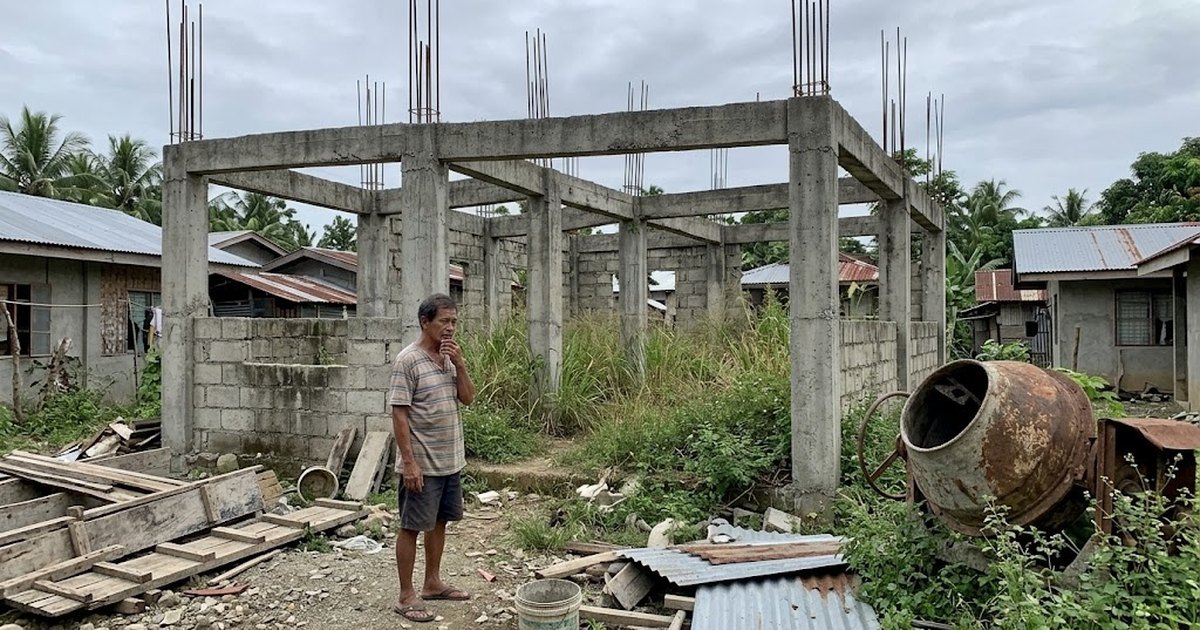
Document the site as the contractor left it before anyone else starts work. Illustrative photo.
Short answer: before you argue about anything, find out whether you are overpaid. Almost every abandonment dispute in Philippine residential work comes down to one number — the value of the work actually standing on site, against the money already released. Get that measured in the first week, while the evidence is still visible, and everything after it becomes straightforward.
Bringing in the next contractor immediately. It feels like progress and it destroys the case. New work covers old work, and once it does, nobody can prove what was there, how much of it there was, or what was wrong with it. Measure and photograph first. Demand performance in writing second. Replace third. In that order the record survives; in any other order it does not.
Four provisions do most of the work in a residential abandonment case.
| Provision | What it gives you | The condition attached |
|---|---|---|
| Art. 1715 | Require the contractor to remove the defect or execute another work; if they fail or refuse, have it done at the contractor's cost | The demand has to come first, and be provable |
| Art. 1191 | In a reciprocal obligation, choose between fulfilment and rescission, with damages either way | The court decrees the rescission; you do not declare it |
| Art. 1170 | Damages against anyone guilty of fraud, negligence or delay, or who contravenes the tenor of the obligation | Without a liquidated damages clause you must prove the actual loss |
| Art. 1724 | On a stipulated price, the contractor cannot withdraw or demand more for higher labour or material costs | Unless the change was authorised in writing and the extra price fixed in writing by both |
Article 1724 is the one homeowners underuse. A contractor who stopped work because "prices went up" has, on a stipulated-price contract, no right to more money and no right to withdraw. And the two escape conditions are both written ones — a verbal instruction followed by a verbal price is not a variation the law will enforce. If the extra work was never put in writing, that usually cuts in the owner's favour.
Article 1727 adds one more: the contractor is responsible for the work done by persons employed by him. A subcontractor walking off is the main contractor's problem, not yours.
Works out whether you are overpaid against the work standing on site, what finishing with a replacement contractor is likely to cost, and where a claim of that size can be heard. Legal thresholds are cited; the takeover premium is an AEDO practice band.
Barangay conciliation is first and it is compulsory where both parties reside in the same city or municipality. Section 412 of the Local Government Code provides that no complaint falling within the authority of the lupon may be filed in court without the certification that a confrontation took place and no settlement was reached. Skip it and the case is dismissed for failure to comply with a condition precedent. Many disputes also genuinely end here, which is the point of it.
Small claims covers money claims of ₱1,000,000 or less under the Supreme Court's expedited procedures, which took effect on 11 April 2022. No lawyer appears for either side, which makes it the only forum in the country where an ordinary homeowner is on equal footing. For a large share of residential abandonment claims this is the right answer, and people skip it because they assume a construction dispute must be complicated.
CIAC arbitration applies where the contract contains an arbitration clause. Executive Order 1008 gives the Construction Industry Arbitration Commission original and exclusive jurisdiction over disputes arising from or connected with construction contracts in the Philippines, "whether the disputes arise before or after the completion of the contract, or after the abandonment or breach thereof." Abandonment is named in the jurisdiction clause itself. Check your contract before assuming you are heading to court.
A PCAB complaint runs alongside any of these. It does not recover your money — it addresses whether the contractor should hold a licence at all. Under RA 4566 as amended by RA 11711, contracting or bidding without a licence carries a fine of ₱100,000 to ₱500,000 plus one-tenth of one percent of the project cost and a one-year bar on obtaining a licence, while using another's licence, giving false evidence to the Board, impersonation or using an expired or revoked licence carries ₱500,000 to ₱1,000,000 and one to six years' imprisonment. For an unlicensed operator, that exposure is usually larger than the debt, which is exactly why it is leverage.
Three clauses prevent most of this. A retention of five to ten percent released only after completion. A liquidated damages rate per day of delay, so you never have to prove what waiting cost you. And payment against measured progress rather than against a calendar. Our construction contract types guide covers the trade-offs, progress billing covers how to pay against work rather than promises, and the quote checker catches the pricing patterns that tend to precede a stoppage.
Taking over an abandoned house costs more per unit of remaining work than building it from scratch would have. That is not opportunism, it is risk: the incoming contractor inherits work they did not build, cannot see inside, and will be blamed for. Expect a premium on the remaining value, and expect it to be larger the less documentation exists.
The way to shrink that premium is the same measured record that protects your claim. A contractor pricing from a proper condition survey and a quantified statement of work in place can price the risk instead of guessing at it. Our guide on the cost to finish an unfinished house covers what the remaining work itself is worth once you get to that stage.
Articles 1170, 1191, 1715, 1724 and 1727 are quoted from the Civil Code of the Philippines, Republic Act 386. Barangay conciliation as a condition precedent is Section 412 of Republic Act 7160, the Local Government Code. The ₱1,000,000 small claims threshold is the Supreme Court's A.M. No. 08-8-7-SC, the Rules on Expedited Procedures in the First Level Courts, effective 11 April 2022. The CIAC jurisdiction wording is Section 4 of Executive Order No. 1008, and CIAC jurisdiction requires the parties to have agreed to arbitration. Contractor licensing is RA 4566, with the penalties as amended by RA 11711. The takeover premium band in the calculator is AEDO practice for Philippine residential work, labelled as such — it is not a legal or code figure. None of this page is legal advice; a claim of any size is worth an hour with a lawyer once you know your net position.
What is the first thing to do when a contractor abandons the project?
Establish the state of the work before anything changes. Photograph and video every area with a dated reference, list the materials on site against what you paid for, and have the quantity of work actually in place measured by someone independent. Then write to the contractor demanding that they resume within a stated period, and send it in a way that proves delivery. Do not let another trade start work until the record is complete, because the moment new work covers old work you lose the ability to prove what was there. Everything that follows, in any forum, is decided on that record.
Can I just hire someone else to finish the house?
Yes, and the Civil Code contemplates it, but do it in the right order. Article 1715 says that where the work has defects that destroy or lessen its value or fitness, the owner may require the contractor to remove the defect or execute another work, and if the contractor fails or refuses, the owner may have the defect removed or another work executed at the contractor's cost. The demand comes first and it has to be provable. Under Article 1191 the injured party in a reciprocal obligation may choose between fulfilment and rescission, with damages either way. Bringing in a replacement without having demanded performance first weakens the claim you are trying to preserve.
Can the contractor demand more money because materials got expensive?
Not on a stipulated-price contract. Article 1724 says a contractor who undertakes to build for a stipulated price in conformity with plans and specifications agreed with the landowner can neither withdraw from the contract nor demand an increase in price on account of the higher cost of labour or materials, unless there has been a change in the plans and specifications, the change was authorised by the proprietor in writing, and the additional price was determined in writing by both parties. Both conditions are written ones. A verbal instruction and a verbal price is not a variation the law will enforce, which cuts in the owner's favour far more often than people expect.
Where do I file a case against a contractor in the Philippines?
It depends on the amount and on what the contract says. If both parties live in the same city or municipality, Section 412 of the Local Government Code makes barangay conciliation a condition precedent, and a case filed without that certification is dismissed for failure to comply with it. For money claims of one million pesos or less the small claims procedure applies, where no lawyer appears for either side. If the contract contains an arbitration clause, Executive Order 1008 gives the Construction Industry Arbitration Commission original and exclusive jurisdiction over disputes connected with construction contracts, expressly including disputes arising after abandonment or breach. A complaint to the Philippine Contractors Accreditation Board runs alongside all of these and addresses the licence rather than your money.
Does it matter whether the contractor had a PCAB license?
It matters a great deal, and it is worth checking even now. Republic Act 4566, the Contractors' License Law, requires a licence to engage in the business of contracting, and Republic Act 11711 raised the penalties sharply. Contracting or bidding without a licence now carries a fine of one hundred thousand to five hundred thousand pesos plus one-tenth of one percent of the project cost, with a one-year bar on obtaining a licence. Presenting another person's licence, giving false evidence to the Board, impersonating another or using an expired or revoked licence carries a fine of five hundred thousand to one million pesos and imprisonment of one to six years. A PCAB complaint does not recover your money, but it is leverage, and an unlicensed contractor generally has far more to lose from the complaint than from the debt.
Can I claim for the delay itself?
If your contract has a liquidated damages clause you claim at the rate it states, which is the main reason that clause exists. Without one you are back to Article 1170, under which those who in the performance of their obligations are guilty of fraud, negligence or delay, or who in any manner contravene the tenor of the obligation, are liable for damages — but you then have to prove what the delay actually cost you. Rent paid while waiting, storage, and finance charges are the usual heads. Keep the receipts from the first week, because reconstructing them a year later is how otherwise good claims shrink.
Every statute, code and official tool used or referred to in this guide, linked to its primary source. Links open in a new tab.
The 15–30% takeover premium in the calculator is an AEDO practice band for Philippine residential work. Nothing on the page is legal advice.
A licensed engineer surveys what is actually standing, quantifies it against the contract, and writes it up. That document is what every forum decides on.