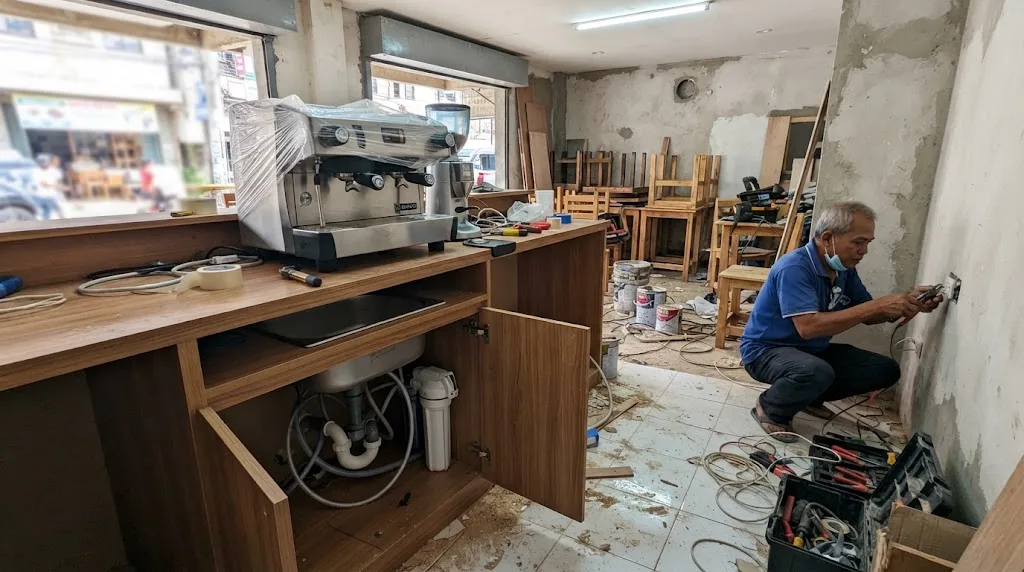
Most of what makes a café expensive sits behind and under the bar: the water line, the filter, the drains and the circuits. Illustrative photo.
Short answer: on AEDO's 2026 planning rates, a 60 sqm mid-range inline café in a mall with a 4.5 m coffee bar, split-type aircon and 24 seats comes to roughly ₱1.6M to ₱3.0M in fit-out works. The same shop on a streetfront runs about ₱1.4M to ₱2.4M, because there's no mall tenancy premium. A 9 sqm milk tea kiosk in a mall lands around ₱0.6M to ₱1.3M. The espresso machine, grinders, blenders and furniture are on top.
A café is not a small restaurant. There's no cook line, no LPG and usually no hood, so if you're planning a full kitchen, read our restaurant and retail fit-out guide and the commercial kitchen guide instead. What a café does have is a very dense bar: a machine that draws 20 amps on its own, a filtered water line, three or four drains in two metres of counter, and a sink that sees milk all day. That is where the budget and the permit questions sit.
Occupant load uses the Fire Code RIRR's 1.4 m² per person for dining rooms. Every peso rate, bar length, equipment wattage (except the cited 2-group machine) and the aircon rule of thumb is an AEDO planning estimate, not a code value or a quotation.
The format decides more of the budget than the finish level does, because it decides what you have to build and what the landlord already gives you.
| Format | What you build | What usually comes with the space | Watch out for |
|---|---|---|---|
| Mall kiosk | A counter module: body, top, cabinets, fascia and signage frame, bar equipment, a sink | A floor spot, a power point and, if you're lucky, a water and drain point nearby | Long water and drain runs under the mall floor to the nearest point; tight rules on height and signage |
| Inline mall store | Everything inside the demising walls: floor, ceiling, lighting, bar, seating, shopfront | A bare shell with stubbed utilities, and often the mall's air-conditioning to tie into | Landlord drawing approval, accredited contractors, night work and a fit-out deadline |
| Inline on a street or strip | Same as the mall store, plus your own aircon and often your own service upgrade | Whatever the previous tenant left | An electrical service too small for the bar; old drains you'll be asked to replace |
| Standalone café | The whole interior plus facade, signage, often a toilet, and site drainage | A building shell (priced separately) | The building's own permits and occupancy; septic or sewer connection; parking |
A kiosk looks cheap because it's small, but it's all bar. Per square metre it's usually the most expensive format, since there's no cheap floor area to average the counter against. An inline store spreads the bar over seating that costs much less per square metre to finish.
No Philippine code sets a bar length or counter height, so everything here is layout practice. AEDO plans the working bar at about 3 m for a milk tea counter, 4.5 m for a two-group espresso café and 6 m for a specialty bar with a batch brewer and pastry display. What goes along it, in order of the drink:
The counter itself is millwork: a plywood or steel carcass, a solid-surface, quartz or stainless top, cut-outs for the sink and knock box, and a raised customer ledge if you want one. The top takes the abuse. Laminate tops around an espresso machine swell at the seams inside a year.
Water in. An espresso machine is a boiler, so the water that feeds it decides how long it lives. Machine suppliers usually specify a filter or softening stage and some tie the warranty to it, so ask yours before you buy the cheapest cartridge. AEDO's standard feed is a shut-off valve, a sediment and carbon stage for taste, then a scale-control stage sized to the machine, with a tee off the filtered line to the ice machine. Budget for cartridge changes as a running cost.
Drains out. A café bar has more drains per metre than most kitchens: the machine's drip tray, the bar sink, the ice machine, the rinser, the hand-wash basin and sometimes a blender station. In an inline unit these all have to reach the landlord's drain point with enough fall, which is why the bar usually ends up on the wall nearest that point. In a kiosk the run is often long, under a finished mall floor, and priced accordingly.
This is the question owners argue about with contractors, so here is exactly what the Revised National Plumbing Code of the Philippines, Section 1011 says. Section 1011.1: when, in the judgment of the Administrative Authority, waste pretreatment is required, an approved-type grease trap shall be installed in the waste line leading from sinks, drains and other fixtures or equipment in establishments such as restaurants, cafes, lunch counters, cafeterias, bars and clubs, and other establishments where grease may be introduced into the drainage in quantities that can stop the line or hinder sewage treatment or private sewage disposal. It is not required for individual dwelling units.
Two things follow. Cafés are named, so "we only serve coffee" isn't an exemption. But the trigger is the Administrative Authority's judgment, so the code doesn't say every kiosk needs a full grease trap either. In practice the plumbing reviewer at the Building Official's office decides, and in a mall the landlord's fit-out manual may require one regardless. We plan for it, because a bar that rinses milk jugs and blender jars all day sends milk fat down the sink, and a small under-counter unit costs far less than a blocked mall drain line.
| NPC Table 10-2, Grease Traps Capacity | Required rate of flow | Grease retention capacity |
|---|---|---|
| 1 fixture connected | 76 L/min | 18 kg |
| 2 fixtures | 95 L/min | 23 kg |
| 3 fixtures | 132 L/min | 32 kg |
| 4 fixtures | 189 L/min | 45 kg |
The rules around that table matter for a bar layout:
Keep the toilet out of all of this. A café toilet goes to the building's sanitary line or septic tank, never through the grease trap. For a standalone café with its own septic tank, our National Plumbing Code guide covers the rest of the system.
Coffee equipment is mostly heating elements and motors, and it all runs at once during the morning rush. Start from the nameplates. As one published example, the spec sheet for a two-group La Marzocco Linea Classic S lists a 4,600 W element at 208 to 240 V single-phase and a 30 A circuit. At 230 V that element alone draws about 20 A. Add two grinders, a blender, two chillers, a pastry display and an ice machine, and the calculator's mid-tier bar reaches about 9.5 kW connected, roughly 41 A at 230 V.
Two practical consequences:
A café is a hard room to cool: lots of people for its size, a glass shopfront, and a bar full of heat sources. The calculator uses the same rule of thumb as our aircon tonnage guide for a restaurant dining area, about 800 BTU/hr per sqm plus 600 BTU/hr per person with a 10% allowance, and it leaves out the bar equipment's heat. A 60 sqm café with 24 seats and three staff comes out near 6 tons of refrigeration before the bar is added. Treat that as a budget figure; the heat from the machine and the ice maker is real and your mechanical designer adds it.
In a mall, the unit is often served from the building's own system and the tenant pays for the fan-coil or duct work inside the unit plus whatever tie-in charge the lease sets. Whether you're allowed your own split units, and where their condensers may go, is a landlord decision. On a street, it's your own equipment, your own condenser location and often your own electrical upgrade.
The number of chairs doesn't set your occupant load. Floor area does. Under Section 10.2.8.1 of the 2019 Revised IRR of RA 9514, the Fire Code, an assembly area of less concentrated use such as a dining room or drinking establishment is computed at 1.4 m² of net floor area per person. Standing room or waiting space is 0.28 m² per person.
Why it matters for a café: the Fire Code RIRR's Classification of Occupancy (Rule 10, Chapter 2, Division 3) lists restaurants and drinking establishments as assembly occupancies, then says restaurants and drinking establishments with an occupant load of less than 50 persons shall be classified as mercantile occupancies. At 1.4 m² per person, that line falls at 70 m² of net seating area. Cross it and you're designing to the places-of-assembly rules for exits, doors and signage. Every assembly room without fixed seats must also post its occupant load near the main exit.
The building code has its own threshold. The 2004 Revised IRR of PD 1096, Rule VII, puts drinking and dining establishments with an occupant load of less than one hundred persons in Group E, Division 2, alongside retail stores and offices. A café moving into an old retail unit often stays in the same group, but the Building Official still has to approve the change of use; our commercial fit-out permit guide covers that paperwork. If there's espresso-bar cooking beyond a pastry oven, the Fire Code's general requirement that cooking equipment be protected by automatic kitchen hood fire suppression comes into play, which is a restaurant-scale item and another reason to read the restaurant guide.
1.4 m² per person is how the Fire Code counts people for exits. It's not a comfortable café layout. Once you allow for aisles, a queue at the counter and a pick-up spot, most cafés seat noticeably fewer than the code count. The calculator shows both so you can see the gap. Where seats and a toilet are provided, the accessibility rules under BP 344 apply too; see our accessible toilet guide.
Every mall runs its own tenant process and writes its own fit-out manual, so we won't pretend there's a standard. What we see consistently, and what our tenant fit-out requirements guide goes through in detail:
AEDO's role on a café fit-out. Nationwide, AEDO prepares the design package: bar layout, water, drain and grease trap details, the electrical layout with dedicated circuits, aircon sizing and the permit drawings, set up to answer the mall's design criteria and the Building Official at the same time. Outside Negros Oriental we can also provide remote oversight of the contractor you hire locally. In Negros Oriental, AEDO designs and builds it.
Construction permits and operating permits are two separate tracks. For the works, the fit-out needs a building or alteration permit with its electrical and plumbing components. For opening:
These are the rates behind the calculator. The base fit-out rate deliberately excludes the aircon, the bar and the bar's plumbing and power, which are priced as their own lines, so don't compare it directly with an all-in per-sqm figure.
| Line item (AEDO 2026 planning rates) | Basic | Mid | Specialty |
|---|---|---|---|
| Base fit-out per sqm: floor, walls, ceiling, lighting, general power, paint, shopfront | ₱7,000–₱12,000 | ₱12,000–₱20,000 | ₱20,000–₱30,000 |
| Kiosk module per sqm of footprint: body, top, cabinets, fascia, lighting | ₱35,000–₱65,000 (all tiers; replaces the base rate and bar line) | ||
| Coffee bar millwork per linear metre, with top and cut-outs | ₱28,000–₱48,000 · 3.0 / 4.5 / 6.0 m by tier | ||
| Water filtration and scale control | ₱20,000–₱40,000 | ₱30,000–₱60,000 | ₱50,000–₱90,000 |
| Bar plumbing: supply, drains, floor sink, hand-wash basin, heater | Kiosk ₱60,000–₱120,000 · inline ₱90,000–₱180,000 · standalone ₱120,000–₱250,000 | ||
| Under-counter grease trap, installed | ₱15,000–₱40,000 | ||
| Electrical: sub-panel plus each dedicated circuit | ₱35,000–₱70,000 plus ₱6,000–₱12,000 per circuit | ||
| Aircon, own split or cassette, per ton installed | ₱40,000–₱65,000 | ||
| Aircon, tie-in to mall system, per ton (excluding landlord charges) | ₱30,000–₱50,000 | ||
| Standalone facade, signage and exterior works | ₱150,000–₱400,000 lump sum | ||
| Mall tenancy premium | 15–25% on the above | ||
| Contingency | 10% | ||
Worked together, the mid-tier 60 sqm café lands at about ₱24,000 to ₱41,000 per sqm on a street and ₱27,000 to ₱51,000 in a mall. That sits at and above the published ₱20,000–₱35,000 per sqm mid-range fit-out band from Alphabuild and J.I. Raymundo Builders, which is written for offices. A café carries far more plumbing and dedicated power per square metre than an office, and a mall adds its premium on top, so landing above the office band is expected. Our restaurant and retail guide uses the same published bands.
Equipment is everything you could unplug and take to the next branch: the espresso machine, grinders, blenders, brewers, chillers, the ice machine, the sealer. Prices swing too much between brands, new and second-hand, and bought versus supplied by a coffee-bean partner for a band to be honest. Enter your quotes in the calculator to see the split. On a small kiosk the equipment can easily match the fit-out.
Grease trap rules and Table 10-2 are read from the Revised National Plumbing Code of the Philippines, Chapter 10, Sections 1011 to 1013. Sanitary permit, health certificate, hand-wash, lighting and toilet-door rules are from PD 856 Sections 14, 15, 17 and 21. The 1.4 m² per person occupant load factor, the 50-person mercantile line for restaurants, the kitchen hood suppression requirement and the FSIC fee are from the 2019 Revised IRR of RA 9514 (Section 10.2.8.1; Rule 10, Chapter 2, Divisions 2 and 3; Section 12.0.0.4). Group E Division 2 is from the 2004 Revised IRR of PD 1096, Rule VII. The 4,600 W and 30 A figures are from a published spec sheet for one two-group machine. The mid-range fit-out band is from Alphabuild and J.I. Raymundo Builders. Bar lengths, other equipment wattages, the aircon rule of thumb, the mall premium and every peso rate are AEDO planning estimates.
How much does it cost to fit out a coffee shop in the Philippines?
On AEDO's 2026 planning rates, a 60 sqm mid-range inline café in a mall, with a 4.5 metre coffee bar, split-type aircon and 24 seats, comes to roughly ₱1.6M to ₱3.0M in fit-out works, or about ₱27,000 to ₱51,000 per sqm. The same shop on a streetfront comes to roughly ₱1.4M to ₱2.4M because there is no mall tenancy premium. A 9 sqm milk tea kiosk in a mall is more like ₱0.6M to ₱1.3M. Espresso machines, grinders, blenders and furniture are on top and should be priced from supplier quotes.
Does a coffee shop or milk tea kiosk need a grease trap?
Not automatically. Section 1011.1 of the Revised National Plumbing Code of the Philippines says that when, in the judgment of the Administrative Authority, waste pretreatment is required, an approved grease trap shall be installed in the waste line from sinks and equipment in establishments such as restaurants, cafes, lunch counters, cafeterias, bars and clubs. Cafes are named, but the trigger is the Administrative Authority's judgment, and in a mall the landlord's fit-out manual may add its own rule. For a single fixture, Table 10-2 lists a required flow rate of 76 litres per minute and a grease retention capacity of 18 kg. A bar that rinses milk jugs and blender jars all day sends milk fat down the sink, so AEDO plans a small under-counter grease trap unless the plumbing reviewer confirms it is not needed.
What permits does a coffee shop need in the Philippines?
Apart from the building or alteration permit for the fit-out works, a café needs a sanitary permit from the local health office, because Section 14 of PD 856 says no person or entity shall operate a food establishment for public patronage without one, and every employee needs a health certificate under Section 15. It also needs a Fire Safety Inspection Certificate from the BFP for the business permit; the 2019 Fire Code RIRR sets that FSIC fee at 15 percent of the fees charged by the LGU, with a ₱500 minimum. Then come the mayor's or business permit, after DTI name registration and barangay clearance, and BIR registration. In a mall, the landlord's own drawing approval comes before any construction starts.
How many seats can a small café have before the Fire Code treats it as an assembly occupancy?
The 2019 Fire Code RIRR classifies restaurants and drinking establishments with an occupant load of less than 50 persons as mercantile occupancies; at 50 or more they are places of assembly, which carry stricter exit rules. Occupant load is computed from floor area, not from the number of chairs: for dining rooms and drinking establishments, Section 10.2.8.1 uses 1.4 square metres of net floor area per person. So a café with 70 sqm of net seating area already computes to 50 persons, whatever the seat count.
How much power does a coffee bar need?
Add up the nameplate ratings. One published spec sheet for a two-group commercial espresso machine lists a 4,600 watt element and a 30 amp circuit at 208 to 240 volts, which is about 20 amps at 230 volts on its own. Add grinders, a blender, chillers and an ice machine and a mid-size café bar reaches roughly 9 to 10 kW connected, or about 40 amps at 230 volts before any demand factor. AEDO puts every heating appliance and every blender on its own circuit. The final circuit, wire and breaker sizes come from the Philippine Electrical Code, applied by your registered electrical engineer.
Codes, statutes and published references read for this article. External links open in a new tab.
Bar lengths, equipment wattages other than the cited spec sheet, the dedicated-circuit grouping, the aircon rule of thumb, the mall tenancy premium and all peso rates are AEDO planning estimates, not code values. No Philippine Electrical Code figures are quoted; circuit sizing belongs to a registered electrical engineer. Mall rules, bonds and tie-in charges are set by each landlord's fit-out manual and lease and are not claimed here.
Get the bar, the water and drains, the grease trap question and the circuits settled on paper before the millwork shop and the mall's reviewers see it.