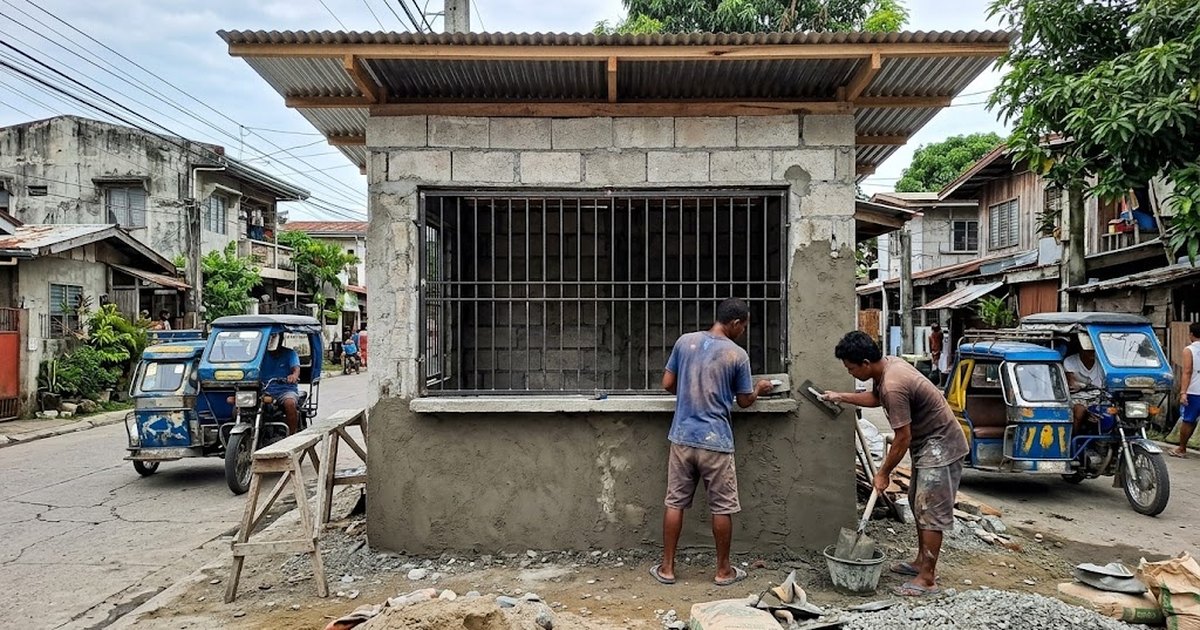
Even a small store is a structure that needs a permit and a proper foundation. Illustrative photo.
Short answer: a small sari-sari store or neighborhood retail shop, the kind most people build at 6-30 sqm, costs somewhere between ₱16,000 and ₱38,000 per sqm in 2026 depending on how finished you want it — meaning a modest 10 sqm store can run ₱160,000-₱200,000 bare-basic, or climb toward ₱750,000-₱950,000 for a 25 sqm store with glass frontage and proper shelving. There's no single number that fits every store, because a sari-sari store isn't one thing — a plywood-and-CHB stall bolted to the front of someone's house and a stand-alone shop with a security grille and tiled counter are built completely differently, even at the same floor area.
This is one of the most common small-business builds in the country and one of the least written about — most construction cost guides talk about houses, warehouses, or full commercial buildings, not the 6-30 sqm structure someone builds with a few hundred thousand pesos of savings to start a store. That gap is exactly why this guide exists: to give an honest, itemized number before you start buying CHB and lumber.
Enter your planned floor area and pick a build-quality tier. This gives a construction-cost range broken into the major components — it excludes land, inventory/stock, and business registration fees.
At 6-30 sqm, a sari-sari store doesn't behave like a scaled-down house. Fixed costs — mobilizing a small crew, minimum permit and material-delivery charges, and the counter/shelving build — don't shrink proportionally with floor area, so a smaller store often costs more per sqm than a bigger one of the same finish level. That's the same principle behind AEDO's own house construction cost guide, which found a 400 sqm house typically costs less per sqm than a 60 sqm house at the same finish — it applies even more sharply at store scale.
The basic-tier rate sits close to AEDO's published economy-house rate (₱20,000-₱26,000/sqm in the house construction cost guide) but slightly below it, since a store has no interior partitioning, plumbing fixtures, or ceiling at basic tier. The mid and upgraded rates track the bare-shell-to-fully-fitted commercial range (₱22,000-₱55,000+/sqm) from AEDO's commercial construction cost guide, capped below its top end since a sari-sari store never needs HVAC ductwork, fire suppression, or lobby-grade finishes the way an office does.
The size of the structure does not exempt it from permitting — and this is the part most first-time store owners get wrong, because the exemption they've heard about doesn't actually cover a business.
A store built onto the front of an existing house is common and perfectly workable, but it's still treated as a distinct structure for permitting and use-classification purposes from the residence behind it. Confirm with your Office of the Building Official whether it's processed as an accessory structure to the existing residential permit or as its own commercial permit application — this affects the fee computation and is worth asking before filing, not after.
AEDO's role outside Negros Oriental. Nationwide, AEDO designs a small commercial structure like this — structural, electrical and layout — and provides remote oversight of a contractor the client hires locally. In Negros Oriental, AEDO designs and builds it directly.
How much does it cost to build a sari-sari store in the Philippines in 2026?
A basic sari-sari store (CHB walls, GI roof, bare cement floor, simple wood counter) runs roughly ₱16,000-₱20,000 per sqm. A mid-range build with tiled flooring, a ceiling and a laminated counter/shelving system runs ₱22,000-₱28,000 per sqm. An upgraded store with glass display frontage, an aircon provision and a built-in shelving system runs ₱30,000-₱38,000 per sqm. A small 10 sqm basic store lands around ₱160,000-₱200,000; a 25 sqm upgraded store around ₱750,000-₱950,000.
Do I need a building permit for a small sari-sari store?
Yes. PD 1096's exemption for minor structures up to 6 sqm only covers structures intended for the private use of the owner — a business structure like a sari-sari store doesn't qualify, no matter the footprint. A building permit is required from your city or municipal Office of the Building Official regardless of size.
Do I still need DTI registration and a business permit if the store is attached to my house?
Yes, both are separate from the building permit. DTI business name registration is required for a sole proprietorship operating under any name other than the owner's own true name, and a barangay clearance plus a mayor's/business permit from the LGU is required to operate the business — neither is waived because the structure is small or attached to a home.
What's the cheapest way to build a sari-sari store?
The basic tier — CHB walls, a GI sheet roof, a bare cement floor, exposed conduit wiring, and a simple wood counter with shelving built by a carpenter rather than a fabricator. Keeping the footprint modest and adding a roll-up shutter or glass frontage later, rather than at the start, keeps the per-sqm cost at the low end.
Does AEDO build small stores like this outside Negros Oriental?
AEDO designs and builds small commercial structures like a sari-sari store directly in Negros Oriental. Outside that province, AEDO provides the design package and remote oversight of a contractor the client hires locally.
Statutes, official pages and AEDO's own published cost guides referred to in this article. External links open in a new tab.
Exact building permit fees and use classification for a small store structure vary by LGU and by whether it's processed as an accessory or standalone structure — confirm these with your city or municipal Office of the Building Official before filing.
Get a realistic, itemized estimate for your exact floor area and finish level before you start buying materials.