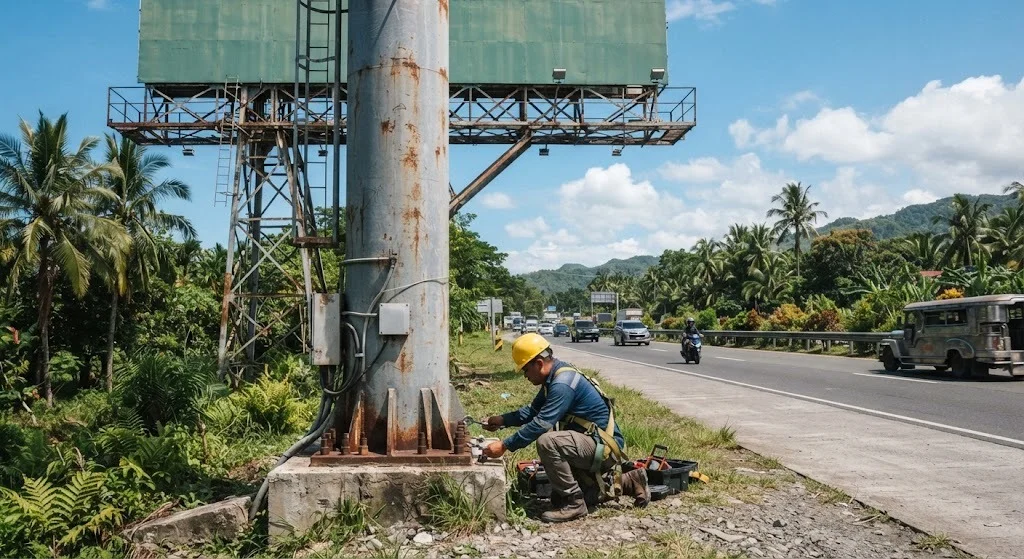
A billboard's entire face pushes wind load through a single pole or a handful of legs, not through a wall of framing. Illustrative photo.
Short answer: a billboard or large freestanding sign is, structurally, one of the most wind-sensitive things anyone builds on a piece of land — a big flat face on a comparatively tiny footing footprint, with almost nothing behind it to share the load. That's exactly why the law treats them as structures needing their own engineering, not as fixtures. A sign or signboard structure over 3 metres high needs design plans signed and sealed by a registered architect or civil engineer before a building permit is issued, and it has to conform with the wind load provisions of the National Structural Code of the Philippines (NSCP). For AEDO, sealing a billboard or large sign is priced per project on face area, height and site wind exposure — the tool below is a preliminary screening check, not that design.
Advertising and property companies usually think about a billboard in terms of media value — traffic count, visibility, lease rate. The structure holding it up gets far less attention, right up until a storm takes it down. Two billboards on the same stretch of a Quezon City road came down in separate storms in 2025 alone. This article is about the engineering and legal side that decides whether yours is one of the ones still standing after the next one.
Most structures on a property — a wall, a carport, a small shed — are judged mainly by how much weight they carry. A billboard barely weighs anything relative to its size; a typical sign face and its steel frame are light. What makes it dangerous in a typhoon is exactly the opposite problem: it presents a large, flat, sail-like surface to the wind, and that wind load has almost no alternate path to the ground except through the pole or the legs directly underneath it.
Compare that to a wall of the same face area. A wall's wind load is shared across a continuous line of footing and, usually, ties into columns or piers spaced along its length. A billboard's load concentrates into one pole footing or a small handful of leg footings, so the overturning moment and uplift at each one is far higher per square metre of face than almost anything else built at that scale. That concentration is also why a billboard connection failure tends to be sudden and total — the whole face goes over, rather than a section peeling or cracking first the way a wall usually gives some warning.
This isn't a theoretical concern. On July 19, 2025, a billboard along the southbound side of Katipunan Avenue in Quezon City was toppled by strong winds from the habagat intensified by Severe Tropical Storm Crising, striking vehicles on the road below and forcing a temporary closure of the lane. Less than four months later, on November 10, 2025, a panel from a separate electronic billboard attached to a condominium building fell onto Katipunan Service Road amid heavy rain and gusty wind from Typhoon Uwan (Fung-wong), injuring two people. Quezon City's local government has since said it will pursue accountability against whoever is found at fault for a collapsed structure, and the Metro Manila Development Authority (MMDA) has been coordinating clearing and inspection operations after these incidents. Beyond these two 2025 cases, Philippine typhoon-season news has recorded billboard collapses recurring for years — reports go back at least to Tropical Storm Xangsane in 2006 and Typhoon Nesat in 2011 blowing down billboards in Manila and Makati.
None of this is unique to one city. Any large sign facing open wind exposure anywhere in the Philippines carries the same fundamental risk; Metro Manila simply has the traffic density that turns a structural failure into a news story every time.
Billboard and large sign structures in the Philippines aren't a regulatory gray area — they're specifically addressed, on top of the general National Building Code (Presidential Decree No. 1096) requirements that apply to any structure.
| Requirement | Source | What it means for you |
|---|---|---|
| Engineered design + PE/architect seal for signs >3m high | Additional Rules and Regulations on Signs/Signboard Structures, amplifying Rule XX of the IRR of PD 1096 | Design plans must be signed and sealed by a duly registered architect or civil engineer before the local Office of the Building Official (OBO) will issue a permit |
| Structural design and wind load per NSCP | Executive Order No. 165 (2022), Sec. 2(b) | The sign's structural design has to conform with the wind load exposure provisions of the current NSCP edition — the same wind chapter (NSCP 2015 Sec. 207) used for buildings |
| Building permit before construction, erection, or alteration | PD 1096 Additional Rules on Signs, and EO 165 Sec. 4 | Local building officials must act on a complete sign permit application within 7 working days; the sign still needs the permit regardless of how fast it's processed |
| Height and face-area limits | EO 165 Sec. 2(c)–(d) | Freestanding sign structures capped at 36m from established grade; roof-mounted combined height capped at 26m (urban) or 36m (rural); display face capped at 250 sqm |
| Typhoon-warning lowering procedure | PD 1096 Additional Rules on Signs, Sec. 4.1 & 7.3; reinforced in EO 165 | Tarpaulin and lowerable sign faces must be brought down on a PAGASA Signal No. 2 typhoon bulletin — an operating duty, not just a design one |
| Certification for existing/undocumented structures | PD 1096 Additional Rules on Signs, Sec. 2.1.2 | An existing sign without a current permit can only keep operating if a duly accredited structural engineer certifies it's structurally safe |
The practical read: if your sign is anything more than a small on-premise storefront sign, it needs a sealed structural design before it goes up, and that design has to run an actual wind-load calculation, not a rule-of-thumb pole size copied from the last job.
A rough, illustrative screening check only — it estimates wind force on the face and a simplified pole foundation adequacy flag. It is not a substitute for a sealed structural design and does not replace the calculation an engineer must run and seal per the NSCP and PD 1096.
AEDO doesn't publish a flat per-sqm rate for billboard sealing the way we do for some cost guides, because the scope shifts too much between a small pole sign and a highway-facing steel tower. What we can tell you is what moves the fee:
Before you commission fabrication. Get the pole or leg base plate detail, footing size and embedment depth, and the engineer's PRC license number and seal in writing before a fabricator starts cutting steel. If your sign faces open highway or coastal wind exposure, treat that as the deciding factor in the design, not an afterthought applied after the frame is already welded.
Advertising companies lease space on rooftops, walls, and vacant lots for billboards constantly, and the property owner often treats the lease as passive income with no engineering responsibility of their own. That's not quite how the exposure works. EO 165 places an operating duty on both the sign owner and the advertising agency to keep the structure safe and to lower tarpaulins and sign faces ahead of a typhoon warning — but a landowner who knowingly hosts an unpermitted or visibly deteriorating structure, or who never asked to see the permit and the engineer's seal before signing the lease, is not automatically insulated if that structure comes down and hurts someone or damages neighboring property.
Before agreeing to host any billboard or large sign on your property, three documents are worth asking for and keeping on file: the current building/sign permit from the local OBO, the sealed structural plans with the engineer's PRC license number, and — if the structure predates your lease or wasn't originally permitted — the structural engineer's certification of safety required under PD 1096 Sec. 2.1.2. None of these guarantee the sign survives every typhoon, but they're the difference between a documented, defensible position and a landowner who has no idea what's bolted to their roof or planted in their lot.
Do billboards and signs need a structural engineer in the Philippines?
Yes for anything beyond a small on-premise sign. The Additional Rules and Regulations on Signs/Signboard Structures under PD 1096 require a sign or signboard structure over 3 meters high to be engineered, with design plans signed and sealed by a duly registered architect or civil engineer, before a building permit is issued. Executive Order 165 additionally requires that a sign or billboard conform with the structural design and wind load exposure prescribed under the latest edition of the National Structural Code of the Philippines.
How much does it cost to design and seal a billboard structure in the Philippines?
AEDO's fee to design and seal a billboard or large freestanding sign is quoted per project, based mainly on face area, height, and the site's wind exposure, in the same fee-band logic covered in our structural engineer fee guide. A small pole-mounted sign is a far smaller scope than a large highway-facing steel-frame billboard, and the fee scales with the engineering, not the advertising value of the sign.
Why is wind the biggest risk for a billboard, more than for a wall of the same size?
A billboard is a large flat face held up on a comparatively small number of posts or a single pole, with almost nothing behind it to share the wind load. Where a building wall transfers wind pressure into a full frame of columns, beams and floors, a billboard's entire face area pushes through just the connection at the top of the pole or posts and down into one footing. That concentrates far more force per square metre of structure than a wall of the same size ever sees.
Is a property owner liable if someone else's billboard on their land collapses?
The advertising company or billboard owner carries the primary responsibility for the structure, but a property owner who leases out space for a billboard is not automatically shielded. Executive Order 165 puts an affirmative duty on both the sign owner and the advertising agency to keep the structure safe, including lowering tarpaulins and signboard faces ahead of a Signal No. 2 typhoon warning, and a landowner who knowingly allows an unpermitted or visibly deteriorated structure to remain on their property faces real exposure if it comes down and causes injury or damage. Reviewing the lease, the permit, and the engineer's certification before agreeing to host a sign is the practical way to limit that exposure.
What's the difference between a pole-mounted and a frame-mounted billboard foundation?
A pole-mounted sign carries its entire face load through one or two vertical poles into a single deep footing, so that footing has to resist overturning moment from wind almost entirely on its own — depth and diameter matter more than footing width. A frame-mounted or lattice-tower billboard spreads the same wind load across several legs and footings, which usually means a smaller footing at each leg but a foundation layout that has to be checked for differential settlement between legs. Neither is inherently cheaper; the right choice depends on face size, height, and the soil at the specific site.
References used for the legal, code and incident claims above. External links open in a new tab.
AEDO's own billboard/signage design fees, and the simplified figures used inside the screening tool above, are AEDO market estimates and illustrative only — they are not a substitute for a sealed structural design and should not be used for construction.
A licensed engineer runs the actual NSCP wind-load calculation and seals the design your permit application needs.