📚 Part of our Why Buildings Fail series →
DPWH-Davao has publicly identified the mechanism behind this collapse — long-term creek erosion undermining the bridge's approaches — in its official statement to media. The analysis below explains what that mechanism means in engineering terms, why it develops the way it does, and what it implies about inspection and monitoring practices, based on that official statement and verified public reporting. Where specific facts are cited, sources are linked directly.
In late May, the situation moved from emergency response toward restoration — and toward exactly the kind of nationwide reckoning this article argues should follow:
We will continue to update this article as DPWH releases its full technical findings, confirms the bailey bridge's operational status, and scopes the permanent bridge replacement.
No earthquake. On a rainy Monday night, a bridge that around 7,000 residents depend on simply gave way beneath rising floodwaters — and DPWH's own engineers said, in plain language, exactly why.
On the evening of Monday, May 18, 2026, heavy rains driven by the Easterlies and the Intertropical Convergence Zone (ITCZ) dumped roughly 129mm of rain on the Davao Region — almost 78% of a typical month's rainfall falling in a single 24-hour span — overflowing rivers and creeks across multiple Davao City barangays, including the Matina Pangi and Bunawan rivers on one side of the city. In Barangay Callawa, on a separate waterway — a small tributary creek of the Davao River that runs beneath the village — the rising floodwaters proved too much for a 15-meter bridge in Purok 2 (the "Secret Village" area), connecting Callawa and Mandug. The bridge collapsed, cutting off the route and leaving roughly 7,000 residents without safe passage. The same night's flooding proved fatal elsewhere in the city too: in Barangay Buhangin, a 21-year-old gasoline station attendant was electrocuted and swept away by floodwaters near his boarding house — a separate tragedy, but a reminder of how widespread and dangerous that single night's rainfall was across Davao City. The Department of Public Works and Highways (DPWH) has since moved to fast-track a temporary bailey bridge — an order President Marcos personally directed be expedited.
What makes this collapse especially worth understanding is that DPWH-Davao did not call it a mystery. Dean Ortiz, DPWH-Davao's spokesperson, named the mechanism directly, on the record: "The creek widened significantly over the years, eroding the bridge approaches until the structure could no longer withstand the pressure from the floodwaters." (SunStar Davao)
That single sentence is, in engineering terms, a textbook description of a well-known and entirely trackable failure mechanism — and it is worth slowing down to understand exactly what it means, because the same mechanism is quietly at work under bridges all over the country right now.
This is called scour — and it is one of the leading causes of bridge failure worldwide, precisely because it is invisible from the road surface. Here is the mechanism DPWH-Davao described, in plain terms:
A bridge's foundations and approach embankments are designed assuming a certain channel width and flow pattern for the creek or river beneath it. Over years of water flow — especially during repeated flood events — the channel can widen and deepen, washing away the soil that the bridge's approaches and supports were resting on. Each flood event removes a little more material than the last. The bridge deck itself may remain intact and look perfectly fine — right up until a flood large enough arrives that the eroded ground beneath it can no longer carry the load, and the structure goes down with the embankment that was supporting it.
In other words: the failure on May 18 was not really about that night's rain. It was about every flood event in the years before it that quietly widened that creek — each one a small, measurable, trackable step toward this outcome.
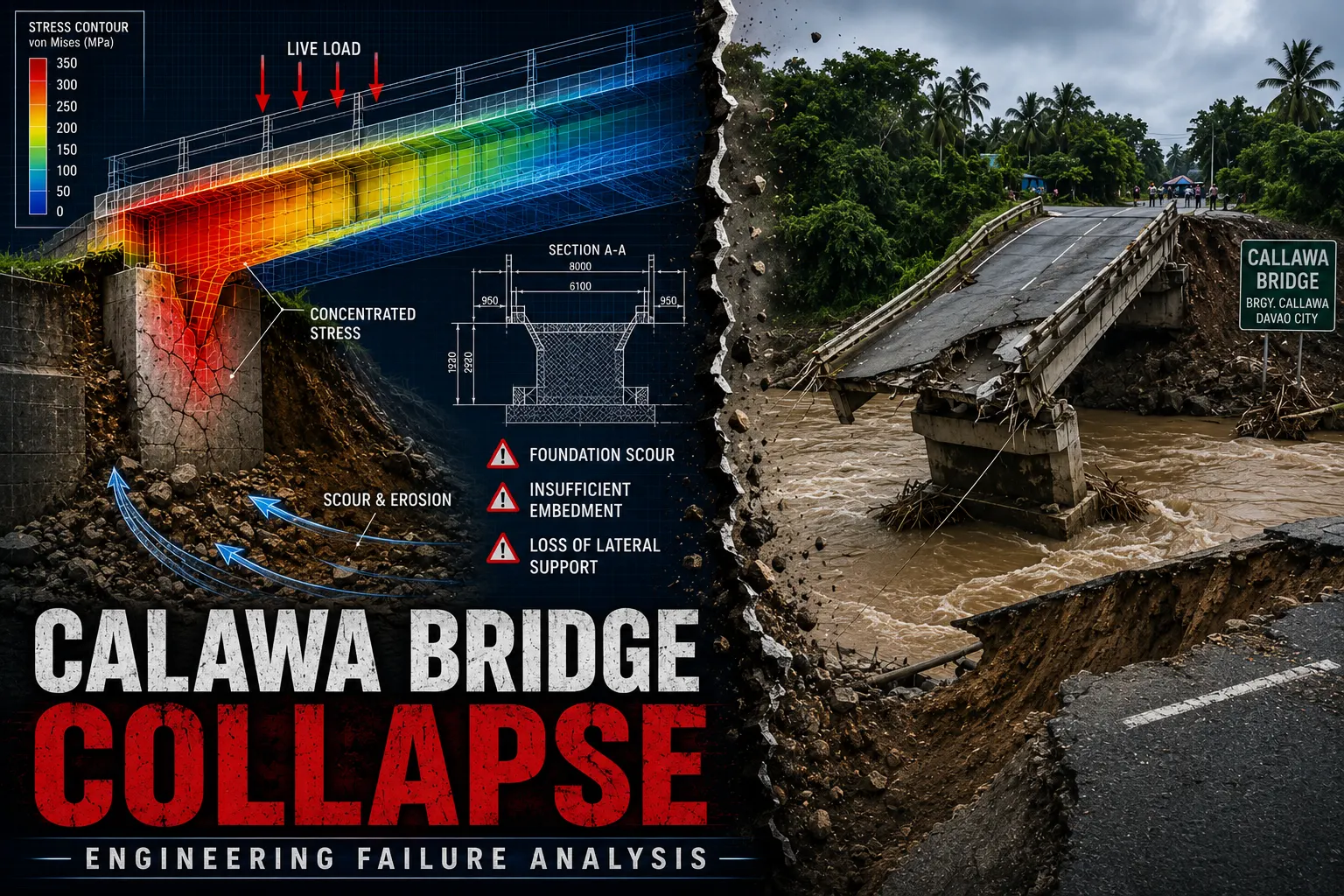
AEDO engineering breakdown of the Callawa Bridge collapse in Barangay Callawa, Davao City — illustrating how foundation scour and eroded approaches concentrated stress on the span until it gave way on May 18, 2026.
If your project, property, or community depends on a bridge, overpass, or elevated structure that has been in service for decades, an independent structural assessment is not an overreaction — it is exactly what responsible engineering looks like before a structure, not after one fails.
To DPWH-Davao's credit, its statement was unusually direct for a government infrastructure failure — it named the mechanism plainly rather than calling it a mystery. That directness is exactly what makes the next set of questions fair, necessary, and answerable.
DPWH's own description — "the creek widened significantly over the years" — is, by definition, describing a gradual process. Channel widening of that scale does not happen in a single storm; it happens across many flood seasons, each one leaving a slightly wider channel and slightly less supported ground than before. That is precisely the kind of change that periodic bridge inspections, hydrological surveys, and scour-monitoring protocols are designed to catch and document while there is still time to reinforce the approaches or redesign the foundations — not after the structure is already gone.
Public records show the Callawa bridge was reconstructed as one component of a much larger 2017 DPWH corridor contract — "Concreting/Widening/Improvement of Bypass Road at Buhangin-Tigatto-Mandug-Callawa-Fatima Road, including Reconstruction of Callawa Bridge" (Contract ID 17LO-0133, total contract value ₱184,588,193.30, awarded to Premium Megastructures Inc., represented by general manager Jerome Butaya). The bridge itself accounted for roughly ₱6.79 million of that larger sum. (Manila Bulletin) That places the structure at roughly eight years of service at the time of collapse — well within a window where scheduled inspections, condition assessments, and scour surveys should already have flagged a "significantly widened" creek channel as a developing risk. It also raises a structural-oversight question worth asking on its own: when a single bridge is folded into a much larger corridor contract as a line item, does it still get the dedicated, ongoing attention a standalone critical structure would receive — or can it quietly become the smallest, least-watched piece of someone else's much bigger project? The fair, answerable question for the investigation is not "could anyone have known?" — DPWH's own statement confirms the erosion was visible and gradual. The question is: was it inspected, documented, and escalated — and if so, at what point, and with what response?
This collapse comes while DPWH is still working through the fallout of last year's "ghost infrastructure" scandal — the discovery of non-existent and substandard infrastructure projects that had been certified as complete. (Wikipedia) We raise this not as a political point but an engineering one: a creek that visibly widens over years near a major bridge is exactly the kind of condition that flood-control and embankment-protection projects are supposed to monitor and address. If those nearby protective works existed only on paper — or were under-scoped, under-built, or never followed up — a slow-moving, well-understood hazard like this one can erode quietly for years with no one formally accountable for noticing. That is the link between "ghost infrastructure" and a very real, very physical bridge collapse: documentation gaps and maintenance gaps can look identical from the outside, and both end exactly the same way.
A building collapse happens in one place, to the people inside it. A bridge collapse happens to an entire city's daily life — commuters, ambulances, delivery trucks, schoolchildren, emergency response routes — all at once, without warning, on an ordinary morning. That is exactly why bridge inspection and maintenance cannot be treated as a budget line to defer. Structural integrity on public infrastructure is not optional engineering — it is a daily public trust.
From an engineering standpoint, keeping a bridge safe over decades of service is not a one-time achievement at the ribbon-cutting — it is an ongoing discipline. At minimum, that discipline includes:
| Area | What Responsible Stewardship Looks Like |
|---|---|
| Routine Inspection | Scheduled, documented visual and structural inspections at defined intervals — not only after visible distress is reported by the public. |
| Load Rating Review | Periodic re-assessment of a bridge's safe carrying capacity against actual, current traffic volumes and vehicle weights — not the assumptions made when it was built. |
| Defect Tracking | Every crack, corrosion spot, or settlement noted in an inspection logged, monitored over time, and prioritized for repair — not noted once and forgotten. |
| Scour and Foundation Monitoring | Regular checks of riverbeds and foundations near piers, especially after major flood events, since scour is one of the leading causes of bridge failure worldwide and is largely invisible from the road surface. |
| Transparent Records | Inspection results, ratings, and remediation actions documented in a way that can be independently verified — the single safeguard that "ghost infrastructure" situations make most urgent. |
A structure does not get safer by staying open longer. Every additional year of service on an aging bridge is an additional year of fatigue cycles, additional exposure to scour and corrosion, and additional traffic load — which means the inspection and maintenance discipline must increase with a structure's age, not stay flat or quietly lapse. A bridge that "has always been fine" is not evidence that it is fine now.
If you manage, develop near, or depend on infrastructure that has been in service for decades — bridges, overpasses, elevated walkways, retaining structures — an independent engineering review is the cheapest insurance available. Message us directly and we will respond within hours.
The BuildX NSCP Kit puts the complete NSCP 2015 structural code in your pocket — load tables, design aids, and reference data for engineers, developers, and anyone who wants to understand how Philippine structures are supposed to be designed and assessed. Built by AEDO engineers, for Philippine engineers.
At AEDO Construction, we believe a structure's most important engineering work happens long after it opens — in the inspections, the documentation, and the honest assessments that keep it safe for the decades it is meant to serve.
Statutes, codes, official tools and references used or referred to in this article, linked to their source. Links open in a new tab.
Prices, cost bands and rate figures in this article are AEDO Construction's own market and practice figures for Philippine work unless a source is named beside them. Code and statute references above link to the primary text.
AEDO Construction provides structural assessment and design nationwide, plus full design-build services in Negros Oriental, for residential, commercial, institutional, and infrastructure-adjacent projects. Whether you are building new or responsible for something that has been standing for decades, we treat structural integrity as the non-negotiable foundation of every recommendation we make.
Most people cross a bridge the same way they flip a light switch — without a second thought, trusting that someone, somewhere, made sure it would work. That trust is exactly what good engineering is supposed to protect — quietly, continuously, in the background, long before anyone notices it's there.
The Callawa Bridge 2 collapse is a reminder that this trust has to be earned every single day a structure remains in service — not just on the day it opens. DPWH has already told us what happened — years of creek erosion that the approaches could no longer withstand. The harder, more important question it raises belongs to every engineer, every LGU, and every agency responsible for the structures the public depends on without ever being asked to think about: are we watching the bridges we've already built as carefully as we plan the ones we haven't?
If you are responsible for infrastructure, a development near aging structures, or a project that needs to be built — and maintained — to last, partner with engineers who treat structural integrity as a lifelong commitment, not a one-time milestone. AEDO Construction is ready to help.
DPWH-Davao publicly identified the cause: years of progressive creek erosion widened the channel beneath the bridge and washed away the soil supporting its approaches, until the structure could no longer withstand the pressure of floodwaters that surged through Barangay Callawa on the night of May 18, 2026. In engineering terms, this is a textbook case of scour — gradual, long-term erosion around a structure's foundations and approaches — triggered into final failure by a major flood event driven by the Easterlies and the Intertropical Convergence Zone (ITCZ).
Scour is the gradual erosion of soil and material from around a bridge's foundations, piers, and approach embankments by flowing water — most aggressively during floods. It is dangerous specifically because it is invisible from the road surface: the bridge deck can look completely normal while the ground supporting it is steadily washed away underneath, year after year, flood after flood — exactly as DPWH-Davao described happening to the Callawa bridge's creek channel "over the years." A structure can lose most of its effective foundation support long before it shows any visible sign of distress, which is why scour-monitoring and channel surveys are a standard, scheduled part of responsible bridge management — not an optional add-on.
DPWH maintains a national bridge inventory and bridge management framework requiring routine inspections, periodic structural assessments, and load rating reviews against current traffic demands. Findings are meant to be documented and used to prioritize rehabilitation or replacement of structurally deficient bridges. After any bridge failure, the central engineering question is always whether that inspection schedule was followed, whether findings were properly documented, and whether flagged deficiencies were acted upon before failure occurred.
Visible warning signs the public can sometimes notice include cracked or spalling concrete, exposed or rusted rebar, sagging or uneven deck surfaces, water pooling or erosion around piers and foundations, and unusual vibration or noise under normal traffic. None of these should be treated as "normal wear" — they are exactly the kind of findings a professional structural inspection is designed to catch and act on early. If you are responsible for or live near a structure showing any of these signs, an independent assessment by a licensed engineer is the right next step.