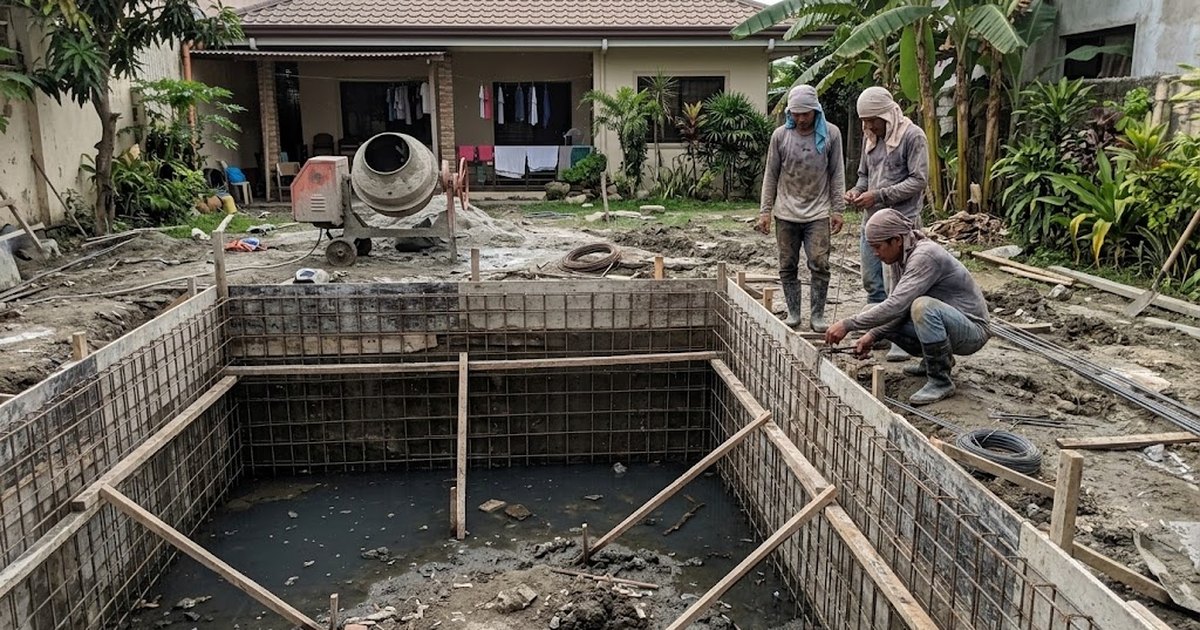
Most of a pool's cost is in the shell you can't see once it's filled. Illustrative photo.
Short answer: a backyard pool isn't priced like a room addition. It's a below-grade concrete structure that has to fight soil pressure from outside when it's empty and groundwater pressure from underneath if the water table is shallow. Cost depends on how much of that fight your site forces on the engineer, plus finish and filtration, which is why a single peso-per-square-metre number for pools would be misleading. Get the volumes right first, then get a quote against your actual soil.
Most homeowners price a pool the way they'd price a patio: length times width times some number they saw online. A pool shell doesn't work that way. Two pools of identical size can cost very differently depending on whether the excavator can reach the site, whether the soil holds its shape while you dig, and whether groundwater shows up a metre down. None of that shows up in a size-based estimate.
This estimates volume and structural complexity, not peso cost. Pool pricing depends on soil, access, finish and filtration too much for a generic number to mean anything — use this to understand the scope, then ask us for a site-specific quote.
This is where a lot of pool guides get sloppy, so here's the honest version. Presidential Decree No. 856, the Code on Sanitation of the Philippines (1975), Chapter XX regulates public swimming and bathing places — resorts, subdivision clubhouse pools, hotel pools, anything operated for public or shared use. It requires a sanitary permit, sets sanitary structural standards, requires water quality testing, and mandates safety signage. If your pool is shared across a subdivision or run as a paid facility, this chapter applies to you and you need that permit.
A private backyard pool at a single-family home isn't covered by that same chapter, and there's no specific Philippine national law that mandates fencing around a private residential pool the way some other countries require. That doesn't make fencing optional in practice. Child-safety fencing, non-slip decking and clear depth markers are standard prudent practice for any body of water on a residential property, law or no law. Some local government units also attach their own conditions through the building permit process — setbacks, enclosure requirements, drainage — so check with your local building official before you finalize the layout.
Public or shared use (resort, subdivision, hotel, any paying use): PD 856 Chapter XX applies — sanitary permit, structural standards, water testing, signage required. Private single-family backyard pool: no dedicated national pool-safety statute, but still needs a regular building permit as a permanent structure, and your LGU may impose its own enclosure conditions.
An in-ground pool shell sits below grade, which means it's fighting two different forces depending on what's happening around it. When the pool is full and the soil around it is saturated after heavy rain, the shell mostly just holds water in. When the pool is empty and the water table nearby is shallow, groundwater outside the shell can push up and inward with nothing on the inside to counter it. That's called hydrostatic uplift, and it's a well-known reason in-ground pools crack, float, or shift when they're drained without a plan.
None of this comes from a swimming-pool-specific table in the NSCP — there isn't one. A pool shell is designed the way any other below-grade concrete structure is designed: using general NSCP soil-structure and retaining-wall principles, sized to the actual soil report and water table for that lot. A firm, dry site needs far less engineering margin than a soft, waterlogged one.
Other AEDO cost guides give a range because we have a market figure to stand behind. For residential pools, we don't have a verified figure we're confident publishing as representative, because the spread is genuinely too wide to be useful. Soil condition changes excavation cost by a large multiple on its own. Site access decides whether an excavator can get in or whether the dig is done by hand. Finish — plain paint, tile, or pebble — is one of the biggest swings in the whole budget. Filtration and pump systems range from a basic setup to a full automated system. Stacking all of that into one number would hide more than it reveals, so we're not doing it.
What we will do is help you scope the job. The calculator above gives you three numbers that matter before you talk to anyone: the water volume, the excavation volume with working clearance, and a rough shell volume. Bring those, plus your soil type and water table, into a quote conversation and you'll get a far more accurate number than any generic per-square-metre figure could give you.
AEDO self-performs design and build for pools and other structures only within Negros Oriental. Outside that province, we provide complete design — structural, and architectural or MEP as needed — plus remote construction oversight of a locally-hired contractor. We don't claim to build pools nationwide; we design them nationwide and build them locally.
A lot of pools in the Philippines are built for owners who aren't here: a family house or a small rental property paid for from overseas. A pool is the worst structure to supervise by photo, because almost everything that decides whether it lasts (the soil, the reinforcement, the waterproofing, the drainage under the shell) is buried or covered before you'd ever see it.
The way to handle it is to settle everything that can be decided on paper before a contractor mobilizes, then check the work against those papers from a distance. Here's how that works with AEDO:
Foreign nationals generally can't own Philippine land except by inheritance. A lease is the usual route: under PD 471, a lease of private land to a foreigner can run up to 25 years, renewable for another 25 by mutual agreement. Settle which ownership path you're relying on with a lawyer before the foundation goes in. See our guide to building as a foreigner and how building from abroad works.
Send Us Your Project Details →
Part 1 of an engineer's walkthrough of designing a reinforced concrete in-ground swimming pool. From the AEDO YouTube channel, uploaded 2022-04-25.

Is there a Philippine law requiring a fence around a swimming pool?
No specific national law mandates fencing for a private residential pool. Presidential Decree No. 856 (Code on Sanitation) Chapter XX regulates public swimming or bathing places (resorts, subdivision pools, hotels) requiring a sanitary permit, safety signage and structural standards, but it doesn't extend the same mandate to a private backyard pool. Fencing is still strongly recommended as safety practice, and some LGUs attach conditions through the building permit.
Do I need a building permit for a residential swimming pool?
Yes, an in-ground pool is a permanent structure and needs a building permit like any other structure; check with your local building official for specific requirements, which can include setback and enclosure conditions.
How much does a swimming pool cost to build in the Philippines?
Cost varies too much by soil condition, site access, finish and filtration system to quote a flat number; get a site-specific quote, and use the calculator on this page to understand the volume and shell scope of your pool before asking for one.
Why does an empty pool sometimes crack or lift out of the ground?
If the water table is shallow, groundwater pressure can push up on an empty pool shell (hydrostatic uplift) since the water's weight is no longer there to hold it down — this is why pools in high-water-table areas need a specific structural check and are not drained without a plan.
Where the facts in this guide come from.
The excavation and shell figures in the calculator are AEDO's own rough planning approximations, not a published cost schedule or a structural design. No peso cost figure is published in this guide because no verified market figure exists that we're confident representing as typical.
Soil report, water table, access and finish decide the cost — not a formula.